Blow-Dry Brushes
The Best Blow-Dry Brushes for 4C and Coily Hair in 2026
As a stretching tool between wash day and a press, a hot air brush does real work at a temperature an iron never touches.
Updated September 2026 · Sawyer V.
A hot air brush stretches coily hair rather than straightening it, and it does so at a much lower temperature than a flat iron. Used as the stretch step before a press, or on its own for a soft blowout, it meaningfully cuts the number of iron passes you need afterwards.
We earn a commission if you buy through the links on this page, at no extra cost to you. It never changes which tool we pick or which one we tell you to skip. How this site is funded.
Quick picks
Tap any row to jump to the full write-up. Prices come from the live price layer; where none is available the button says so rather than showing a number we cannot stand behind.
| # | Product | Best for | Price |
|---|---|---|---|
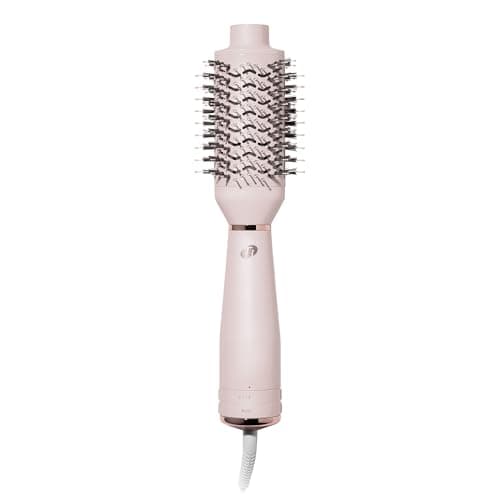
| 1 | T3 AireBrush One-Step smoothing and volumizing dryer brush Three heat and two speed settings with ceramic bristles — separate speed control is what lets you stretch slowly. | Stretching before a press | |
| 2 | 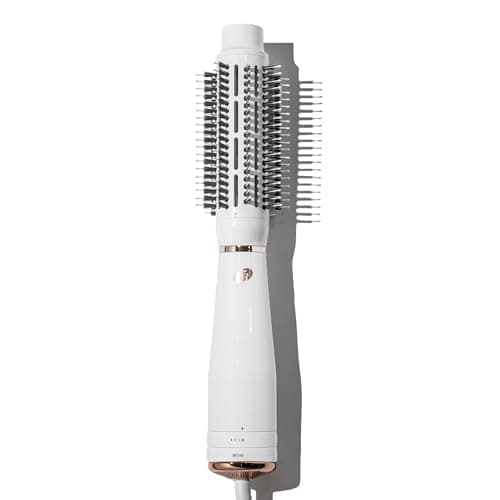 T3 AireBrush Round ionic blow-dry brush A round barrel with SmoothGrip bristles and a published 1,200 W. | Coily hair that slips out of a paddle shape | |
| 3 | 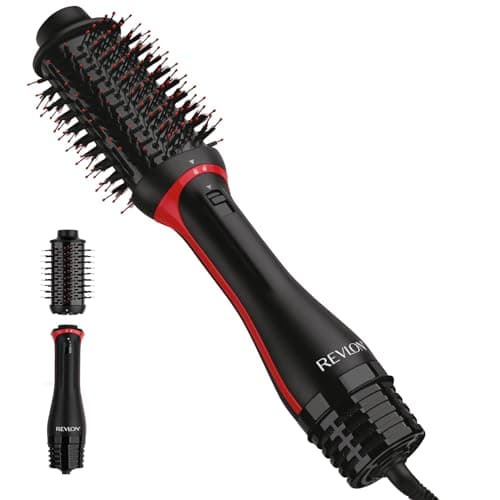 Revlon One-Step Volumizer Plus hair dryer and hot air brush Four heat settings including cool, a detachable head for cleaning, and a four-year warranty. | Stretching on a budget | |
| — | 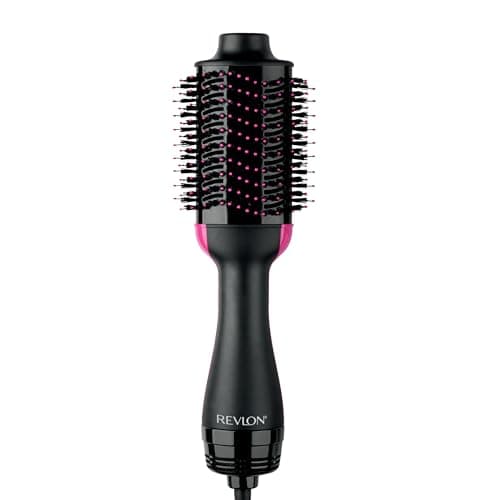 Revlon Salon One-Step hair dryer and volumizer A brush head that does not come off, on the hair type that clogs one fastest. We’d skip this | Not coily hair |
1. Best tension control
T3 AireBrush One-Step smoothing and volumizing dryer brush
Best for: Stretching before a press
Three heat and two speed settings with ceramic bristles — separate speed control is what lets you stretch slowly.
Stretching coily hair is a tension exercise. You are pulling the coil straighter while it dries so it sets stretched, and the thing that makes that controllable is being able to lower the airflow independently of the heat.
Six heat-and-speed combinations is the most adjustable brush in our registry. CeraGloss ceramic with heat-resistant bristles, which T3 positions for even heat without hot spots — and even heat is what stops you re-passing a section.
16 oz published without the cord, 8 ft 360-degree swivel cord, 125 V, two-year warranty.
What’s wrong with it
No published wattage, and on tight 4C patterns the barrel may not hold enough tension on its own — this is a partner to a dryer with a comb attachment, not a replacement for one.
Published specifications — T3 AireBrush One-Step smoothing and volumizing dryer brush
| Wattage | Not published |
|---|---|
| Heat settings | 3 heat settings |
| Speed settings | 2 speed settings |
| Weight | 16 oz (cord not included) |
| Cord length | 8 ft, 360-degree swivel cord |
| Noise (dB) | Not published |
| Attachments | None supplied |
| Plate / barrel | CeraGloss ceramic surface, heat-resistant bristles |
| Dual voltage | No — 125 V |
| Warranty | 2-year warranty |
Every figure above is taken from T3 Micro — AireBrush One-Step product page. “Not published” means the figure does not appear on that page — it is not an estimate withheld, it is a number the manufacturer does not state. How we compile these.
What it costs to run for a year
T3 does not publish a wattage for this tool, so there is nothing honest to compute. The formula is watts ÷ 1,000 × hours a year × your rate per kWh; if you find a rating plate on the handle, 65 hours a year and 18.34 cents per kilowatt-hour will get you the rest of the way.
2. Best grip on a section
T3 AireBrush Round ionic blow-dry brush
Best for: Coily hair that slips out of a paddle shape
A round barrel with SmoothGrip bristles and a published 1,200 W.
A round barrel lets you wrap a section rather than just pass over it, which holds tension on a coil far better than a flat paddle does. T3 publishes SmoothGrip bristles on a CeraGloss ceramic surface.
It is also the only brush in our registry that publishes a wattage — 1,200 W — so it is the one you can actually compare against a dryer when deciding how much of the job to give it.
Three heat and two speed settings, 16 oz, an 8 ft swivel cord, quick-dry and style attachments, two-year warranty.
What’s wrong with it
1,200 W is modest for dense coily hair, and T3 publishes no voltage for this model so it cannot be assessed for travel.
Published specifications — T3 AireBrush Round ionic blow-dry brush
| Wattage | 1,200 W |
|---|---|
| Heat settings | 3 heat settings |
| Speed settings | 2 speed settings |
| Weight | 16 oz (cord not included) |
| Cord length | 8 ft, 360-degree swivel cord |
| Noise (dB) | Not published |
| Attachments | Quick-dry attachment and style attachment |
| Plate / barrel | Korean CeraGloss ceramic surface, SmoothGrip bristles |
| Dual voltage | No — 125 V |
| Warranty | 2-year warranty |
Every figure above is taken from T3 Micro — AireBrush Round product page. “Not published” means the figure does not appear on that page — it is not an estimate withheld, it is a number the manufacturer does not state. How we compile these.
What it costs to run for a year
$14.31 a year
1,200 W × 65 hours a year = 78.0 kWh, at 18.34 cents per kilowatt-hour. The hours assume 15 minutes a session, 5 days a week — that is an assumption, not a measurement, so swap in your own if it is wrong.
3. Best value for a long session
Revlon One-Step Volumizer Plus hair dryer and hot air brush
Best for: Stretching on a budget
Four heat settings including cool, a detachable head for cleaning, and a four-year warranty.
The detachable brush head is worth more on this hair type than almost any other. Coily hair sheds into bristles and carries more product, and a head that comes off is the difference between a tool that still works in year four and one that quietly stopped.
Four heat settings including a dedicated cool is more heat granularity than the more expensive T3 brushes publish, and the cool step is what sets a stretched section rather than letting it spring back.
Four-year limited warranty — the longest in our registry.
What’s wrong with it
Revlon publishes no wattage, weight, cord length or speed count. On tight 4C patterns the barrel is frequently too small to hold effective tension.
Published specifications — Revlon One-Step Volumizer Plus hair dryer and hot air brush
| Wattage | Not published |
|---|---|
| Heat settings | 4 heat settings — low, medium, high, cool |
| Speed settings | Not published |
| Weight | Not published |
| Cord length | Not published |
| Noise (dB) | Not published |
| Attachments | Detachable brush head |
| Plate / barrel | Ceramic titanium barrel; tourmaline ionic |
| Dual voltage | Not published |
| Warranty | 4-year limited warranty |
Every figure above is taken from Revlon Hair Tools — One-Step Volumizer Plus product page. “Not published” means the figure does not appear on that page — it is not an estimate withheld, it is a number the manufacturer does not state. How we compile these.
What it costs to run for a year
Revlon does not publish a wattage for this tool, so there is nothing honest to compute. The formula is watts ÷ 1,000 × hours a year × your rate per kWh; if you find a rating plate on the handle, 65 hours a year and 18.34 cents per kilowatt-hour will get you the rest of the way.
The one we'd skip
Revlon Salon One-Step hair dryer and volumizer
Best for: Not coily hair
A brush head that does not come off, on the hair type that clogs one fastest.
Coily hair sheds into bristles more than any other texture and carries the most product. A non-detachable head on this hair type is a tool with a limited working life built into it.
Revlon publishes no heat-setting count for this model either, where the Volumizer Plus states four including cool — and the cool step is what makes a stretch hold. Both carry the same four-year warranty.
There is no version of this comparison where the older model is the right buy. Take the Plus.
What’s wrong with it
Non-detachable head, no published heat-setting count, and no published wattage, weight or cord length.
Published specifications — Revlon Salon One-Step hair dryer and volumizer
| Wattage | Not published |
|---|---|
| Heat settings | Not published |
| Speed settings | Not published |
| Weight | Not published |
| Cord length | Not published |
| Noise (dB) | Not published |
| Attachments | Non-detachable brush head |
| Plate / barrel | Ceramic coating |
| Dual voltage | Not published |
| Warranty | 4-year limited warranty |
Every figure above is taken from Revlon Hair Tools — Salon One-Step hair dryer and volumizer. “Not published” means the figure does not appear on that page — it is not an estimate withheld, it is a number the manufacturer does not state. How we compile these.
What it costs to run for a year
Revlon does not publish a wattage for this tool, so there is nothing honest to compute. The formula is watts ÷ 1,000 × hours a year × your rate per kWh; if you find a rating plate on the handle, 65 hours a year and 18.34 cents per kilowatt-hour will get you the rest of the way.
Stretching is not straightening
Set expectations before anything else. A hot air brush will not make 4C hair straight. It stretches the coil into a looser, elongated version of your own pattern, which is a genuinely useful result and a different one from a silk press.
What that buys you is real: a stretched head of hair is far easier to press afterwards, because the iron is finishing rather than straightening from scratch. That cuts the number of iron passes, and passes are where nearly all press damage lives.
The temperature argument
This is the strongest case for the tool on this hair type. A flat iron clamps a surface at 365°F or higher directly onto the hair. A hot air brush moves warm air through a barrel that is in intermittent contact.
Published DSC work puts the melting point of the ordered keratin in dry hair at about 401°F, and a flat-iron study reported denaturation at 459°F alongside observed cuticle damage. A brush operating well below those figures, used to reduce the number of passes at the figures, is a sound trade.
It is not a heat-free trade. These tools publish heat settings because they get hot, and the heat damage guidance applies to them.
Technique for coily hair
- Detangle wet with conditioner in. Never take a heated brush to tangled dry coils — that is mechanical breakage before heat is even a factor.
- Work on damp, not soaking hair. Rough-dry to about seventy percent first. A brush is not a dryer.
- Small sections, held under tension the whole way. Slack is what leaves the coil in, which is what forces the iron to work harder later.
- One pass per section, then move on. Going back is where the damage is.
- Finish cool. The stretched shape sets as it cools, exactly as a curl does.
The honest limit
On tight 4C patterns a brush barrel frequently cannot hold enough tension on its own, and you will get better results from a dryer with a proper stretch comb attachment. Only two dryers in our registry publish one — the Shark SpeedStyle Pro and the Dyson Supersonic — and they are at the best hair dryers for 4C and coily hair.
If a press is the goal, the sequence that does the least damage is: detangle wet, stretch with a comb attachment or brush, then press once with an iron that finishes in a single pass. The iron half is at the best flat irons for 4C and coily hair, and the frequency question — which matters more than any of the tools — is at how often you can use heat.
Price per use, at 5 uses a week over 5 years
| What you pay | Cost per use | Cost per year |
|---|---|---|
| $30 | $0.02 | $6.00 |
| $60 | $0.05 | $12.00 |
| $100 | $0.08 | $20.00 |
| $150 | $0.12 | $30.00 |
| $200 | $0.15 | $40.00 |
| $300 | $0.23 | $60.00 |
| $400 | $0.31 | $80.00 |
| $500 | $0.38 | $100.00 |
5 uses a week for 5 years is 1300 uses. Both figures are stated assumptions, not measurements — halve the life and every cost per use doubles. We publish the ladder rather than a worked example for one specific product because a price we typed into a sentence would be wrong within a week.
Questions people actually ask
Can you use a blow-dry brush on 4C hair?
Yes, as a stretching tool. It elongates the coil into a looser version of your own pattern at a far lower temperature than a flat iron, which meaningfully reduces the number of iron passes needed afterwards.
Will a hot air brush straighten 4C hair?
No. It stretches rather than straightens. If you want genuinely straight hair, the brush is the stretch step and a flat iron is the finish — and doing it in that order takes fewer iron passes than pressing from air-dried hair.
Is a blow-dry brush safer than a flat iron for coily hair?
It transfers heat through moving air rather than clamping a surface at full temperature onto the hair, so contact is less direct. It is still a heated tool, and a long session with a mild tool can exceed a short one with a harsh tool.