Hair Dryers
The Best Hair Dryers for 4C and Coily Hair in 2026
The attachment matters more than the dryer. On coily hair the job is stretching the section while it dries, and most makers will not tell you whether their tool can.
Updated September 2026 · Sawyer V.
For 4C and coily hair the specification that matters is a comb or stretch attachment, not raw wattage. Drying with tension does most of the straightening at a far gentler temperature than an iron, which is what cuts the number of press passes later. Sustained airflow matters second.
We earn a commission if you buy through the links on this page, at no extra cost to you. It never changes which tool we pick or which one we tell you to skip. How this site is funded.
Quick picks
Tap any row to jump to the full write-up. Prices come from the live price layer; where none is available the button says so rather than showing a number we cannot stand behind.
| # | Product | Best for | Price |
|---|---|---|---|
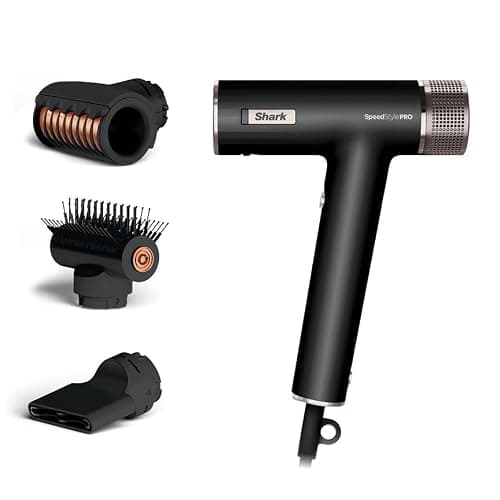
| 1 | Shark SpeedStyle Pro hair dryer The only dryer here that names a lift-and-stretch wide-tooth comb, alongside a diffuser, at 1,750 W. | Stretching dense coils before a press | |
| 2 | 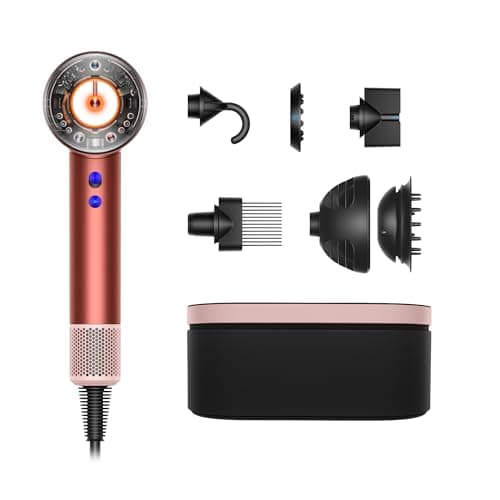 Dyson Supersonic hair dryer A wide-tooth comb Dyson describes as engineered for curly and textured hair, with four published heat settings. | Coily hair that has already taken too much heat | |
| 3 | 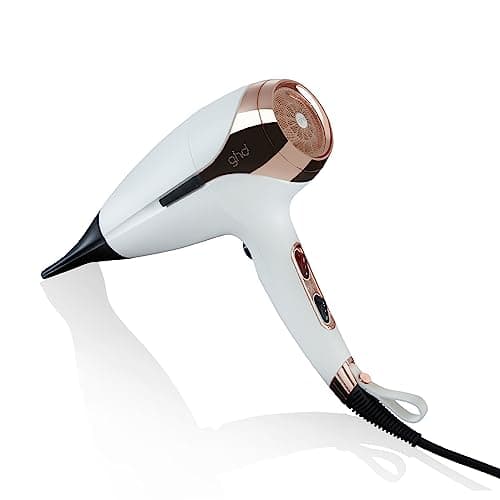 ghd Helios 1875W advanced professional hair dryer 1,875 W — the highest rating on this site — with variable temperature and a cool shot. | Dense hair where session length is the complaint | |
| — | 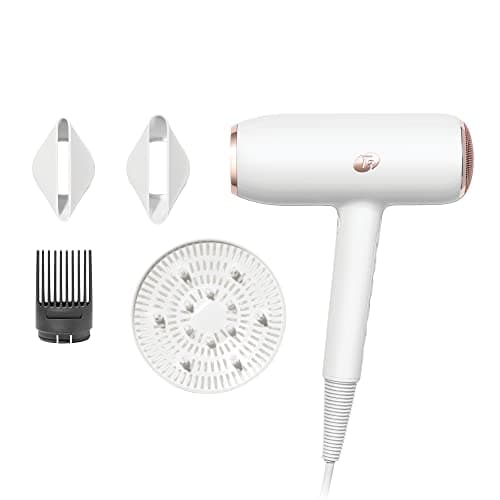 T3 Featherweight StyleMax professional hair dryer No published wattage and no published attachment list — the two rows this hair type most needs to check. We’d skip this | Not dense coily hair |
1. Best stretch attachment
Shark SpeedStyle Pro hair dryer
Best for: Stretching dense coils before a press
The only dryer here that names a lift-and-stretch wide-tooth comb, alongside a diffuser, at 1,750 W.
Shark publishes six attachments and two of them are aimed squarely at textured hair: a DefrizzFast diffuser and a wide-tooth comb described for lift and stretch. A comb attachment that holds tension while the section dries is doing the specific job this hair type needs from a dryer, and almost nobody else in this category names one.
1,750 W is the highest published rating of any premium dryer we list. On dense coils total drying time is its own form of stress, so power is worth having here in a way it is not on fine hair.
1.65 lb published, and a published cord length of 96.1 in — which matters on a session that involves working right around your head.
What’s wrong with it
Shark publishes no heat-setting or speed-setting count, so you cannot check how low it goes. 120 V only, and at 1,750 W it is the most expensive dryer here to run at about $21 a year.
Published specifications — Shark SpeedStyle Pro hair dryer
| Wattage | 1,750 W (peak 1,750 W) |
|---|---|
| Heat settings | Not published |
| Speed settings | Not published |
| Weight | 1.65 lb |
| Cord length | 96.1 in (8.0 ft) |
| Noise (dB) | Not published |
| Attachments | Turbo concentrator, QuickSmooth brush, DefrizzFast diffuser, wide-tooth comb, touch-up brush, FrizzFighter finishing tool |
| Plate / barrel | High-velocity airflow; no heated styling surface |
| Dual voltage | No — 120 V |
| Warranty | 2-year limited warranty |
Every figure above is taken from SharkNinja — Shark SpeedStyle Pro (HD731) product page. “Not published” means the figure does not appear on that page — it is not an estimate withheld, it is a number the manufacturer does not state. How we compile these.
What it costs to run for a year
$20.86 a year
1,750 W (peak 1,750 W) × 65 hours a year = 113.8 kWh, at 18.34 cents per kilowatt-hour. The hours assume 15 minutes a session, 5 days a week — that is an assumption, not a measurement, so swap in your own if it is wrong.
2. Best documented heat control
Dyson Supersonic hair dryer
Best for: Coily hair that has already taken too much heat
A wide-tooth comb Dyson describes as engineered for curly and textured hair, with four published heat settings.
Dyson ships three attachments and two of them are for textured hair — a diffuser and a wide-tooth comb the company describes as having robust teeth to lengthen hair as it dries. That is the stretch function, described in Dyson’s own words.
What this dryer adds over the Shark is a published heat-setting count: four steps plus a cold shot. If your hair is already showing damage from pressing, being able to check the low end before you buy is worth more than the extra 150 W.
1,600 W, 8.6 ft cable, 120 V, two-year limited warranty. About $19.07 a year to run.
What’s wrong with it
The heaviest dryer in our registry at a published 1.8 lb, on the hair type with the longest drying sessions. 120 V only.
Published specifications — Dyson Supersonic hair dryer
| Wattage | 1,600 W |
|---|---|
| Heat settings | 4 heat settings, including a cold shot |
| Speed settings | 3 speed settings |
| Weight | 1.8 lb |
| Cord length | 8.6 ft |
| Noise (dB) | Not published |
| Attachments | 3 — styling concentrator, diffuser, wide-tooth comb |
| Plate / barrel | Air-multiplier body; no heated styling surface |
| Dual voltage | No — 120 V |
| Warranty | 2-year limited warranty |
Every figure above is taken from Dyson — Supersonic hair dryer product page. “Not published” means the figure does not appear on that page — it is not an estimate withheld, it is a number the manufacturer does not state. How we compile these.
What it costs to run for a year
$19.07 a year
1,600 W × 65 hours a year = 104.0 kWh, at 18.34 cents per kilowatt-hour. The hours assume 15 minutes a session, 5 days a week — that is an assumption, not a measurement, so swap in your own if it is wrong.
3. Most published power
ghd Helios 1875W advanced professional hair dryer
Best for: Dense hair where session length is the complaint
1,875 W — the highest rating on this site — with variable temperature and a cool shot.
ghd publishes 1,875 W for the Helios, which ties the drugstore Revlon SmoothStay for the highest rating anywhere in this registry and beats every other premium dryer we list. On genuinely dense coils, that is the number that shortens the session.
Variable power and temperature controls including a cool shot, and a 9 ft power cable — tied for the longest here. The cool shot is worth more on this hair type than people expect, because a stretched section holds its shape as it cools.
Two-year consumer warranty, one-year professional.
What’s wrong with it
ghd publishes no attachment list for it, so a stretch comb cannot be confirmed from the product page — and on this hair type that is the attachment that matters. No published weight either.
Published specifications — ghd Helios 1875W advanced professional hair dryer
| Wattage | 1,875 W |
|---|---|
| Heat settings | Variable temperature control, including a cool shot |
| Speed settings | Variable power control |
| Weight | Not published |
| Cord length | 9 ft power cable |
| Noise (dB) | Not published |
| Attachments | Not published |
| Plate / barrel | Aeroprecis airflow; no heated styling surface |
| Dual voltage | No — ghd states it is not universal voltage |
| Warranty | 2-year consumer warranty (1-year professional) |
Every figure above is taken from ghd — Helios 1875W professional hair dryer product page. “Not published” means the figure does not appear on that page — it is not an estimate withheld, it is a number the manufacturer does not state. How we compile these.
What it costs to run for a year
$22.35 a year
1,875 W × 65 hours a year = 121.9 kWh, at 18.34 cents per kilowatt-hour. The hours assume 15 minutes a session, 5 days a week — that is an assumption, not a measurement, so swap in your own if it is wrong.
The one we'd skip
T3 Featherweight StyleMax professional hair dryer
Best for: Not dense coily hair
No published wattage and no published attachment list — the two rows this hair type most needs to check.
This is a well-specified dryer on most rows and it is the wrong buy here, for reasons that are entirely about what T3 declines to publish.
No wattage appears on the product page, so there is no way to compare its power against the 1,875 W options — and on dense coils, power is the variable that decides whether drying takes twenty minutes or forty. No attachment list appears either, so whether a stretch comb is in the box cannot be confirmed.
Five heat settings and 16.6 oz are genuinely good numbers, and they win it the fine-hair page. On a page where the two decisive rows are blank, we would buy something that tells you.
What’s wrong with it
Neither wattage nor attachments published, so neither drying power nor stretch capability can be verified before purchase.
Published specifications — T3 Featherweight StyleMax professional hair dryer
| Wattage | Not published |
|---|---|
| Heat settings | 5 heat settings |
| Speed settings | 3 speed settings |
| Weight | 16.6 oz (cord not included) |
| Cord length | 9 ft professional cord |
| Noise (dB) | Not published |
| Attachments | Not published |
| Plate / barrel | Ceramic |
| Dual voltage | No — 125 V |
| Warranty | 2-year warranty |
Every figure above is taken from T3 Micro — Featherweight StyleMax product page. “Not published” means the figure does not appear on that page — it is not an estimate withheld, it is a number the manufacturer does not state. How we compile these.
What it costs to run for a year
T3 does not publish a wattage for this tool, so there is nothing honest to compute. The formula is watts ÷ 1,000 × hours a year × your rate per kWh; if you find a rating plate on the handle, 65 hours a year and 18.34 cents per kilowatt-hour will get you the rest of the way.
Stretch is the job, not heat
The single most useful thing on this page is not a product. If you go into a press with air-dried coily hair, the flat iron has to do all the straightening and you will pass over each section repeatedly — and repeat passes are where nearly all press damage lives.
If you blow-dry with tension first, using a comb attachment or a proper stretch technique, the iron only has to finish. The number of passes drops sharply, and it drops at a temperature far below what an iron uses. That is why the dryer matters as much as the iron for this hair type, and why an attachment nobody talks about is the specification we weight above wattage.
What each maker actually publishes
Textured-hair attachments and power, as published
| Dryer | Stretch/comb attachment | Diffuser | Wattage |
|---|---|---|---|
| Shark SpeedStyle Pro | Yes — lift-and-stretch wide-tooth comb | Yes — DefrizzFast | 1,750 W |
| Dyson Supersonic | Yes — wide-tooth comb for curly and textured hair | Yes | 1,600 W |
| ghd Helios | Not published | Not published | 1,875 W |
| T3 Featherweight StyleMax | Not published | Not published | Not published |
Attachment names are quoted from each manufacturer's own page. Where no attachment list is published we do not assume anything is in the box.
Two of four publish a comb attachment by name. That is the whole shortlist, and it is why this page is shorter on options than the fine-hair equivalent — not because fewer dryers work, but because fewer makers will tell you.
Why drying temperature matters less than press temperature
Published research puts the melting point of the ordered keratin in dry hair at about 401°F and, critically, at about 311°F once hair carries 23% moisture — a ninety-degree drop from water alone. That figure is the reason the drying stage is comparatively gentle: a dryer is not putting a 400°F surface against your hair, it is moving warm air past it.
It is also the reason hair must be completely dry before an iron touches it. Coily hair holds water deep inside a section and dries unevenly, which makes this the hair type most likely to get that wrong. The evidence is on the flat iron temperature page.
Technique that beats any upgrade
- Detangle wet, with conditioner in. Dry detangling on coily hair is mechanical breakage, and it happens before the dryer is even switched on.
- Work in small sections and keep tension the whole way through. Slack is what leaves the coil in, which is what forces the iron to work harder later.
- Medium heat, high airflow. The opposite of the curly-hair rule, because here you are stretching rather than preserving a pattern.
- Finish each section on cool. A stretched section sets as it cools, exactly as a curl does.
The running cost, since sessions are long
This is the hair type where drying time genuinely runs long, so the arithmetic is worth stating. At the June 2026 US average residential rate of 18.34 cents per kWh, a 1,750 W dryer run for thirty minutes a day, five days a week, costs about $42 a year rather than the $21 our standard fifteen-minute assumption gives. Still not a reason to choose one dryer over another.
Price per use, at 5 uses a week over 5 years
| What you pay | Cost per use | Cost per year |
|---|---|---|
| $30 | $0.02 | $6.00 |
| $60 | $0.05 | $12.00 |
| $100 | $0.08 | $20.00 |
| $150 | $0.12 | $30.00 |
| $200 | $0.15 | $40.00 |
| $300 | $0.23 | $60.00 |
| $400 | $0.31 | $80.00 |
| $500 | $0.38 | $100.00 |
5 uses a week for 5 years is 1300 uses. Both figures are stated assumptions, not measurements — halve the life and every cost per use doubles. We publish the ladder rather than a worked example for one specific product because a price we typed into a sentence would be wrong within a week.
Where to go next
The iron half of this is at the best flat irons for 4C and coily hair, and the full routing across every tool category is at the coily and 4C hair page. If you press regularly, how often you can use heat is the page that will do the most for your hair.
Questions people actually ask
What kind of hair dryer is best for 4C hair?
One that publishes a comb or stretch attachment, because drying with tension does most of the straightening at a far gentler temperature than an iron. Only two dryers in our registry name such an attachment on their product page.
Should I blow dry 4C hair before flat ironing it?
Yes, and with tension rather than just dry. Stretching during the blow-dry means the iron is finishing rather than straightening from scratch, which reliably cuts the number of passes — and passes are where most press damage happens.
Is high heat necessary for coily hair?
High airflow is more useful than high heat. Coily hair is dense rather than heat-tolerant in any special way, so the goal is moving enough air to shorten the session rather than raising the temperature.