Hair Dryers
The Best Hair Dryers for a Silk Press in 2026
The better the blow-dry, the fewer iron passes. That is the whole argument for spending here.
Updated September 2026 · Sawyer V.
A silk press is decided at the drying stage. Hair that has been stretched smooth with tension needs one or two iron passes; hair that was dried roughly needs four. The specifications that matter are a comb or concentrator attachment, sustained airflow and low weight.
We earn a commission if you buy through the links on this page, at no extra cost to you. It never changes which tool we pick or which one we tell you to skip. How this site is funded.
Quick picks
Tap any row to jump to the full write-up. Prices come from the live price layer; where none is available the button says so rather than showing a number we cannot stand behind.
| # | Product | Best for | Price |
|---|---|---|---|
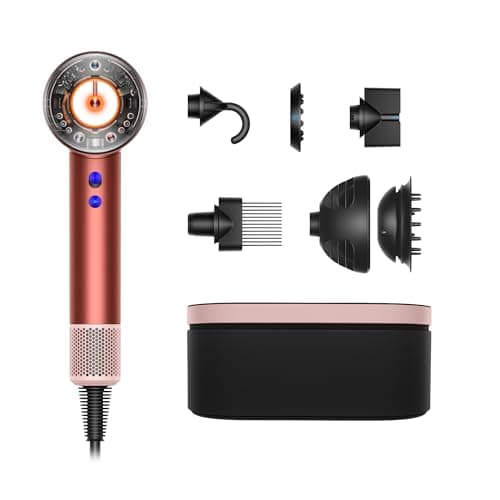
| 1 | Dyson Supersonic hair dryer Three attachments including a wide-tooth comb, 1,600 W and four heat settings with a cold shot. | Stretching coily hair while it dries | |
| 2 | 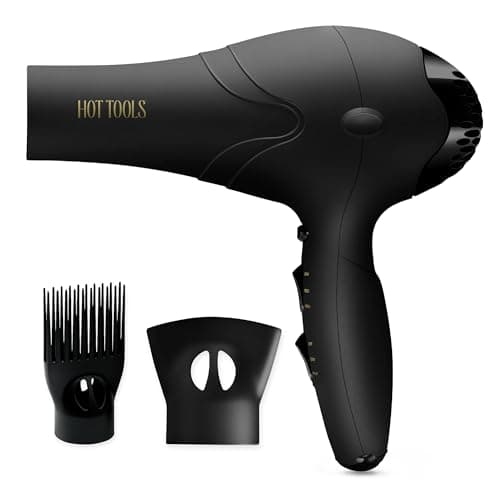 Hot Tools Pro Artist Infrared Ionic Salon Dryer 1875W 1,875 W with a concentrator and a diffuser in the box, a 9 ft cord and a lifetime limited warranty. | Thick, dense hair that takes a long time to dry | |
| 3 | 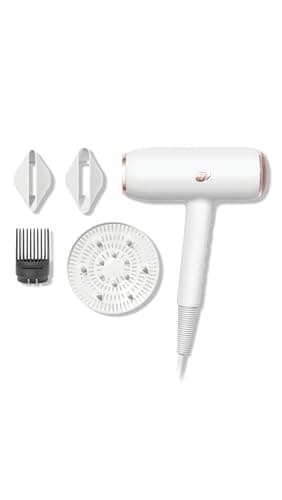 T3 Featherweight StyleMax professional hair dryer 16.6 oz published, five heat settings and three speeds - fifteen combinations, on one of the lightest dryers here. | Long presses where your arm gives out before your patience | |
| — | 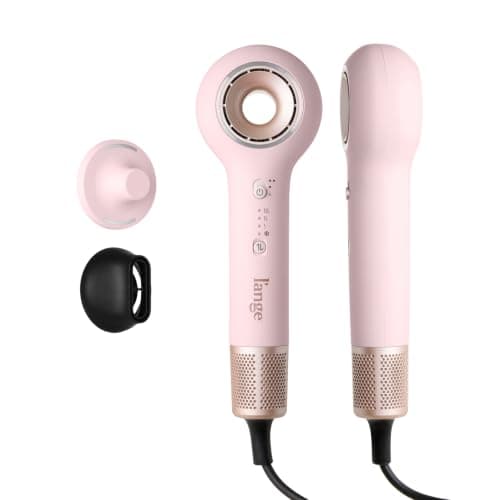 L'ange Axia HaloRing Hair Dryer 1,300 W with a published 140-230°F ceiling - excellent restraint, and not enough for a full head of dense hair. We’d skip this | Not dense textured hair |
1. A comb attachment, and published control
Dyson Supersonic hair dryer
Best for: Stretching coily hair while it dries
Three attachments including a wide-tooth comb, 1,600 W and four heat settings with a cold shot.
The wide-tooth comb attachment is the reason this leads. Only two dryers in this registry publish one — this and the Shark SpeedStyle Pro. Stretching is the job at this stage: hair held under tension while the water leaves it dries straighter, and straighter hair needs fewer iron passes.
The Shark is lighter at 1.65 lb and publishes more power at 1,750 W, and on those two rows it beats the Dyson. It publishes no heat settings and no speed settings, though, and on a silk press you want to drop the temperature for the final stretching passes. The Dyson documents exactly how you can; the Shark does not say.
Four heat settings with a genuine cold shot gives you a cool finish on each section, which sets the stretch before the iron ever arrives. Three speeds on top of that is twelve combinations.
1,600 W and an 8.6 ft cord. 1.8 lb published is the heaviest dryer here, which is a real cost on a session this long — but the comb attachment is doing work only one other dryer here can do.
What’s wrong with it
The heaviest dryer in this registry at 1.8 lb, and 120 V only, on the longest kind of drying session there is.
Published specifications — Dyson Supersonic hair dryer
| Wattage | 1,600 W |
|---|---|
| Heat settings | 4 heat settings, including a cold shot |
| Speed settings | 3 speed settings |
| Weight | 1.8 lb |
| Cord length | 8.6 ft |
| Noise (dB) | Not published |
| Attachments | 3 — styling concentrator, diffuser, wide-tooth comb |
| Plate / barrel | Air-multiplier body; no heated styling surface |
| Dual voltage | No — 120 V |
| Warranty | 2-year limited warranty |
Every figure above is taken from Dyson — Supersonic hair dryer product page. “Not published” means the figure does not appear on that page — it is not an estimate withheld, it is a number the manufacturer does not state. How we compile these.
What it costs to run for a year
$19.07 a year
1,600 W × 65 hours a year = 104.0 kWh, at 18.34 cents per kilowatt-hour. The hours assume 15 minutes a session, 5 days a week — that is an assumption, not a measurement, so swap in your own if it is wrong.
2. Most sustained power for dense hair
Hot Tools Pro Artist Infrared Ionic Salon Dryer 1875W
Best for: Thick, dense hair that takes a long time to dry
1,875 W with a concentrator and a diffuser in the box, a 9 ft cord and a lifetime limited warranty.
Dense hair is a volume problem, and volume is where raw output genuinely helps. 1,875 W ties the highest published figure on this site, and the concentrator is supplied rather than sold separately.
A 9 ft cord is worth naming here because a silk press means moving around your own head for half an hour or more. Cord tension is the small irritation that makes people rush the back sections.
The lifetime limited warranty is the longest in the registry, which matters on a tool being used weekly rather than occasionally.
What’s wrong with it
No published weight, no published voltage, and 3 heat settings with 2 speeds is the least granular control on this page.
Published specifications — Hot Tools Pro Artist Infrared Ionic Salon Dryer 1875W
| Wattage | 1,875 W |
|---|---|
| Heat settings | 3 heat settings |
| Speed settings | 2 speeds, with a cool shot |
| Weight | Not published |
| Cord length | 9 ft professional cord |
| Noise (dB) | Not published |
| Attachments | 2 — curl-defining diffuser and precision concentrator |
| Plate / barrel | Tourmaline ceramic grill; no heated styling surface |
| Dual voltage | Not published |
| Warranty | Lifetime limited warranty |
Every figure above is taken from Hot Tools — Pro Artist Infrared Ionic Salon Dryer 1875W product page. “Not published” means the figure does not appear on that page — it is not an estimate withheld, it is a number the manufacturer does not state. How we compile these.
What it costs to run for a year
$22.35 a year
1,875 W × 65 hours a year = 121.9 kWh, at 18.34 cents per kilowatt-hour. The hours assume 15 minutes a session, 5 days a week — that is an assumption, not a measurement, so swap in your own if it is wrong.
3. Lightest tool for the longest session
T3 Featherweight StyleMax professional hair dryer
Best for: Long presses where your arm gives out before your patience
16.6 oz published, five heat settings and three speeds - fifteen combinations, on one of the lightest dryers here.
16.6 oz is about 1.04 lb, against the Dyson Supersonic’s 1.8 lb. Over a forty-minute session with the arm raised, that is the difference between finishing the back properly and rushing it.
Five heat settings and three speeds is the most granular control on this page. On a silk press you want to drop the temperature for the final stretching passes, and fifteen combinations makes that possible in a way three settings does not.
A 9 ft professional cord. T3 publishes no wattage on any product, so there is no power figure to compare and no running cost to compute.
What’s wrong with it
No published wattage, no attachments published, and 125 V only.
Published specifications — T3 Featherweight StyleMax professional hair dryer
| Wattage | Not published |
|---|---|
| Heat settings | 5 heat settings |
| Speed settings | 3 speed settings |
| Weight | 16.6 oz (cord not included) |
| Cord length | 9 ft professional cord |
| Noise (dB) | Not published |
| Attachments | Not published |
| Plate / barrel | Ceramic |
| Dual voltage | No — 125 V |
| Warranty | 2-year warranty |
Every figure above is taken from T3 Micro — Featherweight StyleMax product page. “Not published” means the figure does not appear on that page — it is not an estimate withheld, it is a number the manufacturer does not state. How we compile these.
What it costs to run for a year
T3 does not publish a wattage for this tool, so there is nothing honest to compute. The formula is watts ÷ 1,000 × hours a year × your rate per kWh; if you find a rating plate on the handle, 65 hours a year and 18.34 cents per kilowatt-hour will get you the rest of the way.
The one we'd skip
L'ange Axia HaloRing Hair Dryer
Best for: Not dense textured hair
1,300 W with a published 140-230°F ceiling - excellent restraint, and not enough for a full head of dense hair.
We would not choose this for a silk press, which is awkward because its published restraint is exactly what we usually argue for.
The problem is time. 1,300 W with a 230°F air ceiling on a full head of dense, coily hair means a long session, and total time under heat is itself a damage variable Evans and Park, Journal of Cosmetic Science. A gentler tool used twice as long is not automatically gentler.
There is also no comb or stretching attachment — only a concentrator and a wall mount — so the tension part of the job falls entirely to your other hand. On fine or shoulder-length hair it is a lovely dryer, and we say so elsewhere.
What’s wrong with it
1,300 W and a 230°F ceiling means a long session on dense hair, with no stretching attachment to speed it up.
Published specifications — L'ange Axia HaloRing Hair Dryer
| Wattage | 1,300 W |
|---|---|
| Heat settings | 4 — cool shot, low, medium, high (140–230°F published) |
| Speed settings | 2 speeds |
| Weight | 0.7 lb (317.5 g) without the cord |
| Cord length | 6.6 ft (2 m) |
| Noise (dB) | Not published |
| Attachments | 2 — magnetic concentrator nozzle and magnetic wall mount |
| Plate / barrel | HaloRing body; no heated styling surface |
| Dual voltage | No — 125 V, 50/60 Hz |
| Warranty | 1-year warranty |
Every figure above is taken from L'ange — Axia HaloRing Hair Dryer product page. “Not published” means the figure does not appear on that page — it is not an estimate withheld, it is a number the manufacturer does not state. How we compile these.
What it costs to run for a year
$15.50 a year
1,300 W × 65 hours a year = 84.5 kWh, at 18.34 cents per kilowatt-hour. The hours assume 15 minutes a session, 5 days a week — that is an assumption, not a measurement, so swap in your own if it is wrong.
The stage that actually decides the result
People buy the flat iron for a silk press and treat the dryer as incidental. It is the wrong way round. The number of iron passes you need is set almost entirely by how straight the hair already is when the iron arrives, and that is the dryer’s job.
Each pass is a thermal cycle, and thermal cycling is where the measurable damage sits Evans and Park, Journal of Cosmetic Science. Going from four passes to two halves the load on the fiber, and that is achieved with a comb attachment and patience, not with a hotter plate.
Tension is the mechanism
Textured hair dries in whatever shape it is held. Held under tension and stretched, it dries closer to straight; left to its own devices, it dries in its pattern and the iron has to undo that afterwards.
- Work in small sections. Large sections dry on the outside and stay damp within, and damp hair under an iron is the bubble-hair mechanism Yin et al., Annals of Dermatology.
- Apply tension with a comb or brush, not just heat. The Dyson comb attachment does this in one hand; otherwise it takes two.
- Direct the airflow down the shaft. Root to tip, with the cuticle rather than against it.
- Finish each section cool. Hair sets as it cools, and a stretched section that cools stretched stays stretched.
Combing force is a real mechanical load on textured hair, measurable in the literature Bloch et al., International Journal of Dermatology, which is why detangling fully before any of this starts matters. See wide-tooth combs.
The attachment table
What each dryer publishes in the box
| Dryer | Attachments published | Useful for a press? |
|---|---|---|
| Dyson Supersonic | Concentrator, diffuser, wide-tooth comb | Yes - the comb stretches |
| Hot Tools Pro Artist | Concentrator, diffuser | Yes - concentrator directs |
| T3 Featherweight StyleMax | Not published | Unknown before purchase |
| L'ange Axia | Concentrator, wall mount | Partly |
A comb or stretching attachment is the single most useful thing a dryer can supply for this job. Two dryers in this registry publish one: the Dyson Supersonic and the Shark SpeedStyle Pro, which is not ranked here because it publishes no heat or speed settings.
Then the iron
Once the hair is properly stretched, the iron’s job is small: one or two slow passes at the lowest temperature that holds. The best flat irons for a silk press covers that half, and heat damage from a silk press covers what to watch for afterwards.
If a section no longer reverts to its pattern when wet while the rest of your head does, that is structural change rather than a styling result. Heat damage on coily and 4C hair is honest about what can and cannot be done about it.
Questions people actually ask
What kind of blow dryer is best for a silk press?
One with a comb or stretching attachment and enough sustained airflow to dry dense hair without a marathon session. Stretching the hair while it dries is what reduces the number of flat iron passes afterwards, and passes are where the damage is.
Should I blow dry before a silk press or go straight to the iron?
Always blow dry first, and stretch while you do it. Ironing hair that is not completely dry is the mechanism behind bubble hair, and hair that dried in its curl pattern needs several more iron passes to straighten.
What temperature should I blow dry for a silk press?
Medium heat with tension beats high heat without it. The L'ange Axia is one of very few dryers here that publishes an air temperature at all, at 140 to 230 degrees Fahrenheit, which gives you a reference point most of the category does not.
Is a comb attachment worth it for a silk press?
It is the most useful attachment for this job, because it applies tension and directs airflow at the same time - which otherwise takes both hands. The Dyson Supersonic and the Shark SpeedStyle Pro are the two dryers in this registry that publish one in the box.