Heat Damage & Protection
What Heat Actually Does to Wet Hair
Water inside a hair shaft that meets a hot surface does not evaporate politely. It becomes steam, and it leaves on its own terms.
Updated September 2026 · Sawyer V.
Water inside the hair shaft turns to steam when it meets a hot surface, and it has to escape. Published microscopy of hair thermally treated wet shows bubbling and buckling of the cuticle from that escape — damage that does not appear when the same treatment is applied dry.

We earn a commission if you buy through the links on this page, at no extra cost to you. It never changes which tool we pick or which one we tell you to skip. How this site is funded.
The mechanism, plainly
Hair holds water both on its surface and inside the cortex. Surface water evaporates easily. Water inside the fiber has to travel out through the cuticle, and if you heat the outside faster than that water can leave, it becomes steam while it is still inside.
Steam occupies far more volume than the water it came from. Trapped inside a structure it cannot immediately exit, it pushes — and it exits wherever the fiber is weakest.
That is the entire difference between styling wet hair and styling dry hair. It is not that wet hair is more delicate in a vague sense. It is that heating it introduces a specific failure mode that dry styling does not have.
What the microscopy shows
The clearest published work on this compared the two conditions directly, using a curling iron. Researchers treated hair wet and dry, with and without tension, over short and prolonged times, and examined the fibers by scanning electron microscopy.
Fibers treated dry, at 50 percent relative humidity, showed radial and axial cracking along with scale edge fusion. Fibers given similar thermal treatment wet showed severe damage of that same type plus bubbling and buckling of the cuticle, due to the formation and escaping of steam from the fiber — Ruetsch and Kamath, Journal of Cosmetic Science.
The authors state the general principle in one line: the propensity of the hair surface to damage depends on the moisture content of the hair. Same tool, same temperature, different water content, different outcome.
Note what the dry result was. Cracking and scale fusion — visible structural change on hair styled correctly. Dry is not free. It is the version without steam blisters.
Bubble hair: the clinical version
This is not confined to the laboratory. There is a recognized condition — bubble hair deformity — characterized by air-filled cavity formations within the hair shaft, usually because of heat damage.
A systematic review of the published case reports found that the majority of patients were middle-aged women who had used a heated tool to dry or style wet hair, and that treatment consisted of cessation of heated tool usage — Li et al., International Journal of Dermatology.
One documented case describes a 61-year-old woman presenting with hair breakage over her crown who regularly dried her damp hair with a blow dryer. Dermoscopy revealed multiple bubbles within the hair shaft, confirmed by light microscopy. The authors describe the case as highlighting the ease of acquisition of this abnormality by means of a common hair dryer — Albers et al., International Journal of Trichology.
The phrase worth carrying is “a common hair dryer”. This is not an exotic outcome requiring an unusual tool.
Being careful about what this proves
It would be easy to overstate all of this, so here is the boundary.
- Case reports establish that something happens, and describe who it happened to. They do not give you a probability for any individual on any given morning.
- The microscopy used a curling iron. The steam mechanism applies to any hot surface in contact with wet hair, but a dryer holds no surface against the fiber at all — the exposure is different, even though the bubble-hair case reports include dryers.
- Nobody has published a safe moisture threshold. The experimental contrast was wet versus 50 percent relative humidity. Where between those a given tool becomes safe is not something we can source, and we are not going to invent a percentage.
- Most people who blow-dry damp hair do not get bubble hair. Saying otherwise would be alarmist and false.
What the evidence supports is a direction, not a threshold: water content raises the cost of a given heat application and adds a failure mode. That is enough to change a routine without needing a scare.
Where the line actually falls, tool by tool
The risk is not uniform across everything in your bathroom, and treating it as though it were leads to bad advice like “never dry wet hair”, which is not a thing anyone can do.
Water content against tool type
| Tool | Contact with the fiber | How wet is acceptable |
|---|---|---|
| Hair dryer, bare nozzle | None — moving air only | Soaking is fine; this is what it is for |
| Hair dryer with concentrator | None, but concentrated and hotter at the point of contact | Damp is fine; keep it moving and a hand's width away |
| Hot air brush | Bristles, warm air through them | Around 80 percent dry — it is a finishing tool |
| Air styler barrel | Warm barrel plus airflow | Around 80 percent dry — too wet and it will not set anyway |
| Curling iron or wand | Direct hot surface, held | Completely dry |
| Flat iron | Two hot plates, clamped | Completely dry |
The pattern is straightforward. A dryer moves hot air past hair; an iron presses a hot surface against it. The steam problem is worst where contact is closest and the heat has nowhere else to go, which is why the strictest rule applies to clamped plates and barrels.
Wet-to-dry irons
There is a whole product category built on doing the thing this page advises against, with vented plates designed to let steam escape rather than build. We do not recommend them and we do not cover any — none of the 24 products in our registry is a wet-to-dry iron.
That means we cannot rank them or compare their vent designs, and we will not write a roundup of products we have no published specifications for. The reasoning in full, and what we would buy instead, is on the wet-to-dry page.
What to do instead
The routine below gets you the same time saving people are chasing when they style damp hair, without the steam.
- Squeeze with a towel, do not rub, then wait ten minutes. Free, removes surface water at zero thermal cost, and it is the largest single time saving available — the arithmetic is here.
- Rough-dry on the bare nozzle until the hair moves freely. No attachment. This is the stage a dryer is genuinely good at.
- Then style. Brushes and air stylers at about 80 percent; irons and wands completely dry.
- Check the ends first. They dry last on some heads and first on others, and they are the oldest, weakest hair you own — why that matters.
- Or dry less. A partial air-dry before any heat is the cheapest intervention on this whole site — the trade-offs.
How to tell if it has already happened
Bubble hair is diagnosed by visualizing the cavities under light microscopy or, increasingly, by trichoscopy — scalp dermoscopy — which the review above supports as a convenient and non-invasive method. Neither is something you can do at home.
What you can notice is the pattern that sent those patients to a dermatologist: breakage concentrated in one area, often where you habitually point the tool, on hair that feels brittle and dry. If that describes you, the published treatment in every one of those case reports was the same and it was not a product — it was stopping use of the heated tool.
What heat damage looks like more generally, and how to distinguish it from ordinary dryness, is on the signs page. And whether any of it can be undone is answered honestly on the repair page — the answer is not the one most sites give.
Price per use, at 5 uses a week over 5 years
| What you pay | Cost per use | Cost per year |
|---|---|---|
| $30 | $0.02 | $6.00 |
| $60 | $0.05 | $12.00 |
| $100 | $0.08 | $20.00 |
| $150 | $0.12 | $30.00 |
| $200 | $0.15 | $40.00 |
| $300 | $0.23 | $60.00 |
| $400 | $0.31 | $80.00 |
| $500 | $0.38 | $100.00 |
5 uses a week for 5 years is 1300 uses. Both figures are stated assumptions, not measurements — halve the life and every cost per use doubles. We publish the ladder rather than a worked example for one specific product because a price we typed into a sentence would be wrong within a week.
If your hair is also bleached
Then you are stacking two things that each modify the fiber. Bleaching produces dehydroalanine and dehydration products — modifications normally associated with alkali or thermal treatment — before any tool touches your hair, so bleached hair arrives already carrying heat-type damage.
Adding steam blistering on top of that is the worst combination available in this subject, and it is the one case where we would say the rule is absolute rather than directional: dry completely, every time. The full case is on the bleached-hair page.
The tools on this page
Prices come from the live price layer. Where none is available the button says so rather than showing a number we cannot stand behind.
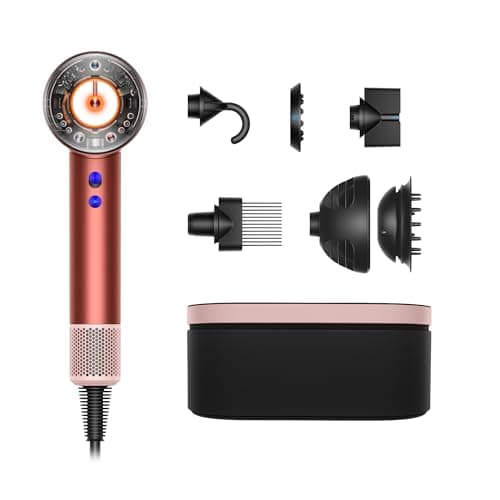
Dyson Supersonic hair dryer
1,600 W is less power than a drugstore dryer draws, and Dyson publishes that openly — the pitch is airflow and heat control, not wattage.
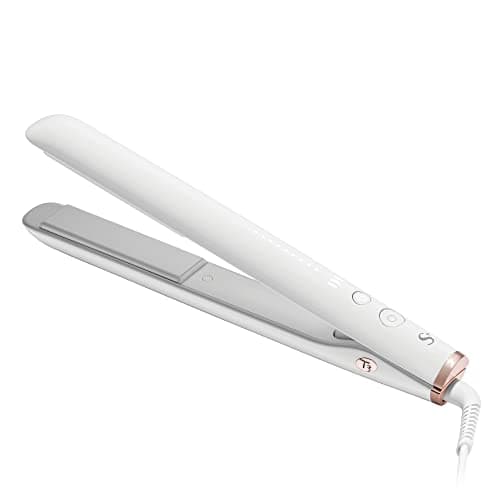
T3 SinglePass StyleMax 1 inch flat iron
Nine heat settings and genuine 100–240 V dual voltage: the most adjustable iron here and the only one you can pack for Europe without a thought.
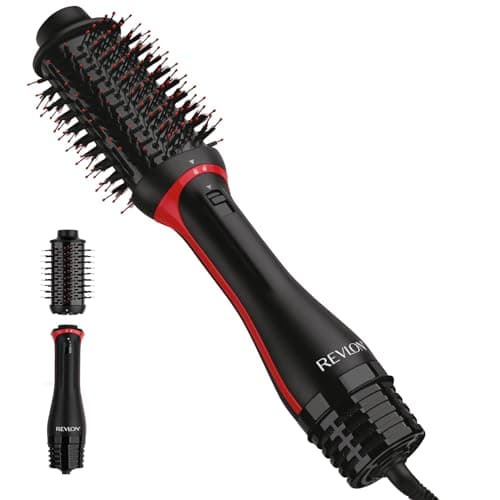
Revlon One-Step Volumizer Plus hair dryer and hot air brush
A 4-year limited warranty, the longest in this registry, on the cheapest kind of tool in it. Worth noticing before paying six times more elsewhere.
Questions people actually ask
Is it bad to straighten wet hair?
Yes. Published microscopy of hair thermally treated while wet shows bubbling and buckling of the cuticle caused by steam forming inside the fiber, on top of the cracking seen in dry treatment.
Can you blow-dry wet hair?
Yes — that is what a dryer is for. A dryer moves hot air past the hair rather than pressing a hot surface against it, so the exposure is different from an iron. The strict rule applies to clamped plates and barrels.
How dry does hair need to be before using a flat iron?
Completely dry. No published study establishes a safe moisture threshold, and the experimental contrast was between wet hair and hair at 50 percent relative humidity, so there is no percentage anyone can honestly give you.
What is bubble hair?
A recognized deformity where air-filled cavities form inside the hair shaft, usually from heat damage. A review of case reports found most patients had used a heated tool on wet hair, and treatment was stopping use of the tool.
Sources
- Ruetsch and Kamath — Effects of thermal treatments with a curling iron on hair fiber, J Cosmet Sci 2004
- Li et al. — A review of bubble hair deformity, Int J Dermatol 2023
- Albers et al. — Blowing Bubbles: Dermoscopy of Bubble Hair, Int J Trichol 2017
- Dyer et al. — Redox proteomic evaluation of bleaching and alkali damage in human hair, Int J Cosmet Sci 2013