Heat Damage & Protection
What Actually Causes Split Ends
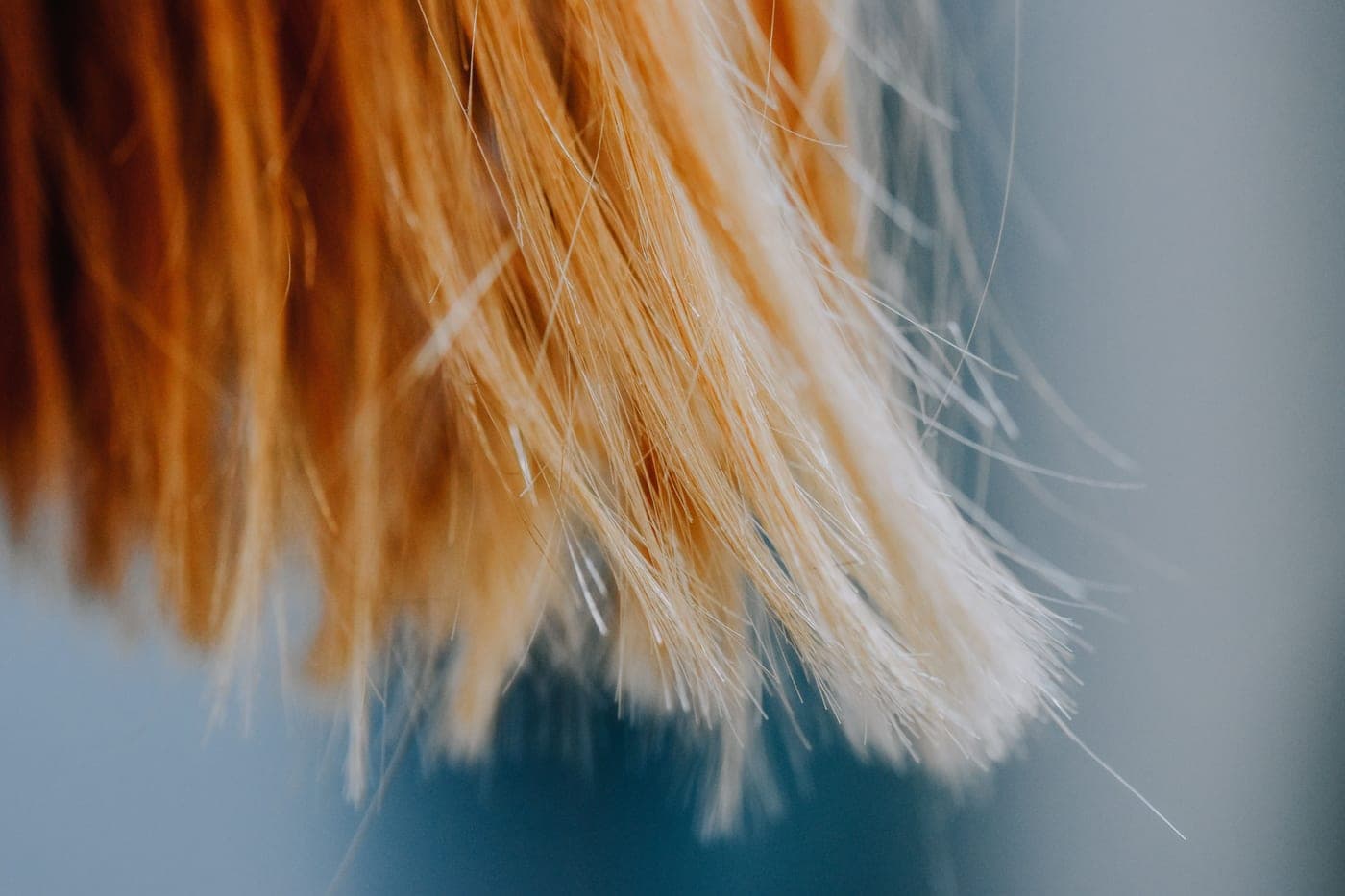
The ends of your hair are the oldest part of it, and they have been losing structure the whole way down. Everything else follows from that.
Updated September 2026 · Sawyer V.
The ends of your hair are its oldest section, and both lipid content and tensile strength decrease measurably from root to tip. Combing and brushing then act as a fatigue process, propagating flaws until the fiber fails. A split is a structural failure, so it cannot be repaired — only cut off.
We earn a commission if you buy through the links on this page, at no extra cost to you. It never changes which tool we pick or which one we tell you to skip. How this site is funded.
Your ends are old
Hair grows at roughly half an inch a month. Hair that is twelve inches long has therefore been on your head for around two years at the tip and a week at the root, and everything that has happened in those two years has happened to the tip and not the root.
That is obvious once stated and it is the foundation of the whole subject. It is also measurable. Researchers cut hair into five segments from root to distal end and analyzed each: the concentrations of free polar lipids and of covalently bound fatty acids decreased steadily from root to tip, and there was a significant reduction in tensile properties across the same span — Duvel et al., International Journal of Cosmetic Science.
The lipids matter specifically. Among the covalently bound fatty acids on the outer surface of the cuticle cells, 18-methyleicosanoic acid is a major component, and this layer is a significant determinant of the hair’s physical properties. As it is progressively lost, the protein and lipid layers underneath become more exposed — which is why the process accelerates rather than proceeding evenly.
Combing is a fatigue process
The second mechanism is mechanical, and the useful way to think about it is borrowed from engineering. Brushing and combing hair is a fatigue loading process: individual strands experience repeated exposure to a stimulus, flaws propagate gradually within each fiber, and eventually failure results — Evans and Park, Journal of Cosmetic Science.
That framing explains something people find confusing: the brush stroke that finally breaks a hair is not different from the thousand before it. Nothing went wrong that morning. The damage had been accumulating for months and that stroke was the one that finished it.
The same work also found that conditioning treatments provided considerable retardation of breakage. Not prevention — retardation. It is one of the few places in this subject where a product claim is straightforwardly supported by measurement, and it is worth knowing that the supported claim is modest.
Two different kinds of break
Not all breakage is the same, and the distinction changes what you should do about it. Work on combing damage found that short fiber fragmentation — pieces under about an inch — and longer segment breaks occur by different pathways, with longer breaks most likely occurring by impact loading rather than steady tension — Robbins, Journal of Cosmetic Science.
Impact loading causes breakage at lower loads than tensile loading. In plain terms: yanking a brush through a knot breaks hair at a force that slow, steady tension would not. The looped and crossed formations in a snag are exactly the geometry that produces impact loads.
The two failure modes, and what each tells you
| What you see | Likely cause | What to change |
|---|---|---|
| Short broken pieces, under an inch | Fragmentation at already-damaged or abraded ends | Trim; reduce heat and chemical load on the lengths |
| Longer broken lengths | Impact loading — snags, knots, fast brushing | Detangle from the ends up, slowly, on conditioned hair |
| Ends splitting into two or three | Cuticle worn away, cortex exposed | Cut. Nothing else works on a split that has formed |
Where heat tools come into it
Heat does not cause split ends on its own so much as it accelerates every step of the process above. It wears the cuticle, it dries the fiber, and it makes hair more prone to the snagging that produces impact loads.
The important consequence for buying decisions is not about temperature. It is about pass count. Every additional pass with an iron is another mechanical traverse of the length as well as another heat application, and both terms accumulate at the ends where the hair is weakest.
So the tools that genuinely help here are the ones that reduce passes: plates that make good contact across a whole section, wide plates that cover more per stroke, and long barrels that wrap more hair at once. The reasoning is spelled out on the plate size page and the barrel size page.
What does not work
- Sealing serums. They coat and smooth the appearance of a split. Nothing rejoins a fiber that has separated — the structural argument is on the repair page.
- Protein treatments, as a fix. They can improve how hair behaves and reduce further breakage. They do not reverse a split that already exists.
- Trimming with anything other than sharp scissors. Blunt scissors crush the fiber end, which is exactly the abraded geometry that produces short fragmentation.
- Waiting. A split does not stop where it started. It travels up the shaft, which is why cutting early costs less length than cutting late.
What does work
- Cutting them off, regularly. Unglamorous and the only actual fix.
- Detangling from the ends upward. Working root-down drags every knot into a bigger knot, which is the impact-loading geometry.
- Conditioning before combing. Measured to considerably retard breakage in repeated-grooming experiments. That is a modest, real claim.
- Fewer, better passes with heat tools. The buying argument on this page.
- Protecting the ends from friction. Collars, bag straps and hair ties all abrade the oldest hair you own.
Price per use, at 5 uses a week over 5 years
| What you pay | Cost per use | Cost per year |
|---|---|---|
| $30 | $0.02 | $6.00 |
| $60 | $0.05 | $12.00 |
| $100 | $0.08 | $20.00 |
| $150 | $0.12 | $30.00 |
| $200 | $0.15 | $40.00 |
| $300 | $0.23 | $60.00 |
| $400 | $0.31 | $80.00 |
| $500 | $0.38 | $100.00 |
5 uses a week for 5 years is 1300 uses. Both figures are stated assumptions, not measurements — halve the life and every cost per use doubles. We publish the ladder rather than a worked example for one specific product because a price we typed into a sentence would be wrong within a week.
How this connects to everything else
Split ends are the visible end state of a long accumulation, which is why they are a useful diagnostic rather than an isolated problem. If you are getting them faster than you can cut them, the input that changed is usually heat frequency or chemical processing rather than brushing technique.
The sensible order is to check what heat damage looks like earlier, then how often you are applying heat, then whether your color is doing more of the work than you assumed on the bleached hair page.
The tools on this page
Prices come from the live price layer. Where none is available the button says so rather than showing a number we cannot stand behind.
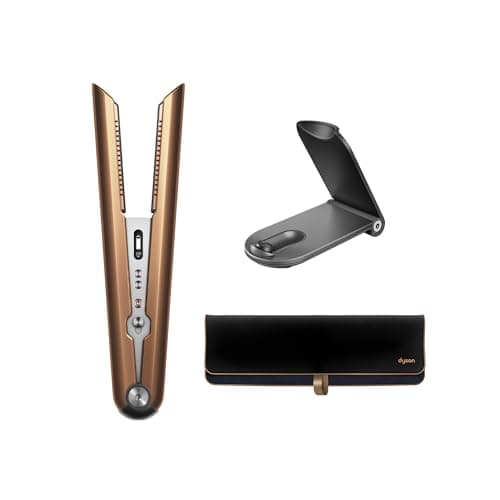
Dyson Corrale straightener
Cordless, and the only iron here whose plates flex. The 200 W figure is a battery rating and is not comparable to a corded iron's draw.
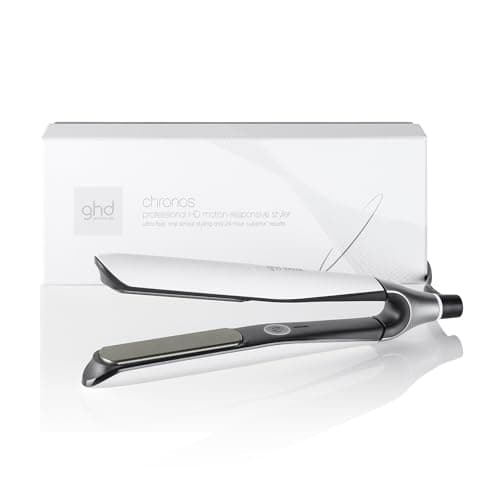
ghd Chronos flat iron (1 inch plate)
The Platinum+ argument with a re-engineered hinge and a wide-plate option — same fixed 365°F, same three-year warranty, more plate choice.
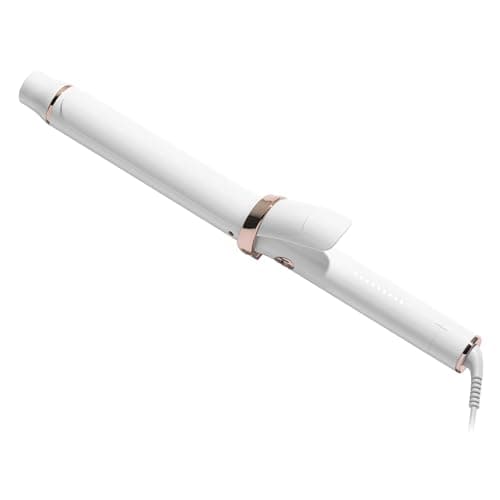
T3 SinglePass Curl X extra-long barrel curling iron
A 6.5-inch barrel and a separate published weight for every barrel size — unusual disclosure in a category where most makers publish a diameter and stop.
Questions people actually ask
Can split ends be repaired?
No. A split is a structural separation of the fiber, and nothing rejoins it. Products can coat and smooth the appearance temporarily; the only fix is cutting the split off before it travels further up the shaft.
Why do my ends split when the rest of my hair is fine?
Because the ends are the oldest part. Lipid content and tensile strength both decrease measurably from root to tip, so the same treatment that healthy roots shrug off is what finishes two-year-old ends.
Does brushing cause split ends?
Repeated brushing behaves as a fatigue process, propagating flaws until failure. Yanking through a knot is worse than steady brushing, because impact loading breaks hair at lower forces than tension does.
How often should I trim to avoid split ends?
There is no published interval to cite. What the research supports is that splits travel up the shaft, so cutting early costs less length than cutting late, and the interval that works is the one that keeps ahead of them.
Sources
- Duvel et al. — Analysis of hair lipids and tensile properties as a function of distance from scalp, Int J Cosmet Sci 2005
- Evans and Park — A statistical analysis of hair breakage II: repeated grooming experiments, J Cosmet Sci 2010
- Robbins — Hair breakage during combing II: impact loading and hair breakage, J Cosmet Sci 2006