Brushes & Accessories
The Best Detangling Brushes in 2026
This is the cheapest damage intervention on the whole site, and the only one where the mechanism is better documented than the products.
Updated September 2026 · Sawyer V.
A detangling brush works by easing knots apart rather than dragging through them. That matters because published work found longer hair breaks occur mostly through impact loading — a sudden yank — which breaks hair at lower forces than steady tension does.
We earn a commission if you buy through the links on this page, at no extra cost to you. It never changes which tool we pick or which one we tell you to skip. How this site is funded.
Quick picks
Tap any row to jump to the full write-up. Prices come from the live price layer; where none is available the button says so rather than showing a number we cannot stand behind.
| # | Product | Best for | Price |
|---|---|---|---|
| 1 | Tangle Teezer The Ultimate Detangler A two-tier flexible bristle design published in Regular, Large and Mini sizes — one of the few detanglers with a manufacturer page to cite. | Wet detangling on hair that breaks when you brush it out |
1. The one we can source
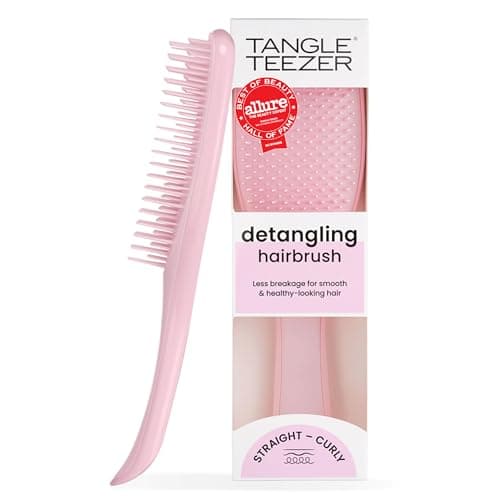
Tangle Teezer The Ultimate Detangler
Best for: Wet detangling on hair that breaks when you brush it out
A two-tier flexible bristle design published in Regular, Large and Mini sizes — one of the few detanglers with a manufacturer page to cite.
The two-tier bristle arrangement is the mechanism: longer bristles begin separating a knot while shorter ones work through what is left, so the load is spread over more of the stroke instead of arriving all at once.
Spreading the load is precisely what the breakage research points at. It is not that a detangler applies less total force — it is that it avoids the sudden peak that snaps a fiber.
Tangle Teezer publishes three sizes: Regular, Large and Mini. Size is the specification that actually varies here, and the honest guide is Large for long or dense hair, Regular for most people, Mini for a bag.
What’s wrong with it
Tangle Teezer publishes no weight, no bristle count and no warranty term we could read — the spec block for this product is mostly “not applicable” and “not published”, which is thin for a page that ranks it first.
Published specifications — Tangle Teezer The Ultimate Detangler
| Wattage | Not applicable — not a powered tool |
|---|---|
| Heat settings | Not applicable |
| Speed settings | Not applicable |
| Weight | Not published |
| Cord length | Not applicable |
| Noise (dB) | Not applicable |
| Attachments | None — published in Regular, Large and Mini sizes |
| Plate / barrel | Two-tier flexible plastic bristles |
| Dual voltage | Not applicable |
| Warranty | Not published |
Every figure above is taken from Tangle Teezer — The Ultimate Detangler product page. “Not published” means the figure does not appear on that page — it is not an estimate withheld, it is a number the manufacturer does not state. How we compile these.
What it costs to run for a year
Tangle Teezer does not publish a wattage for this tool, so there is nothing honest to compute. The formula is watts ÷ 1,000 × hours a year × your rate per kWh; if you find a rating plate on the handle, 65 hours a year and 18.34 cents per kilowatt-hour will get you the rest of the way.
What a detangler is actually solving
Not tangles. Tangles are the symptom. What it is solving is a specific mechanical failure mode, and the research on it is unusually clear.
Work on combing damage found that short fiber fragmentation and longer segment breaks happen by different pathways, with the longer breaks most likely occurring through impact loading rather than steady tension — and that impact loading causes breakage at lower loads than tensile loading does — Robbins, Journal of Cosmetic Science. The looped and crossed formations in a snag are exactly the geometry that produces impact loads.
Translated: the yank is what breaks your hair, not the brushing. A slow, steady stroke that meets a knot and works through it is a different event from a fast stroke that hits the same knot and pulls.
Separately, repeated brushing behaves as a fatigue process — flaws propagate through a fiber until it fails — Evans and Park, Journal of Cosmetic Science. So both the peak force and the number of strokes count against you.
Why this page ranks one product
Because it is the only detangling brush we found with a manufacturer product page we could cite, and every product on this site carries a spec block sourced from the maker’s own page.
This category is harder to source than heated tools, and the reason is structural rather than suspicious: a heated tool has a rating plate and a regulatory reason to publish figures. A brush has neither. Most detanglers are sold with a photograph, a colorway and a claim.
We would rather rank one and give you criteria than assemble a ten-item list out of retailer copy — the same position we take on storage bags and universal diffusers. What to apply is below.
The criteria
What actually differs between detangling brushes
| Property | What to look for | Why |
|---|---|---|
| Bristle flex | Bristles that visibly give when pressed | Flex is what eases a knot apart instead of dragging it |
| Bristle height | Two tiers rather than one | Spreads the load across more of the stroke |
| Tip finish | Rounded, not cut flat | The tips land on your scalp as well as your hair |
| Head size | Matched to your hair volume | Too small means more strokes; too large means less control near the face |
| Handle or handleless | Whichever you will actually use wet | Most breakage happens detangling wet hair in the shower |
| Cleanability | Bristles you can get shed hair out of | A loaded brush drags rather than passes through |
Technique beats the purchase
This is genuinely true here in a way it is not on most pages. The brush helps; how you use it helps more, and it is free.
- Start at the ends and work up. The single most important habit. Brushing root-down drags every knot into a bigger knot ahead of the brush, which is how you manufacture an impact load.
- Hold the section above where you are brushing. Your other hand takes the tension instead of your scalp and the fiber above the knot.
- Never pull through a snag. Stop, work it apart, then continue. The stroke that finally breaks a hair is not different from the thousand before it — the damage had been accumulating.
- Condition before combing. Conditioning treatments were measured to provide considerable retardation of breakage in repeated-grooming experiments. That is a modest, real, supported claim.
- Wet hair needs the most care. Hair is at its most extensible when wet, which makes it easier to stretch past recovery.
Why this matters more than which iron you own
A claim worth defending rather than asserting. If your hair is breaking, the interventions available to you rank roughly like this, cheapest and most effective first: change how you detangle, reduce heat frequency, then change tools.
Detangling is at the top because it is free, because it happens every single day rather than on styling days, and because the mechanism is mechanical failure at a known load rather than an accumulation you cannot observe. You can feel a snag. You cannot feel a cuticle.
The heat side of that ordering is on how often you can use heat, and what breakage looks like as it develops is on the signs page.
Hair type changes the answer
Coily and curly hair is structurally more vulnerable to mechanical stress. A study comparing chemical and physical treatments across hair types found that bleaching, dyeing and UVA/visible radiation increased combing work on Afro-textured tresses, indicating cuticle scale damage confirmed by scanning electron microscopy — Bloch et al., JEADV.
Increased combing work means more force required for the same stroke, which means more opportunity for a peak load. On coily hair, detangling in sections with conditioner in — and often with fingers before a brush — is the routine that follows from that. The tool-side view is on the coily and 4C router.
Price per use, at 5 uses a week over 5 years
| What you pay | Cost per use | Cost per year |
|---|---|---|
| $30 | $0.02 | $6.00 |
| $60 | $0.05 | $12.00 |
| $100 | $0.08 | $20.00 |
| $150 | $0.12 | $30.00 |
| $200 | $0.15 | $40.00 |
| $300 | $0.23 | $60.00 |
| $400 | $0.31 | $80.00 |
| $500 | $0.38 | $100.00 |
5 uses a week for 5 years is 1300 uses. Both figures are stated assumptions, not measurements — halve the life and every cost per use doubles. We publish the ladder rather than a worked example for one specific product because a price we typed into a sentence would be wrong within a week.
What we would buy
The Tangle Teezer Ultimate Detangler, in the size that matches your hair volume — it is the one product in this category we could verify against a manufacturer page, and the two-tier bristle design matches the mechanism the research points at.
And then change the technique, which will do more than the brush. Ends first, hold above the knot, and stop when you feel resistance.
The tools on this page
Prices come from the live price layer. Where none is available the button says so rather than showing a number we cannot stand behind.
Tangle Teezer The Ultimate Detangler
Three published sizes and a two-tier bristle design, on the one tool in this registry whose whole job is reducing the force you pull with.
Questions people actually ask
Do detangling brushes actually prevent breakage?
They address a documented mechanism. Published work found longer hair breaks occur mostly through impact loading — a sudden yank — which breaks hair at lower forces than steady tension. A brush that eases knots apart reduces those peaks.
Should I detangle wet or dry hair?
Whichever you do, work from the ends upward and hold the section above the knot. Hair is at its most extensible when wet, so wet detangling needs the most care and benefits most from conditioner being present.
Why do you only rank one detangling brush?
Because it is the only one we found with a manufacturer product page we could cite, and every product on this site carries a spec block sourced from the maker's own page. We give the criteria for judging the rest.
What size detangling brush should I get?
Tangle Teezer publishes Regular, Large and Mini. Large suits long or dense hair, Regular suits most people, and Mini is a bag brush. Too small means more strokes; too large means less control near the face.