Brushes & Accessories
Hair Rollers: The Only Zero-Heat Way to Curl
Every other way to curl hair costs you something thermally. This one costs you time instead, which is a trade worth understanding properly.
Updated September 2026 · Sawyer V.
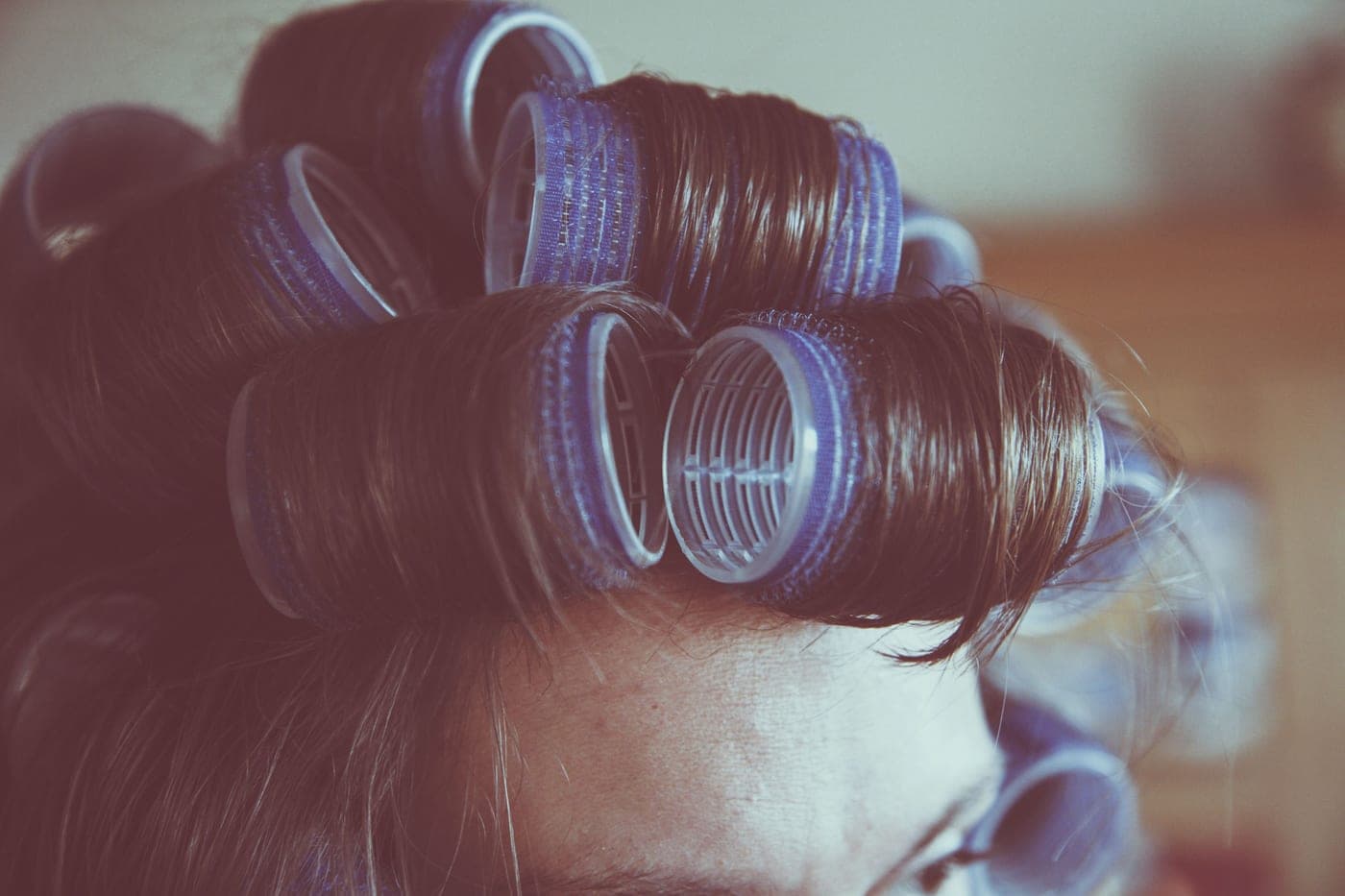
Rollers set a curl by drying hair in a shape rather than heating it into one, so the thermal cost is zero. What they cost instead is time, and the risk that remains is mechanical — a roller wound too tight applies sustained tension at the root for hours.
Why this is the only genuinely zero-heat method
Every heated tool on this site works the same way underneath: heat makes the hair temporarily reshapeable, and it sets in whatever shape it holds as it cools. Rollers get to the same place by a different route — hair is also reshapeable when wet, and it sets as it dries.
That removes the thermal side of the damage equation entirely. No contact heat means none of the radial and axial cracking or scale edge fusion that published microscopy shows on thermally treated fibers, even in dry conditions — Ruetsch and Kamath, Journal of Cosmetic Science.
It is worth being precise about what that does and does not mean. Rollers are not damage-free. They are heat-free, and the remaining risk is mechanical.
The four types, and what each is actually for
Roller types against what they do
| Type | How it holds | Best for | Watch for |
|---|---|---|---|
| Velcro | The hooks grip the hair itself | Root lift and body on fine hair; fast | The hooks can catch and tear fine or damaged hair on removal |
| Foam or satin (heatless) | Bent or tied closed | Sleeping in; the gentlest option | Bulky to sleep on; results vary with how damp you set them |
| Magnetic or smooth plastic | Clipped or pinned | A defined, uniform set; the classic salon result | Needs pins and takes the longest to dry |
| Flexi-rods | Bent around themselves | Curly and coily hair; spiral definition | Tension is easy to overdo along the length |
The type mostly follows from when you plan to wear them. If it is overnight, foam or satin. If it is thirty minutes while you get ready, velcro. If you want a set that reads as deliberate, magnetic with pins.
The tension trap
This is the part that gets left out of most roller advice, and it is the reason rollers are not automatically the safe option.
A roller wound tight enough to hold applies sustained tension at the root — for hours, sometimes overnight. That is a different loading pattern from a brush stroke, and it is not obviously benign. Published work treats repeated grooming as a fatigue process where flaws propagate under repeated loading until the fiber fails — Evans and Park, Journal of Cosmetic Science.
We are not going to overclaim here: that research is about brushing and combing, not rollers, and nobody has published a study on roller tension that we could find. What we can say is that traction at the root is a known mechanism of hair loss in other contexts, and that “it is heatless so it cannot hurt” does not follow.
Practically: wind firmly enough to hold and no firmer, and if your scalp is sore when you take them out, they were too tight.
Getting the dampness right
The single most common reason a roller set fails, and it is the mirror image of the same problem on heated tools.
- Too wet and the hair will not be dry by the time you take them out, so it drops immediately.
- Too dry and there is no water leaving the fiber, so nothing sets at all.
- The target is damp — around 80 percent dry. Same window an air styler needs, for the same underlying reason.
- Bone dry with a mist works as a compromise if you are refreshing rather than setting from wash.
And do not take them out early. Hair that is still damp inside the roller has not set, and the curl will relax within the hour — the same cooling-and-setting principle covered on why curls drop.
Why we do not rank roller sets
Every product on this site carries a spec block read off the manufacturer’s own product page. Roller sets are sold overwhelmingly by brands that publish no diameter, no material and no count you can rely on — and diameter is the one specification that decides the result.
Ranking them would mean inventing the data. So this is a buying guide rather than a roundup, and the criteria are these:
- A stated diameter. Larger rollers give body and a loose bend; smaller give a defined curl. Same relationship as barrel size on a curling iron — that page explains it.
- Enough of them. A set too small for your hair means sections too thick, which means the middle never dries.
- A smooth surface if your hair is fragile. Velcro grips by catching, which is the thing you are trying to avoid.
- Fasteners included. Magnetic rollers without pins are half a product.
Where rollers fit in a real routine
The honest case for them is not that they replace a curling iron for everyone. It is that they let you take heat days off without taking style days off.
Total heat exposure is roughly temperature multiplied by contact time, summed across everything you do in a week. Replacing two heated sessions a week with roller sets is a real reduction in that total, and it is a bigger intervention than any change of tool. That framework is on how often you can use heat.
Other heat-free approaches — braid-outs, twist-outs, plopping — are on the heat-free styling page, and if you are here because your hair is already damaged, the repair page is the honest starting point.
Price per use, at 5 uses a week over 5 years
| What you pay | Cost per use | Cost per year |
|---|---|---|
| $30 | $0.02 | $6.00 |
| $60 | $0.05 | $12.00 |
| $100 | $0.08 | $20.00 |
| $150 | $0.12 | $30.00 |
| $200 | $0.15 | $40.00 |
| $300 | $0.23 | $60.00 |
| $400 | $0.31 | $80.00 |
| $500 | $0.38 | $100.00 |
5 uses a week for 5 years is 1300 uses. Both figures are stated assumptions, not measurements — halve the life and every cost per use doubles. We publish the ladder rather than a worked example for one specific product because a price we typed into a sentence would be wrong within a week.
What we would do
Foam or satin rollers for overnight sets, wound firmly rather than tightly, on hair at about 80 percent dry. Velcro only if your hair is healthy — the hooks that make them fast are the same hooks that catch on fragile hair coming out.
And measure the result in weeks rather than mornings. The point of a roller set is not that it beats a curling iron on any single day; it is that a month of them costs your hair nothing thermally.
Questions people actually ask
Are hair rollers better for your hair than a curling iron?
They add no thermal load at all, which removes the heat side of the damage equation entirely. The remaining risk is mechanical — a roller wound too tight applies sustained tension at the root for hours.
Should hair be wet or dry for rollers?
Damp, around 80 percent dry. Too wet and the hair is still damp when you take them out, so the curl drops immediately. Too dry and there is no water leaving the fiber, so nothing sets.
What size hair rollers should I use?
Larger rollers give body and a loose bend; smaller ones give a defined curl. It is the same relationship as barrel diameter on a curling iron, and it is the one specification that decides the result.
Why don't you rank roller sets?
Because the brands selling them publish no diameter, material or count we can cite, and diameter is the specification that decides the outcome. Every product on this site carries a spec block from the maker's own page.