Curling Irons & Wands
Why Your Curls Drop, and What Actually Holds
Almost every dropped curl traces back to one moment: the section was touched while it was still warm. The rest is humidity and weight.
Updated September 2026 · Sawyer V.
Hair takes its shape as it cools, not while it is hot. A curl released and handled warm relaxes straight back out, which is the single biggest cause of dropped curls. Turning the temperature up does not fix it and makes the damage worse.
We earn a commission if you buy through the links on this page, at no extra cost to you. It never changes which tool we pick or which one we tell you to skip. How this site is funded.
The cooling step is the whole thing
When you heat hair you make the fiber temporarily reshapeable. When it cools, it sets in whatever shape it is holding at that moment. Those are two separate events and most people only perform the first one.
Release a curl straight off the barrel and it is warm, soft and hanging under its own weight. It cools in that position — stretched out — and that is the shape it sets in. Ten minutes later you conclude the curl did not take.
The fix costs nothing. Take the curl off the barrel, catch it in your hand or coil it flat against your head, and pin it there until it is completely cool. Then release. This is the single highest-value habit on this page and it is why old-fashioned pin curling worked so well with far worse tools.
The same principle governs blowouts, which is why a cool shot matters on a dryer — covered on the blow-dry guide.
Reason two: your hair was not dry
A curl set into hair that still holds moisture will drop as the remaining water redistributes. That is why a curl can look perfect for twenty minutes and then sag.
There is a much stronger reason to start dry, and it is not cosmetic. Published microscopy comparing thermal treatment of wet and dry hair found that wet treatment produced severe damage plus bubbling and buckling of the cuticle, caused by steam forming and escaping from inside the fiber — Ruetsch and Kamath, Journal of Cosmetic Science.
So “curl dry hair” is both a holding instruction and a damage instruction. The detail is on the wet hair page.
Reason three: humidity, and the number behind it
Hair takes up moisture from the air, and how much it takes up changes its mechanical behavior. That is not folklore — it is measurable, and there is a transition point.
Work on moisture sorption by hair identifies a glass transition occurring at around 60 to 70 percent relative humidity, with a second, less-examined transition at around 30 percent, and notes that both transitions are reflected by corresponding changes in the fiber’s mechanical behavior — Breakspear et al., International Journal of Cosmetic Science.
In plain terms: above roughly 60 to 70 percent humidity, hair is a measurably different material from the one you styled. A curl set in a dry bathroom is being asked to hold in a fiber that has since softened. That is why the same routine works in February and fails in July.
What to do about it — and what genuinely helps — is on the humidity page.
Reason four: weight and barrel size
A curl is fighting gravity from the moment you release it, and long or dense hair gives it more to fight. This is why the same tool produces a curl that lasts all day on a bob and drops by noon on waist-length hair.
The adjustment is to go one step tighter than the finished look you want, because every curl relaxes as it cools and keeps relaxing through the day. If you want a one-inch curl on long hair, a smaller barrel gets you there by evening.
The full mapping of diameter to result is on the barrel size page, and the long-hair specific case is on the long-hair page.
What does not work
- Turning the temperature up. The mistake this page exists to prevent. Heat makes hair reshapeable; it does not make the shape permanent, and cooling does. Higher heat buys you nothing on holding and costs you cuticle.
- Holding the section on the barrel longer. Same reasoning. Past the point where the section has reached temperature, extra contact time is pure exposure — the arithmetic.
- More product on already-heavy hair. Product weight is one of the things dragging the curl down. Light hold at the root and nothing on the ends beats a heavy spray everywhere.
- Brushing straight after. If you want softer curls, wait until they are stone cold and then break them with your fingers. A brush on a warm curl removes it.
What does work, in order
Ranked by how much difference it makes
| Do this | Why | Cost |
|---|---|---|
| Pin or hold every curl until stone cold | Hair sets on cooling — this is the mechanism | Free, adds five minutes |
| Start on completely dry hair | Residual moisture redistributes and drops the curl | Free |
| Go one step tighter than the target look | Every curl relaxes as it cools and through the day | Free |
| Smaller sections | The inside of a thick section never reaches temperature | Free, adds time |
| Light hold at the root, nothing on the ends | Product weight is part of what drags a curl out | Free |
| Check the humidity before blaming the tool | Above ~60–70 percent RH hair behaves differently | Free |
Every row is free. That is the honest summary of this page: dropped curls are almost always a technique problem, not a tool problem, and the tool upgrade most people reach for does not address any of the six.
When the tool is genuinely the issue
Two cases, and they are narrower than people assume.
The first is barrel size. If your barrel is much larger than the curl you want, no technique closes that gap on hair that drops — you are asking a loose shape to survive gravity. A smaller diameter is the fix.
The second is a tool that cannot reach a temperature your hair needs to take a shape at all. Coarse, resistant hair sometimes genuinely does not set at a fixed 365°F — every ghd curling tool sits there with no adjustment, and T3 publishes nine settings on the SinglePass Curl X and the CurlWrap. That is a real, if uncommon, reason to change tools rather than technique.
Price per use, at 5 uses a week over 5 years
| What you pay | Cost per use | Cost per year |
|---|---|---|
| $30 | $0.02 | $6.00 |
| $60 | $0.05 | $12.00 |
| $100 | $0.08 | $20.00 |
| $150 | $0.12 | $30.00 |
| $200 | $0.15 | $40.00 |
| $300 | $0.23 | $60.00 |
| $400 | $0.31 | $80.00 |
| $500 | $0.38 | $100.00 |
5 uses a week for 5 years is 1300 uses. Both figures are stated assumptions, not measurements — halve the life and every cost per use doubles. We publish the ladder rather than a worked example for one specific product because a price we typed into a sentence would be wrong within a week.
The one-paragraph version
Curl dry hair in small sections, one step tighter than you want it, and then do not touch it until it is completely cool. Everything else on this page is a refinement of that sentence, and the tool matters far less than the five minutes of cooling you are probably skipping.
The tools on this page
Prices come from the live price layer. Where none is available the button says so rather than showing a number we cannot stand behind.
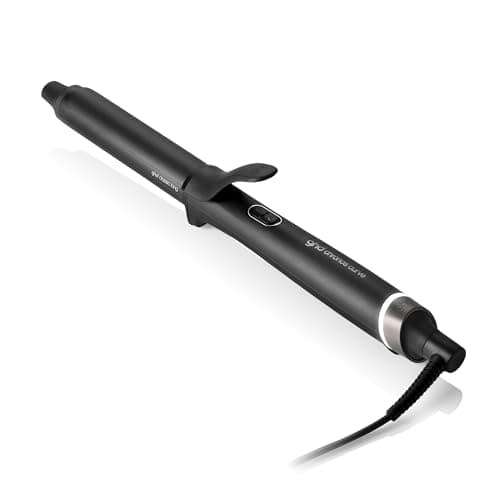
ghd Chronos Curve Classic curling iron (1 inch barrel)
A curling iron with no temperature dial at all — 365°F fixed, and a 20-minute sleep mode, which is unusual restraint in this category.
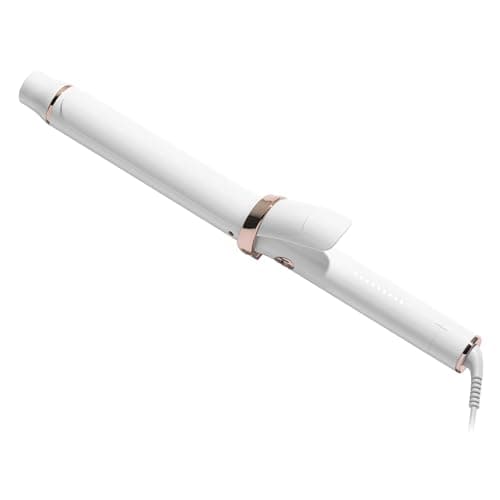
T3 SinglePass Curl X extra-long barrel curling iron
A 6.5-inch barrel and a separate published weight for every barrel size — unusual disclosure in a category where most makers publish a diameter and stop.
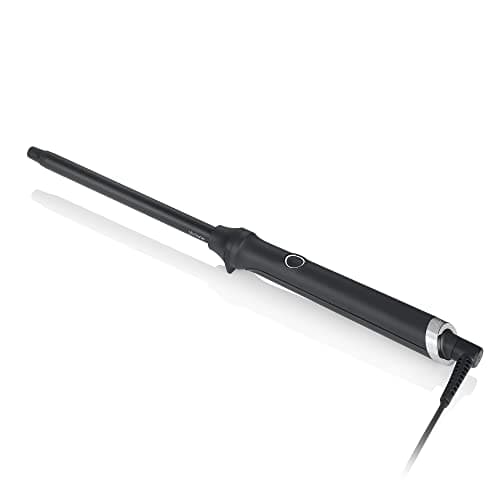
ghd Curve Thin curling wand (0.5 inch barrel)
A 0.5 inch barrel is the smallest in this registry and the one that holds a curl on short hair, with a 30-second heat-up and universal voltage.
Questions people actually ask
Why do my curls fall out so fast?
Almost always because the curl was released and handled while still warm. Hair sets as it cools rather than while it is hot, so a warm curl cools hanging under its own weight and sets straight.
Should I use a higher temperature to make curls last?
No. Heat makes hair reshapeable; cooling is what sets the shape. Turning the temperature up buys nothing on holding power and costs you cuticle.
Why do my curls drop in humidity?
Because above roughly 60 to 70 percent relative humidity, hair passes a glass transition and its mechanical behavior measurably changes. The curl is being asked to hold in a softer material than the one you styled.
Does hairspray make curls last longer?
A light hold at the root can help. Heavy product through the lengths adds weight, and weight is one of the forces pulling the curl out — especially on long hair.