Guides
How to Blow-Dry Hair Straight Without an Iron
Straight hair from a dryer is a technique, not a temperature. Get the direction and the tension right and the flat iron becomes optional.
Updated September 2026 · Sawyer V.
Smoothness comes from airflow traveling along the hair shaft under tension, not from temperature. Rough-dry to 80 percent, then work in one-inch sections with a concentrator pointing root to tip and a brush holding the section taut. Finish each section cold.
We earn a commission if you buy through the links on this page, at no extra cost to you. It never changes which tool we pick or which one we tell you to skip. How this site is funded.
Why direction beats heat
The outer layer of a hair is a set of overlapping cuticle scales, arranged like tiles pointing from root to tip. When those scales lie flat, light reflects evenly and the hair reads as smooth and shiny. When they lift, light scatters and the hair reads as dull and frizzy.
Air arriving across the shaft lifts the scales. Air arriving along it, from root toward tip, presses them down. That is the entire mechanism behind a good blowout, and it is why the same dryer produces a sleek result in one person’s hands and a cloud of frizz in another’s.
Which means the useful adjustment is almost never the heat dial. It is the angle of the nozzle and the tension on the section — both free, and both learnable in one session.
The method
1. Get to 80 percent dry with no technique at all
Squeeze with a towel, then rough-dry on the bare nozzle at the highest comfortable speed until the hair stops feeling wet and starts moving freely. Do not try to shape anything during this phase — soaking hair will not hold a shape and you are only holding heat on it while you try.
This step is also where most of the time saving lives. The full case, including why a concentrator makes the whole-head dry slower, is on the drying time page.
2. Fit the concentrator
Now, and not before. The concentrator narrows the airflow into a slot so you can aim it, which is exactly what the styling phase needs and exactly what the drying phase does not.
Only two dryers in our registry publish a concentrator in the box — the Dyson Supersonic and the Shark SpeedStyle Pro. Everything else leaves the attachment list blank, which on this page matters — the attachments page has the full table.
3. Section properly, and start underneath
Clip everything up except a horizontal section at the nape about an inch deep. Work up the head in layers, finishing with the top. The top layer is what people see, so it should be the last thing you touch and therefore the freshest.
Sections thicker than an inch have hair in the middle that never meets the brush and never gets the airflow. That hair stays damp, dries in a random direction as you move on, and is the reason a blowout looks smooth on the outside and frizzy underneath.
4. Tension first, then heat
Place the round brush under the section at the root and pull it taut. Tension is doing at least half the straightening — it is a mechanical force flattening the cuticle, and it works at any temperature.
Then bring the nozzle in above the brush, pointing down the length of the section, and follow the brush as you draw it from root to tip in one slow, continuous pass. The nozzle stays a hand’s width away and moves with the brush.
5. One pass, slowly
A single slow pass beats three fast ones, on time and on damage. Total heat exposure is temperature multiplied by contact time, and repeat passes are the term you can actually reduce — the same reasoning that governs flat ironing on the iron technique page.
6. Finish cold, on the brush
Switch to cool for the last two seconds of each section with the hair still wrapped on the brush. Hair sets as it cools, so this is the moment the shape actually locks in. Skip it and the section relaxes back within the hour.
A published cool shot is worth looking for on a spec sheet. Dyson publishes four heat settings including a cold shot; ghd publishes a cool shot on the Helios. Several tools publish no settings count at all.
The four mistakes
- Aiming the nozzle at the hair rather than along it. This is the whole difference between smooth and frizzy, and it is the most common error by a distance.
- Starting too early. Shaping soaking hair does not work and costs you five extra minutes of heat.
- Sections that are too thick. The middle stays damp, then dries however it likes.
- Turning the heat up instead of slowing down. Speed of the pass, not temperature, is what you should be adjusting.
Do you still need the flat iron?
For most hair, a properly executed blow-dry gets you 80 to 90 percent of the way to iron-straight, and the last 10 percent is a choice rather than a necessity. That matters because a blow-dry is a lower-intensity heat event than a clamped plate: the air is cooler than a plate and it is not held against the fiber.
If you want genuinely pin-straight, the iron is the tool. If you want smooth and shiny, the dryer is enough, and the routine above is cheaper in both time and heat than blow-drying badly and then ironing to fix it.
The honest comparison of the two approaches is on the brush versus flat iron page, and the case for the middle option — a one-step brush that supplies the tension for you — is on the technique page.
Making it last
A blowout drops for two reasons: it did not cool in position, and it picked up moisture from the air. The first is fixable with the cool finish above. The second is why humidity is the enemy of every technique on this page.
What genuinely helps: finishing completely dry rather than nearly dry, because residual moisture is what lets the hair revert; and not touching it for the first ten minutes, because the cooling is still happening. More on holding a style on the blowout tools page.
Price per use, at 5 uses a week over 5 years
| What you pay | Cost per use | Cost per year |
|---|---|---|
| $30 | $0.02 | $6.00 |
| $60 | $0.05 | $12.00 |
| $100 | $0.08 | $20.00 |
| $150 | $0.12 | $30.00 |
| $200 | $0.15 | $40.00 |
| $300 | $0.23 | $60.00 |
| $400 | $0.31 | $80.00 |
| $500 | $0.38 | $100.00 |
5 uses a week for 5 years is 1300 uses. Both figures are stated assumptions, not measurements — halve the life and every cost per use doubles. We publish the ladder rather than a worked example for one specific product because a price we typed into a sentence would be wrong within a week.
If your hair is curly or coily
The same physics applies and the technique needs adapting, because stretching a curl pattern out takes more tension and more patience than smoothing an already-straight one. Doing it badly — high heat, insufficient tension, repeat passes — is how curl pattern gets permanently lost.
The dedicated method is on the curly blow-dry page, and the risk of losing pattern for good is covered on the signs of heat damage page.
The tools on this page
Prices come from the live price layer. Where none is available the button says so rather than showing a number we cannot stand behind.
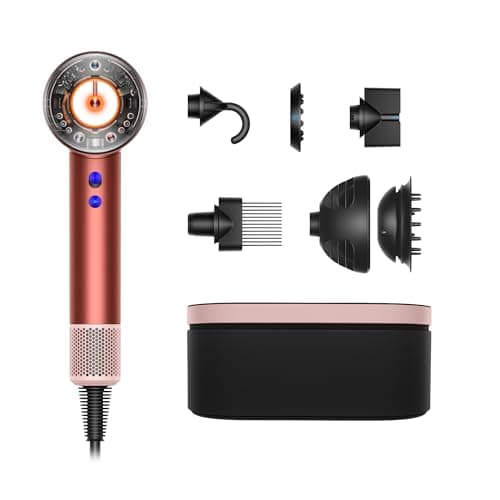
Dyson Supersonic hair dryer
1,600 W is less power than a drugstore dryer draws, and Dyson publishes that openly — the pitch is airflow and heat control, not wattage.
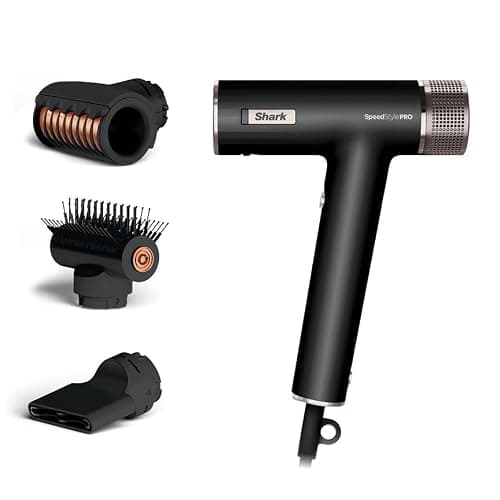
Shark SpeedStyle Pro hair dryer
The highest published wattage of the premium dryers here and the most attachments in the box, at a fraction of Dyson's asking price.
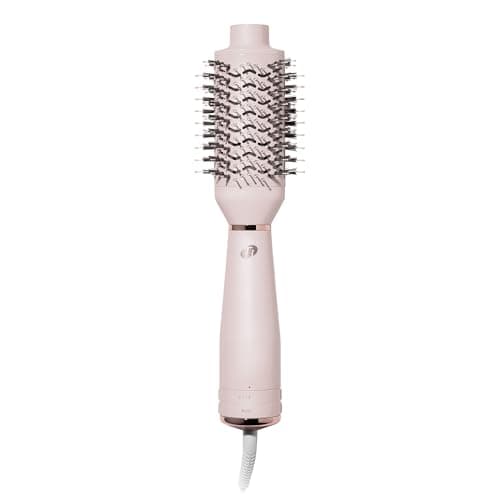
T3 AireBrush One-Step smoothing and volumizing dryer brush
Six heat-and-speed combinations against the Revlon's four heat steps, and a published weight — but half the warranty.
Questions people actually ask
How do I blow-dry my hair straight without frizz?
Point the nozzle along the hair from root to tip rather than across it, and keep the section taut on a brush. Air arriving across the shaft lifts the cuticle, which is what frizz is.
Do I need a round brush or a paddle brush?
A round brush for tension and for turning the ends; a paddle for length and speed on already-straight hair. If you only own one, a medium round brush covers more situations.
Should I blow-dry with hot or cool air?
Hot to dry and shape, cool for the last two seconds of each section. Hair sets as it cools rather than while it is hot, so skipping the cool finish is why blowouts drop by lunchtime.
Is blow-drying straight less damaging than a flat iron?
Generally yes. The air is cooler than a plate and it is not clamped against the fiber. A well-executed blow-dry also gets most of the way to straight, which makes the iron optional rather than necessary.