Shop by Hair Type
The Best Hair Tools for Thick Hair in 2026
Thick hair is a volume problem, not a heat problem, and almost every popular fix for it makes that mistake.
Updated September 2026 · Sawyer V.
Thick hair needs sustained airflow, a long cord and small sections — not a higher temperature. Heat past a moderate setting adds risk faster than it adds speed, and the actual bottleneck is almost always that the middle of the section is still wet.
We earn a commission if you buy through the links on this page, at no extra cost to you. It never changes which tool we pick or which one we tell you to skip. How this site is funded.
Why heat is the wrong lever
Drying is evaporation, and evaporation is driven mostly by how much dry air moves across wet hair. Hotter air holds more moisture, so heat helps — but past a moderate temperature you are adding risk faster than speed, because the water is what was protecting the hair.
On thick hair the real bottleneck is almost always that the outside of the section is dry while the inside is soaking. Temperature does not fix that. Smaller sections and a concentrator do, because they get moving air to the middle.
Density is not texture
“Thick hair” is used for two different things and they have opposite implications.
- Coarse texture — thick individual strands. These hold more mass, dry more slowly per strand, and tolerate more heat.
- High density — a lot of strands. This makes sessions long regardless of how thick each strand is, and says nothing about heat tolerance.
If your hair is dense but each strand is fine — a very common combination — take the heat guidance from the fine hair page and the power guidance from here. Heat tolerance follows strand thickness, and it is the constraint you cannot argue with.
The three specifications that matter
- Airflow, imperfectly measured by wattage. No manufacturer publishes airflow in comparable units, so wattage is the only shared number — and it measures electricity drawn, not air moved. Treat it as a rough proxy.
- Cord length. None of the ten competitor pages we examined publishes it. The range across our registry is 8 ft to 10.9 ft, and on a twenty-minute session that is the difference between comfortable and tethered.
- Weight. Published figures run from 1.23 lb to 1.8 lb. Held up for twenty minutes, that gap is the whole experience.
Every category, for dense hair
- Best hair dryers for thick hair
- Flat irons for dense and coily hair
- Air stylers compared
- Curling irons for long, heavy hair
Price per use, at 5 uses a week over 5 years
| What you pay | Cost per use | Cost per year |
|---|---|---|
| $30 | $0.02 | $6.00 |
| $60 | $0.05 | $12.00 |
| $100 | $0.08 | $20.00 |
| $150 | $0.12 | $30.00 |
| $200 | $0.15 | $40.00 |
| $300 | $0.23 | $60.00 |
| $400 | $0.31 | $80.00 |
| $500 | $0.38 | $100.00 |
5 uses a week for 5 years is 1300 uses. Both figures are stated assumptions, not measurements — halve the life and every cost per use doubles. We publish the ladder rather than a worked example for one specific product because a price we typed into a sentence would be wrong within a week.
Quick picks
Tap any row to jump to the full write-up. Prices come from the live price layer; where none is available the button says so rather than showing a number we cannot stand behind.
| # | Product | Best for | Price |
|---|---|---|---|
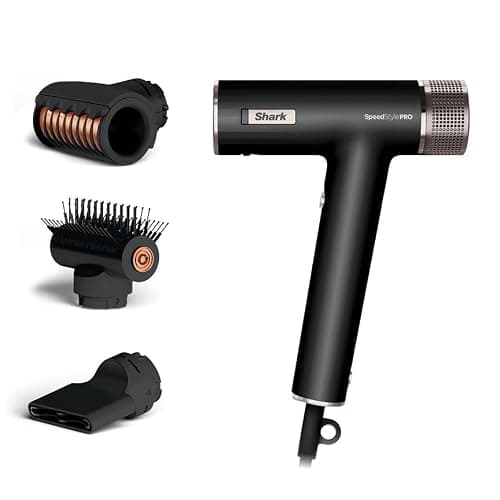
| 1 | Shark SpeedStyle Pro hair dryer 1,750 W published — the highest of any premium dryer here — plus a turbo concentrator in the box. | Sessions that take too long | |
| 2 | 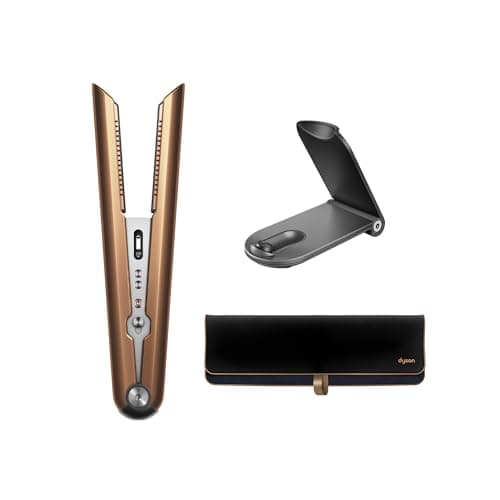 Dyson Corrale straightener Flexing plates that gather the hair, and cordless so you can work all the way round a long session. | Dense sections that escape rigid plates | |
| 3 | 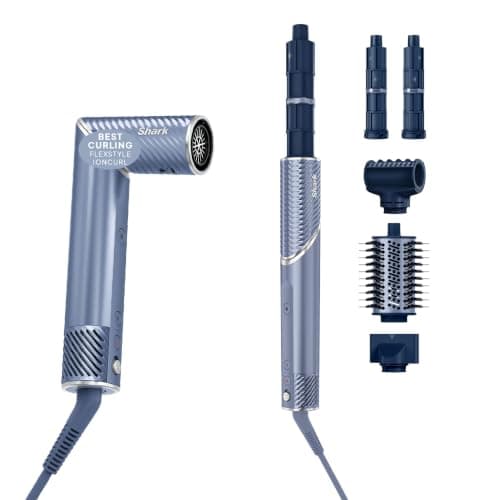 Shark FlexStyle IonCurl hair styler 1,700 W, the highest air styler rating in our registry, at a published 1.5 lb. | Dense hair the standard models dry too slowly | |
| 4 | 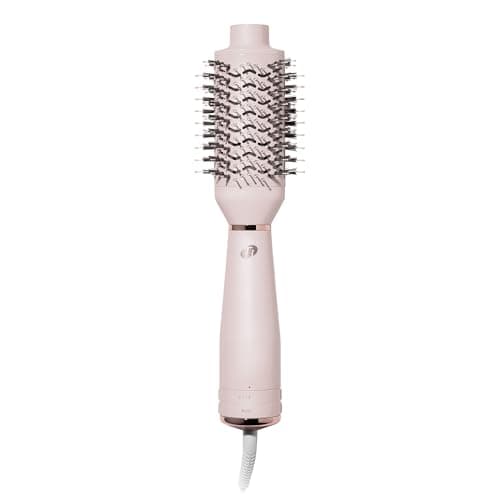 T3 AireBrush One-Step smoothing and volumizing dryer brush Three heat and two speed settings, ceramic bristles, and a published 16 oz. | Smoothing dense hair section by section | |
| — | 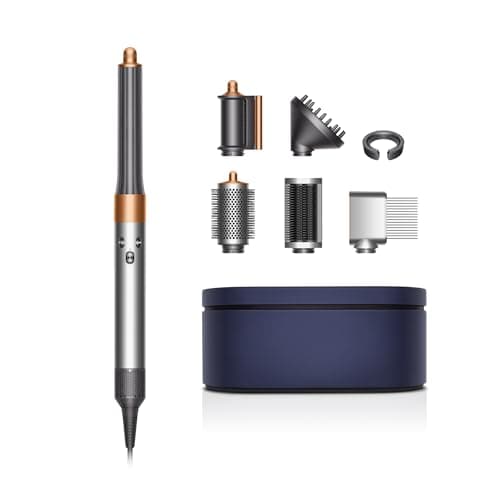 Dyson Airwrap multi-styler (Complete Long) 1,300 W — the lowest mains rating on the site — on a tool that works by drying hair into shape. We’d skip this | Not the dense-hair problem |
1. The dryer
Shark SpeedStyle Pro hair dryer
Best for: Sessions that take too long
1,750 W published — the highest of any premium dryer here — plus a turbo concentrator in the box.
On dense hair the honest constraint is how long you stand there. This publishes the highest wattage of any premium dryer we list, names a turbo concentrator among six attachments, and weighs a published 1.65 lb.
Full comparison including the cheaper option with even more raw power at best hair dryers for thick hair.
What’s wrong with it
No published heat- or speed-setting count, so you cannot check how low it goes. 120 V only.
Published specifications — Shark SpeedStyle Pro hair dryer
| Wattage | 1,750 W (peak 1,750 W) |
|---|---|
| Heat settings | Not published |
| Speed settings | Not published |
| Weight | 1.65 lb |
| Cord length | 96.1 in (8.0 ft) |
| Noise (dB) | Not published |
| Attachments | Turbo concentrator, QuickSmooth brush, DefrizzFast diffuser, wide-tooth comb, touch-up brush, FrizzFighter finishing tool |
| Plate / barrel | High-velocity airflow; no heated styling surface |
| Dual voltage | No — 120 V |
| Warranty | 2-year limited warranty |
Every figure above is taken from SharkNinja — Shark SpeedStyle Pro (HD731) product page. “Not published” means the figure does not appear on that page — it is not an estimate withheld, it is a number the manufacturer does not state. How we compile these.
What it costs to run for a year
$20.86 a year
1,750 W (peak 1,750 W) × 65 hours a year = 113.8 kWh, at 18.34 cents per kilowatt-hour. The hours assume 15 minutes a session, 5 days a week — that is an assumption, not a measurement, so swap in your own if it is wrong.
2. The flat iron
Dyson Corrale straightener
Best for: Dense sections that escape rigid plates
Flexing plates that gather the hair, and cordless so you can work all the way round a long session.
Thick sections do not lie flat between rigid plates — the edges escape and you pass again. Dyson’s flexing manganese-copper alloy plates are built to gather the section instead, and their own guidance says to loosen your grip because of it.
Cordless matters on thick hair, where a full straightening session means working right round the head. More at irons for dense and coily hair.
What’s wrong with it
Battery-powered, so a full session on very thick hair may outlast a charge. Three heat settings, and it is the most expensive iron here.
Published specifications — Dyson Corrale straightener
| Wattage | 200 W |
|---|---|
| Heat settings | 3 heat settings; Dyson's stated starting point is 365°F |
| Speed settings | Not applicable |
| Weight | 1.23 lb |
| Cord length | 10.9 ft charging cable |
| Noise (dB) | Not applicable |
| Attachments | Charging dock and travel pouch |
| Plate / barrel | Flexing manganese-copper alloy plates |
| Dual voltage | Battery — 10.8 V–16.8 V cell |
| Warranty | 2-year limited warranty |
Every figure above is taken from Dyson — Corrale straightener product page. “Not published” means the figure does not appear on that page — it is not an estimate withheld, it is a number the manufacturer does not state. How we compile these.
What it costs to run for a year
$2.38 a year
200 W × 65 hours a year = 13.0 kWh, at 18.34 cents per kilowatt-hour. The hours assume 15 minutes a session, 5 days a week — that is an assumption, not a measurement, so swap in your own if it is wrong.
3. The air styler
Shark FlexStyle IonCurl hair styler
Best for: Dense hair the standard models dry too slowly
1,700 W, the highest air styler rating in our registry, at a published 1.5 lb.
Air stylers work by drying hair into shape, so on dense hair the published wattage is the specification that decides session length. The IonCurl publishes 400 W more than the Dyson Airwrap at the same published weight and cord length as the standard FlexStyle.
The caveat is real: Shark publishes no attachment list for this model, so confirm what is in the box at the point of purchase. The standard model publishes more — the FlexStyle write-up.
What’s wrong with it
No published attachment list and no published heat-setting count, so two important rows are unavailable from the manufacturer.
Published specifications — Shark FlexStyle IonCurl hair styler
| Wattage | 1,700 W (peak 1,700 W) |
|---|---|
| Heat settings | Not published |
| Speed settings | Not published |
| Weight | 1.5 lb |
| Cord length | 8 ft |
| Noise (dB) | Not published |
| Attachments | Not published |
| Plate / barrel | Coanda airflow barrels; plastic and metal body |
| Dual voltage | No — 120 V |
| Warranty | 2-year limited warranty |
Every figure above is taken from SharkNinja — Shark FlexStyle IonCurl (HD840PK1) product page. “Not published” means the figure does not appear on that page — it is not an estimate withheld, it is a number the manufacturer does not state. How we compile these.
What it costs to run for a year
$20.27 a year
1,700 W (peak 1,700 W) × 65 hours a year = 110.5 kWh, at 18.34 cents per kilowatt-hour. The hours assume 15 minutes a session, 5 days a week — that is an assumption, not a measurement, so swap in your own if it is wrong.
4. The blow-dry brush
T3 AireBrush One-Step smoothing and volumizing dryer brush
Best for: Smoothing dense hair section by section
Three heat and two speed settings, ceramic bristles, and a published 16 oz.
On thick hair a brush is a section-by-section tool rather than a whole-head one — you will not get through dense hair with a brush alone in a reasonable time. Used after a rough-dry, it smooths and finishes well.
Separate heat and speed control lets you keep the heat down while still moving enough air. More at the hot air brushes hub.
What’s wrong with it
No published wattage, a two-year warranty against Revlon's four, and it is slow on genuinely dense hair.
Published specifications — T3 AireBrush One-Step smoothing and volumizing dryer brush
| Wattage | Not published |
|---|---|
| Heat settings | 3 heat settings |
| Speed settings | 2 speed settings |
| Weight | 16 oz (cord not included) |
| Cord length | 8 ft, 360-degree swivel cord |
| Noise (dB) | Not published |
| Attachments | None supplied |
| Plate / barrel | CeraGloss ceramic surface, heat-resistant bristles |
| Dual voltage | No — 125 V |
| Warranty | 2-year warranty |
Every figure above is taken from T3 Micro — AireBrush One-Step product page. “Not published” means the figure does not appear on that page — it is not an estimate withheld, it is a number the manufacturer does not state. How we compile these.
What it costs to run for a year
T3 does not publish a wattage for this tool, so there is nothing honest to compute. The formula is watts ÷ 1,000 × hours a year × your rate per kWh; if you find a rating plate on the handle, 65 hours a year and 18.34 cents per kilowatt-hour will get you the rest of the way.
The one we'd skip
Dyson Airwrap multi-styler (Complete Long)
Best for: Not the dense-hair problem
1,300 W — the lowest mains rating on the site — on a tool that works by drying hair into shape.
We would not buy the Airwrap for thick hair, and the reasoning comes entirely from Dyson’s own published figure.
1,300 W is the lowest mains rating in our whole registry, and the tool’s mechanism is drying damp hair into shape. On dense hair that means the longest session with the least power, at the highest price on the site.
It is an excellent tool for the hair type it was designed around — we recommend it on the fine-hair page. This is a mismatch, not a defect.
What’s wrong with it
Lowest published wattage on the site on the hair type that most needs power, at the highest price.
Published specifications — Dyson Airwrap multi-styler (Complete Long)
| Wattage | 1,300 W |
|---|---|
| Heat settings | 3 heat settings |
| Speed settings | 3 speed settings |
| Weight | 1.4 lb |
| Cord length | 8.5 ft |
| Noise (dB) | Not published |
| Attachments | Curling barrels, smoothing brushes, round volumizing brush, drying nozzle |
| Plate / barrel | Coanda airflow barrels; no clamped heat plate |
| Dual voltage | No — 120 V |
| Warranty | 2-year limited warranty |
Every figure above is taken from Dyson — Airwrap Complete Long product page. “Not published” means the figure does not appear on that page — it is not an estimate withheld, it is a number the manufacturer does not state. How we compile these.
What it costs to run for a year
$15.50 a year
1,300 W × 65 hours a year = 84.5 kWh, at 18.34 cents per kilowatt-hour. The hours assume 15 minutes a session, 5 days a week — that is an assumption, not a measurement, so swap in your own if it is wrong.
Questions people actually ask
What wattage do I need for thick hair?
Published ratings top out around 1,875 W and higher generally means faster on dense hair. But wattage measures electricity drawn rather than air moved, and nobody publishes airflow in comparable units, so treat it as a rough proxy.
Why does my thick hair take so long to dry?
Almost always because the sections are too big, so the outside dries while the middle stays soaked. Smaller sections and a concentrator nozzle shorten the session more than a more powerful dryer does.
My hair is dense but each strand is fine. What do I do?
Take the heat guidance for fine hair, because heat tolerance follows strand thickness, and the power guidance for dense hair, so you are not compensating for a weak tool with a higher setting.