Shop by Hair Type
The Best Hair Tools for Gray Hair in 2026
Often more wiry, usually more visible when it is damaged, and rarely discussed by anyone selling tools.
Updated September 2026 · Sawyer V.
Gray hair is frequently described as coarser and more resistant than pigmented hair, and damage shows more plainly on it. The tools that suit it publish both a low floor and enough headroom for a resistant strand — and no maker publishes gray-specific guidance at all.
We earn a commission if you buy through the links on this page, at no extra cost to you. It never changes which tool we pick or which one we tell you to skip. How this site is funded.
What can and cannot be said here
Start with the limits, because this is a segment where marketing runs far ahead of evidence. No manufacturer in this registry publishes a gray-specific setting, temperature or recommendation, and the hair science this site cites does not address pigment loss and heat as a combined question.
So this page will not tell you that a particular tool prevents yellowing or “restores” anything. What it can do is take the two properties gray hair is consistently reported to have — coarser texture and higher visibility of damage — and map them onto rows that manufacturers do publish.
Coarse and resistant cuts both ways
A coarser, more wiry strand is harder to smooth, which pushes people toward higher heat. But the same hair is usually older hair, with more cumulative thermal history behind it, and repeated thermal cycling degrades the fiber measurably Evans and Park, Journal of Cosmetic Science.
That is why the right tool here is not simply a hot one. It is one with a wide published range: a floor low enough for the finer strands around the hairline, and headroom for the wiry ones that will not cooperate. A tool that publishes only a ceiling gives you half the information.
If your gray is also colored
Many people with gray hair are also coloring it, and that changes the rules: chemically processed hair starts with measurably less margin Dyer et al., Journal of Cosmetic Science, with substantial protein loss reported after treatment França-Stefoni et al., Journal of Cosmetic Dermatology.
In that case the floor matters more than the headroom, and tools for color-treated hair is the more relevant page.
What to look for
- A published range, not a ceiling. You want to know both ends, because gray hair is rarely uniform across one head.
- Steps you can select. Nine published settings beats a variable dial with no labels when different sections need different answers.
- A cool finish. Hair sets as it cools, and a coarse strand that has been persuaded straight needs the cool stage to stay there.
- Gentle detangling. Combing force is a measurable mechanical load Bloch et al., International Journal of Dermatology, and coarse hair invites harder brushing.
The temperature starting points by hair type are at the temperature table.
Quick picks
Tap any row to jump to the full write-up. Prices come from the live price layer; where none is available the button says so rather than showing a number we cannot stand behind.
| # | Product | Best for | Price |
|---|---|---|---|
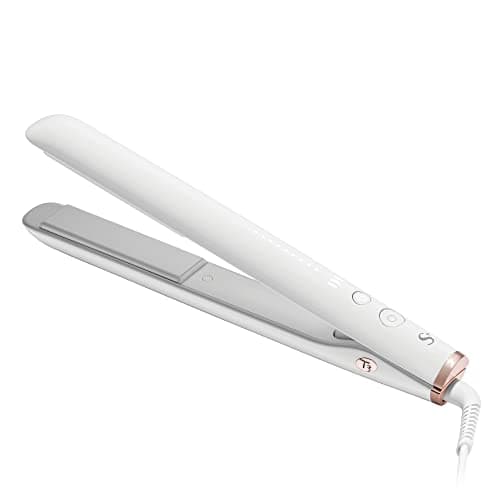
| 1 | T3 SinglePass StyleMax 1 inch flat iron Nine published heat settings at 11.1 oz, with 100-240 V world voltage. | One head with several textures on it | |
| 2 | 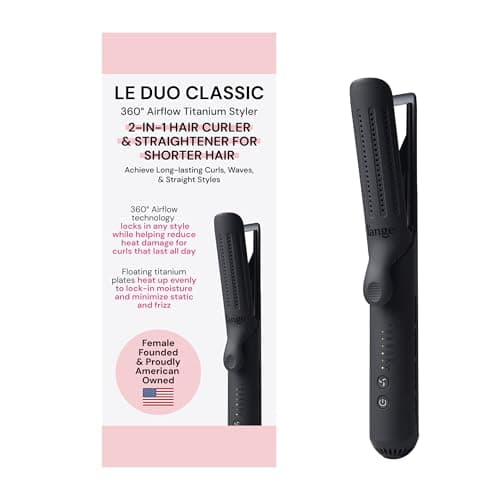 L'ange Le Duo 360° Airflow Styler (Standard) Five settings from a published 280°F, titanium plates with rounded edges, 0.8 lb and 100-240 V. | Fine or colored gray at the hairline | |
| 3 | 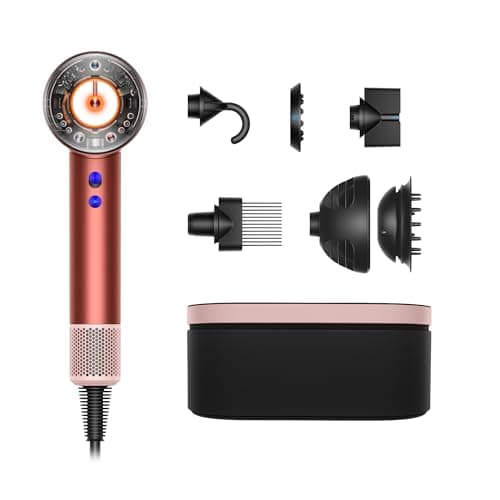 Dyson Supersonic hair dryer Four heat settings with a genuine cold shot, three speeds, and a wide-tooth comb attachment in the box. | Drying coarse hair smooth before any iron | |
| — | 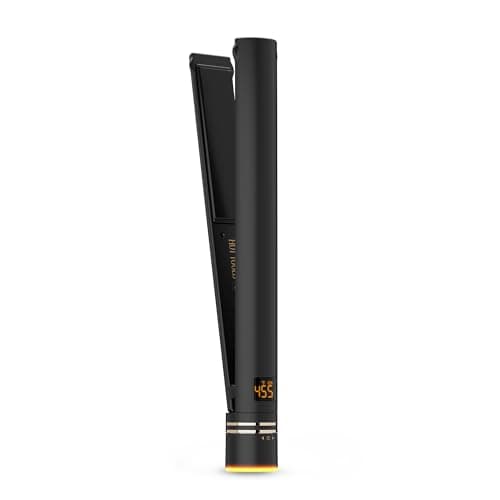 Hot Tools Black Gold Evolve Ionic Salon Flat Iron Variable heat to 455°F with no published starting point, on hair that needs both ends of a range. We’d skip this | Not hair that varies across one head |
1. Both ends of the range, published
T3 SinglePass StyleMax 1 inch flat iron
Best for: One head with several textures on it
Nine published heat settings at 11.1 oz, with 100-240 V world voltage.
Nine steps is the most granular control in this registry, and it is the right answer for hair that is wiry at the crown and finer at the temples. You can move between sections instead of compromising across them.
11.1 oz makes it the lightest iron here, which matters because coarse hair usually means a longer session.
T3 publishes no wattage on any product, and the cord length is stated only as a 360-degree swivel.
What’s wrong with it
No published wattage or cord length, and nine settings is nine chances to pick badly without a test section.
Published specifications — T3 SinglePass StyleMax 1 inch flat iron
| Wattage | Not published |
|---|---|
| Heat settings | 9 heat settings |
| Speed settings | Not applicable |
| Weight | 11.1 oz (cord not included) |
| Cord length | 360-degree swivel cord — length not published |
| Noise (dB) | Not applicable |
| Attachments | None supplied |
| Plate / barrel | CeraGloss ceramic plates, 1 in |
| Dual voltage | Yes — auto world voltage, 100–240 V |
| Warranty | 2-year warranty |
Every figure above is taken from T3 Micro — SinglePass StyleMax 1 inch flat iron product page. “Not published” means the figure does not appear on that page — it is not an estimate withheld, it is a number the manufacturer does not state. How we compile these.
What it costs to run for a year
T3 does not publish a wattage for this tool, so there is nothing honest to compute. The formula is watts ÷ 1,000 × hours a year × your rate per kWh; if you find a rating plate on the handle, 65 hours a year and 18.34 cents per kilowatt-hour will get you the rest of the way.
2. The lowest published floor
L'ange Le Duo 360° Airflow Styler (Standard)
Best for: Fine or colored gray at the hairline
Five settings from a published 280°F, titanium plates with rounded edges, 0.8 lb and 100-240 V.
280°F is the lowest published starting temperature of any plate tool here, which is the number that protects the finer, often colored hair around the face.
Titanium recovers temperature quickly, which suits the coarse sections — the rounded plate edges are the mitigation for working close to the root without leaving a crease.
430°F at the top gives genuine headroom for a resistant strand, so this is one of the few tools that covers both ends of a gray head.
What’s wrong with it
A one-year warranty, the shortest here, and no published speed settings or attachments.
Published specifications — L'ange Le Duo 360° Airflow Styler (Standard)
| Wattage | 36 W (Standard); 50 W (Grande) |
|---|---|
| Heat settings | 5 settings, 280–430°F |
| Speed settings | Not published |
| Weight | 0.8 lb / 358 g (Standard); 0.9 lb / 400 g (Grande) |
| Cord length | 8.2 ft (2.5 m) |
| Noise (dB) | Not published |
| Attachments | Not published |
| Plate / barrel | Titanium floating plates with rounded edges, 3.5 in × 1 in |
| Dual voltage | Yes — 100–240 V, 50/60 Hz |
| Warranty | 1-year warranty |
Every figure above is taken from L'ange — Le Duo 360° Airflow Styler product page. “Not published” means the figure does not appear on that page — it is not an estimate withheld, it is a number the manufacturer does not state. How we compile these.
What it costs to run for a year
$0.43 a year
36 W (Standard); 50 W (Grande) × 65 hours a year = 2.3 kWh, at 18.34 cents per kilowatt-hour. The hours assume 15 minutes a session, 5 days a week — that is an assumption, not a measurement, so swap in your own if it is wrong.
3. Cold shot and a comb attachment
Dyson Supersonic hair dryer
Best for: Drying coarse hair smooth before any iron
Four heat settings with a genuine cold shot, three speeds, and a wide-tooth comb attachment in the box.
Most of the work on coarse hair happens at the drying stage. Hair stretched smooth while it dries needs fewer iron passes, and passes are the damage variable.
The comb attachment applies tension while drying, which is exactly the job here, and the cold shot sets the result without another hot pass.
1.8 lb published is the heaviest dryer in this registry, and 120 V means it stays in North America.
What’s wrong with it
The heaviest dryer here, 120 V only, and the most expensive dryer on this site.
Published specifications — Dyson Supersonic hair dryer
| Wattage | 1,600 W |
|---|---|
| Heat settings | 4 heat settings, including a cold shot |
| Speed settings | 3 speed settings |
| Weight | 1.8 lb |
| Cord length | 8.6 ft |
| Noise (dB) | Not published |
| Attachments | 3 — styling concentrator, diffuser, wide-tooth comb |
| Plate / barrel | Air-multiplier body; no heated styling surface |
| Dual voltage | No — 120 V |
| Warranty | 2-year limited warranty |
Every figure above is taken from Dyson — Supersonic hair dryer product page. “Not published” means the figure does not appear on that page — it is not an estimate withheld, it is a number the manufacturer does not state. How we compile these.
What it costs to run for a year
$19.07 a year
1,600 W × 65 hours a year = 104.0 kWh, at 18.34 cents per kilowatt-hour. The hours assume 15 minutes a session, 5 days a week — that is an assumption, not a measurement, so swap in your own if it is wrong.
The one we'd skip
Hot Tools Black Gold Evolve Ionic Salon Flat Iron
Best for: Not hair that varies across one head
Variable heat to 455°F with no published starting point, on hair that needs both ends of a range.
We would not choose this one. Gray hair is the case where you most need to know both ends of the range, and this page publishes only the top of it.
The headroom is genuinely useful on wiry sections. The problem is everything else on the same head: without a stated floor there is no way to know whether the low setting is safe for the finer, possibly colored hair at the temples.
A lifetime limited warranty and a 9 ft cord are the best in this registry, and they do not answer the question this page is about.
What’s wrong with it
No published floor, wattage, weight or voltage - four blank rows on hair that needs precision at both ends.
Published specifications — Hot Tools Black Gold Evolve Ionic Salon Flat Iron
| Wattage | Not published |
|---|---|
| Heat settings | Variable, up to 455°F |
| Speed settings | Not applicable |
| Weight | Not published |
| Cord length | 9 ft professional swivel cord with a hanging ring |
| Noise (dB) | Not applicable |
| Attachments | Not published |
| Plate / barrel | Black Gold ceramic-titanium floating plates, 1 in and 1¼ in |
| Dual voltage | Not published |
| Warranty | Lifetime limited warranty |
Every figure above is taken from Hot Tools — Black Gold Evolve Ionic Salon Flat Iron product page. “Not published” means the figure does not appear on that page — it is not an estimate withheld, it is a number the manufacturer does not state. How we compile these.
What it costs to run for a year
Hot Tools does not publish a wattage for this tool, so there is nothing honest to compute. The formula is watts ÷ 1,000 × hours a year × your rate per kWh; if you find a rating plate on the handle, 65 hours a year and 18.34 cents per kilowatt-hour will get you the rest of the way.
Questions people actually ask
Is gray hair harder to style?
It is frequently described as coarser and more resistant, which makes it harder to smooth. No manufacturer in this registry publishes gray-specific guidance, so the practical answer is a tool with a published range rather than just a high ceiling.
Does heat turn gray hair yellow?
We will not claim it does or does not. No maker publishes anything on this, and the hair science this site cites does not address pigment loss and heat as a combined question. Keeping passes and temperatures down is sound advice regardless.
What temperature should I use on gray hair?
Start at the lowest setting that works on a test section and step up only for the sections that resist. Gray hair is rarely uniform across one head, which is the argument for a tool with many published steps.
I color my grays - does that change the answer?
Yes. Chemically processed hair starts with measurably less margin, so the floor of the range matters more than the headroom does.