Flat Irons & Straighteners
The Best Titanium Flat Irons in 2026
A harder, faster-recovering plate for hair that resists. Only two makers here put the word on the spec sheet.
Updated September 2026 · Sawyer V.
Two irons in this registry publish a titanium plate surface: the L’ange Le Duo, with titanium floating plates and a stated 280–430°F range, and the Hot Tools Black Gold Evolve, with ceramic-titanium plates and a 455°F ceiling. Titanium suits coarse, dense, resistant hair.
We earn a commission if you buy through the links on this page, at no extra cost to you. It never changes which tool we pick or which one we tell you to skip. How this site is funded.
Quick picks
Tap any row to jump to the full write-up. Prices come from the live price layer; where none is available the button says so rather than showing a number we cannot stand behind.
| # | Product | Best for | Price |
|---|---|---|---|
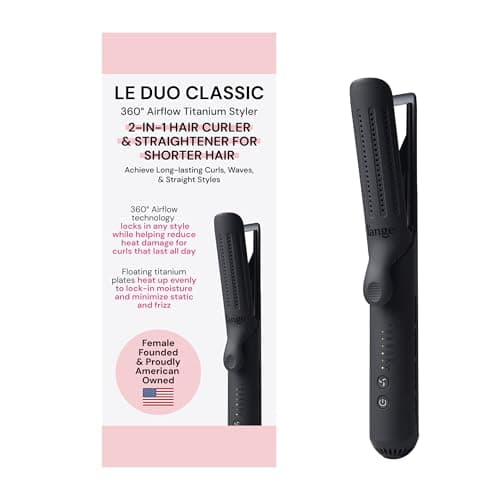
| 1 | L'ange Le Duo 360° Airflow Styler (Standard) Titanium floating plates with rounded edges, five settings from a published 280°F, 0.8 lb and 100-240 V. | Coarse hair that still wants a low starting temperature | |
| — | 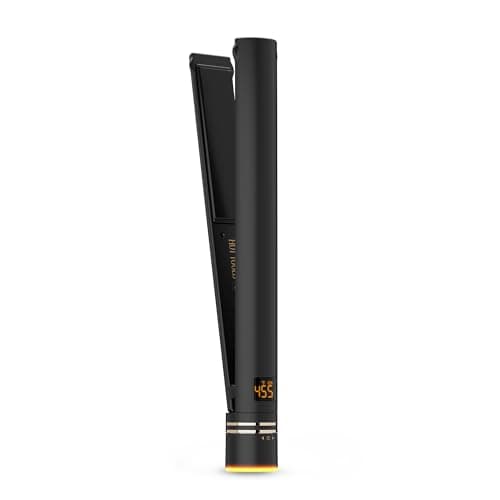 Hot Tools Black Gold Evolve Ionic Salon Flat Iron Ceramic-titanium floating plates in 1 in and 1¼ in, a 9 ft swivel cord and a lifetime limited warranty. We’d skip this | Dense, resistant hair in a professional setting | |
| 3 | 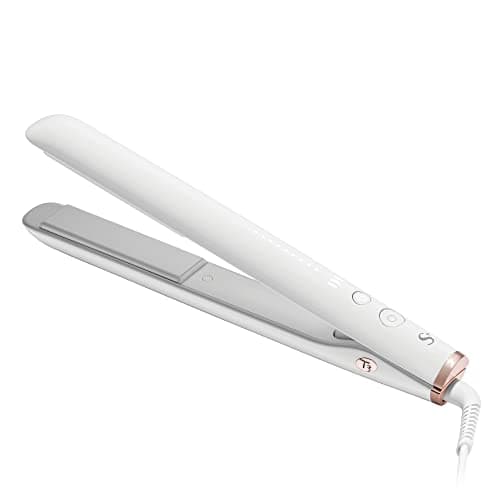 T3 SinglePass StyleMax 1 inch flat iron CeraGloss ceramic plates with nine published heat settings at 11.1 oz - more documented control than either titanium iron here. | Fine, colored or previously damaged hair |
1. The only fully documented titanium plate here
L'ange Le Duo 360° Airflow Styler (Standard)
Best for: Coarse hair that still wants a low starting temperature
Titanium floating plates with rounded edges, five settings from a published 280°F, 0.8 lb and 100-240 V.
This is the only titanium iron on the site whose maker fills in the rows that matter. Five settings, each published, running from 280°F — the lowest stated starting temperature of any plate tool in this registry — up to 430°F.
That range is what makes titanium usable on hair that is coarse in places and fragile in others. Titanium holds its set temperature hard, so the number you choose is closer to the number your hair sees. Choosing a low number therefore matters more here, not less.
Rounded plate edges are worth naming on a titanium iron: a harder, faster surface is less forgiving of a paused pass, and rounded edges reduce the crease that a stalled iron leaves. 100–240 V means it travels.
What’s wrong with it
A one-year warranty, the shortest in this registry, and no published speed settings or attachments.
Published specifications — L'ange Le Duo 360° Airflow Styler (Standard)
| Wattage | 36 W (Standard); 50 W (Grande) |
|---|---|
| Heat settings | 5 settings, 280–430°F |
| Speed settings | Not published |
| Weight | 0.8 lb / 358 g (Standard); 0.9 lb / 400 g (Grande) |
| Cord length | 8.2 ft (2.5 m) |
| Noise (dB) | Not published |
| Attachments | Not published |
| Plate / barrel | Titanium floating plates with rounded edges, 3.5 in × 1 in |
| Dual voltage | Yes — 100–240 V, 50/60 Hz |
| Warranty | 1-year warranty |
Every figure above is taken from L'ange — Le Duo 360° Airflow Styler product page. “Not published” means the figure does not appear on that page — it is not an estimate withheld, it is a number the manufacturer does not state. How we compile these.
What it costs to run for a year
$0.43 a year
36 W (Standard); 50 W (Grande) × 65 hours a year = 2.3 kWh, at 18.34 cents per kilowatt-hour. The hours assume 15 minutes a session, 5 days a week — that is an assumption, not a measurement, so swap in your own if it is wrong.
The one we'd skip
Hot Tools Black Gold Evolve Ionic Salon Flat Iron
Best for: Dense, resistant hair in a professional setting
Ceramic-titanium floating plates in 1 in and 1¼ in, a 9 ft swivel cord and a lifetime limited warranty.
We would not pick this one, and the reason is the same blank row we flag everywhere Hot Tools appears: the page publishes a 455°F ceiling and never states where the range begins or how many steps it has.
On a titanium plate that omission matters more than it would on ceramic. Titanium transfers heat quickly and recovers temperature fast between sections, so an unknown floor on a fast surface is the least forgiving combination in the category.
What you do get is real: a 1¼ in plate option that covers dense hair in fewer passes, a 9 ft cord, and the longest warranty anywhere on this site. For a stylist who already knows the tool, that is a defensible buy. For a first titanium iron it is not.
What’s wrong with it
No published temperature floor, wattage, weight or voltage - four blank rows on a fast, unforgiving plate surface.
Published specifications — Hot Tools Black Gold Evolve Ionic Salon Flat Iron
| Wattage | Not published |
|---|---|
| Heat settings | Variable, up to 455°F |
| Speed settings | Not applicable |
| Weight | Not published |
| Cord length | 9 ft professional swivel cord with a hanging ring |
| Noise (dB) | Not applicable |
| Attachments | Not published |
| Plate / barrel | Black Gold ceramic-titanium floating plates, 1 in and 1¼ in |
| Dual voltage | Not published |
| Warranty | Lifetime limited warranty |
Every figure above is taken from Hot Tools — Black Gold Evolve Ionic Salon Flat Iron product page. “Not published” means the figure does not appear on that page — it is not an estimate withheld, it is a number the manufacturer does not state. How we compile these.
What it costs to run for a year
Hot Tools does not publish a wattage for this tool, so there is nothing honest to compute. The formula is watts ÷ 1,000 × hours a year × your rate per kWh; if you find a rating plate on the handle, 65 hours a year and 18.34 cents per kilowatt-hour will get you the rest of the way.
3. The ceramic answer if titanium is wrong for you
T3 SinglePass StyleMax 1 inch flat iron
Best for: Fine, colored or previously damaged hair
CeraGloss ceramic plates with nine published heat settings at 11.1 oz - more documented control than either titanium iron here.
Not a titanium iron, and here deliberately. Most people searching for titanium are really searching for “an iron that works on hair that resists,” and on fine, colored or damaged hair the honest answer is a well-documented ceramic plate with a low setting you can actually select.
Nine stated settings is the most granular control on this site, and 11.1 oz makes it the lightest iron here. 100–240 V auto world voltage as well.
If your hair genuinely does not straighten on ceramic in one or two passes, go back to the Le Duo. That is the correct order to try them in.
What’s wrong with it
T3 publishes no wattage on any product, and the cord length is stated only as a 360-degree swivel.
Published specifications — T3 SinglePass StyleMax 1 inch flat iron
| Wattage | Not published |
|---|---|
| Heat settings | 9 heat settings |
| Speed settings | Not applicable |
| Weight | 11.1 oz (cord not included) |
| Cord length | 360-degree swivel cord — length not published |
| Noise (dB) | Not applicable |
| Attachments | None supplied |
| Plate / barrel | CeraGloss ceramic plates, 1 in |
| Dual voltage | Yes — auto world voltage, 100–240 V |
| Warranty | 2-year warranty |
Every figure above is taken from T3 Micro — SinglePass StyleMax 1 inch flat iron product page. “Not published” means the figure does not appear on that page — it is not an estimate withheld, it is a number the manufacturer does not state. How we compile these.
What it costs to run for a year
T3 does not publish a wattage for this tool, so there is nothing honest to compute. The formula is watts ÷ 1,000 × hours a year × your rate per kWh; if you find a rating plate on the handle, 65 hours a year and 18.34 cents per kilowatt-hour will get you the rest of the way.
What titanium actually changes
Titanium is a metal plate or plate coating. Against ceramic, the useful differences are physical rather than chemical: it heats up faster, and it recovers its set temperature faster after each section pulls heat out of it.
For coarse, dense or resistant hair that is an advantage, because the last section of a thick head gets the same plate temperature as the first. For fine, bleached or heat-damaged hair it is a liability for exactly the same reason: the plate gives back everything it has, and a moment of hesitation is delivered at full temperature.
Plate surfaces across the irons in this registry, as published
| Iron | Surface, as the maker states it |
|---|---|
| L'ange Le Duo | Titanium floating plates with rounded edges |
| Hot Tools Black Gold Evolve | Black Gold ceramic-titanium floating plates |
| T3 SinglePass StyleMax | CeraGloss ceramic plates, 1 in |
| ghd Platinum+ | Precision-milled floating high-gloss plates, 1 in |
| CHI 1" Original | 1 in ceramic floating plates |
| Dyson Corrale | Flexing manganese-copper alloy plates |
Quoted from each manufacturer's own product page. Two of the six publish titanium.
Who titanium is for, and who it is not
- Buy titanium if your hair is coarse, dense, very curly or resistant, and a ceramic iron takes three or more passes per section to straighten.
- Do not buy titanium if your hair is fine, bleached, colored or recovering from heat damage. The faster surface removes the margin for error you most need. Start at flat irons for fine hair.
- It makes no difference to how long a style lasts. Hold is a function of temperature, dryness and cooling, not of what the plate is made from.
The part of the claim we will not score
Plate marketing runs well ahead of published measurement. Makers describe surfaces as titanium, ceramic-titanium, tourmaline-infused and a dozen proprietary names, and almost none publish a plate temperature uniformity figure, a heat-up time or a recovery time you could compare.
So we rank on the rows that are published — stated temperatures, plate width, weight, voltage, warranty — and treat the surface name as a material description rather than a performance claim. The same reasoning is worked through at ceramic vs tourmaline and ceramic vs titanium.
Titanium does not mean hotter
A frequent misreading: titanium irons are often sold beside a 450 or 455°F ceiling, and the two get conflated. The ceiling is a capability, not an instruction. Repeated thermal cycling degrades the fiber’s mechanical properties measurably Evans and Park, Journal of Cosmetic Science, and nothing about a titanium surface changes that.
Use the lowest setting that straightens a test section in one slow pass. The temperature table gives the starting points by hair type.
Questions people actually ask
Is a titanium flat iron better than ceramic?
Better for coarse, dense or resistant hair, because titanium heats faster and recovers its set temperature faster between sections. Worse for fine, colored or damaged hair, for the same reason - the plate gives back all of its heat with no margin for a slow pass.
Which flat irons here have titanium plates?
Two. The L'ange Le Duo publishes titanium floating plates with rounded edges and a 280 to 430 degree range, and the Hot Tools Black Gold Evolve publishes ceramic-titanium plates with a 455 degree ceiling and no stated floor.
Does a titanium iron damage hair more?
Not inherently - temperature and the number of passes dominate. In practice it can, because titanium delivers its heat faster, so the same careless pass costs more than it would on ceramic.
Do titanium plates need a higher temperature?
No. Titanium is usually sold alongside a high ceiling, but the ceiling is a capability rather than an instruction. Start at the lowest setting that straightens a test section in one slow pass.