Flat Irons & Straighteners
The Best Flat Irons for Thick Hair in 2026
On thick hair the enemy is the second pass. Everything worth paying for is whatever gets a section straight the first time.
Updated September 2026 · Sawyer V.
Thick hair needs an iron that finishes a section in one pass — which means good plate contact, fast heat recovery between sections, and enough plate width to cover ground. Total damage is passes multiplied by temperature, and on dense hair passes are the part you can actually cut.
We earn a commission if you buy through the links on this page, at no extra cost to you. It never changes which tool we pick or which one we tell you to skip. How this site is funded.
Quick picks
Tap any row to jump to the full write-up. Prices come from the live price layer; where none is available the button says so rather than showing a number we cannot stand behind.
| # | Product | Best for | Price |
|---|---|---|---|
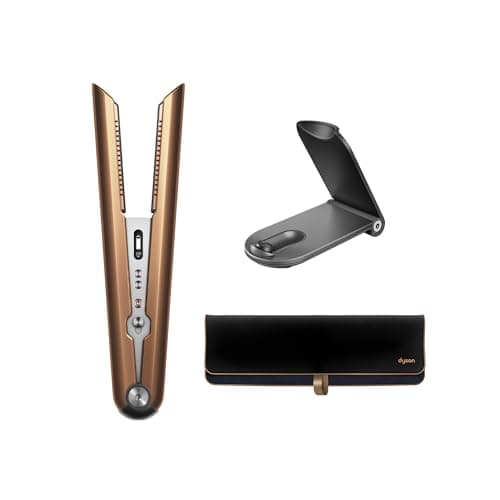
| 1 | Dyson Corrale straightener Flexing manganese-copper alloy plates that gather the section, and cordless for a long session. | Dense sections that escape rigid plates | |
| 2 | 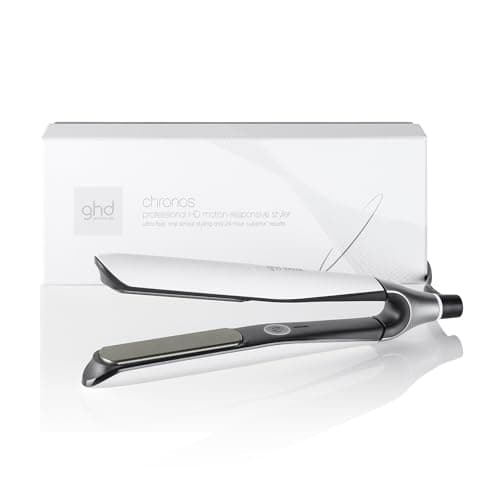 ghd Chronos flat iron (1 inch plate) Floating ceramic plates with an ultra-gloss coating, and ghd publishes a wide-plate version alongside the 1 inch. | Long, dense hair where coverage per pass decides the session | |
| 3 | 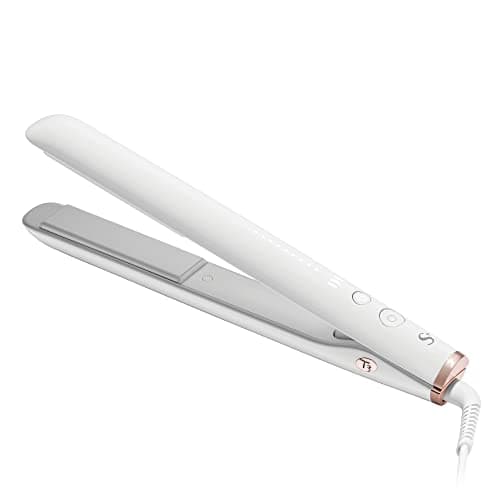 T3 SinglePass StyleMax 1 inch flat iron Nine heat settings, so a dense section and a fragile hairline do not have to share a temperature. | Adjusting between a coarse crown and a finer nape | |
| — | 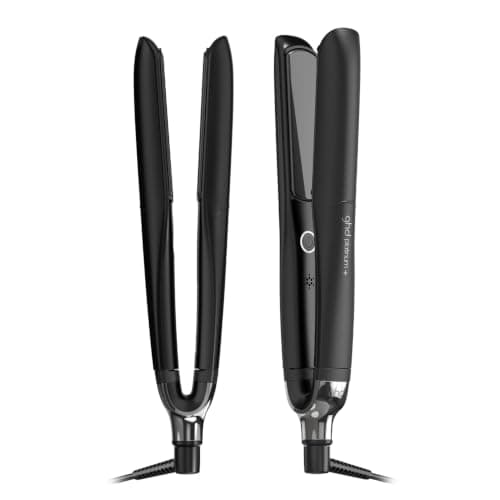 ghd Platinum+ flat iron (1 inch plate) 365°F fixed with no way up, and only a 1 inch plate. We’d skip this | Not resistant thick hair |
1. Best plate contact
Dyson Corrale straightener
Best for: Dense sections that escape rigid plates
Flexing manganese-copper alloy plates that gather the section, and cordless for a long session.
A thick section is not flat. It has volume in every direction, so rigid plates make contact with the middle and miss the edges — and you compensate with another pass, which is where the damage lives.
Dyson’s flexing plates are built specifically for this, and Dyson’s own guidance tells you to loosen your grip because the plates shape to gather the hair. It is the only iron in our registry whose headline feature maps directly onto the thick-hair problem.
Cordless matters more here than on any other hair type, because straightening dense hair means working right around your head for a long time. Published 1.23 lb, three heat settings, 10.9 ft charging cable.
What’s wrong with it
Battery-powered, so a full session on very thick hair can outlast a charge. Three heat settings is the fewest of any iron we list, and it is the most expensive.
Published specifications — Dyson Corrale straightener
| Wattage | 200 W |
|---|---|
| Heat settings | 3 heat settings; Dyson's stated starting point is 365°F |
| Speed settings | Not applicable |
| Weight | 1.23 lb |
| Cord length | 10.9 ft charging cable |
| Noise (dB) | Not applicable |
| Attachments | Charging dock and travel pouch |
| Plate / barrel | Flexing manganese-copper alloy plates |
| Dual voltage | Battery — 10.8 V–16.8 V cell |
| Warranty | 2-year limited warranty |
Every figure above is taken from Dyson — Corrale straightener product page. “Not published” means the figure does not appear on that page — it is not an estimate withheld, it is a number the manufacturer does not state. How we compile these.
What it costs to run for a year
$2.38 a year
200 W × 65 hours a year = 13.0 kWh, at 18.34 cents per kilowatt-hour. The hours assume 15 minutes a session, 5 days a week — that is an assumption, not a measurement, so swap in your own if it is wrong.
2. Wide plate option
ghd Chronos flat iron (1 inch plate)
Best for: Long, dense hair where coverage per pass decides the session
Floating ceramic plates with an ultra-gloss coating, and ghd publishes a wide-plate version alongside the 1 inch.
Plate width is the specification thick hair benefits from most and the one fewest makers offer a choice on. ghd publishes the Chronos in a wide-plate version as well as the 1 inch, which is the difference between covering a dense section in one pass and taking two.
The plates float and ghd publishes a re-engineered wishbone hinge to hold them aligned — alignment being what stops a wide plate gripping unevenly across a thick section.
365°F fixed, three-year warranty, which is the longest iron warranty in this registry.
What’s wrong with it
No temperature adjustment at all, which on very resistant hair leaves repeat passes as the only option. ghd publishes no wattage, weight or cord length for it.
Published specifications — ghd Chronos flat iron (1 inch plate)
| Wattage | Not published |
|---|---|
| Heat settings | One fixed temperature — 365°F |
| Speed settings | Not applicable |
| Weight | Not published |
| Cord length | Not published |
| Noise (dB) | Not applicable |
| Attachments | None supplied |
| Plate / barrel | Floating ceramic plates with ultra-gloss coating, 1 in; wide-plate version also sold |
| Dual voltage | Not published |
| Warranty | 3-year warranty |
Every figure above is taken from ghd — Chronos flat iron (1 inch plate) product page. “Not published” means the figure does not appear on that page — it is not an estimate withheld, it is a number the manufacturer does not state. How we compile these.
What it costs to run for a year
ghd does not publish a wattage for this tool, so there is nothing honest to compute. The formula is watts ÷ 1,000 × hours a year × your rate per kWh; if you find a rating plate on the handle, 65 hours a year and 18.34 cents per kilowatt-hour will get you the rest of the way.
3. Most heat headroom
T3 SinglePass StyleMax 1 inch flat iron
Best for: Adjusting between a coarse crown and a finer nape
Nine heat settings, so a dense section and a fragile hairline do not have to share a temperature.
Thick heads are rarely uniform. The crown is usually the most resistant part and the nape and hairline the most fragile, and an iron with high and low forces one compromise across both.
Nine settings is the most granular range in our registry, and on this page it is useful in the opposite direction from the fine-hair page: you want the headroom to go up on the crown without taking the whole head there.
11.1 oz published without the cord, CeraGloss ceramic plates, and 100–240 V auto world voltage.
What’s wrong with it
1 inch plates mean many sections on genuinely dense hair, so the session runs long. No published wattage or cord length.
Published specifications — T3 SinglePass StyleMax 1 inch flat iron
| Wattage | Not published |
|---|---|
| Heat settings | 9 heat settings |
| Speed settings | Not applicable |
| Weight | 11.1 oz (cord not included) |
| Cord length | 360-degree swivel cord — length not published |
| Noise (dB) | Not applicable |
| Attachments | None supplied |
| Plate / barrel | CeraGloss ceramic plates, 1 in |
| Dual voltage | Yes — auto world voltage, 100–240 V |
| Warranty | 2-year warranty |
Every figure above is taken from T3 Micro — SinglePass StyleMax 1 inch flat iron product page. “Not published” means the figure does not appear on that page — it is not an estimate withheld, it is a number the manufacturer does not state. How we compile these.
What it costs to run for a year
T3 does not publish a wattage for this tool, so there is nothing honest to compute. The formula is watts ÷ 1,000 × hours a year × your rate per kWh; if you find a rating plate on the handle, 65 hours a year and 18.34 cents per kilowatt-hour will get you the rest of the way.
The one we'd skip
ghd Platinum+ flat iron (1 inch plate)
Best for: Not resistant thick hair
365°F fixed with no way up, and only a 1 inch plate.
We recommend this iron on other pages and it is the wrong shape for this job, for the same reason it is right on fine hair: there is no dial.
When a dense, resistant section does not straighten on the first pass, a fixed-temperature iron leaves you exactly one option — another pass. On the hair type most likely to need one, that is the worst possible constraint.
It is also 1 inch only, where its own newer sibling the Chronos is offered with a wide plate. If you want the ghd fixed-temperature philosophy on thick hair, buy the Chronos wide plate instead. On fine hair the Platinum+ remains our top pick without reservation.
What’s wrong with it
No temperature headroom and no wide-plate option, which together push you toward repeat passes on exactly the hair type that can least afford them.
Published specifications — ghd Platinum+ flat iron (1 inch plate)
| Wattage | Not published |
|---|---|
| Heat settings | One fixed temperature — 365°F |
| Speed settings | Not applicable |
| Weight | Not published |
| Cord length | 9 ft power cable |
| Noise (dB) | Not applicable |
| Attachments | None supplied |
| Plate / barrel | Precision-milled floating high-gloss plates, 1 in |
| Dual voltage | Yes — universal voltage |
| Warranty | 3-year warranty |
Every figure above is taken from ghd — Platinum+ flat iron (1 inch plate) product page. “Not published” means the figure does not appear on that page — it is not an estimate withheld, it is a number the manufacturer does not state. How we compile these.
What it costs to run for a year
ghd does not publish a wattage for this tool, so there is nothing honest to compute. The formula is watts ÷ 1,000 × hours a year × your rate per kWh; if you find a rating plate on the handle, 65 hours a year and 18.34 cents per kilowatt-hour will get you the rest of the way.
Passes, not temperature
Total heat exposure is roughly the plate temperature multiplied by how long the plate is in contact, and on thick hair contact time is dominated by how many times you go over a section. Three passes at 380°F is more total exposure than one at 420°F, even though the second number looks more alarming.
That reframes the whole purchase. You are not shopping for the coolest iron; you are shopping for the iron that finishes a section first time. Plate contact, heat recovery and plate width are what buy that.
Plate width, honestly
Plate width against hair length and density
| Your hair | Sensible plate width | Why |
|---|---|---|
| Thick and long | Wide (over 1.5 in) | Covers more per pass; the session is the constraint |
| Thick and mid-length | 1 in to 1.5 in | Balances coverage against control near the root |
| Thick with a fringe or layers | 1 in | Wide plates cannot get near a short layer |
| Thick and coily | 1 in | Control beats coverage when sections are small anyway |
Of the irons in our registry only the ghd Chronos is published in more than one plate width. Everything else here is 1 inch.
The specification nobody publishes
Heat recovery time — how quickly the plates return to temperature after a pass has pulled heat out of them. On dense hair this is arguably the single most important number, because an iron whose plates drop and stay dropped feels like it is not working, and you compensate by passing again.
Not one manufacturer in our registry publishes it. We cannot report a figure that does not exist, so we do not — and we say so plainly, because a page confidently ranking irons on heat recovery is not working from published data either. What we can do is note that ghd publishes heat monitoring across the plates on both the Platinum+ and the Chronos, which is a related claim rather than a recovery figure.
The temperature question
Coarse hair tolerates more heat than fine hair, which is not the same as needing maximum. The manufacturers’ own anchors are worth repeating: ghd fixes both the Platinum+ and the Chronos at 365°F, and Dyson tells Corrale owners to begin at a medium heat of 365°F.
Published DSC work puts the melting point of the ordered keratin in dry hair at about 401°F, and a flat-iron study reported denaturation at 237°C — 459°F — alongside electron microscopy showing cuticle damage. There is genuinely no headroom above 400°F, whatever your hair type. The full evidence is at the flat iron temperature page.
Free things that shorten a thick-hair session
- Blow-dry with tension first. A stretched section needs one pass; an air-dried one needs three. This is the biggest single lever and it costs nothing.
- Section smaller than feels reasonable. The temptation on a dense head is to take big pieces to get it over with, and it guarantees repeat passes.
- Clip the rest out of the way properly. Most re-passing happens because a stray piece got caught in with a finished section.
- Work bottom to top. The nape is the most fragile part and the part you have the most patience for at the start.
Read next
If your hair is dense but each strand is fine — a common and confusing combination — take the heat guidance from the fine-hair irons page and the coverage guidance from here. Heat tolerance follows strand thickness, not volume. The full routing is at the thick hair page, and the plate-size decision on its own is at what plate size you need.
Price per use, at 5 uses a week over 5 years
| What you pay | Cost per use | Cost per year |
|---|---|---|
| $30 | $0.02 | $6.00 |
| $60 | $0.05 | $12.00 |
| $100 | $0.08 | $20.00 |
| $150 | $0.12 | $30.00 |
| $200 | $0.15 | $40.00 |
| $300 | $0.23 | $60.00 |
| $400 | $0.31 | $80.00 |
| $500 | $0.38 | $100.00 |
5 uses a week for 5 years is 1300 uses. Both figures are stated assumptions, not measurements — halve the life and every cost per use doubles. We publish the ladder rather than a worked example for one specific product because a price we typed into a sentence would be wrong within a week.
Questions people actually ask
What size flat iron plate is best for thick hair?
Wider than 1 inch if your hair is also long, because coverage per pass is what shortens the session. Of the irons in our registry only the ghd Chronos is published in more than one plate width.
What temperature should I straighten thick hair at?
Start at the 365 degrees Fahrenheit that ghd fixes its irons at and Dyson names as the Corrale's starting point, and go up only if one pass genuinely fails. Published research puts the melting point of dry hair keratin at about 401 degrees, so there is no headroom above 400.
Why does my thick hair not stay straight?
Usually because it was not completely dry, or because it was not stretched during the blow-dry so the iron was straightening from scratch. Both produce a result that reverts as soon as there is humidity in the air.