Flat Irons & Straighteners
The Best Flat Irons for Fine Hair in 2026
Fine hair heats through in a fraction of a second. The temperature you can work at matters far more than the temperature the iron can reach.
Updated September 2026 · Sawyer V.
Fine hair should be straightened at the lowest temperature that works in one pass — the mid-300s Fahrenheit is where the manufacturers themselves start. Both ghd and Dyson name 365°F as a normal setting. An iron that lets you sit at or below that, and heats evenly enough for one pass, is what fine hair needs.
We earn a commission if you buy through the links on this page, at no extra cost to you. It never changes which tool we pick or which one we tell you to skip. How this site is funded.
Quick picks
Tap any row to jump to the full write-up. Prices come from the live price layer; where none is available the button says so rather than showing a number we cannot stand behind.
| # | Product | Best for | Price |
|---|---|---|---|
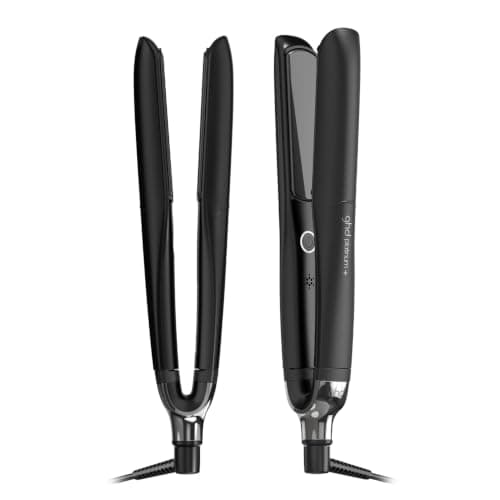
| 1 | ghd Platinum+ flat iron (1 inch plate) One temperature, 365°F, no dial. The decision that damages fine hair is the one this iron removes. | Anyone who turns the dial up when the first pass fails | |
| 2 | 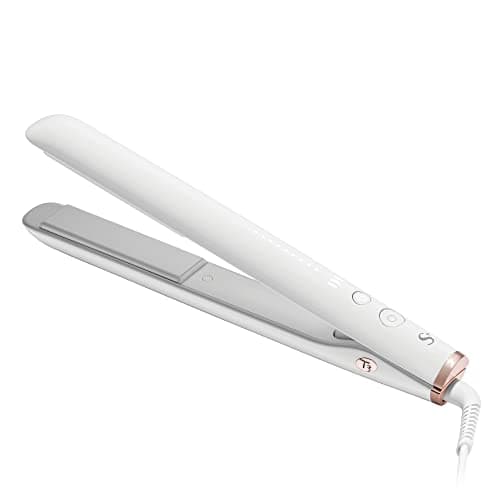 T3 SinglePass StyleMax 1 inch flat iron Nine heat settings and 11.1 oz published — the lightest iron here and the only one with a genuinely low low. | Fine hair that needs to sit below 365°F | |
| — | 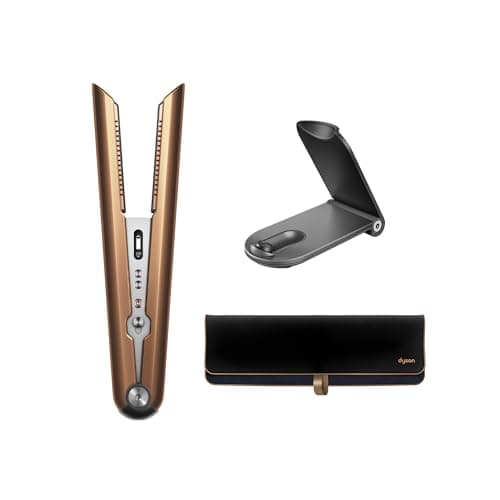 Dyson Corrale straightener The most expensive iron here, and its flexing-plate argument is aimed at hair fine hair does not have. We’d skip this | Not the fine-hair problem |
1. Best fixed temperature
ghd Platinum+ flat iron (1 inch plate)
Best for: Anyone who turns the dial up when the first pass fails
One temperature, 365°F, no dial. The decision that damages fine hair is the one this iron removes.
ghd publishes a single fixed styling temperature of 365°F with no adjustment at all. For fine hair that is not a limitation, it is the feature: the most common way fine hair gets damaged is somebody turning the dial up because the first pass did not take, and this iron makes that impossible.
The published spec sheet supports the approach. Precision-milled floating high-gloss plates at 1 inch, infinity sensors that ghd states monitor heat 250 times a second across the plates, a 20-second heat-up, universal voltage, and a sleep mode that powers down after 30 minutes of inactivity.
Three-year warranty, the longest of any iron on this site. And universal voltage means it travels on nothing but a plug adapter — see the dual voltage list.
What’s wrong with it
No adjustment at all, which is genuinely limiting on very coarse or resistant hair. ghd publishes no wattage and no weight for it.
Published specifications — ghd Platinum+ flat iron (1 inch plate)
| Wattage | Not published |
|---|---|
| Heat settings | One fixed temperature — 365°F |
| Speed settings | Not applicable |
| Weight | Not published |
| Cord length | 9 ft power cable |
| Noise (dB) | Not applicable |
| Attachments | None supplied |
| Plate / barrel | Precision-milled floating high-gloss plates, 1 in |
| Dual voltage | Yes — universal voltage |
| Warranty | 3-year warranty |
Every figure above is taken from ghd — Platinum+ flat iron (1 inch plate) product page. “Not published” means the figure does not appear on that page — it is not an estimate withheld, it is a number the manufacturer does not state. How we compile these.
What it costs to run for a year
ghd does not publish a wattage for this tool, so there is nothing honest to compute. The formula is watts ÷ 1,000 × hours a year × your rate per kWh; if you find a rating plate on the handle, 65 hours a year and 18.34 cents per kilowatt-hour will get you the rest of the way.
2. Most adjustable
T3 SinglePass StyleMax 1 inch flat iron
Best for: Fine hair that needs to sit below 365°F
Nine heat settings and 11.1 oz published — the lightest iron here and the only one with a genuinely low low.
Nine heat settings is the most granular range on the site. If your hair is fine and fragile — colored, chemically treated, already showing damage — 365°F may still be more than you want, and this is the iron that lets you go under it deliberately rather than by accident.
T3 publishes 11.1 oz without the cord, which makes it the lightest iron in our registry. Fine hair usually means small sections and a long session, so weight is not a trivia row here.
CeraGloss ceramic plates at 1 inch, and auto world voltage at 100–240 V, so it travels as easily as the ghd does. Two-year warranty.
What’s wrong with it
T3 publishes no wattage and no cord length — just that the cord swivels 360 degrees. Nine settings also means nine chances to pick the wrong one.
Published specifications — T3 SinglePass StyleMax 1 inch flat iron
| Wattage | Not published |
|---|---|
| Heat settings | 9 heat settings |
| Speed settings | Not applicable |
| Weight | 11.1 oz (cord not included) |
| Cord length | 360-degree swivel cord — length not published |
| Noise (dB) | Not applicable |
| Attachments | None supplied |
| Plate / barrel | CeraGloss ceramic plates, 1 in |
| Dual voltage | Yes — auto world voltage, 100–240 V |
| Warranty | 2-year warranty |
Every figure above is taken from T3 Micro — SinglePass StyleMax 1 inch flat iron product page. “Not published” means the figure does not appear on that page — it is not an estimate withheld, it is a number the manufacturer does not state. How we compile these.
What it costs to run for a year
T3 does not publish a wattage for this tool, so there is nothing honest to compute. The formula is watts ÷ 1,000 × hours a year × your rate per kWh; if you find a rating plate on the handle, 65 hours a year and 18.34 cents per kilowatt-hour will get you the rest of the way.
The one we'd skip
Dyson Corrale straightener
Best for: Not the fine-hair problem
The most expensive iron here, and its flexing-plate argument is aimed at hair fine hair does not have.
The Corrale is a genuinely interesting piece of engineering and we would not buy it for fine hair specifically.
Its distinguishing feature is plates that flex to gather hair, and Dyson’s own styling guidance says to loosen your grip because the flexing plates shape to gather your hair. That is a solution to a problem thick, dense hair has: sections escaping the plates. Fine hair does not have that problem, so you are paying a premium for engineering aimed elsewhere.
It is also cordless, which means a battery, which means the heat is being delivered from a 200 W battery system rather than the mains. Dyson publishes 3 heat settings against T3’s nine, and a 2-year warranty against ghd’s three. For fine hair specifically, both cheaper irons on this page are better matched.
What’s wrong with it
Fewest heat settings on the page, shortest warranty, highest price, and its headline feature solves a problem fine hair does not have.
Published specifications — Dyson Corrale straightener
| Wattage | 200 W |
|---|---|
| Heat settings | 3 heat settings; Dyson's stated starting point is 365°F |
| Speed settings | Not applicable |
| Weight | 1.23 lb |
| Cord length | 10.9 ft charging cable |
| Noise (dB) | Not applicable |
| Attachments | Charging dock and travel pouch |
| Plate / barrel | Flexing manganese-copper alloy plates |
| Dual voltage | Battery — 10.8 V–16.8 V cell |
| Warranty | 2-year limited warranty |
Every figure above is taken from Dyson — Corrale straightener product page. “Not published” means the figure does not appear on that page — it is not an estimate withheld, it is a number the manufacturer does not state. How we compile these.
What it costs to run for a year
$2.38 a year
200 W × 65 hours a year = 13.0 kWh, at 18.34 cents per kilowatt-hour. The hours assume 15 minutes a session, 5 days a week — that is an assumption, not a measurement, so swap in your own if it is wrong.
The manufacturers have already given you the number
This is the most useful thing on the page and almost nobody says it. ghd sells the Platinum+ with one fixed temperature — 365°F — and no way to change it. Dyson tells Corrale owners to begin at a medium heat, 365°F, and adjust from there.
Two companies, no reason to under-sell their own products, both landing on the same number for typical hair. Meanwhile plenty of irons dial past 450°F. If your fine hair looks worse than it used to, the gap between those two numbers is the most likely explanation, and it costs nothing to close.
Published temperature behavior on the irons here
| Iron | Heat settings | Published temperature | Plate |
|---|---|---|---|
| ghd Platinum+ | One, fixed | 365°F | 1 in floating high-gloss |
| T3 SinglePass StyleMax | 9 | Not published | 1 in CeraGloss ceramic |
| Dyson Corrale | 3 | 365°F stated as the starting point | Flexing manganese-copper alloy |
Figures from each manufacturer's own product page. T3 publishes a settings count but not the temperatures those settings correspond to.
Why fine hair is different
Fine describes strand thickness. A fine strand has less mass, so it reaches the plate temperature faster and holds less water to buffer against it. The same two seconds that a coarse strand shrugs off is a longer effective exposure on a fine one.
The consequence is that fine hair needs a lower temperature and fewer passes, and those two goals fight each other unless the iron heats evenly. That is why plate quality matters more here than raw temperature: an iron with cold spots forces a second pass, and the second pass is the damage.
Getting one pass to work
- Hair must be completely dry. Water in the cuticle turns to steam against a hot plate. This is the fastest way to damage fine hair and it is entirely avoidable.
- Sections thin enough to see through. If the plate cannot reach the middle, you will pass again, and passing again is what you are trying to avoid.
- Slow and steady beats hot and quick. One controlled pass at 365°F is less total exposure than three fast passes at 450°F.
- Heat protectant, applied to dry hair, before the iron. What it does and does not do is in our guide to it.
What the extra money buys here
Price per use, at 5 uses a week over 5 years
| What you pay | Cost per use | Cost per year |
|---|---|---|
| $30 | $0.02 | $6.00 |
| $60 | $0.05 | $12.00 |
| $100 | $0.08 | $20.00 |
| $150 | $0.12 | $30.00 |
| $200 | $0.15 | $40.00 |
| $300 | $0.23 | $60.00 |
| $400 | $0.31 | $80.00 |
| $500 | $0.38 | $100.00 |
5 uses a week for 5 years is 1300 uses. Both figures are stated assumptions, not measurements — halve the life and every cost per use doubles. We publish the ladder rather than a worked example for one specific product because a price we typed into a sentence would be wrong within a week.
Irons draw far less power than dryers, so running cost barely registers — and two of the three here publish no wattage at all, so we cannot compute it. The whole decision is the purchase price divided by uses, which is why the ladder above is the honest way to present it. More at the value pages.
Read next
If your hair is fine but there is a lot of it, read the fine hair page for how texture and density pull in different directions. If it is already damaged, start at the flat irons for damaged hair instead — the priorities change.
Questions people actually ask
What temperature should I use on fine hair?
Start below 365 degrees Fahrenheit, which is where both ghd and Dyson set or recommend starting for typical hair. Fine hair reaches plate temperature faster because each strand has less mass, so it should sit below the general-purpose number rather than at it.
Are titanium flat irons bad for fine hair?
Manufacturers position titanium for coarse hair because it transfers heat faster, and ceramic for fine hair because it heats more gradually. That is their framing rather than a test we have run, but it is consistent across the category.
Why does my fine hair go limp after straightening?
Usually too much heat rather than too little. Over-heated fine hair loses body along with texture. Dropping the temperature and reducing the number of passes usually brings movement back before any product does.