Flat Irons & Straighteners
The Best Flat Irons for Damaged Hair in 2026
The honest version of this page starts by saying the best tool for damaged hair is often no tool at all.
Updated September 2026 · Sawyer V.
If your hair is already heat damaged, the highest-value change is using heat less often, not buying a better iron. When you do use one, choose a tool that makes a low temperature easy to stay at — a fixed mid-300s setting or a fine-grained range you can sit at the bottom of.
We earn a commission if you buy through the links on this page, at no extra cost to you. It never changes which tool we pick or which one we tell you to skip. How this site is funded.
Quick picks
Tap any row to jump to the full write-up. Prices come from the live price layer; where none is available the button says so rather than showing a number we cannot stand behind.
| # | Product | Best for | Price |
|---|---|---|---|
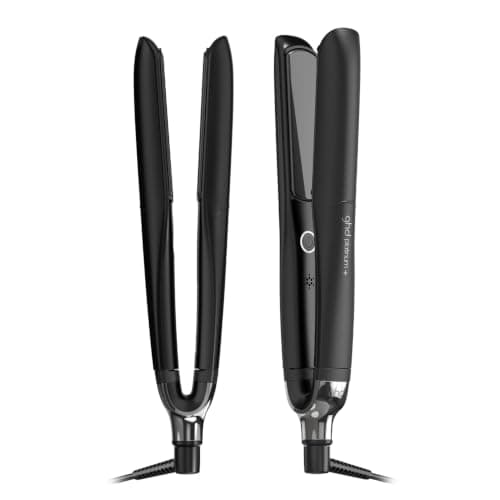
| 1 | ghd Platinum+ flat iron (1 inch plate) One fixed temperature at 365°F, so the decision that caused the damage is no longer available. | Anyone whose hair got damaged by turning the dial up | |
| 2 | 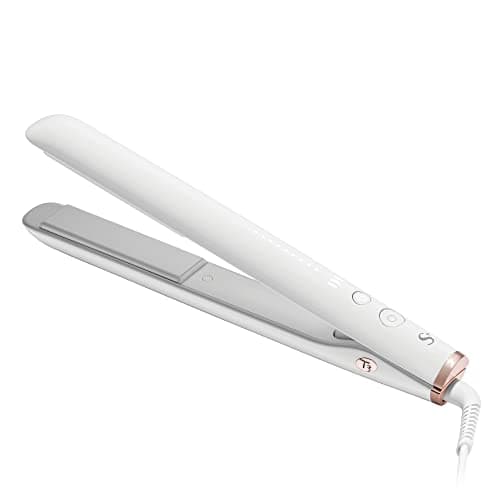 T3 SinglePass StyleMax 1 inch flat iron Nine heat settings, so the bottom of the range is genuinely low and genuinely reachable. | Hair that needs to sit under 365°F | |
| — | 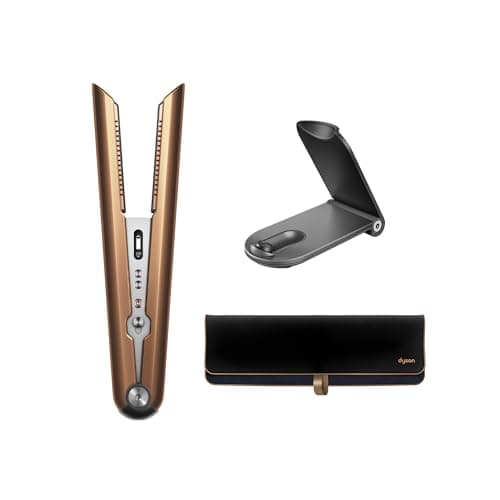 Dyson Corrale straightener Three heat settings and flagship pricing for engineering aimed at a different problem. We’d skip this | Not damaged hair, at this price |
1. Best guardrail
ghd Platinum+ flat iron (1 inch plate)
Best for: Anyone whose hair got damaged by turning the dial up
One fixed temperature at 365°F, so the decision that caused the damage is no longer available.
Most heat damage is not caused by a single bad session. It is caused by a habit — reaching for a higher setting when a pass does not take, and never going back down. An iron with no dial removes that habit at the hardware level.
ghd fixes the Platinum+ at 365°F and publishes infinity sensors that monitor heat 250 times a second across the plates. The floating plates and 20-second heat-up support the same goal: finishing a section without needing more heat.
Three-year warranty, the longest iron warranty on this site, and universal voltage.
What’s wrong with it
You cannot go lower than 365°F either, and hair that is very damaged might want to. No published wattage or weight.
Published specifications — ghd Platinum+ flat iron (1 inch plate)
| Wattage | Not published |
|---|---|
| Heat settings | One fixed temperature — 365°F |
| Speed settings | Not applicable |
| Weight | Not published |
| Cord length | 9 ft power cable |
| Noise (dB) | Not applicable |
| Attachments | None supplied |
| Plate / barrel | Precision-milled floating high-gloss plates, 1 in |
| Dual voltage | Yes — universal voltage |
| Warranty | 3-year warranty |
Every figure above is taken from ghd — Platinum+ flat iron (1 inch plate) product page. “Not published” means the figure does not appear on that page — it is not an estimate withheld, it is a number the manufacturer does not state. How we compile these.
What it costs to run for a year
ghd does not publish a wattage for this tool, so there is nothing honest to compute. The formula is watts ÷ 1,000 × hours a year × your rate per kWh; if you find a rating plate on the handle, 65 hours a year and 18.34 cents per kilowatt-hour will get you the rest of the way.
2. Lowest usable setting
T3 SinglePass StyleMax 1 inch flat iron
Best for: Hair that needs to sit under 365°F
Nine heat settings, so the bottom of the range is genuinely low and genuinely reachable.
If your hair is damaged enough that the mid-300s is still too much, the ghd’s fixed temperature stops being a guardrail and starts being a floor you cannot get under. This is the iron for that case.
Nine settings across the range means the lowest is meaningfully lower than the lowest on a three-setting tool, where the same span is divided into thirds. T3 positions CeraGloss ceramic for even heat without hot spots, which is what makes a low setting actually work rather than just feel virtuous.
Lightest iron in the registry at 11.1 oz, and 100–240 V auto world voltage.
What’s wrong with it
Nine settings also means you can choose a high one, so it offers no protection against the habit that caused the damage in the first place.
Published specifications — T3 SinglePass StyleMax 1 inch flat iron
| Wattage | Not published |
|---|---|
| Heat settings | 9 heat settings |
| Speed settings | Not applicable |
| Weight | 11.1 oz (cord not included) |
| Cord length | 360-degree swivel cord — length not published |
| Noise (dB) | Not applicable |
| Attachments | None supplied |
| Plate / barrel | CeraGloss ceramic plates, 1 in |
| Dual voltage | Yes — auto world voltage, 100–240 V |
| Warranty | 2-year warranty |
Every figure above is taken from T3 Micro — SinglePass StyleMax 1 inch flat iron product page. “Not published” means the figure does not appear on that page — it is not an estimate withheld, it is a number the manufacturer does not state. How we compile these.
What it costs to run for a year
T3 does not publish a wattage for this tool, so there is nothing honest to compute. The formula is watts ÷ 1,000 × hours a year × your rate per kWh; if you find a rating plate on the handle, 65 hours a year and 18.34 cents per kilowatt-hour will get you the rest of the way.
The one we'd skip
Dyson Corrale straightener
Best for: Not damaged hair, at this price
Three heat settings and flagship pricing for engineering aimed at a different problem.
For damaged hair specifically, we would not spend this much. Three heat settings is the coarsest range of the three irons here, on the page where fine control of the low end matters most.
The Corrale’s flexing plates solve a real problem — sections escaping rigid plates on thick and coily hair — and it is a genuine advantage on coily hair. Damaged hair does not have that problem. It has a heat problem, and a three-setting range is not the answer to it.
There is also a plainer point. If your hair is damaged, the most cost-effective purchase in this category is not an iron at all.
What’s wrong with it
Fewest heat settings of the three on a page where low-end control is the entire criterion, at the highest price.
Published specifications — Dyson Corrale straightener
| Wattage | 200 W |
|---|---|
| Heat settings | 3 heat settings; Dyson's stated starting point is 365°F |
| Speed settings | Not applicable |
| Weight | 1.23 lb |
| Cord length | 10.9 ft charging cable |
| Noise (dB) | Not applicable |
| Attachments | Charging dock and travel pouch |
| Plate / barrel | Flexing manganese-copper alloy plates |
| Dual voltage | Battery — 10.8 V–16.8 V cell |
| Warranty | 2-year limited warranty |
Every figure above is taken from Dyson — Corrale straightener product page. “Not published” means the figure does not appear on that page — it is not an estimate withheld, it is a number the manufacturer does not state. How we compile these.
What it costs to run for a year
$2.38 a year
200 W × 65 hours a year = 13.0 kWh, at 18.34 cents per kilowatt-hour. The hours assume 15 minutes a session, 5 days a week — that is an assumption, not a measurement, so swap in your own if it is wrong.
The uncomfortable part first
If your hair is already heat damaged, buying a better flat iron is unlikely to be the most useful thing you can do with the money. Using heat less often will do more. So will cutting off the length that is already gone. Neither of those earns us anything, and both are true.
Heat damage is permanent structural change to keratin. It does not heal and it does not reverse — see what repair actually means. Products that improve the look and feel of damaged hair are doing something genuinely useful, and they are not restoring anything.
So the honest framing of this page is: if you are going to keep using an iron, here is how to do the least additional harm. That is a narrower promise than most pages on this topic make, and it is the one we can keep.
What actually reduces further damage
- Frequency, first and by a wide margin. Going from five heat sessions a week to two is a sixty percent cut in exposure, and it costs nothing.
- Temperature, second. Sit at the lowest setting that works in one pass. Both ghd and Dyson name 365°F for typical hair; damaged hair should start under it.
- Passes, third. One controlled pass beats three quick ones at the same setting, every time.
- Never on damp hair. On damaged hair the cuticle is already compromised and water escapes as steam far more readily.
- Heat protectant, every time. What it does and does not do.
How to tell whether it is damage or something else
Dryness, frizz and breakage are not all the same thing and they do not all come from heat. Hair that is dry but elastic is usually a moisture problem; hair that stretches and snaps is usually protein loss; hair that has stopped holding its curl pattern in patches is usually heat. The full checklist is at how to tell if hair is heat damaged, and it is worth going through before you spend anything.
If you buy nothing here
That is a legitimate outcome and this page is written to allow it. Give your hair a month with meaningfully less heat, get the damaged length cut, and see where you are. If you still want an iron after that, the picks above are chosen to make restraint easy rather than to make styling impressive.
Price per use, at 5 uses a week over 5 years
| What you pay | Cost per use | Cost per year |
|---|---|---|
| $30 | $0.02 | $6.00 |
| $60 | $0.05 | $12.00 |
| $100 | $0.08 | $20.00 |
| $150 | $0.12 | $30.00 |
| $200 | $0.15 | $40.00 |
| $300 | $0.23 | $60.00 |
| $400 | $0.31 | $80.00 |
| $500 | $0.38 | $100.00 |
5 uses a week for 5 years is 1300 uses. Both figures are stated assumptions, not measurements — halve the life and every cost per use doubles. We publish the ladder rather than a worked example for one specific product because a price we typed into a sentence would be wrong within a week.
Questions people actually ask
Can a good flat iron fix damaged hair?
No. No iron repairs damage — the best an iron can do is cause less of it. Heat damage is permanent structural change to keratin, and the damaged length has to grow out and be cut off.
What temperature should I use on damaged hair?
Below the mid-300s that manufacturers name for typical hair, at the lowest setting that still finishes a section in one pass. If nothing under that works, the honest answer is to use heat less often rather than turning it up.
Should I stop using heat entirely?
Cutting frequency is the single most effective change available, and going from five sessions a week to two is a sixty percent reduction in exposure. Total elimination is not necessary for most people, and it is not what the evidence demands.