Flat Irons & Straighteners
Ceramic vs Titanium Flat Irons: What the Difference Is
Two materials, two very different heating behaviors, and a lot of marketing language stacked on top of both.
Updated September 2026 · Sawyer V.
Ceramic is a coating that heats gradually and distributes heat evenly, which manufacturers position for fine, damaged or color-treated hair. Titanium is a metal plate that heats fast and transfers heat aggressively, positioned for coarse, thick or resistant hair. Neither is better in the abstract.
We earn a commission if you buy through the links on this page, at no extra cost to you. It never changes which tool we pick or which one we tell you to skip. How this site is funded.
The short version, in a table
Ceramic and titanium, as the manufacturers describe them
| Ceramic | Titanium | |
|---|---|---|
| What it is | A coating over a metal plate | The plate metal itself |
| Heat-up | More gradual | Faster |
| Heat transfer | Even, gentler | Aggressive, direct |
| Positioned for | Fine, damaged, color-treated hair | Coarse, thick, resistant hair |
| Typical risk | May need a second pass on resistant hair | Easy to overshoot on fine hair |
| Pick this if | Your hair is fragile or you overshoot | Your hair resists a single pass |
Every characterization here is how manufacturers describe their own products. We have not tested plate behavior and are not claiming to have.
Ceramic
Ceramic in this context is a coating applied over a metal plate rather than a solid material. Its claimed advantage is even heat distribution — fewer hot spots across the plate surface — and a more gradual heat-up that makes overshooting less likely.
Even heat matters more than it sounds. A plate with hot spots is a plate where part of your section gets more heat than the setting implies, and where a cooler region leaves the section unfinished so you pass again. Both are damage you did not choose.
T3 uses CeraGloss ceramic across their irons, brushes and barrels and positions it for even heat without hot spots. Revlon publishes ceramic coatings on their dryers and hot air brushes. It is by far the more common of the two materials at every price point.
Titanium
Titanium plates are the metal itself rather than a coating. The claimed advantages are faster heat-up, faster recovery between sections and more direct heat transfer into the hair — which is genuinely what coarse, dense or very resistant hair needs to be finished in one pass.
The corresponding risk is straightforward: the same aggressive transfer that gets through coarse hair in one pass will overshoot on fine hair in the same time. Titanium is a tool for a specific job rather than a general upgrade, and it is frequently marketed as the latter.
Where tourmaline fits
Tourmaline is a third word that appears alongside both and is not a plate material in the same sense. It is a mineral used in coatings, and manufacturers credit it with producing negative ions when heated — the same ionic claim made for dryers. Revlon publishes ceramic tourmaline ionic technology across several products.
Because it appears at every price point and alongside both materials, it is not a useful way to tell two irons apart. Our full treatment of the ionic claim is at are ionic hair dryers worth it.
What actually matters more than either
Given the choice between the ideal plate material at the wrong temperature, and the other material at the right one, take the right temperature every time. Plate material shapes how heat arrives; the setting decides how much of it there is, and the setting is the variable with the larger effect and the one you control.
Which is why the most useful page on this site for the question you are probably actually asking is the flat iron temperature table, not this one.
What we cannot tell you
We have not measured plate temperature uniformity, heat-up time or recovery rate on any iron. No manufacturer publishes those figures either, which is why this page reports positioning rather than performance. If you read a page that ranks plate materials on measured heat distribution, ask what instrument was used — the answer is usually nothing.
The tools on this page
Prices come from the live price layer. Where none is available the button says so rather than showing a number we cannot stand behind.
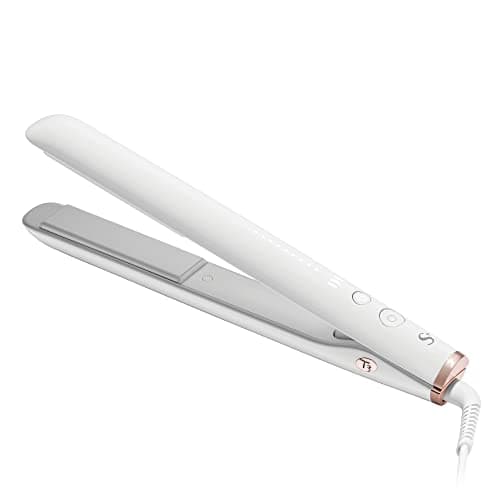
T3 SinglePass StyleMax 1 inch flat iron
Nine heat settings and genuine 100–240 V dual voltage: the most adjustable iron here and the only one you can pack for Europe without a thought.
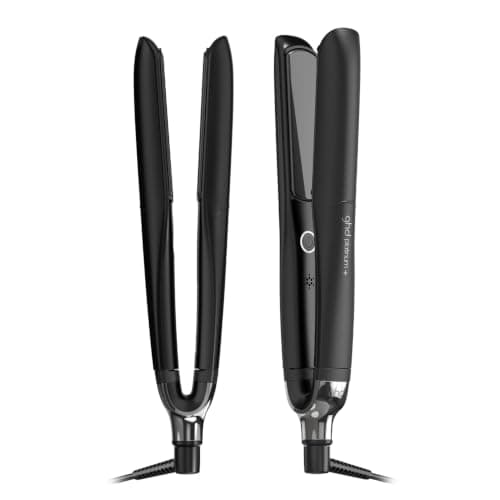
ghd Platinum+ flat iron (1 inch plate)
One temperature, 365°F, no dial to get wrong — the strongest heat-discipline argument in the category, and the longest iron warranty here at three years.
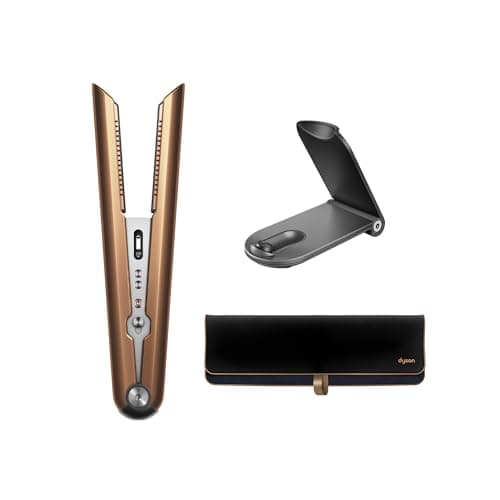
Dyson Corrale straightener
Cordless, and the only iron here whose plates flex. The 200 W figure is a battery rating and is not comparable to a corded iron's draw.
Questions people actually ask
Is titanium or ceramic better for a flat iron?
Neither in the abstract. Manufacturers position titanium for coarse, thick or resistant hair because it transfers heat faster, and ceramic for fine, damaged or color-treated hair because it heats more gradually and more evenly.
Is titanium bad for fine hair?
It is the wrong match. The fast, direct heat transfer that gets coarse hair straight in one pass will overshoot on fine hair in the same contact time. Ceramic is the material makers position for fine hair.
What does tourmaline do on a flat iron?
It is a mineral used in plate coatings, credited by manufacturers with producing negative ions when heated. Because it appears at every price point alongside both ceramic and titanium, it is not a useful way to choose between irons.
Do ceramic plates wear out?
Ceramic is a coating rather than the plate itself, so it can chip or wear with heavy use and abrasive cleaning. No manufacturer publishes a wear figure, so there is no honest number to give you.