Flat Irons & Straighteners
The Best Ceramic Flat Irons in 2026
Ceramic is the default assumption in this category and it is not the default reality. Two of the four irons we cover publish it.
Updated September 2026 · Sawyer V.
Two irons in our registry publish a ceramic plate: the ghd Chronos (floating ceramic with an ultra-gloss coating) and the T3 SinglePass StyleMax (CeraGloss ceramic). The Dyson Corrale publishes a manganese-copper alloy instead, and ghd describes the Platinum+ plates without using the word.
We earn a commission if you buy through the links on this page, at no extra cost to you. It never changes which tool we pick or which one we tell you to skip. How this site is funded.
Quick picks
Tap any row to jump to the full write-up. Prices come from the live price layer; where none is available the button says so rather than showing a number we cannot stand behind.
| # | Product | Best for | Price |
|---|---|---|---|
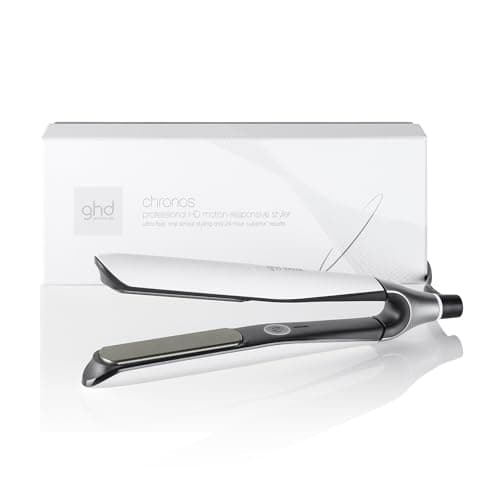
| 1 | ghd Chronos flat iron (1 inch plate) Floating ceramic plates with an ultra-gloss coating, a re-engineered wishbone hinge, and the only wide-plate option in ghd's range. | Long or dense hair that needs coverage per pass | |
| 2 | 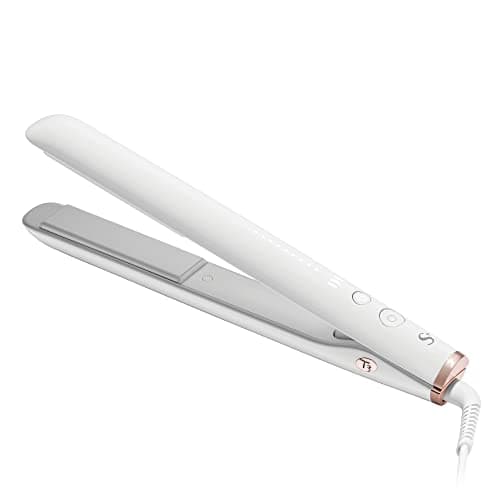 T3 SinglePass StyleMax 1 inch flat iron CeraGloss ceramic plates and nine heat settings — the only iron here that works meaningfully below 365°F. | Bleached, highlighted or otherwise processed hair | |
| 3 | 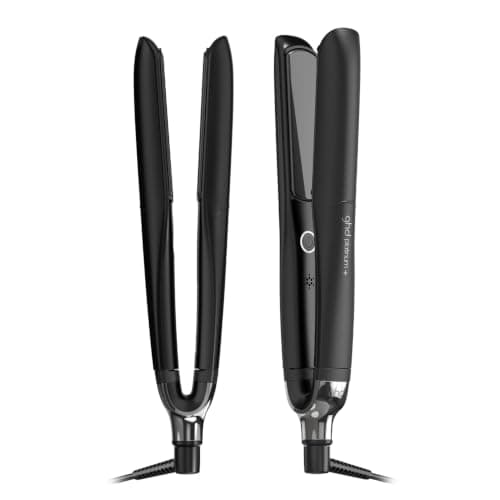 ghd Platinum+ flat iron (1 inch plate) Precision-milled floating high-gloss plates — ghd publishes the milling and the coating, and does not describe them as ceramic. | Fine hair, where the fixed temperature is the feature | |
| — | 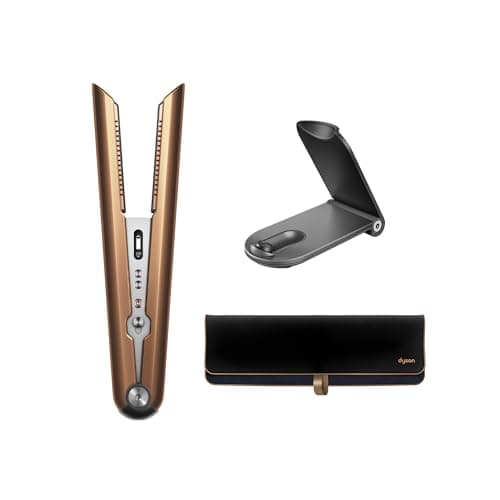 Dyson Corrale straightener Flexing manganese-copper alloy plates — deliberately not ceramic, and the reason the tool works. We’d skip this | Not the ceramic shopper |
1. Best published ceramic plate
ghd Chronos flat iron (1 inch plate)
Best for: Long or dense hair that needs coverage per pass
Floating ceramic plates with an ultra-gloss coating, a re-engineered wishbone hinge, and the only wide-plate option in ghd's range.
ghd publishes ceramic here explicitly, and pairs it with the two things that make a ceramic plate work properly. Floating means the plates self-align on a section rather than gripping hardest through the middle; the wishbone hinge is what holds them parallel under pressure.
Alignment matters more on ceramic than on metal, because the whole argument for ceramic is even heat distribution. A plate that heats evenly and then contacts unevenly has given the advantage back.
The wide-plate version is the other reason to choose it. Three-year warranty — the longest iron warranty in our registry — fixed 365°F, no wattage or weight published. Full sheet on our Chronos review.
What’s wrong with it
No temperature adjustment at all, and ghd publishes no voltage rating for it — which is why it is our named skip on the travel page.
Published specifications — ghd Chronos flat iron (1 inch plate)
| Wattage | Not published |
|---|---|
| Heat settings | One fixed temperature — 365°F |
| Speed settings | Not applicable |
| Weight | Not published |
| Cord length | Not published |
| Noise (dB) | Not applicable |
| Attachments | None supplied |
| Plate / barrel | Floating ceramic plates with ultra-gloss coating, 1 in; wide-plate version also sold |
| Dual voltage | Not published |
| Warranty | 3-year warranty |
Every figure above is taken from ghd — Chronos flat iron (1 inch plate) product page. “Not published” means the figure does not appear on that page — it is not an estimate withheld, it is a number the manufacturer does not state. How we compile these.
What it costs to run for a year
ghd does not publish a wattage for this tool, so there is nothing honest to compute. The formula is watts ÷ 1,000 × hours a year × your rate per kWh; if you find a rating plate on the handle, 65 hours a year and 18.34 cents per kilowatt-hour will get you the rest of the way.
2. Ceramic with an actual temperature dial
T3 SinglePass StyleMax 1 inch flat iron
Best for: Bleached, highlighted or otherwise processed hair
CeraGloss ceramic plates and nine heat settings — the only iron here that works meaningfully below 365°F.
The ceramic argument and the temperature argument point the same way on damaged hair, and this is the only iron in our registry that delivers both. Even heat distribution reduces hot spots; nine settings let you pick a genuinely low one.
Both ghd irons are fixed at 365°F and the Dyson Corrale starts there, so on hair that needs less this is the entire field. Bleaching produces molecular changes normally associated with thermal treatment before you apply any heat, which is the case for going lower — the reasoning is here.
11.1 oz without the cord — the lightest published iron weight here — genuine 100–240 V auto world voltage, two-year warranty.
What’s wrong with it
Nine settings is nine chances to choose a hotter one than your hair needs, and T3 publishes no wattage, no cord length and no wide-plate option.
Published specifications — T3 SinglePass StyleMax 1 inch flat iron
| Wattage | Not published |
|---|---|
| Heat settings | 9 heat settings |
| Speed settings | Not applicable |
| Weight | 11.1 oz (cord not included) |
| Cord length | 360-degree swivel cord — length not published |
| Noise (dB) | Not applicable |
| Attachments | None supplied |
| Plate / barrel | CeraGloss ceramic plates, 1 in |
| Dual voltage | Yes — auto world voltage, 100–240 V |
| Warranty | 2-year warranty |
Every figure above is taken from T3 Micro — SinglePass StyleMax 1 inch flat iron product page. “Not published” means the figure does not appear on that page — it is not an estimate withheld, it is a number the manufacturer does not state. How we compile these.
What it costs to run for a year
T3 does not publish a wattage for this tool, so there is nothing honest to compute. The formula is watts ÷ 1,000 × hours a year × your rate per kWh; if you find a rating plate on the handle, 65 hours a year and 18.34 cents per kilowatt-hour will get you the rest of the way.
3. The one that does not say the word
ghd Platinum+ flat iron (1 inch plate)
Best for: Fine hair, where the fixed temperature is the feature
Precision-milled floating high-gloss plates — ghd publishes the milling and the coating, and does not describe them as ceramic.
This is here as an honest asterisk rather than a ceramic recommendation. ghd publishes “precision-milled floating high-gloss plates” for the Platinum+ and publishes “floating ceramic plates with ultra-gloss coating” for the Chronos. Same brand, two products, one word of difference.
We are not going to tell you the Platinum+ is or is not ceramic, because ghd does not say. What we can say is that if ceramic specifically is your buying criterion, the Chronos is the ghd that states it.
On every other measure the Platinum+ remains an excellent iron — universal voltage, a 9 ft cable, a three-year warranty, and the fixed 365°F that makes it our top pick on the fine-hair page.
What’s wrong with it
The plate material is not actually published, which on a page about plate material is the whole problem — plus no wattage, no weight and 1 inch only.
Published specifications — ghd Platinum+ flat iron (1 inch plate)
| Wattage | Not published |
|---|---|
| Heat settings | One fixed temperature — 365°F |
| Speed settings | Not applicable |
| Weight | Not published |
| Cord length | 9 ft power cable |
| Noise (dB) | Not applicable |
| Attachments | None supplied |
| Plate / barrel | Precision-milled floating high-gloss plates, 1 in |
| Dual voltage | Yes — universal voltage |
| Warranty | 3-year warranty |
Every figure above is taken from ghd — Platinum+ flat iron (1 inch plate) product page. “Not published” means the figure does not appear on that page — it is not an estimate withheld, it is a number the manufacturer does not state. How we compile these.
What it costs to run for a year
ghd does not publish a wattage for this tool, so there is nothing honest to compute. The formula is watts ÷ 1,000 × hours a year × your rate per kWh; if you find a rating plate on the handle, 65 hours a year and 18.34 cents per kilowatt-hour will get you the rest of the way.
The one we'd skip
Dyson Corrale straightener
Best for: Not the ceramic shopper
Flexing manganese-copper alloy plates — deliberately not ceramic, and the reason the tool works.
Dyson publishes a manganese-copper alloy, and it is a skip on this page for a straightforward reason: it is not ceramic and does not claim to be.
The material choice is doing something ceramic cannot. These plates flex around a section rather than pressing through it, which is a mechanical property a rigid ceramic plate does not have. Dyson’s own guidance tells you to loosen your grip because the plates shape to gather the hair.
So if what you actually want is fewer passes on thick hair, this is the better iron and the ceramic criterion is the wrong one — it wins the thick-hair page on exactly that. It is only a skip if ceramic is genuinely what you came for.
What’s wrong with it
Not a ceramic plate at all, battery-powered so a long session can outlast a charge, three heat settings starting at 365°F, and the most expensive iron we list.
Published specifications — Dyson Corrale straightener
| Wattage | 200 W |
|---|---|
| Heat settings | 3 heat settings; Dyson's stated starting point is 365°F |
| Speed settings | Not applicable |
| Weight | 1.23 lb |
| Cord length | 10.9 ft charging cable |
| Noise (dB) | Not applicable |
| Attachments | Charging dock and travel pouch |
| Plate / barrel | Flexing manganese-copper alloy plates |
| Dual voltage | Battery — 10.8 V–16.8 V cell |
| Warranty | 2-year limited warranty |
Every figure above is taken from Dyson — Corrale straightener product page. “Not published” means the figure does not appear on that page — it is not an estimate withheld, it is a number the manufacturer does not state. How we compile these.
What it costs to run for a year
$2.38 a year
200 W × 65 hours a year = 13.0 kWh, at 18.34 cents per kilowatt-hour. The hours assume 15 minutes a session, 5 days a week — that is an assumption, not a measurement, so swap in your own if it is wrong.
What ceramic actually does
Ceramic is a heat-distribution argument, not a heat-intensity one. A ceramic or ceramic-coated plate spreads heat more evenly across its surface than bare metal does, which reduces hot spots — small areas significantly hotter than the setting you selected.
Hot spots matter because damage is driven by peak temperature at the point of contact, not by the number on the dial. A plate that reads 365°F on average but has a patch at 400°F is doing 400°F damage to whatever passes over that patch.
That is the whole mechanism, and it is genuinely worth having. What it is not is a safety feature — an evenly heated plate at a temperature your hair cannot take is still too hot.
Who publishes what
Published plate material across every iron in our registry
| Iron | Published plate material | Ceramic? |
|---|---|---|
| ghd Chronos | Floating ceramic plates, ultra-gloss coating; 1 in and wide | Yes, stated |
| T3 SinglePass StyleMax | CeraGloss ceramic plates, 1 in | Yes, stated |
| ghd Platinum+ | Precision-milled floating high-gloss plates, 1 in | Not stated either way |
| Dyson Corrale | Flexing manganese-copper alloy plates | No — deliberately |
Two clear yeses out of four. That is a narrower field than the category’s marketing would suggest, and the two that are not ceramic are not cutting corners — one publishes a different material for a specific mechanical reason, and one simply does not say.
Ceramic versus titanium, briefly
The usual comparison, and worth stating even though it does not affect this page’s ranking: nobody in our registry publishes a titanium plate. Not one of the four.
The short version of the distinction is that ceramic heats more evenly while titanium transfers heat faster — which suits coarse, resistant hair and punishes fine hair. If you are weighing the two, you are weighing our irons against tools we do not cover, and the material page goes through it properly.
What "ceramic" does not tell you
- Whether it is solid ceramic or a coating. None of the makers here distinguishes, and a coating can wear where solid material cannot. Warranty length is the closest available proxy — three years on both ghd irons, two on the T3.
- What temperature it runs at. Entirely separate. Both ghd irons are fixed at 365°F regardless of plate material.
- How evenly it makes contact. Floating plates and hinge design decide that, and only ghd publishes anything about either.
- Plate width. The specification that actually reduces pass count on dense hair — covered here.
Why pass count still beats material
Total heat exposure is roughly temperature multiplied by contact time, and on a whole head contact time is dominated by how many times you go over a section. Three passes at 380°F is more accumulated exposure than one at 420°F.
Which means an evenly heated ceramic plate that takes three passes is worse for your hair than an uneven one that takes one. Material is a real criterion and it sits below plate width, plate flex and technique — the method is on the flat iron technique page.
Price per use, at 5 uses a week over 5 years
| What you pay | Cost per use | Cost per year |
|---|---|---|
| $30 | $0.02 | $6.00 |
| $60 | $0.05 | $12.00 |
| $100 | $0.08 | $20.00 |
| $150 | $0.12 | $30.00 |
| $200 | $0.15 | $40.00 |
| $300 | $0.23 | $60.00 |
| $400 | $0.31 | $80.00 |
| $500 | $0.38 | $100.00 |
5 uses a week for 5 years is 1300 uses. Both figures are stated assumptions, not measurements — halve the life and every cost per use doubles. We publish the ladder rather than a worked example for one specific product because a price we typed into a sentence would be wrong within a week.
What we would buy
The ghd Chronos if you want a published ceramic plate and the option of a wide one, and you are content with a fixed temperature. The T3 SinglePass StyleMax if your hair is processed and you need to work below 365°F, which no other iron here can do.
If your real complaint is that sections take more than one pass, buy on plate behavior rather than plate material — the thick-hair page ranks on exactly that.
Questions people actually ask
Which flat irons have ceramic plates?
In our registry, the ghd Chronos publishes floating ceramic plates with an ultra-gloss coating and the T3 SinglePass StyleMax publishes CeraGloss ceramic. The Dyson Corrale uses a manganese-copper alloy, and ghd does not use the word for the Platinum+.
Is ceramic better than titanium for a flat iron?
Ceramic heats more evenly; titanium transfers heat faster, which suits coarse hair and punishes fine hair. Nobody in our registry publishes a titanium plate, so that comparison runs against tools we do not cover.
Does a ceramic plate make a flat iron safer?
It reduces hot spots, which is real. It does not lower the temperature — an evenly heated plate at a setting your hair cannot take is still too hot, and pass count matters more than material either way.