Flat Irons & Straighteners
CHI Lava 1 inch Review: One Temperature You Cannot Lower
CHI says the lava ceramic lets you use lower temperature settings. This model does not have settings.
Updated September 2026 · Sawyer V.
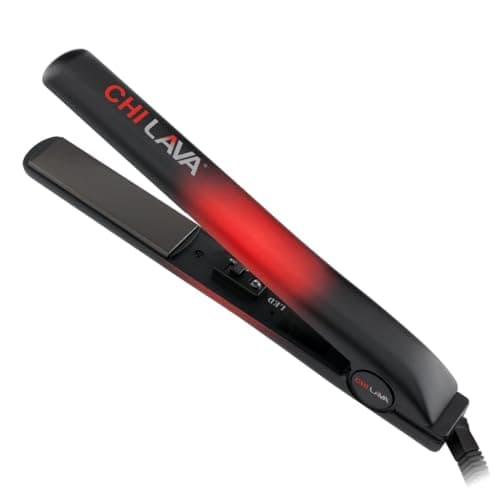
CHI publishes a single preset at 395°F (202°C), 1 in floating volcanic lava ceramic plates, 2.08 lb, an 11 ft cord, dual voltage and a two-year limited warranty. It publishes no wattage. At 2.08 lb this is the heaviest tool in this registry, and the temperature cannot be adjusted.
We earn a commission if you buy through the links on this page, at no extra cost to you. It never changes which tool we pick or which one we tell you to skip. How this site is funded.
The specification sheet, in full
CHI Lava 1 inch Volcanic Ceramic Hairstyling Iron (GF8269), as published
| Row | Published figure |
|---|---|
| Wattage | Not published |
| Heat settings | One - a single preset 395°F (202°C) |
| Weight | 2.08 lb |
| Cord length | 11 ft |
| Plates | 1 in floating volcanic lava ceramic |
| Attachments | Not published |
| Dual voltage | Yes |
| Warranty | 2-year limited |
Quoted from CHI's own product page.
Eight rows, six of them filled. That is a better-than-average sheet for this category, and every figure above is CHI’s own rather than a retailer’s.
One temperature, and CHI’s own claim about it
CHI’s product page says the volcanic lava ceramic lets you “use lower temperature settings than traditional heat styling.” The same page publishes a single preset temperature of 395°F and no control of any kind.
Both statements sit on the same page, and they do not sit together comfortably. The fairest reading is that the sentence is a claim about the material across CHI’s Lava range rather than a feature of this model: the argument is that the plate transfers heat efficiently enough that a given result needs less temperature than a conventional ceramic plate would. That may well be true. What matters for a buyer is that on this iron there is no setting to lower. Whatever the material does or does not permit, you get 395°F.
It is worth being clear that a fixed temperature is not automatically a flaw. CHI and ghd are the two brands here that deliberately refuse to give you a dial, and the reasoning is sound: the dial is what people reach for when a pass does not work, so removing it leaves only the fixes that actually help — thinner sections, drier hair, slower travel. The catch is that a fixed number has to be fixed at the right number for your hair, and 395°F is a high place to fix it.
The mineral claim, and what supports it
CHI also states that “minerals found in the volcanic lava help to strengthen the hair.” No study is cited on the product page, no mechanism is described, and no measurable specification follows from it — there is no figure you could compare against another iron.
This site’s position on claims like that is to neither repeat them nor dismiss them. We have no evidence that mineral transfer from a plate coating strengthens hair, and CHI publishes none. What we can compare is the rest of the sheet: plate size, plate movement, published temperature, weight, cord and warranty. Those rows are where the decision actually gets made, and the Lava does well on several of them.
The material discussion in full — what a surface description can and cannot tell you — is on CHI Original vs CHI Lava, which puts the two coatings side by side.
2.08 lb, and what it costs over a session
Of the seventeen products on this site whose maker publishes a weight, the Lava is the heaviest. It is heavier than the Dyson Supersonic at 1.8 lb, and roughly three times the T3 SinglePass StyleMax at 11.1 oz.
On a dryer, weight is annoying. On a flat iron it is a different problem, because of how you hold one: arm raised, wrist rotated, often behind your own head, for as long as the section takes. Weight that is unremarkable for the first ten minutes is the reason the last sections get rushed — and rushed sections on a fixed-temperature iron mean more passes, which is the one thing you cannot afford at 395°F.
This is the row to weigh honestly against your own hair. If you have short or fine hair and a session is ten minutes, 2.08 lb is a non-issue. If you have long, dense hair and you are working section by section for half an hour or more, it is the specification most likely to change how you feel about the tool, and it is the one CHI cannot fix later.
Who 395°F is wrong for
395°F is 30 degrees above ghd’s fixed 365°F and near the top of what any iron in this registry offers. On coarse, dense, resistant hair that is the point of the tool. On hair that has been processed, it is a problem you cannot dial out.
Bleached and chemically treated hair starts with measurably less margin. Redox proteomic work on virgin, bleached and relaxed hair found that peroxide bleaching produced significantly increased oxidative damage at the molecular level Dyer et al., International Journal of Cosmetic Science, and combining chemical services compounds it — dye plus a sodium hydroxide relaxer produced a 356 percent increase in protein loss over virgin hair França-Stefoni et al., Journal of Cosmetic Dermatology. Hair in that condition needs the option of less heat, and this tool does not have one.
The same applies to anyone whose styling is frequent rather than occasional, because repeated thermal cycling degrades the fiber’s mechanical properties measurably Evans and Park, Journal of Cosmetic Science. A single preset removes your ability to spend less heat on the days that do not need it.
The practical test before buying is the same one we give for the Original: find the temperature your hair actually straightens at in one pass, using what the dial numbers mean and the temperature guidance by hair type. If that figure is at or near 395°F, this iron suits you. If it is meaningfully below, buy an adjustable iron or ghd’s lower fixed setting instead. Fine and damaged hair should start at flat irons for fine hair.
Eleven feet and dual voltage
These are the two rows that earn the Lava its place. An 11 ft cord is the longest class of cord published on this site, and bathroom sockets are rarely beside the mirror — the extra reach is a daily convenience and it keeps tension off the cord, which is the failure most warranties exclude.
Dual voltage matters more than it sounds. Plenty of irons people consider are sold for one market only, and a 120 V-only tool is simply not packable. CHI publishes dual voltage here, which means the Lava runs on a 230 V supply with a plug adapter rather than a voltage converter — see adapter vs converter for why that distinction decides whether a tool survives the trip.
The missing row
Wattage. On a flat iron this is the least costly omission, because an iron draws in short bursts to hold two small plates at temperature and its annual running cost is small however the figure comes out — see running costs. It is still worth noting for consistency: a maker that publishes weight to two decimal places and cord length to the foot has the number and has chosen not to print it. Neither CHI iron on this site publishes one.
Who should buy it
- Coarse, dense or resistant hair that genuinely needs heat near the top of the range and wants one repeatable pass with no decisions to get wrong.
- Anyone who styles away from the socket — 11 ft is the longest class of cord published here.
- Travelers, since dual voltage is published and a fixed setting means there is nothing to reconfigure abroad.
- Not fine, bleached, color-treated or heat-damaged hair. 395°F with no adjustment is above where the temperature guidance puts that hair, and the tool gives you no way to compensate. The same no-dial idea is available 30 degrees lower from ghd, and the T3 SinglePass StyleMax offers nine settings at roughly a third of the weight.
- Not long, dense hair on a long session if weight bothers you — 2.08 lb is the heaviest published figure on this site, and you hold it at head height.
The head-to-head with its lighter sibling is at CHI Original vs CHI Lava, and the brand picture at the CHI brand page.
The tools on this page
Prices come from the live price layer. Where none is available the button says so rather than showing a number we cannot stand behind.
CHI Lava 1" Volcanic Ceramic Hairstyling Iron (GF8269)
2.08 lb published makes this the heaviest tool in the registry — heavier than the Dyson Supersonic at 1.8 lb — and it is a flat iron you hold at head height.
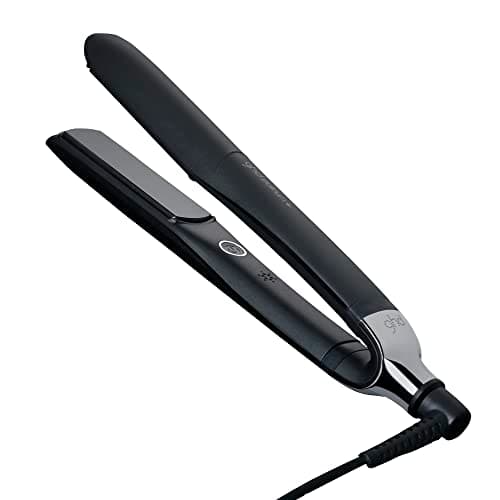
ghd Platinum+ flat iron (1 inch plate)
One temperature, 365°F, no dial to get wrong — the strongest heat-discipline argument in the category, and the longest iron warranty here at three years.
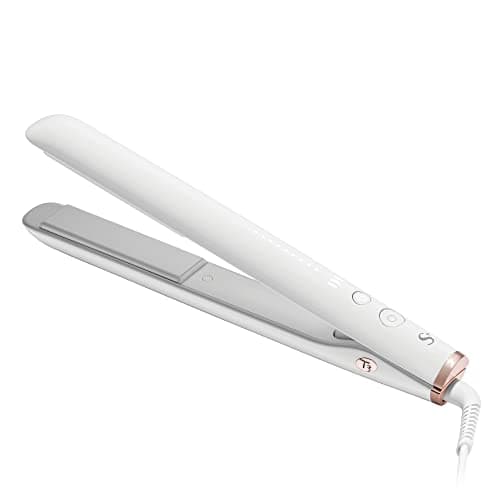
T3 SinglePass StyleMax 1 inch flat iron
Nine heat settings and genuine 100–240 V dual voltage: the most adjustable iron here and the only one you can pack for Europe without a thought.
Questions people actually ask
Does the CHI Lava have temperature settings?
No. CHI publishes a single preset at 395 degrees Fahrenheit (202 Celsius) with no adjustment. The product page separately says the lava ceramic lets you use lower temperature settings, but this model has no settings to lower.
Is the CHI Lava good for fine or damaged hair?
No. A fixed 395 degrees is above where the temperature guidance puts fine, color-treated, bleached or previously damaged hair, and there is no way to turn it down.
How heavy is the CHI Lava?
CHI publishes 2.08 lb. That is the heaviest published weight of any tool on this site - heavier than the Dyson Supersonic at 1.8 lb, and about three times the T3 SinglePass StyleMax at 11.1 oz.
Is the CHI Lava dual voltage?
Yes. CHI publishes dual voltage, so it runs on a 230 V supply with a plug adapter rather than a voltage converter.
CHI Lava or CHI Original?
The Original on weight, at 1.4 lb against 2.08 lb, and the three degrees between their presets is not a difference you will detect. Choose the Lava only if you specifically want its plate coating.
Sources
- CHI - Lava 1 inch Analog Volcanic Ceramic Hairstyling Iron (GF8269) product page
- Dyer et al. - Redox proteomic evaluation of bleaching and alkali damage in human hair, Int J Cosmet Sci 2013
- França-Stefoni et al. - Protein loss in human hair from combination straightening and coloring treatments, J Cosmet Dermatol 2015
- Evans and Park - thermal cycling and mechanical properties