Flat Irons & Straighteners
CHI Original vs CHI Lava: Two Thirds of a Pound Apart
Three degrees of temperature and two thirds of a pound. Only one of those you will notice.
Updated September 2026 · Sawyer V.
CHI publishes a fixed 392°F and 1.4 lb on the Original, and a fixed 395°F and 2.08 lb on the Lava. Both publish 1 in floating ceramic plates, an 11 ft cord, dual voltage and two years. Buy the Original: the 3°F gap is imperceptible, the weight gap is not.
We earn a commission if you buy through the links on this page, at no extra cost to you. It never changes which tool we pick or which one we tell you to skip. How this site is funded.
Side by side, published only
CHI 1 inch Original vs CHI Lava 1 inch, as published
| Row | CHI Original | CHI Lava |
|---|---|---|
| Heat control | One preset, 392°F (202°C) | One preset, 395°F |
| Weight | 1.4 lb | 2.08 lb |
| Cord length | 11 ft swivel | 11 ft |
| Plates | 1 in ceramic floating | 1 in floating volcanic lava ceramic |
| Wattage | Not published | Not published |
| Attachments | Not published | Not published |
| Dual voltage | Yes | Yes |
| Warranty | 2-year limited | 2-year limited |
Six of the eight rows are identical. The comparison is weight.
2.08 lb is the heaviest tool on this site
Heavier than the Dyson Supersonic’s published 1.8 lb, and that is a dryer you hold at arm’s length rather than a clamp you close repeatedly at head height. The Original at 1.4 lb is mid-pack; the T3 SinglePass StyleMax at 11.1 oz is less than a third of the Lava.
Weight is the specification people notice last when buying and first when using. A long straightening session ends with faster, rougher passes when the tool is heavy, and rushed passes are where damage happens rather than in the temperature itself.
The three degrees are not a feature
392°F against 395°F. Nothing in the damage literature distinguishes those two numbers, and no hair behaves differently between them. Treat them as the same iron thermally.
Both are fixed, which is CHI’s position: no dial means no escalation. It also means neither suits hair that needs to sit lower — see what the dial numbers mean for how to find your own number first.
What “volcanic lava ceramic” tells you
It is a surface description rather than a measurement. CHI publishes no plate temperature uniformity figure, no heat-up time and no recovery time for either iron, so there is nothing to compare beyond the material name.
This site ranks on published figures and declines to score unpublished claims, which is the same position we take at ceramic vs tourmaline. On the rows that are published, the Lava is heavier and three degrees hotter, and that is all that can honestly be said.
What both do well
- 11 ft of cord. The longest published figure on this site, and a daily convenience if your socket is not by the mirror.
- Dual voltage. Both travel on a plug adapter.
- Floating plates. Self-aligning contact, which reduces the urge to squeeze.
- A two-year warranty on a tool that costs less than the premium irons here.
Eleven feet, on both
Both publish an 11 ft cord, the longest figure on this site by a clear margin - two feet more than the 9 ft cords on the premium irons and nearly five feet more than the Calista tools.
It reads as trivia and behaves like a daily feature. Bathroom sockets are rarely beside the mirror, and a cord that reaches means styling where the light is rather than where the power is - which on the back sections is the difference between seeing what you are doing and guessing.
It also means slack. A cord under tension at the strain relief is the most common way an iron dies, and it is the failure that limited warranties exclude. Whichever of these two you buy, coil it loosely rather than winding it round a warm plate.
Neither of these publishes a wattage, so neither can be costed to run. On an iron that is a small omission - plates draw power in short bursts to hold temperature, and the annual electricity cost is minor next to a dryer's - but it is worth noting that a brand publishing weight to two decimal places and cord length to the foot clearly has the figure and has chosen not to print it.
Who should buy which
Buy the CHI Original. On published evidence it is the better buy of the two for almost everyone: the same cord, the same warranty, the same voltage, the same plate width, and two thirds of a pound less in your hand.
Buy the Lava only if you specifically want that plate finish and know the weight does not bother you — for example if you style short hair in a few minutes.
Buy neither if your hair is fine, colored or recovering. A fixed 392°F is above where the temperature guidance puts that hair, with no way down. See flat irons for fine hair and the CHI brand page.
The tools on this page
Prices come from the live price layer. Where none is available the button says so rather than showing a number we cannot stand behind.
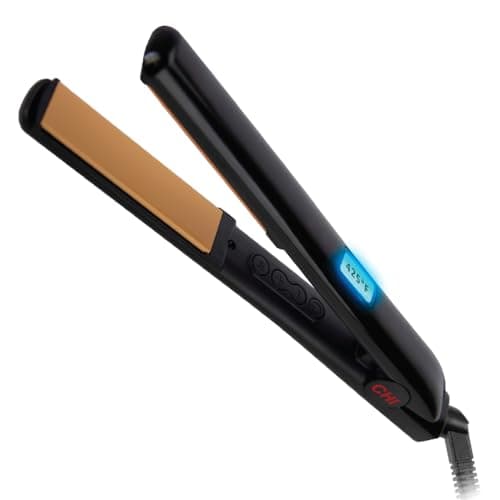
CHI 1" Original Ceramic Hairstyling Iron (GF1001)
The longest published cord on this site at 11 ft, and the only iron here with no temperature control at all — one preset, 392°F, take it or leave it.
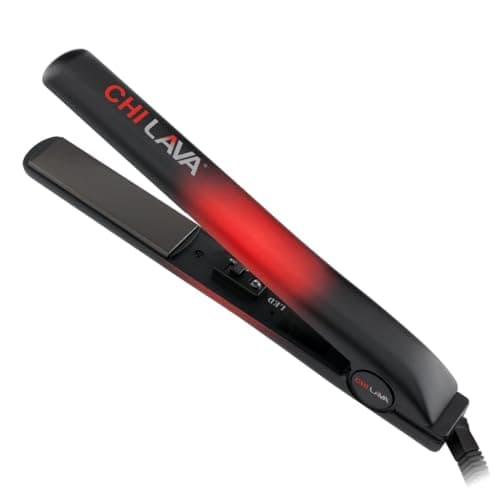
CHI Lava 1" Volcanic Ceramic Hairstyling Iron (GF8269)
2.08 lb published makes this the heaviest tool in the registry — heavier than two Dyson Supersonics — and it is a flat iron you hold at head height.
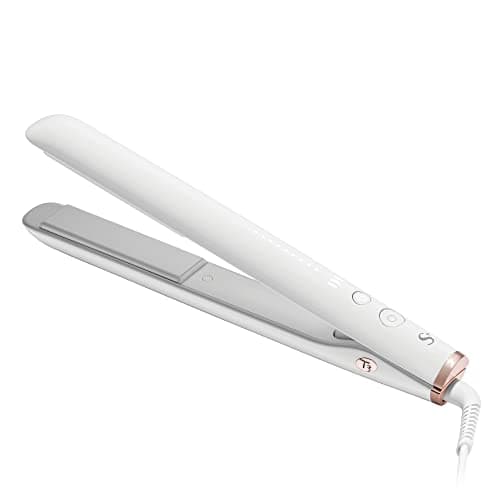
T3 SinglePass StyleMax 1 inch flat iron
Nine heat settings and genuine 100–240 V dual voltage: the most adjustable iron here and the only one you can pack for Europe without a thought.
Questions people actually ask
What is the difference between the CHI Original and the CHI Lava?
Published weight and a three-degree preset. The Original is 1.4 lb at 392 degrees Fahrenheit; the Lava is 2.08 lb at 395. Cord, plate width, voltage and warranty are identical.
Is the CHI Lava worth the extra weight?
On published evidence, no. Volcanic lava ceramic is a surface description rather than a measured claim, and 2.08 lb is the heaviest tool in this registry - heavier than the Dyson Supersonic.
Do CHI irons have adjustable temperature?
Not these two. Both publish a single fixed preset with no adjustment, which is CHI's design position rather than an oversight.
Are CHI flat irons good for fine hair?
Not these fixed-preset models. 392 degrees with no way to turn it down sits above where the guidance puts fine, colored or previously damaged hair.