Flat Irons & Straighteners
CHI vs ghd: The Same Argument at Different Temperatures
Two brands with the same philosophy, twenty-seven degrees apart. That gap is the entire decision.
Updated September 2026 · Sawyer V.
ghd fixes its irons at 365°F with a 9 ft cord and a three-year warranty. CHI fixes its classic irons at 392°F with an 11 ft cord, 1.4 lb published and two years. Neither publishes a wattage. Fine, colored or damaged hair wants the lower number; coarse, resistant hair may need the higher one.
We earn a commission if you buy through the links on this page, at no extra cost to you. It never changes which tool we pick or which one we tell you to skip. How this site is funded.
The shared idea
Both brands have decided that giving you a temperature dial makes your hair worse. The reasoning is identical and it is sound: the dial exists so that when a pass fails you can turn it up, and turning it up is almost never the right correction. The right correction is a thinner section, drier hair, or a slower pass.
Removing the dial forces those corrections. It is the most paternalistic design decision in this category and it is defensible, which is why two otherwise unrelated brands arrived at it.
The 27 degrees
CHI Original 1 inch vs ghd Platinum+ - published figures only
| Row | CHI 1" Original | ghd Platinum+ |
|---|---|---|
| Temperature | Fixed 392°F (202°C) | Fixed 365°F |
| Wattage | Not published | Not published |
| Weight | 1.4 lb | Not published |
| Cord length | 11 ft swivel | 9 ft power cable |
| Plates | 1 in ceramic floating | Precision-milled floating, 1 in |
| Dual voltage | Yes | Yes - universal voltage |
| Attachments | Not published | None supplied |
| Warranty | 2-year limited | 3-year |
Twenty-seven degrees sounds small and is not. It straddles the region where the thermal-degradation work starts reporting clear mechanical loss, and on hair that has been colored or bleached — where the fiber is already measurably altered Dyer et al., Journal of Cosmetic Science — it is the difference between a tool that suits you and one that does not.
In the other direction, coarse and resistant hair sometimes genuinely does not straighten at 365°F in a reasonable number of passes, and more passes at a lower temperature is not automatically gentler than fewer at a higher one Evans and Park, Journal of Cosmetic Science.
Where CHI wins
- Cord. 11 ft against ghd’s 9 ft, and the longest published figure on this site. It is the difference between standing at the mirror and standing at the socket.
- Disclosure, on one row. CHI publishes 1.4 lb. ghd publishes no weight on its irons at all.
- Price. Consistently the more affordable of the two, for a tool making the same core promise.
- Coarse hair. 392°F does in one pass what 365°F may take two to do on resistant textures.
Travel is a draw, not a win: both classic CHI irons publish dual voltage, and the ghd Platinum+ publishes universal voltage.
Where ghd wins
- The number itself. 365°F is the more defensible place to fix a temperature for the majority of domestic hair.
- Warranty. Three years against two.
- Attachments. ghd states plainly that none are supplied. CHI leaves the row blank, which is a worse answer than a disappointing one.
- Plate engineering. Precision-milled floating plates, described in more detail than CHI’s pages offer.
What neither of them publishes
Both pages leave the same row blank, and it is worth naming because it is the row that would let you compare them on cost. Neither ghd nor CHI states a wattage for these irons, so no running-cost figure can be computed for either and no power comparison is possible.
On an iron that matters less than it would on a dryer. A flat iron draws power in short bursts to hold a plate at temperature rather than heating a large moving volume of air, and its annual electricity cost is small whatever the figure turns out to be. The dryers on this site range from about $15.50 to $22.35 a year at 65 hours of use; an iron sits well below that.
ghd also leaves weight blank, which CHI does not — 1.4 lb on the Original, 2.08 lb on the Lava. Weight is the specification you feel every session, so a brand that publishes it is doing something useful even when the number is unflattering. On that row CHI is the more forthcoming of the two.
Between them the two brands fill eight of our ten rows. The two they share as blanks are wattage and, on ghd’s side, weight — which is a better disclosure record than most of this category manages.
Which to buy
Buy the ghd if your hair is fine, color-treated, bleached or recovering from heat damage, or if you want the longest warranty on a premium iron. The lower fixed temperature is the point of the tool and it is the right point for most people.
Buy the CHI if your hair is coarse, dense or resistant, if you style away from the socket, or if the ghd is simply out of budget for a tool that makes a very similar promise.
Buy neither if you do not know yet what temperature your hair needs. A fixed-temperature iron is a commitment to a number, and if you have never established yours, an iron with published steps — the T3 SinglePass StyleMax has nine, the L’ange Le Duo five from a 280°F floor — will teach you more in a month than either of these will.
More on each brand at CHI and ghd, and the wider case for one setting at the best flat irons for beginners.
The tools on this page
Prices come from the live price layer. Where none is available the button says so rather than showing a number we cannot stand behind.
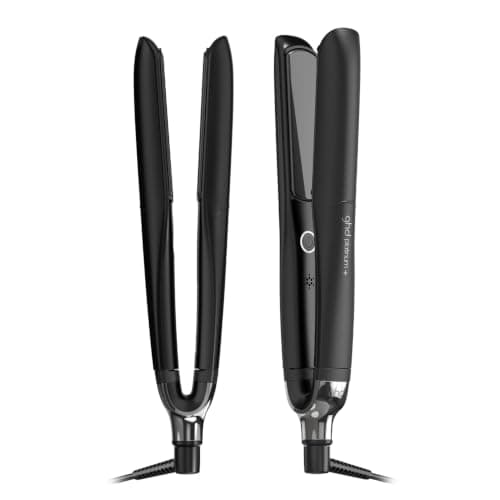
ghd Platinum+ flat iron (1 inch plate)
One temperature, 365°F, no dial to get wrong — the strongest heat-discipline argument in the category, and the longest iron warranty here at three years.
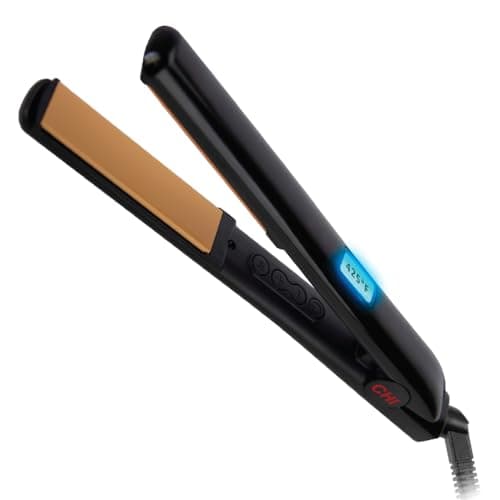
CHI 1" Original Ceramic Hairstyling Iron (GF1001)
The longest published cord on this site at 11 ft, and the only iron here with no temperature control at all — one preset, 392°F, take it or leave it.
Questions people actually ask
Is CHI or ghd better?
They make the same promise at different temperatures. ghd fixes at 365 degrees Fahrenheit with a three-year warranty, CHI at 392 with a two-year warranty and an 11 ft cord. Fine, colored or damaged hair wants the ghd; coarse resistant hair may need the CHI.
Why do CHI and ghd not have temperature settings?
Both brands argue that the dial is what causes damage: when a pass fails, people turn the heat up rather than fixing the section thickness, the dampness or the pass speed. Removing the dial forces the correct correction.
Does a 27 degree difference actually matter?
On hair that has been colored or bleached, yes. That gap straddles the region where the thermal-degradation literature starts reporting clear mechanical loss, and processed hair has less margin to begin with.
Are CHI flat irons dual voltage like ghd?
Both are. Both classic CHI irons publish dual voltage and the ghd Platinum+ publishes universal voltage, so either travels on a plug adapter. A plug adapter is not a voltage converter, and the distinction matters on tools that are not dual voltage.