Flat Irons & Straighteners
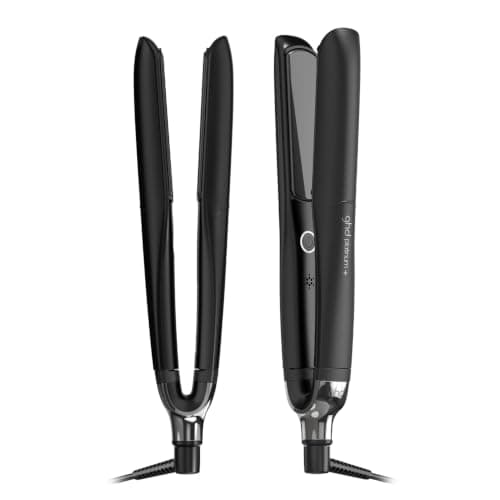
ghd Platinum+: What the Published Specs Say
The only iron here with nothing to get wrong. That is the entire product, and whether it suits you depends on one question about your own hair.
Updated September 2026 · Sawyer V.
ghd publishes one fixed temperature of 365°F, precision-milled floating 1 inch plates, a 9 ft cable, universal voltage and a three-year warranty — the longest iron warranty in our registry. It does not publish a wattage or a weight. There is no temperature dial, deliberately.
We earn a commission if you buy through the links on this page, at no extra cost to you. It never changes which tool we pick or which one we tell you to skip. How this site is funded.
One number, and the argument behind it
365°F. That is the only temperature this iron does, and there is no control to change it. Nearly every competing iron sells adjustability as a feature; ghd has built its entire position on removing it.
The reasoning is straightforward once you accept the premise. Damage is driven by temperature and by number of passes, and the temperature most people select when given a dial is higher than the one their hair needs. A fixed setting removes the most common self-inflicted error in the category, which is turning it up because the first pass did not work and then blaming the hair.
The counter-argument is equally real: resistant, coarse hair sometimes genuinely needs more heat than 365°F, and when a fixed-temperature iron fails to straighten a section, your only remaining option is another pass. On the hair type least able to afford repeat passes, that is the wrong constraint — which is why we name it the skip on the thick-hair page and the winner on the fine-hair page. Same iron, same spec sheet, opposite verdicts.
What 365°F means against the evidence
Published research on thermal damage to hair does not hand you a single safe number, and anyone quoting one is overstating what the literature says. What it does support is that the effects accumulate and start lower than intuition suggests — mechanical properties of hair begin changing at temperatures well under boiling in controlled drying experiments.
So 365°F is not a magic threshold. What it is, is a decision made once by someone else instead of made badly by you every morning at speed. Our fuller treatment of what temperature to use, and why the honest answer is a range rather than a figure, is on the flat iron temperature page.
The plates
ghd publishes precision-milled floating high-gloss plates, 1 inch wide. Two words there are doing real work.
- Floating. The plates move slightly within the body rather than being fixed rigid, so they self-align on a section instead of gripping hardest in the middle. Uneven contact is what makes you go back over a section, and passes are the thing worth eliminating.
- 1 inch. The standard width, and the right one for most hair. It is also the constraint on this particular model: ghd offers a wide-plate version of the newer Chronos but not of the Platinum+, so if you have long dense hair and want coverage per pass, the sibling product is the one to look at.
The three-year warranty is the underrated specification
Three years is the longest iron warranty in our registry. Dyson publishes two on the Corrale, T3 publishes two on the SinglePass StyleMax, and ghd publishes three on both the Platinum+ and the Chronos.
A warranty is a manufacturer stating, in a legally binding way, how long they expect the tool to last. It is one of the few numbers on a spec sheet that cannot be marketing, because it costs money to be wrong about. On a tool with no moving parts beyond a hinge and no battery to degrade, three years of cover is a meaningful statement about build.
It also changes the arithmetic. Every price-per-use figure on this site assumes a five-year service life; a longer warranty is evidence for that assumption rather than against it. The general case for weighing warranty in the purchase decision is on the warranty page.
Price per use, at 5 uses a week over 5 years
| What you pay | Cost per use | Cost per year |
|---|---|---|
| $30 | $0.02 | $6.00 |
| $60 | $0.05 | $12.00 |
| $100 | $0.08 | $20.00 |
| $150 | $0.12 | $30.00 |
| $200 | $0.15 | $40.00 |
| $300 | $0.23 | $60.00 |
| $400 | $0.31 | $80.00 |
| $500 | $0.38 | $100.00 |
5 uses a week for 5 years is 1300 uses. Both figures are stated assumptions, not measurements — halve the life and every cost per use doubles. We publish the ladder rather than a worked example for one specific product because a price we typed into a sentence would be wrong within a week.
Universal voltage, stated plainly
ghd publishes universal voltage for the Platinum+, which makes it one of only a handful of tools here you can take abroad without thinking about it. Their own Helios dryer, by contrast, is explicitly stated as not universal voltage — the same brand publishing both facts candidly.
Combined with a 9 ft cable, that is a genuinely travel-friendly iron that happens not to be marketed as one. It is the top pick on the travel irons page for exactly that reason, and why a plug adapter is enough for it is worth understanding before you pack anything else.
What ghd does not publish
What it costs to run for a year
ghd does not publish a wattage for this tool, so there is nothing honest to compute. The formula is watts ÷ 1,000 × hours a year × your rate per kWh; if you find a rating plate on the handle, 65 hours a year and 18.34 cents per kilowatt-hour will get you the rest of the way.
No wattage, so no running cost. No weight, which on an iron matters less than on a dryer but is still a real omission when the competing Dyson publishes 1.23 lb and T3 publishes 11.1 oz. No attachments, because there are none — that row is honest rather than blank.
The pattern is consistent across ghd’s range: temperature philosophy and warranty terms in detail, physical specifications sparingly. It is the same shape as the Helios spec sheet, and it is worth knowing about the brand before you shortlist on published numbers.
Who this is for
- Fine, fragile or previously damaged hair. A fixed 365°F on hair that never needed more is the single best fit for this product.
- Anyone who has cooked their hair by turning it up. If your honest self-assessment is that you use too much heat, the iron with no dial is not a compromise, it is the fix.
- Travelers. Universal voltage, stated.
- People who keep tools for years. Three-year warranty, no battery to degrade.
Who should skip it
- Coarse, resistant or very thick hair. When 365°F is not enough, repeat passes are your only option, and that is the worst outcome on dense hair. Look at the wide-plate Chronos or an adjustable iron.
- Anyone who also wants a curling tool. There is no attachment ecosystem here — it straightens, and that is all.
- Buyers who shortlist on published specifications. No wattage and no weight is a thin sheet at this price.
What we cannot tell you
We have not used this iron. We do not know what it weighs, how fast it heats, or how the plate coating holds up over three years of use. Everything above is read off ghd’s own product page. If you want it against the other flagship iron here, that is Corrale versus Platinum+.
The tools on this page
Prices come from the live price layer. Where none is available the button says so rather than showing a number we cannot stand behind.
ghd Platinum+ flat iron (1 inch plate)
One temperature, 365°F, no dial to get wrong — the strongest heat-discipline argument in the category, and the longest iron warranty here at three years.
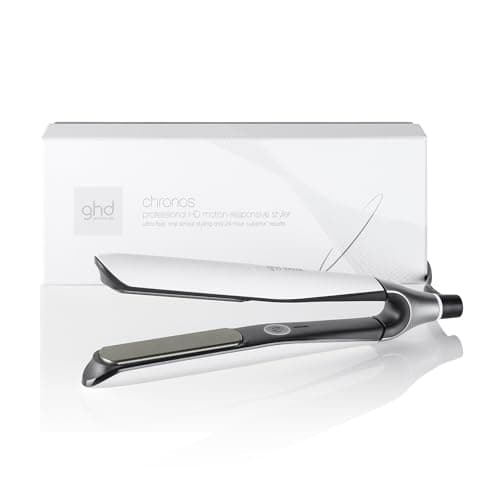
ghd Chronos flat iron (1 inch plate)
The Platinum+ argument with a re-engineered hinge and a wide-plate option — same fixed 365°F, same three-year warranty, more plate choice.
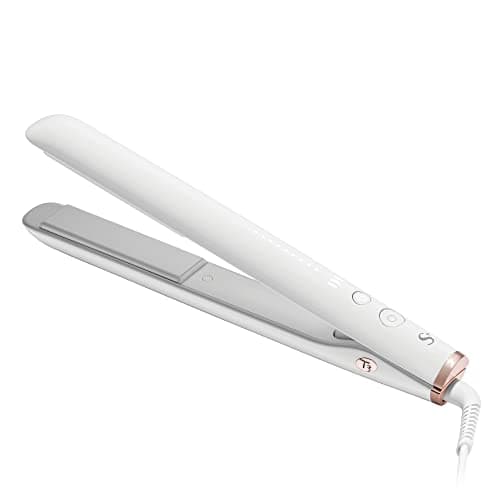
T3 SinglePass StyleMax 1 inch flat iron
Nine heat settings and genuine 100–240 V dual voltage: the most adjustable iron here and the only one you can pack for Europe without a thought.
Questions people actually ask
What temperature is the ghd Platinum+?
365°F, fixed. There is no temperature control on the tool at all, which is the product's central design decision rather than an omission.
Is the ghd Platinum+ dual voltage?
Yes. ghd publishes universal voltage for it, so a plug adapter is all you need abroad. Their Helios dryer is explicitly not universal voltage, so do not assume it applies across the brand.
How long is the ghd Platinum+ warranty?
Three years, which is the longest iron warranty in our registry. Dyson and T3 both publish two years on their comparable irons.
Is the ghd Platinum+ good for thick hair?
It is the one hair type we would not buy it for. With no way to raise the temperature, a section that does not straighten on the first pass leaves you with repeat passes, and dense hair can least afford those.