Flat Irons & Straighteners
The Best Flat Irons for Beginners in 2026
The right first iron is not the most capable one. It is the one with the fewest decisions in it.
Updated September 2026 · Sawyer V.
The mistakes beginners make are escalating the temperature, taking sections that are too thick, and ironing hair that is not fully dry. The iron that helps is one with a fixed or clearly stated temperature, floating plates and low weight — not the one with the widest range.
We earn a commission if you buy through the links on this page, at no extra cost to you. It never changes which tool we pick or which one we tell you to skip. How this site is funded.
Quick picks
Tap any row to jump to the full write-up. Prices come from the live price layer; where none is available the button says so rather than showing a number we cannot stand behind.
| # | Product | Best for | Price |
|---|---|---|---|
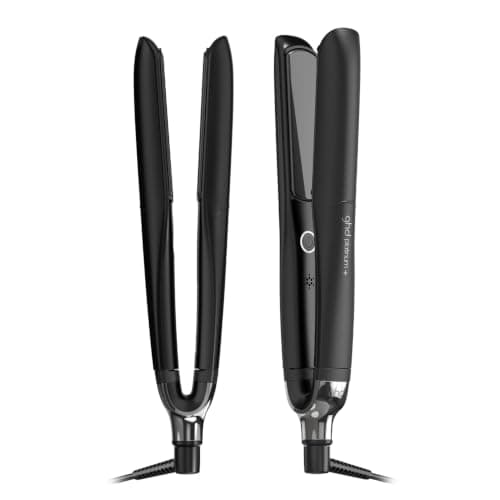
| 1 | ghd Platinum+ flat iron (1 inch plate) One fixed temperature at 365°F, floating plates and a three-year warranty - the decision is removed rather than explained. | A first iron you cannot set wrong | |
| 2 | 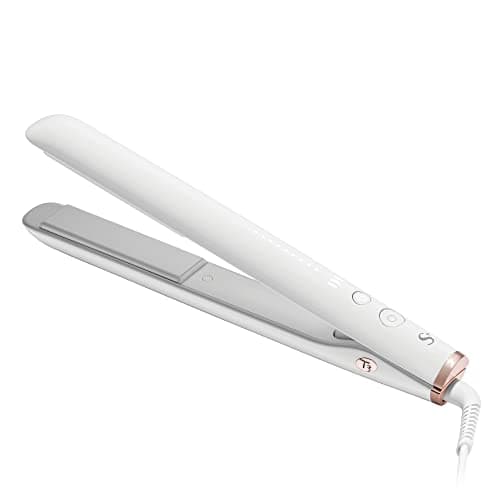 T3 SinglePass StyleMax 1 inch flat iron Nine published heat settings and 11.1 oz, so you can start at the bottom and find your number. | Learning what temperature your hair actually needs | |
| 3 | 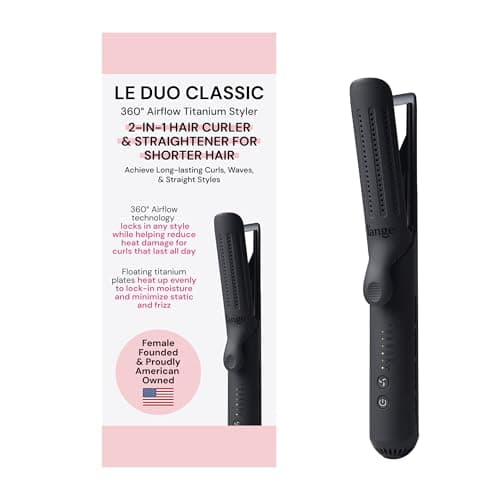 L'ange Le Duo 360° Airflow Styler (Standard) A published 280°F floor across five settings, 0.8 lb, and 100-240 V. | Fine or already-fragile hair learning to style | |
| — | 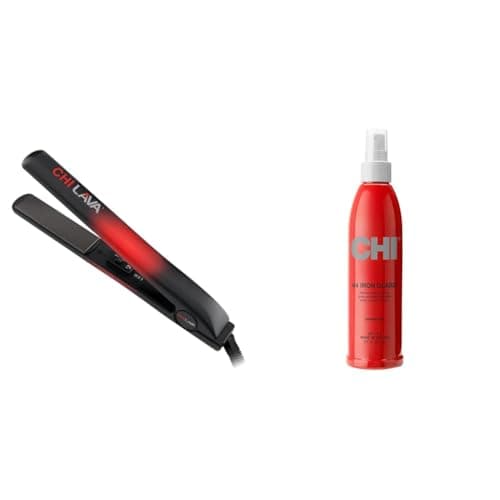 CHI Lava 1" Volcanic Ceramic Hairstyling Iron (GF8269) A fixed 395°F with no adjustment, on the heaviest tool in this registry at 2.08 lb. We’d skip this | Not a first iron |
1. No dial, no mistake
ghd Platinum+ flat iron (1 inch plate)
Best for: A first iron you cannot set wrong
One fixed temperature at 365°F, floating plates and a three-year warranty - the decision is removed rather than explained.
The single most common beginner error is the escalation loop: the first pass does not smooth, so the temperature goes up, and the second pass is hotter than the hair needed. An iron with no dial cannot be escalated.
365°F is a defensible place to fix it. It is below the CHI presets at 392 and 395°F and well below the 455°F ceilings the professional market advertises, and it is high enough to straighten most hair in a pass or two.
Floating plates matter for a beginner more than for anyone else, because the instinct when a section will not close is to squeeze, and floating plates take that instinct out of play by self-aligning.
What’s wrong with it
One of the more expensive first irons, and if 365°F turns out to be too low for very coarse hair there is nothing to adjust.
Published specifications — ghd Platinum+ flat iron (1 inch plate)
| Wattage | Not published |
|---|---|
| Heat settings | One fixed temperature — 365°F |
| Speed settings | Not applicable |
| Weight | Not published |
| Cord length | 9 ft power cable |
| Noise (dB) | Not applicable |
| Attachments | None supplied |
| Plate / barrel | Precision-milled floating high-gloss plates, 1 in |
| Dual voltage | Yes — universal voltage |
| Warranty | 3-year warranty |
Every figure above is taken from ghd — Platinum+ flat iron (1 inch plate) product page. “Not published” means the figure does not appear on that page — it is not an estimate withheld, it is a number the manufacturer does not state. How we compile these.
What it costs to run for a year
ghd does not publish a wattage for this tool, so there is nothing honest to compute. The formula is watts ÷ 1,000 × hours a year × your rate per kWh; if you find a rating plate on the handle, 65 hours a year and 18.34 cents per kilowatt-hour will get you the rest of the way.
2. The iron you can grow into
T3 SinglePass StyleMax 1 inch flat iron
Best for: Learning what temperature your hair actually needs
Nine published heat settings and 11.1 oz, so you can start at the bottom and find your number.
The opposite argument, and it is also good. A beginner does not yet know what their hair needs, and nine settings lets them find out safely by starting at the lowest and working up one step at a time.
11.1 oz is the lightest iron here, which matters when your technique is still slow. A light tool stays controllable through the awkward back sections that take beginners three times as long as they take anyone else.
100–240 V auto world voltage is a bonus that becomes relevant the first time you travel, and it means the iron will not be outgrown.
What’s wrong with it
Nine settings is also nine chances to pick the wrong one, and T3 publishes no wattage on any product.
Published specifications — T3 SinglePass StyleMax 1 inch flat iron
| Wattage | Not published |
|---|---|
| Heat settings | 9 heat settings |
| Speed settings | Not applicable |
| Weight | 11.1 oz (cord not included) |
| Cord length | 360-degree swivel cord — length not published |
| Noise (dB) | Not applicable |
| Attachments | None supplied |
| Plate / barrel | CeraGloss ceramic plates, 1 in |
| Dual voltage | Yes — auto world voltage, 100–240 V |
| Warranty | 2-year warranty |
Every figure above is taken from T3 Micro — SinglePass StyleMax 1 inch flat iron product page. “Not published” means the figure does not appear on that page — it is not an estimate withheld, it is a number the manufacturer does not state. How we compile these.
What it costs to run for a year
T3 does not publish a wattage for this tool, so there is nothing honest to compute. The formula is watts ÷ 1,000 × hours a year × your rate per kWh; if you find a rating plate on the handle, 65 hours a year and 18.34 cents per kilowatt-hour will get you the rest of the way.
3. Starts lower than anything else here
L'ange Le Duo 360° Airflow Styler (Standard)
Best for: Fine or already-fragile hair learning to style
A published 280°F floor across five settings, 0.8 lb, and 100-240 V.
280°F is the lowest published starting temperature in this registry. For a beginner with fine or color-treated hair, that floor is worth more than any other feature on this page, because the damage you do while learning happens at the top of the range.
0.8 lb published for the Standard makes it one of the lightest tools here, and the rounded plate edges are a genuine help when you are still learning not to leave a crease at the root.
Five settings is enough granularity to learn on without being overwhelming, and every one of them is published as an actual temperature rather than a number on a dial.
What’s wrong with it
A one-year warranty, the shortest in this registry, and no published speed settings or attachments.
Published specifications — L'ange Le Duo 360° Airflow Styler (Standard)
| Wattage | 36 W (Standard); 50 W (Grande) |
|---|---|
| Heat settings | 5 settings, 280–430°F |
| Speed settings | Not published |
| Weight | 0.8 lb / 358 g (Standard); 0.9 lb / 400 g (Grande) |
| Cord length | 8.2 ft (2.5 m) |
| Noise (dB) | Not published |
| Attachments | Not published |
| Plate / barrel | Titanium floating plates with rounded edges, 3.5 in × 1 in |
| Dual voltage | Yes — 100–240 V, 50/60 Hz |
| Warranty | 1-year warranty |
Every figure above is taken from L'ange — Le Duo 360° Airflow Styler product page. “Not published” means the figure does not appear on that page — it is not an estimate withheld, it is a number the manufacturer does not state. How we compile these.
What it costs to run for a year
$0.43 a year
36 W (Standard); 50 W (Grande) × 65 hours a year = 2.3 kWh, at 18.34 cents per kilowatt-hour. The hours assume 15 minutes a session, 5 days a week — that is an assumption, not a measurement, so swap in your own if it is wrong.
The one we'd skip
CHI Lava 1" Volcanic Ceramic Hairstyling Iron (GF8269)
Best for: Not a first iron
A fixed 395°F with no adjustment, on the heaviest tool in this registry at 2.08 lb.
This is the pick we would steer a beginner away from, for two reasons that compound each other.
2.08 lb is heavy, and heavy tools punish slow technique. A beginner is slow by definition; the section takes longer, the arm tires, and the passes get faster and rougher exactly when they should be getting more careful.
A fixed 395°F is also the wrong number to hand someone who does not yet know their hair. It is 30 degrees above the ghd, with no way to come down if the answer turns out to be that your hair needed less.
What’s wrong with it
Heaviest tool here, fixed at a high temperature, with no adjustment for hair that needs less.
Published specifications — CHI Lava 1" Volcanic Ceramic Hairstyling Iron (GF8269)
| Wattage | Not published |
|---|---|
| Heat settings | One — a single preset 395°F (202°C) |
| Speed settings | Not applicable |
| Weight | 2.08 lb |
| Cord length | 11 ft cord |
| Noise (dB) | Not applicable |
| Attachments | Not published |
| Plate / barrel | 1 in floating volcanic lava ceramic plates |
| Dual voltage | Yes — dual voltage |
| Warranty | 2-year limited warranty |
Every figure above is taken from CHI — Lava 1" Volcanic Ceramic Hairstyling Iron product page. “Not published” means the figure does not appear on that page — it is not an estimate withheld, it is a number the manufacturer does not state. How we compile these.
What it costs to run for a year
CHI does not publish a wattage for this tool, so there is nothing honest to compute. The formula is watts ÷ 1,000 × hours a year × your rate per kWh; if you find a rating plate on the handle, 65 hours a year and 18.34 cents per kilowatt-hour will get you the rest of the way.
The three mistakes, and the specs that prevent them
Beginner mistakes mapped to the specification that helps
| Mistake | What prevents it |
|---|---|
| Turning the heat up when a pass does not work | A fixed temperature, or a stated floor you can return to |
| Sections too thick to straighten in one pass | Nothing on the spec sheet - this is technique |
| Ironing hair that is still slightly damp | Nothing on the spec sheet - this is patience |
| Squeezing the plates to close a gap | Floating plates that self-align |
| Rushing the back of the head | Low weight, and a long cord so you can face the mirror |
Two of the five are not solvable by purchase. That is worth knowing before spending.
The middle row is the important admission. No iron on this site fixes a section that is too thick, and no iron fixes damp hair. Both are technique, both are free to correct, and both do more damage than any plate coating ever will.
The four things to do before buying anything
- Dry the hair completely. Not nearly. Water trapped under a hot plate flashes to steam inside the shaft, which is the bubble-hair mechanism Yin et al., Annals of Dermatology.
- Take sections you can see through. If the plate cannot make contact with every strand, the pass has failed and you will do it again.
- Move slowly and continuously. One slow pass beats three fast ones at the same temperature.
- Use a heat protectant. It is the cheapest step in the routine. See what heat protectant does.
How to section hair covers the second point properly, and it is the single highest-return thing a beginner can learn.
What not to buy first
Three things look like features on a first iron and are not.
A 455°F ceiling
Almost no domestic hair needs 455°F, and a beginner certainly does not. A high ceiling is a professional capability sold as a consumer feature, and its only effect on a learner is to make the worst mistake available on the dial.
A wide plate
Wide plates cover ground fast on long dense hair and are awkward everywhere else — near the root, around the face, on short layers. Start at 1 inch. See plate size.
The cheapest thing available
The floor matters here. A tool that publishes no temperature at all gives a beginner nothing to learn from, and learning what number your hair responds to is most of what the first year of owning an iron is for. Our budget flat irons page holds the least-bad options if the budget is fixed.
What to buy second
Almost nobody’s second tool is another flat iron. It is usually a better dryer, because a good blow-dry reduces how much ironing is needed at all, and reducing passes is the whole game. See upgrading from a drugstore tool and how many tools you actually need.
Questions people actually ask
What is the best hair straightener for a beginner?
One with a fixed or clearly published temperature, floating plates and low weight. A fixed-temperature iron removes the most common beginner mistake - escalating the heat when a pass does not work - and a light tool keeps technique steady through the slow sections.
What temperature should a beginner use on a flat iron?
The lowest setting that straightens a test section in one slow pass. Start at the bottom of the range and step up, never the other way around, and stay lower if your hair is fine, colored or bleached.
Do I need a 450 degree flat iron?
Almost certainly not. Very little domestic hair requires the top of that range, and for a learner the main effect of a high ceiling is that the worst available mistake is on the dial.
Should my first iron have a wide plate?
No. A 1 inch plate is easier to control at the root, around the face and on shorter layers. Wide plates only earn their place on long, dense hair where covering ground quickly matters more than precision.