Guides
Flat Iron Settings Explained: What the Numbers Mean
Nobody agrees what 5 means. Two makers publish degrees; the rest publish a number and leave you to guess.
Updated September 2026 · Sawyer V.
A numbered setting is not a temperature. There is no industry standard behind it, so “5” on one iron and “5” on another can be tens of degrees apart. Only two tools in this registry publish an actual figure for every setting.
We earn a commission if you buy through the links on this page, at no extra cost to you. It never changes which tool we pick or which one we tell you to skip. How this site is funded.
There is no standard, and that is the answer
If you searched for what temperature setting 5 is, the honest answer is that nobody can tell you without knowing which iron you own — and for most irons, not even then. Dial numbers are a manufacturer’s own scale. They are not calibrated against each other and no standard requires them to be.
That is why this page maps what each maker publishes rather than printing a conversion table. A conversion table would be invented, and inventing it is exactly the failure this site exists to avoid.
What each iron here actually publishes
Heat control, exactly as each manufacturer states it
| Iron | What the dial gives you | Degrees published? |
|---|---|---|
| L'ange Le Duo | 5 settings, 280-430°F | Yes - the full range |
| Calista Perfecter Pro (heated brush) | 325-395°F in 10°F steps | Yes - every step |
| T3 SinglePass StyleMax | 9 heat settings | No - a count only |
| ghd Platinum+ | One fixed temperature, 365°F | Yes - the single figure |
| ghd Chronos | One fixed temperature, 365°F | Yes - the single figure |
| CHI 1" Original | One preset, 392°F | Yes - the single figure |
| CHI Lava 1" | One preset, 395°F | Yes - the single figure |
| Dyson Corrale | 3 settings; stated starting point 365°F | Partly - the start only |
| Hot Tools Black Gold Evolve | Variable, up to 455°F | Ceiling only - no floor |
Quoted from each manufacturer's own product page. Two tools publish a figure for every setting; one publishes only a maximum.
Read the last row against the first. One maker tells you where its range starts and ends; another tells you only how hot it can get. Those are very different amounts of information for the same kind of dial.
What to do if your iron just has numbers
Most people own an iron in the middle rows: a count with no degrees. That is workable, because the number you need is not a temperature, it is your setting — the lowest one that straightens a test section in one slow pass.
- Test at the back. Take a section at the nape, where a mistake does not show.
- Start at the bottom of the dial. Not the middle.
- One slow pass. If it holds straight, stop. That is your setting, and it is the only number that matters.
- Step up one at a time only if a pass genuinely fails, and re-test rather than assuming.
- Write it down. Seriously — on a tool with nine settings, next week you will not remember.
Our temperature-by-hair-type table gives the region to aim for when your iron does publish degrees.
Why the lowest working setting is the right one
Because passes and temperature are the two variables that decide damage, and you control both. Repeated thermal cycling degrades the fiber measurably Evans and Park, Journal of Cosmetic Science, and hair that has been colored or bleached starts from a lower baseline Dyer et al., Journal of Cosmetic Science.
The escalation loop is the thing to avoid: a pass fails, the dial goes up, and the next pass is hotter than the hair ever needed. The usual real causes of a failed pass are a section that was too thick or hair that was not completely dry — and hair that is not dry under a hot plate is the bubble-hair mechanism Yin et al., Annals of Dermatology.
Why some irons have no dial at all
ghd and CHI both remove the dial deliberately, fixing one temperature — 365°F for ghd, 392 or 395°F for CHI. The argument is that the dial is what people use to damage hair, so taking it away forces the correct fix instead.
It is a real position with a real cost: if the fixed number is wrong for your hair, there is nothing to adjust. CHI vs ghd works through the 27-degree gap between the two, and flat irons for beginners covers who should buy a fixed iron in the first place.
The tools on this page
Prices come from the live price layer. Where none is available the button says so rather than showing a number we cannot stand behind.
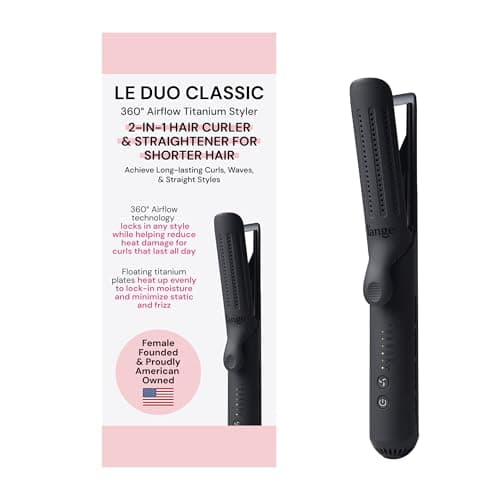
L'ange Le Duo 360° Airflow Styler (Standard)
36 W is the lowest published draw of any styling tool in this registry, by a factor of roughly fifty — and L'ange publishes it plainly rather than hiding behind a hair-dryer-sized number.
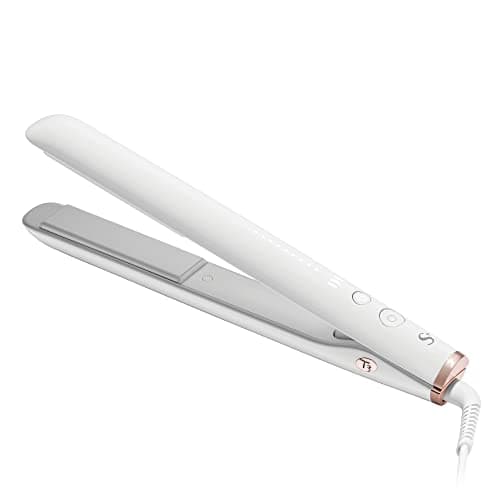
T3 SinglePass StyleMax 1 inch flat iron
Nine heat settings and genuine 100–240 V dual voltage: the most adjustable iron here and the only one you can pack for Europe without a thought.
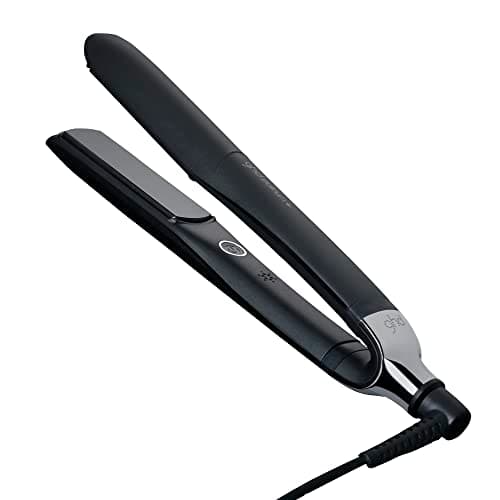
ghd Platinum+ flat iron (1 inch plate)
One temperature, 365°F, no dial to get wrong — the strongest heat-discipline argument in the category, and the longest iron warranty here at three years.
Questions people actually ask
What temperature is 5 on a flat iron?
There is no universal answer. Dial numbers are each manufacturer's own scale and are not calibrated against each other, so 5 on one iron can be tens of degrees from 5 on another. Only some makers publish degrees at all.
Which flat irons publish actual temperatures?
In this registry, L'ange publishes a full 280 to 430 degree range across its five settings, and the fixed-temperature irons publish their single figure - 365 degrees for ghd, 392 and 395 for CHI. T3 publishes nine settings without degrees.
What setting should I use on my flat iron?
The lowest one that straightens a test section at the nape in one slow pass. Start at the bottom of the dial rather than the middle, and step up one setting at a time only if a pass genuinely fails.
Is a higher setting faster?
It can straighten in fewer passes on resistant hair, which is a real benefit. But the usual reason a pass fails is a section that is too thick or hair that is not fully dry, and turning the dial up fixes neither.