Flat Irons & Straighteners
Ceramic vs Tourmaline: What the Makers Actually Publish
Every plate on this site is ceramic, titanium or an alloy. Tourmaline is a thing added to one of those, and nobody will tell you how much.
Updated September 2026 · Sawyer V.
Tourmaline is a boron silicate mineral blended into a plate or grill coating — it is an additive, not a plate material in its own right. No manufacturer in this registry publishes an ion count, a temperature difference or a drying-time figure for it, so no comparison can be made on published evidence.
We earn a commission if you buy through the links on this page, at no extra cost to you. It never changes which tool we pick or which one we tell you to skip. How this site is funded.
The question contains a category error
“Ceramic vs tourmaline” is one of the most searched comparisons in this category, and it compares two things that are not the same kind of thing. Ceramic is what the plate is made of, or coated with. Tourmaline is a mineral crushed and mixed into a coating. A tourmaline plate is a ceramic or titanium plate with tourmaline in the coating; there is no such thing as a plate made of tourmaline.
That is not pedantry, because it changes the shopping question entirely. You are never choosing between ceramic and tourmaline. You are choosing between ceramic and titanium — a real choice we work through on ceramic vs titanium — and then deciding whether a tourmaline claim on top of that should influence you.
What every maker here actually publishes
This is the whole evidence base, taken from the manufacturers’ own product pages. Read the right-hand column carefully: it is a list of material descriptions, and not one of them is a measurement.
Plate and grill surfaces, exactly as each maker states them
| Tool | Surface, as published |
|---|---|
| ghd Platinum+ | Precision-milled floating high-gloss plates, 1 in |
| T3 SinglePass StyleMax | CeraGloss ceramic plates, 1 in |
| Dyson Corrale | Flexing manganese-copper alloy plates |
| CHI 1" Original | 1 in ceramic floating plates |
| CHI Lava 1" | 1 in floating volcanic lava ceramic plates |
| Hot Tools Black Gold Evolve | Black Gold ceramic-titanium floating plates |
| L'ange Le Duo | Titanium floating plates with rounded edges |
| Hot Tools Pro Artist dryer | Tourmaline ceramic grill |
Every figure above is quoted from the manufacturer's own product page. The sources are listed at the foot of this page.
One tool in the entire registry publishes the word tourmaline: a hair dryer grill, not an iron plate. And even there the page gives a name rather than a proportion. We do not know whether that grill is one percent tourmaline or thirty, and neither does anyone else outside the factory.
The negative-ion claim, and why we will not score it
The marketing argument for tourmaline is that it releases negative ions when heated, and that those ions reduce frizz by neutralizing positive charge on the hair surface. The mechanism is plausible. The problem is that it is unfalsifiable as sold: no maker in this registry publishes an ion output figure, a unit, a test method or a measured frizz outcome.
This site’s rule is that we compare published figures and decline to rank on unpublished claims. So we are declining here. If a manufacturer begins publishing ions per cubic centimeter at a stated distance and temperature, this page will get a table. Until then, “tourmaline” on a box tells you the coating contains a mineral and nothing about what the tool will do to your hair.
The same reasoning applies to ionic dryers, which we work through in detail on are ionic hair dryers worth it. The short version: the claim is measurable in principle and is not being measured in public.
The plate specifications that do decide the outcome
Four rows on a flat iron’s spec sheet change your result, and none of them is the coating name.
- Temperature floor. Where the range starts, not where it ends. The L’ange Le Duo publishes 280°F; ghd fixes at 365°F; CHI fixes at 392°F; Hot Tools publishes only a 455°F ceiling.
- Number of stated settings. The T3 SinglePass StyleMax publishes nine. That is the difference between adjusting for your hair and hoping.
- Plate width. 1 in suits most hair; wider plates cover ground faster on long dense hair and are clumsy near the root. See plate size.
- Weight. Between 11.1 oz and 2.08 lb across the irons here, which is a threefold difference in what your wrist carries.
Floating plates — plates mounted so they self-align under pressure — appear on most of the list and are worth having, because they reduce the temptation to clamp harder to close a gap. That is a mechanical claim you can verify by looking at the tool, which is more than the ion claim offers.
Does any coating protect hair?
The honest answer is that the temperature and the moisture state of the hair dominate everything a coating could plausibly contribute. Direct contact heat on hair that is not fully dry produces the cavitated shafts described in the bubble-hair literature Kaushik et al., Indian Dermatology Online Journal, and repeated thermal cycling degrades mechanical properties regardless of what the plate is made of Evans and Park, Journal of Cosmetic Science.
A smoother plate glides with less snagging, and less snagging means fewer passes. That is a real benefit and it is why plate finish is worth caring about. It is not the same claim as the coating changing the chemistry of your hair.
What to do instead of choosing a coating
Pick the temperature behavior first, then the weight, then the plate width, and treat the coating name as a tiebreaker with no evidence behind it. If your hair is fine, colored or heat-damaged, start from the temperature-by-hair-type table and buy the iron that can sit where the table puts you.
The tools on this page
Prices come from the live price layer. Where none is available the button says so rather than showing a number we cannot stand behind.
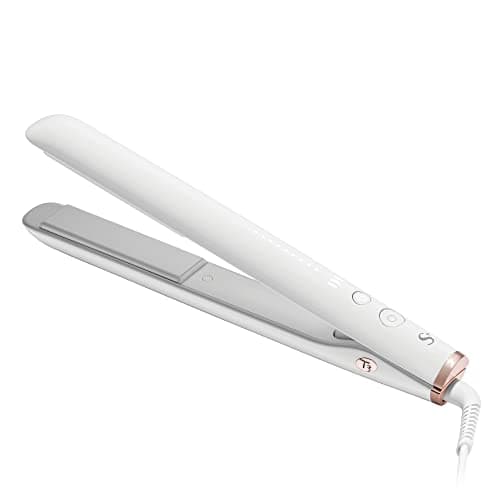
T3 SinglePass StyleMax 1 inch flat iron
Nine heat settings and genuine 100–240 V dual voltage: the most adjustable iron here and the only one you can pack for Europe without a thought.
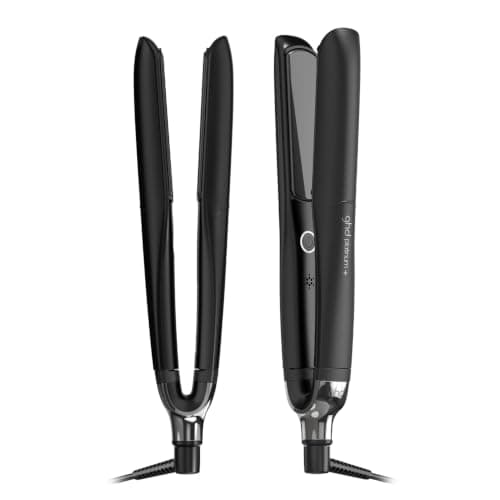
ghd Platinum+ flat iron (1 inch plate)
One temperature, 365°F, no dial to get wrong — the strongest heat-discipline argument in the category, and the longest iron warranty here at three years.
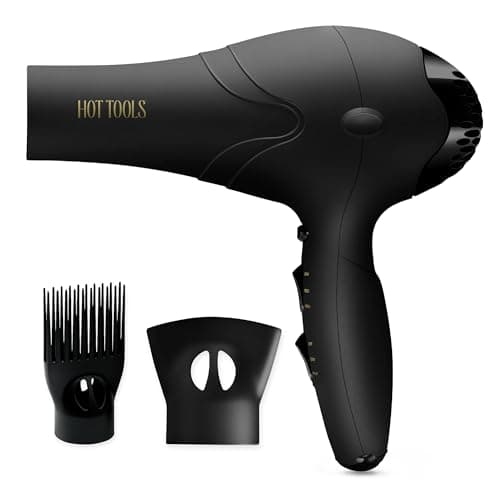
Hot Tools Pro Artist Infrared Ionic Salon Dryer 1875W
1,875 W ties the highest published draw on this site — the ghd Helios and Revlon SmoothStay state the same figure — on the only one of the three that publishes both attachments in the box and never expires.
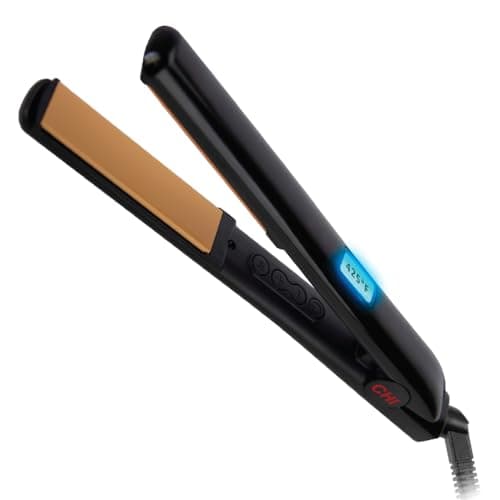
CHI 1" Original Ceramic Hairstyling Iron (GF1001)
The longest published cord on this site at 11 ft, and the only iron here with no temperature control at all — one preset, 392°F, take it or leave it.
Questions people actually ask
Is tourmaline better than ceramic for a flat iron?
The comparison does not hold up: tourmaline is a mineral added to a coating, and ceramic is what the plate is made of or coated with. A tourmaline plate is a ceramic or titanium plate with tourmaline mixed into the surface.
Does tourmaline actually reduce frizz?
No manufacturer in this registry publishes an ion output figure, a test method or a measured frizz result for tourmaline. The mechanism is plausible and the evidence is not public, so we decline to rank tools on it.
What should I look at instead of the plate coating?
The temperature floor, the number of stated settings, the plate width and the weight. Those four rows change your result and are published as actual numbers you can compare.
Is ceramic or titanium better?
Titanium heats faster and holds temperature harder, which suits coarse and dense hair; ceramic tends to be more forgiving on fine or damaged hair. That is a genuine material difference, unlike the tourmaline question.