Flat Irons & Straighteners
CHI Lava vs L'ange Le Duo: One Temperature or Five
One of these can be set to the other's temperature. The other cannot be set at all.
Updated October 2026 · Sawyer V.
CHI publishes one fixed 395°F, 2.08 lb and no wattage. L’ange publishes five settings from 280°F to 430°F, 0.8 lb and 36 W. The L’ange range contains CHI’s fixed point, so it can do what the CHI does and more — but the CHI holds a longer cord and double the warranty, and the two tools are not the same kind of object.
We earn a commission if you buy through the links on this page, at no extra cost to you. It never changes which tool we pick or which one we tell you to skip. How this site is funded.
Side by side, published only
CHI Lava 1 inch vs L'ange Le Duo 360 Airflow Styler (Standard), as published
| Row | CHI Lava 1 inch | L'ange Le Duo (Standard) |
|---|---|---|
| Heat control | One preset, 395°F (202°C) | 5 settings, 280–430°F |
| Wattage | Not published | 36 W (50 W Grande) |
| Weight | 2.08 lb | 0.8 lb / 358 g |
| Cord length | 11 ft | 8.2 ft (2.5 m) |
| Plates | 1 in floating volcanic lava ceramic | 3.5 in × 1 in floating titanium, rounded edges |
| Auto shut-off | Not published | 60 minutes |
| Dual voltage | Yes | Yes — 100–240 V, 50/60 Hz |
| Warranty | 2-year limited | 1-year |
Quoted from each maker's own product page, both re-checked for this comparison.
They are not the same kind of tool
This has to come first, because the spec rows can make the two look more alike than they are. The CHI is a flat iron and nothing else: two heated plates, closed on a section, drawn down. The L’ange Le Duo is a 360-degree airflow styler — L’ange states it both curls and straightens, and it moves air through the barrel to set the shape as the plates leave it.
That means the honest comparison is not “which iron is better.” It is: do you want a dedicated straightener that does one job with a lot of plate contact, or a lighter multi-purpose tool that straightens and curls and gives up some of that single-mindedness? If you only ever straighten, the airflow is a feature you are carrying around for nothing.
The range brackets the fixed point
This is the row that decides most of the decision. CHI gives you one temperature, 395°F. L’ange gives you five settings spanning 280°F to 430°F — a range that contains 395°F and extends both below and above it.
Read that carefully, because it is asymmetric. The Le Duo can be set to approximately where the CHI permanently sits, and it can also be set 115 degrees lower. The CHI cannot be set anywhere. Whatever argument exists for a fixed temperature — and there is a real one, which the next section makes — it is not an argument about capability. On capability this row is one-sided.
It matters most for hair that has been processed. Bleached and chemically treated hair starts with measurably less margin: redox proteomic work on virgin, bleached and relaxed hair found peroxide bleaching produced significantly increased oxidative damage at the molecular level Dyer et al., International Journal of Cosmetic Science, and repeated thermal cycling degrades the fiber’s mechanical properties measurably Evans and Park, Journal of Cosmetic Science. A 280°F floor is a real option for that hair. A fixed 395°F is not an option at all. Find your own figure first using the temperature guidance by hair type and what the dial numbers mean.
The case for the fixed temperature
It is not a null argument, and this site makes it on CHI’s and ghd’s behalf elsewhere. A dial is what people reach for when a pass does not work. Remove it and the only fixes left are the ones that actually help: thinner sections, drier hair, slower travel, one pass. Someone who has spent years creeping a dial upward may genuinely do less damage with a tool that refuses to negotiate.
There is also a repeatability point. A fixed tool is doing the same thing every morning, and in a shared bathroom there is no setting for anyone else to move. On the Le Duo, five settings means five chances to be on the wrong one — and L’ange’s 430°F ceiling is 35 degrees above where the CHI tops out, which is a real way to do harm if you treat the top setting as the default.
So the fair statement is this: the Le Duo is the more capable tool, and the CHI is the more foolproof one. Which of those you need depends on your own history with a dial more than on your hair.
0.8 lb against 2.08 lb
The CHI Lava publishes 2.08 lb. That is the heaviest published weight of any tool in this registry. The Le Duo publishes 0.8 lb, which makes the CHI roughly two and a half times heavier.
On a flat iron, weight is felt differently than on a dryer, because of how you hold one — arm raised, wrist rotated, often behind your own head, for as long as the section takes. Weight that is unremarkable for the first ten minutes is why the last sections get rushed, and rushed sections on a fixed-temperature iron mean extra passes, which is the one thing a fixed 395°F cannot absorb.
If your hair is short or fine and a session is ten minutes, this row is close to irrelevant. If you have long, dense hair and work section by section for half an hour, it is the row most likely to decide how you feel about the tool a month in.
36 W against a blank row
L’ange publishes 36 W for the Standard. At the U.S. average residential rate of 18.34 cents per kilowatt-hour and 65 hours of use a year, that is about 43 cents a year to run. CHI publishes no wattage at all, so the same figure cannot be computed for the Lava.
Be clear about how much this matters: almost nothing, in dollars. Irons draw in short bursts to hold two small plates at temperature, and the annual cost is pennies however the number comes out — the running-cost page has the formula. What the row is actually worth is as a disclosure signal. A maker that publishes weight to two decimal places and cord length to the foot, as CHI does, plainly has the wattage figure and has chosen not to print it.
Where the CHI wins
Two rows, and they are not trivial ones.
The cord: 11 ft against 8.2 ft. Eleven feet is the longest class of cord published on this site, and bathroom sockets are rarely beside the mirror. Nearly three extra feet is the difference between styling where the light is and styling where the power is, and it keeps tension off the cord — the failure most warranties exclude.
The warranty: two years against one. L’ange’s single year is the shortest cover of any tool in this registry, and it is the clearest cost of buying the cheaper tool. Against that, L’ange is the only one of the two publishing an auto shut-off at all, at 60 minutes — CHI’s page states none, which is a blank row on a tool that gets left plugged in.
Both of them pack
Unusually for this pair’s price gap, both publish dual voltage, so both run on a 230 V supply with a plug adapter rather than a voltage converter — see adapter vs converter for why that distinction decides whether a tool survives the trip. On packed size and weight the Le Duo is the obvious one to take, at under half the weight and with a shorter cord to coil.
Who should buy which
- Fine, bleached, color-treated or heat-damaged hair: the Le Duo. The 280°F floor is the entire reason. A fixed 395°F gives that hair no way to compensate. Start at flat irons for fine hair.
- Coarse, dense, resistant hair that wants one hot repeatable pass: the CHI. It sits near the top of the range on purpose, and the longer cord and longer warranty come with it.
- Anyone who curls as well as straightens: the Le Duo, since L’ange publishes both functions and the airflow is there to set the shape.
- Long sessions on dense hair: the Le Duo, on weight alone — 0.8 lb against the heaviest tool on this site.
- Anyone who knows they creep a dial upward: the CHI. The absence of a control is the feature, and it is a real one.
- Skip both if you need a published floor below 280°F or cover longer than two years. Neither tool offers either.
The single-product detail is at the CHI Lava review and the Le Duo review. If you are choosing within CHI rather than across brands, CHI Original vs CHI Lava is the page.
The tools on this page
Prices come from the live price layer. Where none is available the button says so rather than showing a number we cannot stand behind.
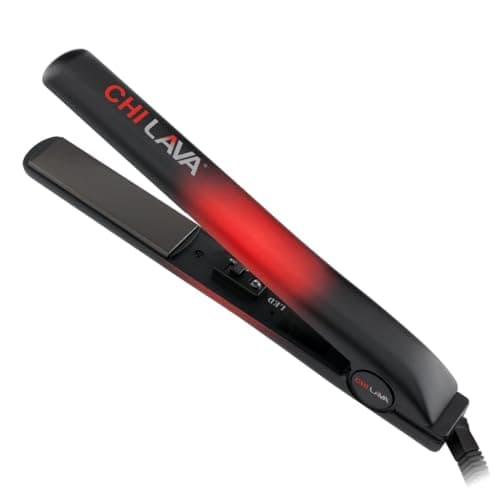
CHI Lava 1" Volcanic Ceramic Hairstyling Iron (GF8269)
2.08 lb published makes this the heaviest tool in the registry — heavier than the Dyson Supersonic at 1.8 lb — and it is a flat iron you hold at head height.
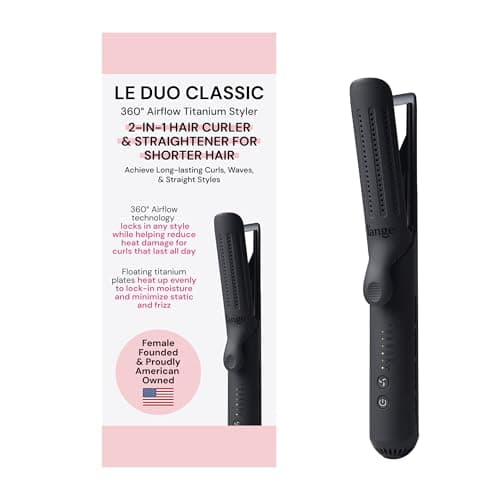
L'ange Le Duo 360° Airflow Styler (Standard)
36 W is the lowest published draw of any styling tool in this registry, by a factor of roughly fifty — and L'ange publishes it plainly rather than hiding behind a hair-dryer-sized number.
Questions people actually ask
Can the L'ange Le Duo get as hot as the CHI Lava?
Yes. L'ange publishes five settings from 280 to 430 degrees Fahrenheit, a range that contains the CHI's fixed 395 and goes 35 degrees above it. The reverse is not true - the CHI cannot be set lower.
Which is better for damaged hair?
The Le Duo, because of the published 280 degree floor. A fixed 395 degrees gives previously damaged or bleached hair no way to compensate.
How much heavier is the CHI Lava?
CHI publishes 2.08 lb and L'ange publishes 0.8 lb, so the CHI is roughly two and a half times heavier. The Lava is the heaviest published weight of any tool on this site.
Do both work abroad?
Yes. Both makers publish dual voltage, so both run on a 230 V supply with a plug adapter rather than a voltage converter. The Le Duo is the easier one to pack at under half the weight.
Which has the better warranty?
The CHI, at two years against one. L'ange's single year is the shortest cover of any tool in this registry. L'ange is the only one of the two that publishes an auto shut-off, at 60 minutes.
Sources
- CHI - Lava 1 inch Analog Volcanic Ceramic Hairstyling Iron (GF8269) product page
- L'ange - Le Duo 360 Airflow Titanium Styler product page
- Dyer et al. - Redox proteomic evaluation of bleaching and alkali damage in human hair, Int J Cosmet Sci 2013
- Evans and Park - thermal cycling and mechanical properties