Flat Irons & Straighteners
ghd Chronos: What the Published Specs Say
The newer ghd iron, and the only one in their range you can buy with a wide plate. It also has the one blank row that stops us packing it.
Updated September 2026 · Sawyer V.
ghd publishes one fixed temperature of 365°F, floating ceramic plates with an ultra-gloss coating in 1 inch and a wide-plate version, and a three-year warranty — the longest iron warranty in our registry. It publishes no wattage, weight, cord length or voltage rating.
We earn a commission if you buy through the links on this page, at no extra cost to you. It never changes which tool we pick or which one we tell you to skip. How this site is funded.
The wide plate is the reason this exists
ghd sells the Chronos in a 1 inch version and a wide-plate version. They do not sell the Platinum+ that way, and that single fact is the clearest reason to choose one over the other.
Plate width decides how much hair you cover per pass, and pass count is the term in the damage arithmetic you can actually reduce. Total heat exposure is roughly temperature multiplied by contact time, and on long or dense hair contact time is dominated by how many times you go over a section. Three passes at 380°F is more accumulated exposure than one at 420°F, even though the second number looks more alarming.
So a wide plate is a damage argument as well as a time argument. It is why the Chronos is a pick on the thick-hair page where the Platinum+ is the named skip — same brand, same temperature philosophy, opposite verdicts, decided by one specification. The full reasoning is on the plate size page.
Floating plates and a wishbone hinge
ghd publishes floating ceramic plates with an ultra-gloss coating, and a re-engineered wishbone hinge holding them aligned.
Floating means the plates move slightly within the body rather than being fixed rigid, so they self-align on a section instead of gripping hardest through the middle. Uneven contact is what makes you go back over a section, so this is the same argument as the wide plate arriving from a different direction.
The hinge matters more on a wide plate than a narrow one. A wider plate has more leverage to twist out of alignment, and misaligned wide plates grip unevenly across exactly the dense section you bought them for. Publishing a hinge redesign alongside a wide-plate option is coherent engineering rather than a feature list.
Dyson takes the same problem somewhere else entirely with plates that physically flex around the section — that comparison is on the Corrale review.
365°F, fixed, again
There is no temperature dial. Every ghd product in our registry runs at one fixed 365°F: the Platinum+, the Chronos, the Chronos Curve Classic, the Curve Thin and the Wave.
The argument for it is genuinely good and we make it in full on the Platinum+ review: damage is driven by temperature and by pass count, and the temperature most people select when handed a dial is higher than the one their hair needs. Removing the dial removes the most common self-inflicted error in the category.
The Chronos softens the counter-argument without removing it. When a fixed-temperature iron fails to straighten a section, your only remaining move is another pass — but a wide plate makes the first pass more likely to work. That is a real improvement on resistant hair, and it still does nothing for hair that needs to work below 365°F. Bleached and double-processed hair is the case, and it is on its own page.
Three years, and what that is worth
Three years is the longest iron warranty in our registry. Dyson publishes two on the Corrale, T3 publishes two on the SinglePass StyleMax, and ghd publishes three on both the Platinum+ and the Chronos.
A warranty term is one of the few numbers on a spec sheet that cannot be marketing, because getting it wrong costs the manufacturer money. On a tool with no moving parts beyond a hinge and no battery to degrade, three years of cover is a real statement about build.
It also supports the arithmetic we publish everywhere. Every price-per-use figure on this site assumes a five-year service life; a three-year warranty is evidence for that assumption rather than against it. The general case is on the warranty page.
Price per use, at 5 uses a week over 5 years
| What you pay | Cost per use | Cost per year |
|---|---|---|
| $30 | $0.02 | $6.00 |
| $60 | $0.05 | $12.00 |
| $100 | $0.08 | $20.00 |
| $150 | $0.12 | $30.00 |
| $200 | $0.15 | $40.00 |
| $300 | $0.23 | $60.00 |
| $400 | $0.31 | $80.00 |
| $500 | $0.38 | $100.00 |
5 uses a week for 5 years is 1300 uses. Both figures are stated assumptions, not measurements — halve the life and every cost per use doubles. We publish the ladder rather than a worked example for one specific product because a price we typed into a sentence would be wrong within a week.
The blank row that keeps it home
What it costs to run for a year
ghd does not publish a wattage for this tool, so there is nothing honest to compute. The formula is watts ÷ 1,000 × hours a year × your rate per kWh; if you find a rating plate on the handle, 65 hours a year and 18.34 cents per kilowatt-hour will get you the rest of the way.
ghd publishes no voltage rating for the Chronos. Not “no”, not “yes” — nothing.
On most specifications a blank row is an inconvenience. On this one it is disqualifying, because the consequence of guessing wrong is a destroyed tool. UK supply is declared at 230 V and may legally reach 253 V, which is more than double what a 120 V-only tool is built for — the figures are on the UK page.
What makes it odd is that ghd clearly knows the row matters. They publish universal voltage for the Platinum+ and for the Curve Thin, and they state outright that the Helios is not universal voltage. Three products disclosed, two left blank. It is why the Chronos is our named skip on the travel irons page.
No wattage either, so no running cost, and no weight or cord length. That is the consistent ghd pattern across their whole range: temperature philosophy and warranty terms in detail, physical specifications sparingly.
Chronos or Platinum+
They share a temperature, a warranty term and a design philosophy. The published differences are narrow and they point clearly.
ghd Chronos against ghd Platinum+, published figures only
| Specification | Chronos | Platinum+ |
|---|---|---|
| Temperature | One fixed — 365°F | One fixed — 365°F |
| Plates | Floating ceramic, ultra-gloss; 1 in and wide | Precision-milled floating high-gloss; 1 in only |
| Hinge | Re-engineered wishbone | Not specified |
| Cord | Not published | 9 ft power cable |
| Voltage | Not published | Universal voltage |
| Warranty | 3 years | 3 years |
| Wattage | Not published | Not published |
| Weight | Not published | Not published |
Buy the Chronos for the wide plate. Buy the Platinum+ for the published voltage and cord length. The full head-to-head is on its own page.
Who this is for
- Long, dense hair where coverage per pass decides the session. The wide-plate option is the only one in ghd’s range.
- Anyone who over-heats their hair given the chance. No dial to reach for.
- People who keep tools. Three years, no battery.
Who should skip it
- Travelers. No published voltage rating. Buy the Platinum+ instead, from the same brand and the same philosophy.
- Bleached or double-processed hair. Nothing below 365°F. The nine-setting T3 SinglePass StyleMax is the tool — reviewed here.
- Spec-sheet shoppers. No wattage, weight, cord or voltage is four blank rows at a flagship price.
What we cannot tell you
We have not used this iron. We do not know what it weighs, how long the cable is, whether it works abroad, or how the ultra-gloss coating holds up across three warranted years. Every figure above is from ghd’s own product page.
The tools on this page
Prices come from the live price layer. Where none is available the button says so rather than showing a number we cannot stand behind.
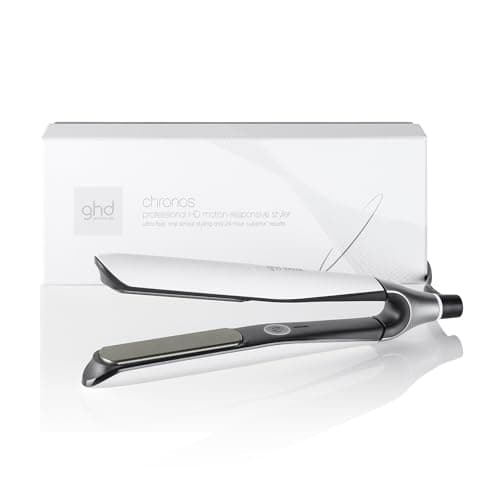
ghd Chronos flat iron (1 inch plate)
The Platinum+ argument with a re-engineered hinge and a wide-plate option — same fixed 365°F, same three-year warranty, more plate choice.
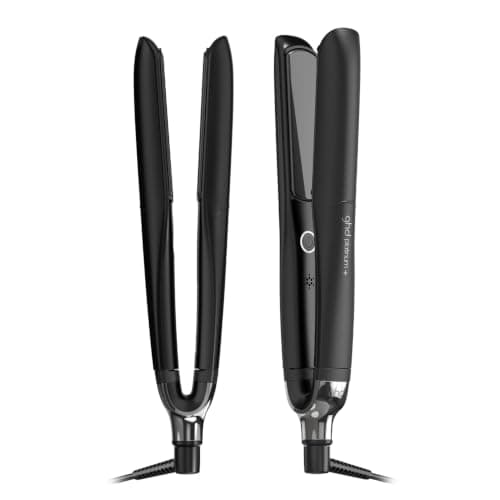
ghd Platinum+ flat iron (1 inch plate)
One temperature, 365°F, no dial to get wrong — the strongest heat-discipline argument in the category, and the longest iron warranty here at three years.
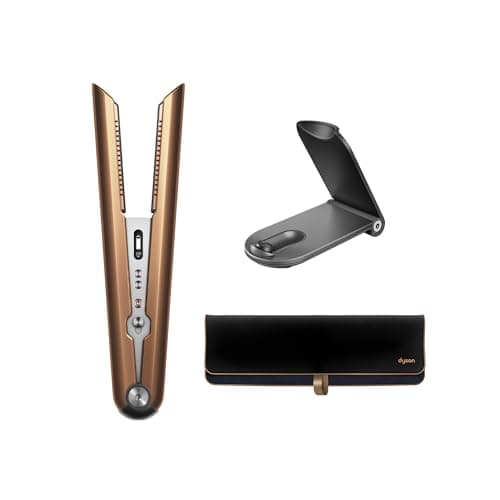
Dyson Corrale straightener
Cordless, and the only iron here whose plates flex. The 200 W figure is a battery rating and is not comparable to a corded iron's draw.
Questions people actually ask
Is the ghd Chronos dual voltage?
ghd publishes no voltage rating for it at all. That is not a yes — check the rating plate before traveling, and note that ghd does publish universal voltage for the Platinum+ and the Curve Thin.
What temperature is the ghd Chronos?
365°F, fixed, with no temperature control on the tool. That is ghd's position across their entire range rather than an omission on this product.
Chronos or Platinum+?
The Chronos for the wide-plate option, which the Platinum+ does not offer and which matters on long dense hair. The Platinum+ for published universal voltage and a stated 9 ft cable.