Flat Irons & Straighteners
Dyson Corrale: What the Published Specs Say
The only iron here whose plates bend around the hair, and the only one whose power rating cannot be compared with anything else on this page.
Updated September 2026 · Sawyer V.
Dyson publishes flexing manganese-copper alloy plates, three heat settings with a stated starting point of 365°F, 1.23 lb, a 10.9 ft charging cable, a 10.8–16.8 V battery and a two-year warranty. The 200 W figure is a battery rating and does not compare with a corded iron’s draw.
We earn a commission if you buy through the links on this page, at no extra cost to you. It never changes which tool we pick or which one we tell you to skip. How this site is funded.
The plates are the product
Every other iron in this registry has rigid plates. This one has plates that flex, and Dyson’s own guidance tells you to loosen your grip because the plates shape themselves to gather the hair.
The problem that solves is specific. A section of hair is not flat — it has thickness in every direction — so rigid plates make firm contact through the middle of the section and lighter contact at the edges. The edges then need another pass. Since total damage is roughly temperature multiplied by contact time, and contact time on thick hair is dominated by pass count, an iron that finishes a section first time is doing more for your hair than an iron with a lower number on the dial.
It is the only headline feature in the category that maps directly onto a mechanism rather than onto a material name, which is why the Corrale wins the thick-hair page and appears on the damaged-hair page.
About that 200 W
What it costs to run for a year
$2.38 a year
200 W × 65 hours a year = 13.0 kWh, at 18.34 cents per kilowatt-hour. The hours assume 15 minutes a session, 5 days a week — that is an assumption, not a measurement, so swap in your own if it is wrong.
Read that number carefully, because it is the most misreadable specification on this site. 200 W here describes a battery-powered tool, and Dyson also publishes the cell as 10.8–16.8 V. It is not telling you the Corrale is one-ninth as powerful as a 1,875 W dryer; those are different kinds of measurement on different kinds of machine.
It also means the running-cost arithmetic we publish for every other tool does not transfer. A corded iron draws its rated power continuously while heating; a battery iron draws whatever the charger draws, for however long charging takes, and Dyson does not publish that. The computed figure above is the honest arithmetic on the published number and should be treated as a floor, not a measurement.
Cordless: what it actually buys and costs
The cordless trade, stated plainly
| What you gain | What you give up |
|---|---|
| Freedom to work around the back of the head without the cord fighting you | A session limited by charge rather than by patience |
| The lightest published iron here at 1.23 lb | A battery that degrades over years in a way plates do not |
| Usable on a plane, in a car, at a venue with no socket | Spare-battery air travel rules that corded irons never trigger |
| No voltage conversion needed to operate it | The charger still has to work wherever you are |
On very thick or very long hair, the charge limit is the real constraint. Straightening dense hair properly is a long session, and a tool that stops partway is worse than one that never stops. That is a genuine reason to prefer a corded iron even though the cordless one has better plates.
For travel, cordless is a mixed blessing rather than a clean win. The FAA permits lithium batteries installed in a device, but spare uninstalled lithium-ion batteries must be in carry-on baggage only, and are capped at 100 watt-hours each — FAA PackSafe. The practical version of that for hair tools is on the carry-on rules page.
Three heat settings, and where they start
Dyson publishes three heat settings and states 365°F as the starting point. Three is the fewest of any adjustable iron we list — T3 publishes nine on the SinglePass StyleMax — and it is the specification most often held against the Corrale.
The fair reading is that it sits between two philosophies. ghd removes the dial entirely and fixes at 365°F; T3 gives you nine steps. Dyson gives you three, starting where ghd stops. If your hair needs less than 365°F, this iron cannot give it to you, and the ghd cannot either — that is a category-wide gap rather than a Dyson one.
The 10.9-foot charging cable
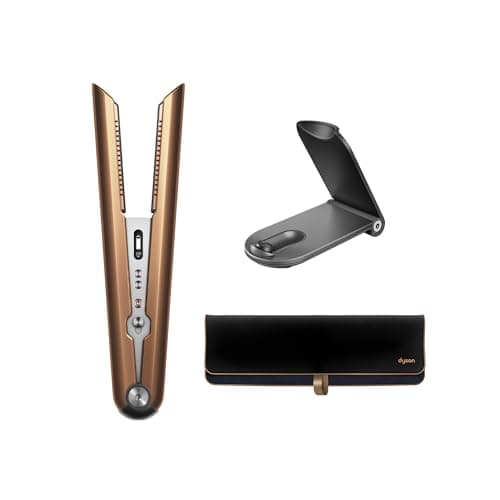
Worth flagging because it is easy to misread as a power cord. It is the longest cable figure in our iron registry and it is for charging; the iron itself is used off the cable. Dyson also publishes a charging dock and a travel pouch in the box, which is the most complete accessory list of any iron here — the others publish none.
Who this is for
- Thick or dense hair. Flexing plates address the exact failure mode that makes dense sections take three passes.
- Anyone straightening around the back of their head. No cord is genuinely different, not marginally different.
- People who style away from a socket. Getting ready somewhere else is the use case this tool is uniquely built for.
Who should skip it
- Very long, very dense hair. A full session can outlast a charge, and a half-straightened head is worse than a slow one.
- Fine hair that needs below 365°F. Three settings starting at 365°F is not the tool. The fixed-temperature ghd is not either, for the same reason — see the fine-hair page.
- Budget-conscious buyers. It is the most expensive iron we list, and the plate technology is the only thing you cannot get elsewhere.
What we cannot tell you
We have not used this iron. We do not know how long a charge lasts in practice, how the battery holds up after two years, or how the flexing plates feel against a rigid pair. Dyson publishes no runtime figure on the product page we cite, which on a battery tool is the specification we would most want.
The tools on this page
Prices come from the live price layer. Where none is available the button says so rather than showing a number we cannot stand behind.
Dyson Corrale straightener
Cordless, and the only iron here whose plates flex. The 200 W figure is a battery rating and is not comparable to a corded iron's draw.
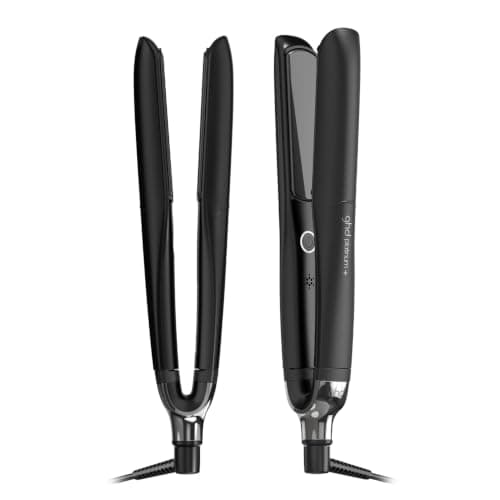
ghd Platinum+ flat iron (1 inch plate)
One temperature, 365°F, no dial to get wrong — the strongest heat-discipline argument in the category, and the longest iron warranty here at three years.
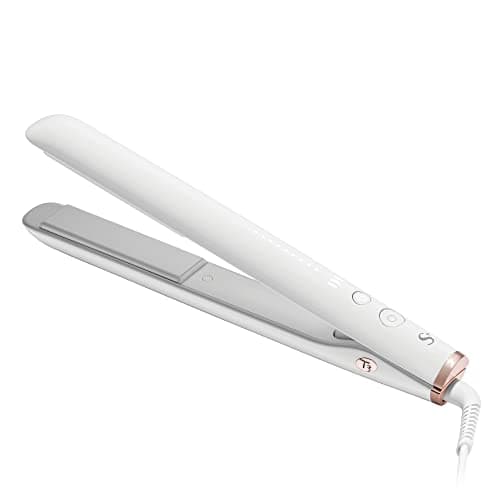
T3 SinglePass StyleMax 1 inch flat iron
Nine heat settings and genuine 100–240 V dual voltage: the most adjustable iron here and the only one you can pack for Europe without a thought.
Questions people actually ask
How many watts is the Dyson Corrale?
Dyson publishes 200 W, but this is a battery-powered tool with a 10.8-16.8 V cell, so that figure is not comparable with a corded iron's draw. Treat it as a battery rating rather than a power rating.
Can you take a Dyson Corrale on a plane?
The FAA permits lithium batteries installed in a device. Spare uninstalled lithium-ion batteries must go in carry-on baggage only and are limited to 100 watt-hours each, so keep the iron with you rather than in checked luggage.
What temperature does the Dyson Corrale start at?
Dyson states 365°F as the starting point across three heat settings. There is nothing below that, which makes it the wrong iron for hair that needs a genuinely low temperature.