Is It Worth It?
Are Expensive Hair Dryers Worth It? The Arithmetic
Nobody in this category publishes the math, so here it is. Electricity is a rounding error, and the whole decision is price divided by uses.
Updated September 2026 · Sawyer V.
At five uses a week over five years — 1,300 uses — every $100 of purchase price works out to about eight cents a use. The premium between a $40 dryer and a $430 one is roughly thirty cents a use. Electricity is irrelevant: the whole spread across our registry is about seven dollars a year.
We earn a commission if you buy through the links on this page, at no extra cost to you. It never changes which tool we pick or which one we tell you to skip. How this site is funded.
Why nobody else publishes this
In research we fetched ten pages ranking for the main terms in this category. Not one published a running cost. Not one published a price-per-use figure. Not one named a product it would not buy. The question every reader is actually asking — is this genuinely six times better, or six times the price — was answered nowhere.
That is odd, because the arithmetic is not hard. It needs a published wattage, a cited electricity rate, a stated usage assumption, and the willingness to show your working.
Step one: electricity is a rounding error
People assume a powerful dryer is expensive to run. Work it out and the assumption collapses.
Annual running cost by published wattage
| Tool | Wattage | kWh per year | Cost per year |
|---|---|---|---|
| Revlon SmoothStay | 1,875 W | 121.9 | $22.36 |
| Shark SpeedStyle Pro | 1,750 W | 113.8 | $20.87 |
| Dyson Supersonic | 1,600 W | 104.0 | $19.07 |
| Dyson Airwrap | 1,300 W | 84.5 | $15.50 |
15 minutes a day, 5 days a week — 65 hours a year — at the June 2026 US average residential rate of 18.34 cents per kWh. Usage is a stated assumption; scale it to yours.
Seven dollars a year separates the most and least power-hungry tools we list, at the rate published by the U.S. Energy Information Administration for June 2026. Over five years, thirty-five dollars.
So anyone telling you a low-wattage premium tool pays for itself in energy savings is doing arithmetic they have not shown you. It does not, by roughly two orders of magnitude.
Step two: the whole decision is price divided by uses
Since running cost is negligible, the entire economics is what you paid, spread across how many times you use it.
Price per use, at 5 uses a week over 5 years
| What you pay | Cost per use | Cost per year |
|---|---|---|
| $30 | $0.02 | $6.00 |
| $60 | $0.05 | $12.00 |
| $100 | $0.08 | $20.00 |
| $150 | $0.12 | $30.00 |
| $200 | $0.15 | $40.00 |
| $300 | $0.23 | $60.00 |
| $400 | $0.31 | $80.00 |
| $500 | $0.38 | $100.00 |
5 uses a week for 5 years is 1300 uses. Both figures are stated assumptions, not measurements — halve the life and every cost per use doubles. We publish the ladder rather than a worked example for one specific product because a price we typed into a sentence would be wrong within a week.
Read the rows for the two prices you are actually comparing and subtract. That difference — usually somewhere between five and thirty cents — is the real premium.
Whether thirty cents a use is worth it is genuinely your call and we are not going to pretend there is an objective answer. What we can do is take the adjectives out of it.
Step three: the two variables that actually move the number
Neither of them is the price.
How usage and lifespan change the cost per use of a $400 tool
| Usage | Service life | Total uses | Cost per use |
|---|---|---|---|
| Twice a month | 2 years | 48 | $8.33 |
| Twice a month | 5 years | 120 | $3.33 |
| Twice a week | 5 years | 520 | $0.77 |
| Five times a week | 5 years | 1,300 | $0.31 |
| Daily | 5 years | 1,825 | $0.22 |
| Daily | 8 years | 2,920 | $0.14 |
Same tool, same price, a nearly sixty-fold range in cost per use. This is the reason a single confident yes-or-no answer to this question is always wrong.
A $400 tool used twice a month for two years is $8.33 a use. The same tool used daily for eight years is fourteen cents. Nothing about the product changed; the entire difference is you.
Which is why lifespan matters as much as price, and why we take published warranties seriously as the only durability figure anyone commits to — see how long hair dryers last.
What the premium genuinely buys
It would be lazy to conclude that expensive tools are a con. On published specifications, three things do reliably improve with price.
- Heat control. Four heat settings plus a cold shot, or nine steps on an iron, or a fixed 365°F with no way to overshoot. All of these are genuinely different from high-and-low, and all of them matter most on the hair that is easiest to damage.
- Weight. Premium dryers publish 1.23 to 1.8 lb. Cheaper ones frequently publish no weight at all, which is its own answer.
- Disclosure. Dyson, Shark and T3 publish weights, cord lengths and voltages. Several cheaper makers publish a wattage and stop. You are partly paying for a company that will tell you what you are buying.
And the one that does not
Warranty. The longest in our entire registry is four years, on a Revlon hot air brush that costs a fraction of a flagship. ghd publishes three. Dyson, Shark and T3 all publish two.
The most expensive tools on this site carry the shortest written durability commitments. That is not a small footnote on a page about whether the premium is worth paying.
The honest summary
- Buy premium if you use it several times a week, your hair is fine or damaged enough that heat control genuinely matters, and you expect to keep it for years.
- Buy mid-range if you want most of the specification without the flagship badge. This is where the curve flattens.
- Buy cheap if your hair is robust and you mostly need it dry. You are giving up granularity and published information, not power.
- Buy nothing if your hair is damaged. Using heat less often will do more than any purchase — the arithmetic on that is here, and it earns us nothing.
Quick picks
Tap any row to jump to the full write-up. Prices come from the live price layer; where none is available the button says so rather than showing a number we cannot stand behind.
| # | Product | Best for | Price |
|---|---|---|---|
| 1 | Dyson Supersonic hair dryer Four heat settings plus a cold shot on the lowest published wattage of any conventional dryer — the heat control the money buys. | Daily use on fine or fragile hair | |
| 2 | 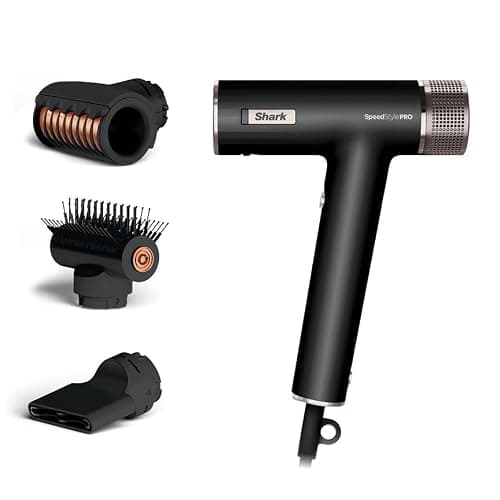 Shark SpeedStyle Pro hair dryer More published wattage than the Dyson, less weight, twice the attachments, the same warranty — for considerably less. | Most people, most hair | |
| 3 | 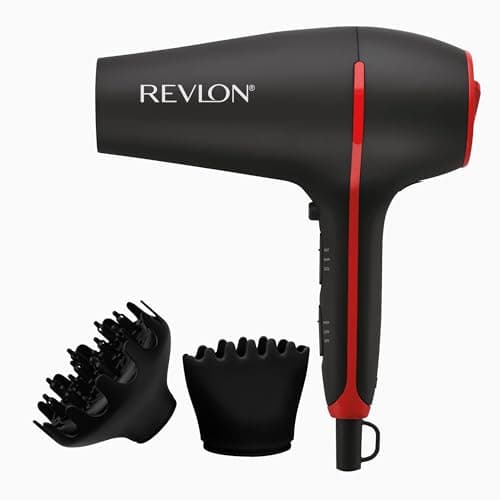 Revlon SmoothStay Coconut Oil-Infused hair dryer The highest published wattage on the site, and the thinnest published spec sheet. | Robust hair on a tight budget | |
| — | 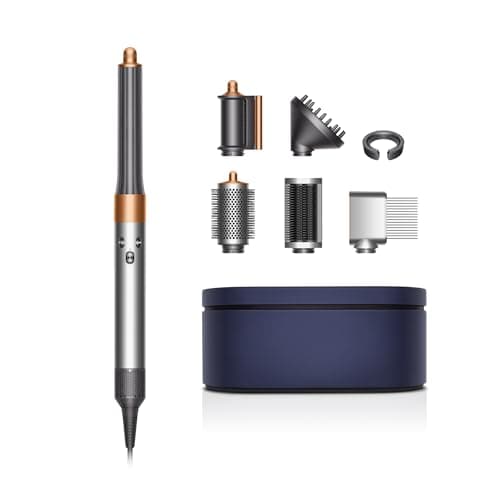 Dyson Airwrap multi-styler (Complete Long) The worst price-per-use arithmetic on the site for anyone who styles occasionally. We’d skip this | Not an occasional purchase |
1. What the premium actually buys
Dyson Supersonic hair dryer
Best for: Daily use on fine or fragile hair
Four heat settings plus a cold shot on the lowest published wattage of any conventional dryer — the heat control the money buys.
If the premium is buying anything measurable, it is here: the most granular published heat control of any conventional dryer we list, on the lowest published wattage. That combination is genuinely hard to find further down the price range, and for fine or already damaged hair it is the thing that matters.
It is also the heaviest dryer in our registry at a published 1.8 lb, and it costs about $19.07 a year to run.
What’s wrong with it
Heaviest published weight here, 120 V only, and a two-year warranty that a $40 hot air brush beats by double.
Published specifications — Dyson Supersonic hair dryer
| Wattage | 1,600 W |
|---|---|
| Heat settings | 4 heat settings, including a cold shot |
| Speed settings | 3 speed settings |
| Weight | 1.8 lb |
| Cord length | 8.6 ft |
| Noise (dB) | Not published |
| Attachments | 3 — styling concentrator, diffuser, wide-tooth comb |
| Plate / barrel | Air-multiplier body; no heated styling surface |
| Dual voltage | No — 120 V |
| Warranty | 2-year limited warranty |
Every figure above is taken from Dyson — Supersonic hair dryer product page. “Not published” means the figure does not appear on that page — it is not an estimate withheld, it is a number the manufacturer does not state. How we compile these.
What it costs to run for a year
$19.07 a year
1,600 W × 65 hours a year = 104.0 kWh, at 18.34 cents per kilowatt-hour. The hours assume 15 minutes a session, 5 days a week — that is an assumption, not a measurement, so swap in your own if it is wrong.
2. Where the curve flattens
Shark SpeedStyle Pro hair dryer
Best for: Most people, most hair
More published wattage than the Dyson, less weight, twice the attachments, the same warranty — for considerably less.
This is the pick that makes the value argument concrete. On four of the nine comparable published rows it beats the flagship, on three it ties, and the two it loses are fractions of a pound and inches of cord.
The rows it does lose matter for one hair type: Shark publishes no heat-setting count, which is exactly what fine or damaged hair needs to check.
What’s wrong with it
No published heat- or speed-setting count, and 120 V only. Costs about $20.87 a year to run — the second highest here.
Published specifications — Shark SpeedStyle Pro hair dryer
| Wattage | 1,750 W (peak 1,750 W) |
|---|---|
| Heat settings | Not published |
| Speed settings | Not published |
| Weight | 1.65 lb |
| Cord length | 96.1 in (8.0 ft) |
| Noise (dB) | Not published |
| Attachments | Turbo concentrator, QuickSmooth brush, DefrizzFast diffuser, wide-tooth comb, touch-up brush, FrizzFighter finishing tool |
| Plate / barrel | High-velocity airflow; no heated styling surface |
| Dual voltage | No — 120 V |
| Warranty | 2-year limited warranty |
Every figure above is taken from SharkNinja — Shark SpeedStyle Pro (HD731) product page. “Not published” means the figure does not appear on that page — it is not an estimate withheld, it is a number the manufacturer does not state. How we compile these.
What it costs to run for a year
$20.86 a year
1,750 W (peak 1,750 W) × 65 hours a year = 113.8 kWh, at 18.34 cents per kilowatt-hour. The hours assume 15 minutes a session, 5 days a week — that is an assumption, not a measurement, so swap in your own if it is wrong.
3. What you give up going cheap
Revlon SmoothStay Coconut Oil-Infused hair dryer
Best for: Robust hair on a tight budget
The highest published wattage on the site, and the thinnest published spec sheet.
1,875 W — more than every premium tool we list. If watts were what you were buying, this would be the flagship and the price structure of the industry would be upside down.
What you give up is not power. It is granularity — three heat settings, two speeds — and disclosure: no published weight, cord length, voltage or warranty. On robust hair that is a fair trade. On fine hair it is not.
What’s wrong with it
Four blank rows in the standard spec block, and the fewest heat settings of any dryer on the site.
Published specifications — Revlon SmoothStay Coconut Oil-Infused hair dryer
| Wattage | 1,875 W |
|---|---|
| Heat settings | 3 heat settings |
| Speed settings | 2 speed settings |
| Weight | Not published |
| Cord length | Not published |
| Noise (dB) | Not published |
| Attachments | Not published |
| Plate / barrel | 1 in grill, triple-coated ceramic; tourmaline ionic |
| Dual voltage | Not published |
| Warranty | Not published |
Every figure above is taken from Revlon Hair Tools — SmoothStay Coconut Oil-Infused hair dryer. “Not published” means the figure does not appear on that page — it is not an estimate withheld, it is a number the manufacturer does not state. How we compile these.
What it costs to run for a year
$22.35 a year
1,875 W × 65 hours a year = 121.9 kWh, at 18.34 cents per kilowatt-hour. The hours assume 15 minutes a session, 5 days a week — that is an assumption, not a measurement, so swap in your own if it is wrong.
The one we'd skip
Dyson Airwrap multi-styler (Complete Long)
Best for: Not an occasional purchase
The worst price-per-use arithmetic on the site for anyone who styles occasionally.
On a page about value the Airwrap is the clearest cautionary case, and the reason is arithmetic rather than quality.
It is the most expensive tool we cover, and it is a styling tool rather than a daily-drying one — which means most owners use it far less often than they use a dryer. A flagship price divided by twice a month over two years is dollars per use, not cents.
At high frequency on fine hair it is a genuinely good buy, and we say so on the fine-hair page. Bought for occasional use, it is the worst value in this category.
What’s wrong with it
Highest price on the site combined with the lowest typical usage frequency — the exact combination that ruins price-per-use arithmetic.
Published specifications — Dyson Airwrap multi-styler (Complete Long)
| Wattage | 1,300 W |
|---|---|
| Heat settings | 3 heat settings |
| Speed settings | 3 speed settings |
| Weight | 1.4 lb |
| Cord length | 8.5 ft |
| Noise (dB) | Not published |
| Attachments | Curling barrels, smoothing brushes, round volumizing brush, drying nozzle |
| Plate / barrel | Coanda airflow barrels; no clamped heat plate |
| Dual voltage | No — 120 V |
| Warranty | 2-year limited warranty |
Every figure above is taken from Dyson — Airwrap Complete Long product page. “Not published” means the figure does not appear on that page — it is not an estimate withheld, it is a number the manufacturer does not state. How we compile these.
What it costs to run for a year
$15.50 a year
1,300 W × 65 hours a year = 84.5 kWh, at 18.34 cents per kilowatt-hour. The hours assume 15 minutes a session, 5 days a week — that is an assumption, not a measurement, so swap in your own if it is wrong.
Questions people actually ask
Are expensive hair dryers worth it?
At five uses a week over five years, every $100 of purchase price is about eight cents a use, so the premium between a cheap dryer and a flagship is roughly thirty cents per use. Whether that is worth it depends almost entirely on how often you use it and how long it lasts.
Do expensive hair dryers save money on electricity?
No. The whole spread across our registry is about seven dollars a year — from $15.50 for a 1,300 W tool to $22.36 for an 1,875 W one, at the June 2026 US average rate. Over five years that is thirty-five dollars against a purchase-price gap of hundreds.
Do I really need an expensive hair dryer?
If your hair is robust and you mostly need it dry, no — the highest published wattage in our registry belongs to a drugstore dryer. If your hair is fine or damaged, the heat-setting granularity that comes with price is the one thing genuinely worth paying for.
What lasts longer, an expensive dryer or a cheap one?
Nothing published supports the expensive one. The longest warranty in our registry is four years on a Revlon hot air brush; Dyson, Shark and T3 all publish two. No manufacturer at any price publishes an expected lifespan.