Is It Worth It?
Why Is Dyson So Expensive?
Read the spec sheet cold and the price makes no sense. That is the interesting part, and it has a real answer.
Updated September 2026 · Sawyer V.
Dyson’s published specifications do not explain the price. The Supersonic states 1,600 W — less than a drugstore dryer — and a two-year warranty, which a $40 hot air brush doubles. What you are paying for is motor and airflow engineering that nobody publishes a comparable figure for, plus design and brand.
We earn a commission if you buy through the links on this page, at no extra cost to you. It never changes which tool we pick or which one we tell you to skip. How this site is funded.
What the spec sheet says
Set the marketing aside and read Dyson’s own numbers against the field.
Dyson's published figures against cheaper tools
| Specification | Dyson | The competition |
|---|---|---|
| Wattage | 1,600 W (Supersonic), 1,300 W (Airwrap) | 1,875 W drugstore Revlon; 1,750 W Shark |
| Weight | 1.8 lb (Supersonic) | 1.65 lb Shark; 16.6 oz T3 |
| Warranty | 2-year limited | 4-year Revlon; 3-year ghd |
| Dual voltage | No — 120 V | Also no, across the category |
| Noise (dB) | Not published | Also not published, by anyone |
| Attachments | 3 (Supersonic) | 6 (Shark SpeedStyle Pro) |
Every figure from each manufacturer's own product page. On five of these six rows the cheaper option matches or beats Dyson.
On five of six comparable rows Dyson does not lead. The premium is not buying more of anything you can look up.
So what is it buying?
1. Motor and airflow engineering, unverifiable
Dyson’s central claim is that a small, fast digital motor moving air more efficiently beats a bigger heating element. That is why the Supersonic can publish 1,600 W and still claim to outperform an 1,875 W dryer, and it may well be true.
It is also unfalsifiable from published information, because no manufacturer publishes airflow in comparable units. Dyson’s entire technical argument lives in the one specification nobody can check. We are not calling that dishonest — we are pointing out that it cannot be verified, and that the absence is convenient.
2. Heat regulation
Dyson states the Supersonic measures air temperature over forty times a second and regulates the heat accordingly. This is a real, checkable design decision in the sense that the four-setting range plus cold shot is published, and it is the most granular conventional dryer control in our registry.
It is also the part of the pitch we find most persuasive, because it points at restraint rather than power — which is the correct axis for the hair most likely to be damaged.
3. Being first with a genuinely new mechanism
The Airwrap category did not exist before the Airwrap. A tool that shapes hair with airflow rather than a clamped hot surface is a real departure, and the entire “dupe” market that followed is evidence that the idea was worth copying.
4. Design, materials and brand
The remainder, and it is not nothing. Some of the price is the object being an attractive object, and some is the badge. That is true of every premium consumer product and there is no reason to be coy about it.
What it is definitely not buying
- More power. Lowest published wattages in the category, by a wide margin.
- A longer warranty. Two years, against ghd’s three and Revlon’s four.
- Travel usability. 120 V only, same as everyone.
- A published noise figure. Nobody publishes one, including Dyson.
- Lighter weight. The Supersonic is the heaviest conventional dryer in our registry.
The honest position
Dyson makes genuinely interesting hardware and prices it above what its published specifications can justify. Both halves of that sentence are true, and the second half is the part the category tends not to say.
If you use a tool daily on hair that needs careful heat control, the price-per-use arithmetic makes it defensible — the numbers are here. If you style occasionally, it is the worst value on this site. And if what you want is the published specification, the alternatives lead on most rows for considerably less.
Quick picks
Tap any row to jump to the full write-up. Prices come from the live price layer; where none is available the button says so rather than showing a number we cannot stand behind.
| # | Product | Best for | Price |
|---|---|---|---|
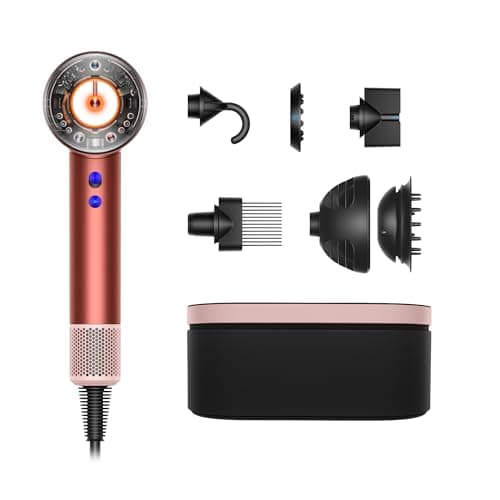
| 1 | Dyson Supersonic hair dryer Four heat settings plus a cold shot, 1.8 lb, an 8.6 ft cable and a two-year warranty. | Daily drying where heat control is the priority | |
| 2 | 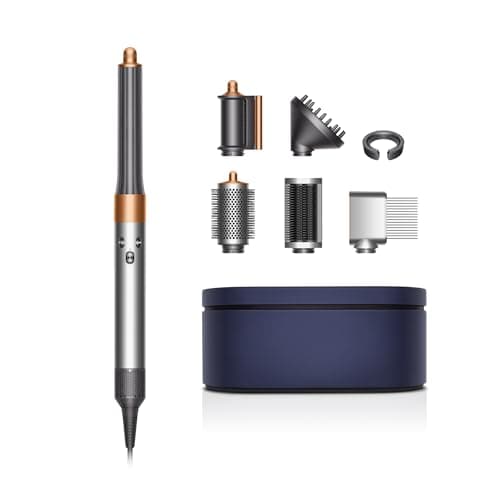 Dyson Airwrap multi-styler (Complete Long) 1,300 W and no heated plate against the hair — the strongest engineering-led argument Dyson makes. | Curling fine hair without a clamped barrel | |
| — | 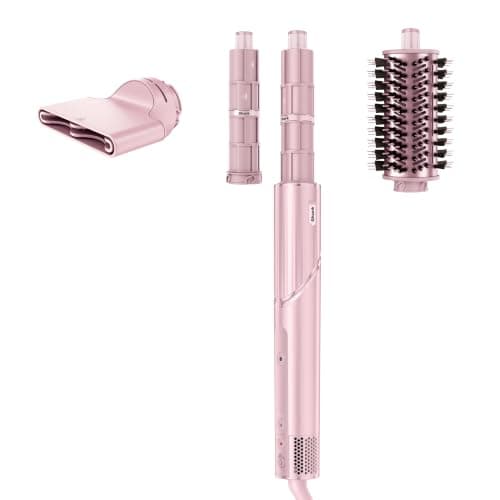 Shark FlexStyle air styling and drying system On published rows the cheaper tool leads — more wattage, the same warranty, and it converts to a dryer. We’d skip this | The value case against the premium |
1. The flagship dryer
Dyson Supersonic hair dryer
Best for: Daily drying where heat control is the priority
Four heat settings plus a cold shot, 1.8 lb, an 8.6 ft cable and a two-year warranty.
The clearest single argument for the price is on this spec sheet: the most granular published heat control of any conventional dryer in our registry, delivered on the lowest conventional wattage.
Full write-up, including who should not buy it, at the Supersonic examined.
What’s wrong with it
Heaviest published weight in our registry at 1.8 lb, 120 V only, and a two-year warranty that costs Dyson little to offer.
Published specifications — Dyson Supersonic hair dryer
| Wattage | 1,600 W |
|---|---|
| Heat settings | 4 heat settings, including a cold shot |
| Speed settings | 3 speed settings |
| Weight | 1.8 lb |
| Cord length | 8.6 ft |
| Noise (dB) | Not published |
| Attachments | 3 — styling concentrator, diffuser, wide-tooth comb |
| Plate / barrel | Air-multiplier body; no heated styling surface |
| Dual voltage | No — 120 V |
| Warranty | 2-year limited warranty |
Every figure above is taken from Dyson — Supersonic hair dryer product page. “Not published” means the figure does not appear on that page — it is not an estimate withheld, it is a number the manufacturer does not state. How we compile these.
What it costs to run for a year
$19.07 a year
1,600 W × 65 hours a year = 104.0 kWh, at 18.34 cents per kilowatt-hour. The hours assume 15 minutes a session, 5 days a week — that is an assumption, not a measurement, so swap in your own if it is wrong.
2. The category creator
Dyson Airwrap multi-styler (Complete Long)
Best for: Curling fine hair without a clamped barrel
1,300 W and no heated plate against the hair — the strongest engineering-led argument Dyson makes.
Where Dyson’s pricing has the best case is here. The Airwrap did not exist as a category before it existed as a product, and being first with a genuinely different mechanism is the kind of thing a premium is normally for.
1,300 W is the lowest mains rating on this site. On fine hair that is the point; on dense hair it is the limitation.
What’s wrong with it
Highest price on the site, 120 V only, and the same two-year warranty as tools costing a fraction as much.
Published specifications — Dyson Airwrap multi-styler (Complete Long)
| Wattage | 1,300 W |
|---|---|
| Heat settings | 3 heat settings |
| Speed settings | 3 speed settings |
| Weight | 1.4 lb |
| Cord length | 8.5 ft |
| Noise (dB) | Not published |
| Attachments | Curling barrels, smoothing brushes, round volumizing brush, drying nozzle |
| Plate / barrel | Coanda airflow barrels; no clamped heat plate |
| Dual voltage | No — 120 V |
| Warranty | 2-year limited warranty |
Every figure above is taken from Dyson — Airwrap Complete Long product page. “Not published” means the figure does not appear on that page — it is not an estimate withheld, it is a number the manufacturer does not state. How we compile these.
What it costs to run for a year
$15.50 a year
1,300 W × 65 hours a year = 84.5 kWh, at 18.34 cents per kilowatt-hour. The hours assume 15 minutes a session, 5 days a week — that is an assumption, not a measurement, so swap in your own if it is wrong.
The one we'd skip
Shark FlexStyle air styling and drying system
Best for: The value case against the premium
On published rows the cheaper tool leads — more wattage, the same warranty, and it converts to a dryer.
The skip on this page is the Dyson premium itself, and the way to show it is to put the alternative next to it.
Shark publishes 1,600 W against the Airwrap’s 1,300 W, the same two-year limited warranty, a weight within 0.1 lb, and a barrel section that detaches so the handle works as a standalone dryer. On published information the cheaper tool leads on power and function and ties on coverage.
What the spec sheets cannot settle is airflow, because nobody publishes it comparably — which is exactly where Dyson’s argument lives and exactly why it cannot be checked. Full comparison at Airwrap vs FlexStyle.
What’s wrong with it
Shark publishes no heat- or speed-setting count, which is the one row where Dyson is straightforwardly more transparent.
Published specifications — Shark FlexStyle air styling and drying system
| Wattage | 1,600 W (peak 1,600 W) |
|---|---|
| Heat settings | Not published |
| Speed settings | Not published |
| Weight | 1.5 lb |
| Cord length | 8 ft |
| Noise (dB) | Not published |
| Attachments | Configurable — auto-wrap curlers, oval brush, paddle brush, concentrator, diffuser |
| Plate / barrel | Coanda airflow barrels; no clamped heat plate |
| Dual voltage | No — 120 V |
| Warranty | 2-year limited warranty |
Every figure above is taken from SharkNinja — Shark FlexStyle (HD400SN) product page. “Not published” means the figure does not appear on that page — it is not an estimate withheld, it is a number the manufacturer does not state. How we compile these.
What it costs to run for a year
$19.07 a year
1,600 W (peak 1,600 W) × 65 hours a year = 104.0 kWh, at 18.34 cents per kilowatt-hour. The hours assume 15 minutes a session, 5 days a week — that is an assumption, not a measurement, so swap in your own if it is wrong.
Questions people actually ask
Why is Dyson so expensive?
Not because of the published specifications — the Supersonic states 1,600 W, less than a drugstore dryer, with a two-year warranty a $40 hot air brush doubles. The price covers motor and airflow engineering that nobody publishes a comparable figure for, plus design and brand.
Are Dyson hair dryers worth the money?
At high usage on hair that needs careful heat control, the price-per-use arithmetic makes it defensible. At occasional usage it is the worst value in this category, because a flagship price divided by a handful of uses a month is dollars rather than cents.
Are Shark hair tools as good as Dyson?
On published specifications Shark leads on wattage and attachment count, ties on warranty and voltage, and adds a dryer conversion the Airwrap does not have. What no spec sheet settles is airflow, which nobody publishes comparably.