Multi-Stylers & Dupes
Dyson Airwrap vs Shark FlexStyle: The Published Numbers
The cheaper tool publishes more power, the same warranty, a comparable weight, and one function the expensive one does not have.
Updated September 2026 · Sawyer V.
Shark publishes 1,600 W for the FlexStyle. Dyson publishes 1,300 W for the Airwrap Complete Long. Both publish a two-year limited warranty and weights within 0.1 lb of each other. The FlexStyle also converts into a standalone dryer. On published figures the cheaper tool leads.
We earn a commission if you buy through the links on this page, at no extra cost to you. It never changes which tool we pick or which one we tell you to skip. How this site is funded.
Every row both companies publish
Dyson Airwrap Complete Long against Shark FlexStyle
| Specification | Dyson Airwrap | Shark FlexStyle | Advantage |
|---|---|---|---|
| Wattage | 1,300 W | 1,600 W (peak 1,600 W) | Shark |
| Weight | 1.4 lb | 1.5 lb | Dyson |
| Cord length | 8.5 ft | 8 ft | Dyson |
| Heat settings | 3 | Not published | Dyson |
| Speed settings | 3 | Not published | Dyson |
| Voltage | 120 V | 120 V | Tie |
| Warranty | 2-year limited | 2-year limited | Tie |
| Converts to a dryer | No | Yes | Shark |
| Noise (dB) | Not published | Not published | Neither |
Figures taken from each manufacturer's own product page on 2026-09-03. Advantage is assessed on the published number alone — we have used neither tool.
Read that table without knowing the prices and you would not guess which one costs several times the other. Dyson wins three rows, Shark wins two, two are ties and two are blank on both sides. The rows Dyson wins are small margins — 0.1 lb and half a foot of cord — while the row Shark wins on power is 300 W, and the row about converting to a dryer is a whole additional function.
The 300 watt gap, and what it means
Dyson’s 1,300 W is the lowest published mains rating anywhere in our product registry — lower than every dryer we list, and 575 W below a drugstore Revlon. Dyson frames low power as heat control, and on fine hair that framing is genuinely persuasive.
On dense hair it points the other way. A multi-styler is a drying tool first: the shape is set as the hair dries around the barrel. Less power means longer drying, and longer drying on a tool held against your head is its own kind of stress. The recurring searches asking whether the Airwrap is worth it specifically for thick hair are consistent with that reading of the number.
What neither company publishes is airflow in comparable units, which is the specification that would actually settle it. Wattage measures electricity drawn, not air moved. Treat the 300 W gap as a strong hint rather than a proof.
The function Shark has and Dyson does not
The FlexStyle’s barrel section detaches, leaving the handle working as a conventional hair dryer. That is not a minor differentiator: it means one purchase covers both jobs, where an Airwrap owner who wants a proper dryer buys a second tool.
If you are comparing total spend rather than sticker price, that changes the arithmetic substantially — and it is the sort of thing that gets lost when a comparison focuses on curl quality.
What the spec sheets cannot settle
- Airflow, and therefore drying speed. Nobody publishes it in comparable units. This is the biggest open question and it stays open.
- Curl hold and finish quality. Entirely a hands-on question. We have not used either tool and will not pretend to a view.
- Noise. Neither publishes a decibel figure, and neither did any of the ten competitor pages we examined.
- Shark’s heat and speed setting counts. Simply absent from the product page, which is the clearest gap on their side.
Running cost, both
At fifteen minutes a day, five days a week — 65 hours a year — and the June 2026 US average residential rate of 18.34 cents per kWh:
Annual running cost from published wattage
| Tool | kWh per year | Cost per year | Over 5 years |
|---|---|---|---|
| Dyson Airwrap (1,300 W) | 84.5 | $15.50 | $77.48 |
| Shark FlexStyle (1,600 W) | 104.0 | $19.07 | $95.35 |
An eighteen-dollar difference across five years, in Dyson's favor. Set against the purchase-price gap, it is not a factor.
The Airwrap does cost less to run, and over five years that saving is under twenty dollars. It is worth knowing precisely so that nobody claims low wattage pays for the price difference. It does not, by roughly two orders of magnitude.
The price difference in cents per use
Price per use, at 5 uses a week over 5 years
| What you pay | Cost per use | Cost per year |
|---|---|---|
| $30 | $0.02 | $6.00 |
| $60 | $0.05 | $12.00 |
| $100 | $0.08 | $20.00 |
| $150 | $0.12 | $30.00 |
| $200 | $0.15 | $40.00 |
| $300 | $0.23 | $60.00 |
| $400 | $0.31 | $80.00 |
| $500 | $0.38 | $100.00 |
5 uses a week for 5 years is 1300 uses. Both figures are stated assumptions, not measurements — halve the life and every cost per use doubles. We publish the ladder rather than a worked example for one specific product because a price we typed into a sentence would be wrong within a week.
Find the row for each price you are looking at and subtract. That is the premium per use, and it is a more useful number than any adjective we could offer. We publish the ladder rather than typing prices into a sentence because a price written into copy is wrong within a week — on this site prices come from the live price layer or the button says so.
Which one to buy
Buy the Airwrap if
- Your hair is fine and you want the lowest heat available. 1,300 W and three published heat settings is the gentlest specification here.
- You already own a dryer you like, so the FlexStyle’s conversion is not worth anything to you.
- You will use it most days. Frequency is what makes flagship pricing defensible.
Buy the FlexStyle if
- Your hair is thick or dense. 300 W more, and drying is the bottleneck.
- You need a dryer too. One tool, both jobs.
- You want the money back. Most comparable rows favor it, and the rows it loses are fractions of a pound and inches of cord.
What we have not done
Used either tool. Everything above came off the two manufacturers’ own product pages or was computed from those figures with the working shown. Where both companies are silent, this page is silent. Individual write-ups: the Airwrap and the FlexStyle. The wider field is at Airwrap dupes.
The tools on this page
Prices come from the live price layer. Where none is available the button says so rather than showing a number we cannot stand behind.
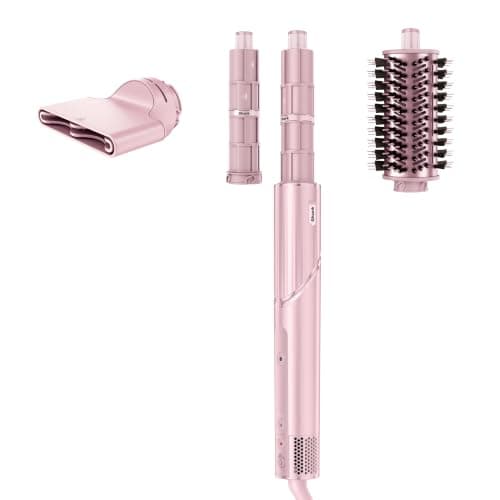
Shark FlexStyle air styling and drying system
Exactly the same published wattage as the Dyson Supersonic, in a tool that also converts to a dryer — the single strongest number in the dupe argument.
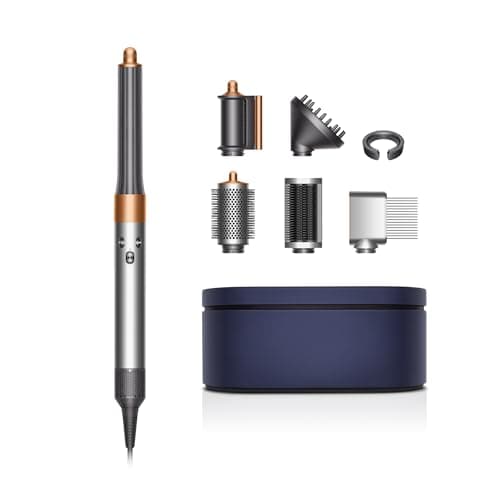
Dyson Airwrap multi-styler (Complete Long)
1,300 W is the lowest published wattage of any mains tool in this registry. That is the design argument, and it is also why it is slow on thick hair.
Questions people actually ask
Is the Shark FlexStyle as good as the Dyson Airwrap?
On published specifications it leads on wattage and converts to a standalone dryer, matches on warranty and voltage, and trails slightly on weight and cord length. Neither company publishes airflow or noise, so curl quality and drying speed cannot be settled from spec sheets.
How many watts is the Dyson Airwrap?
Dyson publishes 1,300 W for the Complete Long, which is the lowest mains rating of any tool in our registry — lower than every hair dryer we list, and 300 W below the Shark FlexStyle.
Does the Shark FlexStyle work as a hair dryer?
Yes. The barrel section detaches and the handle works as a conventional dryer, which is a function the Airwrap does not have. If you would otherwise buy a separate dryer, that changes the total-spend comparison substantially.
Which one is cheaper to run?
The Airwrap, at about $15.50 a year against the FlexStyle's $19.07, using 15 minutes a day five days a week and the June 2026 US average rate. That is under twenty dollars across five years, so it does not offset the purchase price.