Hair Dryers
Diffuser vs Concentrator: Which One Your Hair Actually Needs
One spreads the air out, one narrows it down. Buying the wrong dryer for the one you need is the most common expensive mistake in this category.
Updated September 2026 · Sawyer V.
A concentrator narrows the airflow into a slot so you can direct it down one section at a time, which is how hair gets smooth. A diffuser spreads the same air over a wide bowl so it barely moves the hair at all, which is how a curl pattern survives drying. They are opposites, and neither is an upgrade on the other.
We earn a commission if you buy through the links on this page, at no extra cost to you. It never changes which tool we pick or which one we tell you to skip. How this site is funded.
Two attachments, one variable
Every argument about diffusers and concentrators comes down to one thing that has nothing to do with heat: air speed at the hair. A dryer produces a fixed volume of moving air. What the attachment on the end does is decide whether that air arrives as a narrow, fast stream or a slow, wide spread.
A concentrator takes the round opening and squeezes it into a flat slot. Same air, smaller hole, so it comes out faster and in a defined direction. That is precisely what you want when you are pulling a section taut over a brush and pointing the airflow along the hair from root to tip, because the direction of the air is what lays the cuticle flat and the speed is what dries the section before you have to hold it there for a minute.
A diffuser does the opposite. It takes the same air and pushes it out through a ring of holes across a wide bowl, so the speed at any one point drops sharply. The prongs hold the hair up off the bowl so warm air can circulate through it rather than blast at it. Nothing about a diffuser dries hair faster — it is slower, deliberately, because the thing you are protecting is the shape the hair dried into.
Which one you need is not a preference
It is decided by what you want the hair to look like at the end, and for most people that is stable enough to make it a purchase decision rather than a daily one.
The attachment follows the outcome, not the hair type
| What you want | Attachment | Why |
|---|---|---|
| Smooth, straight, stretched | Concentrator | Directed air along the hair shaft with tension is what flattens the cuticle |
| Curls or waves kept as they are | Diffuser | Low air speed lets the pattern set instead of being blown apart |
| Volume at the root, texture at the ends | Diffuser, upside down | Cupping the roots lifts them without disturbing the lengths |
| Rough-dried to 80 percent, then styled | Neither | The bare nozzle moves the most air; save the attachment for the finish |
That last row is the one people skip. If you are going to straighten afterwards, the first three-quarters of the dry does not need an attachment at all — it needs the fastest airflow the dryer has. Fitting a concentrator for the whole session makes the dry longer, and total heat exposure is temperature multiplied by time.
The thing nobody tells you before you buy
Of the six dryers in our registry, two publish what is in the box. That is not a rhetorical flourish, it is a count.
Published attachment lists, by dryer
| Dryer | What the maker publishes |
|---|---|
| Dyson Supersonic | 3 — styling concentrator, diffuser, wide-tooth comb |
| Shark SpeedStyle Pro | Turbo concentrator, QuickSmooth brush, DefrizzFast diffuser, wide-tooth comb, touch-up brush, FrizzFighter finishing tool |
| ghd Helios | Not published |
| T3 AireLuxe | Not published |
| T3 Featherweight StyleMax | Not published |
| Revlon SmoothStay | Not published |
| ghd flight+ | Nozzle only, and a folding handle |
Read that table with curly hair and the shortlist writes itself. If the diffuser is the entire reason you are buying a dryer, there are exactly two products here where you can confirm one is included before you pay, and one product — the ghd flight+ — where you can confirm one is not.
It is worth being fair about why the lists are missing. Attachment bundles change by retailer, by colorway and by season, and a maker who publishes a fixed list has to keep it accurate. Leaving it off is easier. But the reader is the one who absorbs the cost of that decision, and on this particular specification the cost is high, because a diffuser bought separately may not seat properly on a nozzle it was not designed for.
How to use each one properly
Concentrator
- Point it down the hair, not at it. The nozzle should be roughly parallel with the section, moving root to tip. Air arriving across the shaft lifts the cuticle; air arriving along it lays the cuticle down. This is the entire mechanism behind why a blowout is shinier than an air-dry.
- Keep a hand’s width of distance. A narrowed airflow is a faster airflow, which means it is also a hotter one at the point of contact.
- Use tension, or do not bother. A concentrator without a brush holding the section taut is just a hot draught. The tension is doing half the work — that is what a blow-dry brush automates.
- Finish each section cold. Hair sets as it cools. If your dryer has a cool shot, the last two seconds on each section is where the shape actually locks.
Diffuser
- Lowest speed, medium heat. This is backwards from what most people reach for. Airflow is what wrecks a curl pattern, not warmth, so the speed dial matters more than the heat dial here.
- Cup and hold, do not sweep. Gather a section into the bowl, hold it against the head, wait, lower it, move on. Moving the diffuser around the head continuously is a slower version of not using one.
- Stop touching it. Every time you run a hand through drying curly hair you break the clump that was forming. That is what frizz is: individual strands separating from the group.
- Dry to 90 percent, not 100. The last of the drying is the most damaging part, and on curls it is also the part that costs you the most definition.
The attachment does not fix the wrong dryer
A diffuser needs a dryer with a genuinely low speed setting to be worth fitting, because a diffuser on full power is only slightly gentler than no diffuser at all. This is where published speed-setting counts start to matter more than wattage.
Dyson publishes three speed settings on the Supersonic. Revlon publishes two on the SmoothStay, which is the fewest here — with two, the “low” setting is a division of the highest published wattage in this registry, and that is not the same thing as a gentle setting. Shark and ghd publish no speed-setting count at all for their dryers, which is a gap you feel specifically on this question.
The full reasoning for curls is on the curly-hair dryers page, and if what you are fighting is frizz rather than curl loss, the frizzy-hair page takes a different route to a similar shortlist.
What about the wide-tooth comb?
Two of the seven products above ship a third attachment — a comb with robust teeth designed to lengthen and stretch coily or textured hair while it dries. It is neither a diffuser nor a concentrator: it dries under mechanical tension supplied by the teeth rather than by a brush in your other hand.
For tightly coily hair it is often the most useful attachment in the box, and it is the reason both dryers that publish a comb also do well on the coily and 4C page. It is also, notably, the attachment that is most often absent from cheaper dryers — an ordinary comb attachment is inexpensive to make, so its absence is a decision about who the dryer is for.
What we would do
If you already own a dryer, try the rough-dry-then-attach routine before buying anything: bare nozzle on high until the hair stops dripping and starts moving freely, then fit the attachment for the last quarter. Most people who think they need a new dryer are running the entire session through a concentrator and then wondering why it takes so long.
If you are buying, treat the published attachment list as a specification with the same weight as wattage, and if the list is missing, assume the box contains a nozzle. That assumption has never disappointed anyone.
The tools on this page
Prices come from the live price layer. Where none is available the button says so rather than showing a number we cannot stand behind.
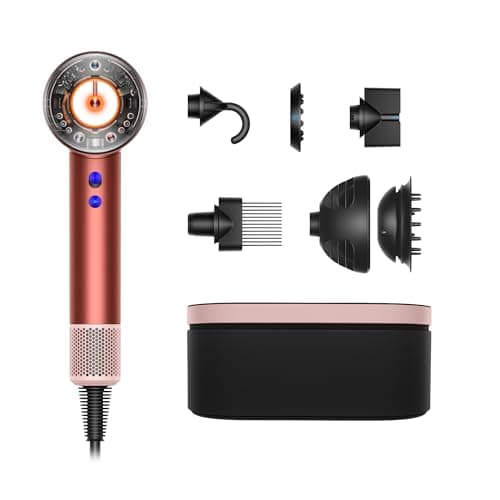
Dyson Supersonic hair dryer
1,600 W is less power than a drugstore dryer draws, and Dyson publishes that openly — the pitch is airflow and heat control, not wattage.
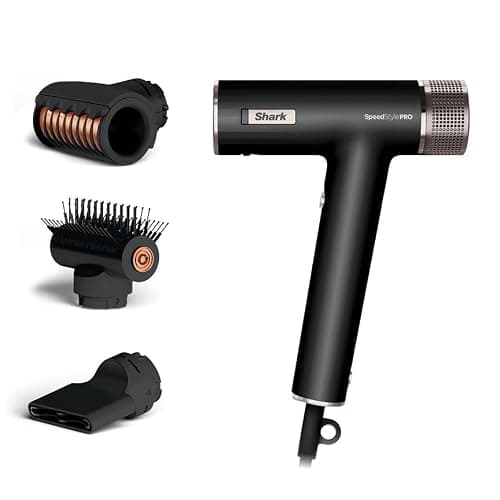
Shark SpeedStyle Pro hair dryer
The highest published wattage of the premium dryers here and the most attachments in the box, at a fraction of Dyson's asking price.
Questions people actually ask
Can I use a diffuser on straight hair?
You can, and it is occasionally useful for adding root volume without stretching the lengths, but it will not make straight hair curly. For straight hair the concentrator does the job you actually want, which is smoothing.
Do I need the diffuser that came with my dryer, or can I buy a universal one?
A universal diffuser has to grip a nozzle it was not designed for, and a loose fit leaks air out of the join rather than through the bowl. If a diffuser is the reason you are buying, buy a dryer that publishes one in the box.
Is a concentrator bad for your hair?
The attachment is not the risk; the distance is. Narrowing the airflow makes it faster and hotter at the point of contact, so hold the nozzle a hand's width away and keep it moving along the section rather than resting on one spot.
Which dryers come with both a diffuser and a concentrator?
In our registry, the Dyson Supersonic publishes both plus a wide-tooth comb, and the Shark SpeedStyle Pro publishes both plus four more. Every other dryer we list publishes no attachment list at all.