Brushes & Accessories
Wide-Tooth Combs: The Tool With the Best Evidence Behind It
The cheapest object in this whole category, addressing the best-documented failure mode in it.
Updated September 2026 · Sawyer V.
Wide spacing means fewer contact points per stroke and fewer chances to catch a knot — and catching a knot produces impact loading, which breaks hair at lower forces than steady tension does. It is the cheapest object on this site and the mechanism behind it is well documented.
We earn a commission if you buy through the links on this page, at no extra cost to you. It never changes which tool we pick or which one we tell you to skip. How this site is funded.
The mechanism, which is unusually clear
Work on combing damage found that short fiber fragmentation and longer segment breaks occur by different pathways, with longer breaks most likely occurring through impact loading rather than steady tension — and that impact loading causes breakage at lower loads than tensile loading does — Robbins, Journal of Cosmetic Science.
The looped and crossed formations in a snag are exactly the geometry that produces impact loads. So the useful property of any detangling tool is not gentleness in the abstract — it is how many opportunities it creates to hit a knot at speed.
A fine-tooth comb has many closely spaced teeth. Each one is a contact point that can catch. Widen the spacing and you reduce the number of those events per stroke, which is the entire argument.
Separately, repeated combing behaves as a fatigue process — flaws propagate through a fiber until it fails — Evans and Park, Journal of Cosmetic Science. Fewer strokes and lower peak forces both count in your favor.
When to use one rather than a brush
Comb against brush, by situation
| Situation | Better tool | Why |
|---|---|---|
| Wet hair with conditioner in | Wide-tooth comb | Hair is most extensible wet; fewest contact points wins |
| Dry detangling before styling | Detangling brush | More points, but flex spreads the load across the stroke |
| Curly or coily hair, any state | Wide-tooth comb, or fingers first | More direction changes per inch means more snag geometry |
| Distributing product | Wide-tooth comb | Even distribution with minimal disturbance to a clump |
| Smoothing before an iron | Brush | You want the section flat, not merely untangled |
The general rule that follows: comb when the hair is wet or patterned, brush when it is dry and you want it smooth. The brush side of that is on the detangling page.
The attachment version, which we can actually rank
There is a wide-tooth comb in our product registry, and it is not sold separately — it is a dryer attachment, and it is one of the more interesting things in this category.
Dyson publishes a wide-tooth comb among three attachments for the Supersonic, describing it as engineered for curly and textured hair with robust teeth to lengthen hair as it dries. Shark publishes one among six for the SpeedStyle Pro.
What it does is different from a hand comb: it dries under mechanical tension supplied by the teeth, which stretches a coil pattern without a clamped plate anywhere near it. On tightly coily hair that is frequently the most useful attachment in the box, and it is the reason both of those dryers win the coily and 4C page.
It is also, notably, the attachment most often missing from cheaper dryers. A comb attachment is inexpensive to make, so its absence is a decision about who the dryer is for — the full attachment table.
What to look for in a hand comb
We do not rank them, for the usual reason: this category is sold almost entirely by brands that publish no material, no tooth spacing and no dimensions we could compare, and every product on this site carries a sourced spec block.
- Seamless teeth. The single most important property. Combs molded in two halves have a seam ridge along each tooth, and that ridge catches. Run a fingernail along a tooth — if you feel a line, it will find your cuticle.
- Rounded tips. They land on your scalp as well as your hair.
- Spacing matched to your hair. Wider for coily and dense; a medium spacing is more useful on fine hair, where very wide teeth simply pass through without doing anything.
- Enough length to hold comfortably. A comb you have to grip tightly is one you will pull with.
- Heat resistance, if it goes near a dryer. Relevant if you comb while drying rather than before.
Technique, which matters more than the object
Genuinely true here. A perfect comb used badly breaks more hair than a mediocre one used well.
- Start at the ends and work up. Combing root-down drags every knot into a bigger knot ahead of the teeth, which is how you manufacture an impact load.
- Hold the section above where you are combing. Your other hand takes the tension instead of your scalp.
- Stop at resistance. Work the knot apart, then continue. The stroke that finally breaks a hair is not different from the thousand before it.
- Comb with conditioner in. Conditioning was measured to provide considerable retardation of breakage in repeated-grooming experiments — a modest, real, supported claim.
- Section it. Combing a whole head at once means long strokes through hair you cannot see.
Price per use, at 5 uses a week over 5 years
| What you pay | Cost per use | Cost per year |
|---|---|---|
| $30 | $0.02 | $6.00 |
| $60 | $0.05 | $12.00 |
| $100 | $0.08 | $20.00 |
| $150 | $0.12 | $30.00 |
| $200 | $0.15 | $40.00 |
| $300 | $0.23 | $60.00 |
| $400 | $0.31 | $80.00 |
| $500 | $0.38 | $100.00 |
5 uses a week for 5 years is 1300 uses. Both figures are stated assumptions, not measurements — halve the life and every cost per use doubles. We publish the ladder rather than a worked example for one specific product because a price we typed into a sentence would be wrong within a week.
Why this is on a hair tool site
Because if you rank interventions by effect per dollar, a wide-tooth comb and a change of technique sit at the top, above every heated tool we cover.
Heat damage is real and we have eleven pages on it. But mechanical breakage happens every single day rather than on styling days, it has better-documented mechanisms, and the fix costs almost nothing. If your hair is breaking, this is where to start — the damaged hair router puts it in order.
The tools on this page
Prices come from the live price layer. Where none is available the button says so rather than showing a number we cannot stand behind.
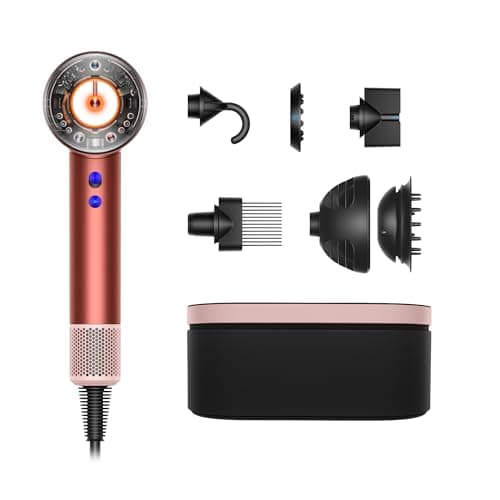
Dyson Supersonic hair dryer
1,600 W is less power than a drugstore dryer draws, and Dyson publishes that openly — the pitch is airflow and heat control, not wattage.
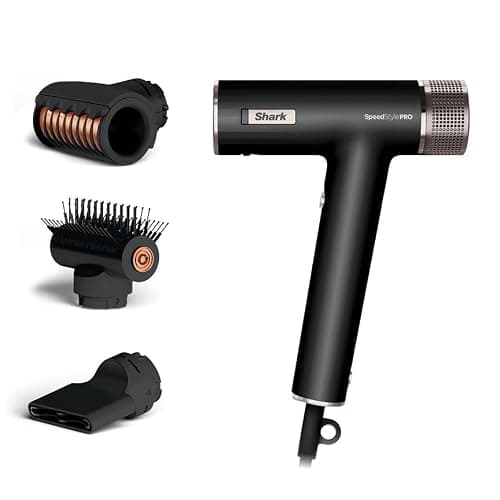
Shark SpeedStyle Pro hair dryer
The highest published wattage of the premium dryers here and the most attachments in the box, at a fraction of Dyson's asking price.
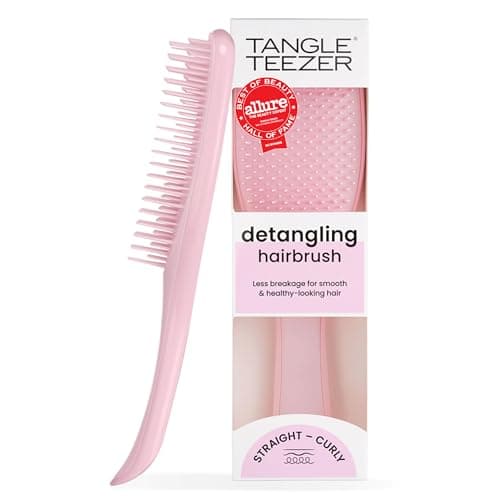
Tangle Teezer The Ultimate Detangler
Three published sizes and a two-tier bristle design, on the one tool in this registry whose whole job is reducing the force you pull with.
Questions people actually ask
Why is a wide-tooth comb better for wet hair?
Fewer contact points per stroke means fewer chances to catch a knot, and catching a knot produces impact loading — which published work found breaks hair at lower forces than steady tension does.
Comb or brush for detangling?
Comb when the hair is wet or has a curl pattern; brush when it is dry and you want it smooth. Hair is at its most extensible when wet, which is when the fewest contact points matter most.
What should I look for in a wide-tooth comb?
Seamless teeth above everything. Combs molded in two halves have a seam ridge along each tooth that catches the cuticle — run a fingernail along one, and if you feel a line it will find your hair.
What is the wide-tooth comb attachment on a hair dryer for?
Drying under mechanical tension supplied by the teeth, which stretches a coil pattern without a clamped plate. Only the Dyson Supersonic and Shark SpeedStyle Pro publish one in our registry.