Heat Damage & Protection
Can Heat-Damaged 4C Hair Be Repaired?
The published research on Afro-textured hair points somewhere most heat-damage advice does not: at how you detangle, not at what you dry with.
Updated September 2026 · Sawyer V.
Genuinely heat-damaged coil pattern does not return; new growth is the only source of new pattern. But coily hair is measurably more vulnerable to mechanical stress than other hair types, and a large share of what gets attributed to heat is actually detangling.
We earn a commission if you buy through the links on this page, at no extra cost to you. It never changes which tool we pick or which one we tell you to skip. How this site is funded.
Start with what the research actually measured
This is one of the few places in hair science where Afro-textured hair was studied specifically rather than assumed to behave like everything else, and the finding is directly useful.
A study comparing chemical and physical treatments across hair types — straight, wavy and curly Caucasian hair and Afro-ethnic hair — found that bleaching, dyeing and UVA/visible radiation increased combing work on Afro-ethnic tresses, indicating damage to the cuticle scales, confirmed by scanning electron microscopy — Bloch et al., JEADV.
“Increased combing work” is the phrase to hold onto. It means more force is required for the same stroke. And more force per stroke, on hair with more direction changes per inch, is the mechanical setup for breakage.
Why the mechanical half dominates here
Two published mechanisms combine badly on tightly coiled hair.
First, repeated brushing and combing behaves as a fatigue process — individual fibers experience repeated loading, flaws propagate, and eventually failure results — Evans and Park, Journal of Cosmetic Science.
Second, longer hair breaks occur mostly through impact loading rather than steady tension, and impact loading breaks hair at lower loads than tensile loading does — Robbins, Journal of Cosmetic Science. The looped and crossed formations in a snag are exactly the geometry that produces impact loads.
Coily hair produces more of those formations by virtue of its shape. Combine that with measurably increased combing work after chemical treatment and you have the reason a lot of 4C breakage is attributed to heat and is actually detangling.
So: is it heat damage or is it breakage?
Two different problems with two different answers
| What you see | Likely cause | What helps |
|---|---|---|
| Sections hang loose and will not coil, even soaking wet | Heat damage to pattern | Grow out and cut; nothing restores it |
| Short broken pieces throughout, pattern intact | Mechanical breakage from detangling | Technique, conditioner, sectioning — all free |
| Ends splitting, pattern fine above | Weathering at the oldest hair | Trim; reduce friction and heat on lengths |
| Whole head looks limp, evenly | Buildup or heavy product | Clarify — this one reverses |
The wet test separates the first two cleanly. Hair that coils when soaking and hangs loose when dry is a drying or product problem. Hair that does not coil even in the shower has lost pattern.
Pattern loss does not reverse
Being straight about the hard part. Coil pattern is a property of the fiber’s internal structure, and heat that alters that structure alters the pattern permanently.
Published microscopy shows radial and axial cracking with scale edge fusion on thermally treated fibers even in dry conditions, and severe damage plus steam bubbling when the same treatment is applied wet — Ruetsch and Kamath, Journal of Cosmetic Science. No product reassembles that.
The honest route is growing it out and cutting, same as the general repair page concludes. What is worth doing meanwhile is protecting everything that is still fine.
The changes that matter most, in order
- Detangle with conditioner in, from the ends up, in sections. The single highest-value change on this page and it costs nothing. Conditioning was measured to provide considerable retardation of breakage under repeated grooming.
- Never pull through a snag. Stop, work it apart, continue. Impact loading is the mechanism, and it is avoidable.
- Fingers before a brush on the worst areas.
- Style completely dry with any contact tool. Steam inside the fiber is a failure mode dry styling does not have — the microscopy.
- Stretch rather than straighten where you can. A wide-tooth comb attachment or a brush attachment dries under tension without a clamped plate.
The stretching question
Most people with 4C hair applying heat are doing it to reduce shrinkage, not to add curl. That reframes which tool matters.
The useful attachment is a wide-tooth comb — it dries under mechanical tension supplied by the teeth rather than by a plate. Only two dryers in our registry publish one: Dyson names it among three attachments for the Supersonic and describes it as engineered for curly and textured hair, and Shark publishes one among six for the SpeedStyle Pro.
That is a short list, and it is the reason both of those dryers win on the coily and 4C dryers page. The lowest-heat route to the same place is on the heat-free page.
Price per use, at 5 uses a week over 5 years
| What you pay | Cost per use | Cost per year |
|---|---|---|
| $30 | $0.02 | $6.00 |
| $60 | $0.05 | $12.00 |
| $100 | $0.08 | $20.00 |
| $150 | $0.12 | $30.00 |
| $200 | $0.15 | $40.00 |
| $300 | $0.23 | $60.00 |
| $400 | $0.31 | $80.00 |
| $500 | $0.38 | $100.00 |
5 uses a week for 5 years is 1300 uses. Both figures are stated assumptions, not measurements — halve the life and every cost per use doubles. We publish the ladder rather than a worked example for one specific product because a price we typed into a sentence would be wrong within a week.
What we are not going to tell you
That any product restores coil pattern, that a particular tool is “safe” for 4C hair, or that there is a temperature at which heat stops mattering. No published study establishes a safe threshold, and inventing one would be worse than saying so.
What is supported is narrow and real: conditioning retards breakage, detangling technique changes peak loads, and dry hair takes contact heat better than wet hair. Everything else on this subject is either technique or patience.
The whole-toolkit view for this hair type is on the coily and 4C router, and the brush that addresses the mechanical half is on the detangling page.
The tools on this page
Prices come from the live price layer. Where none is available the button says so rather than showing a number we cannot stand behind.
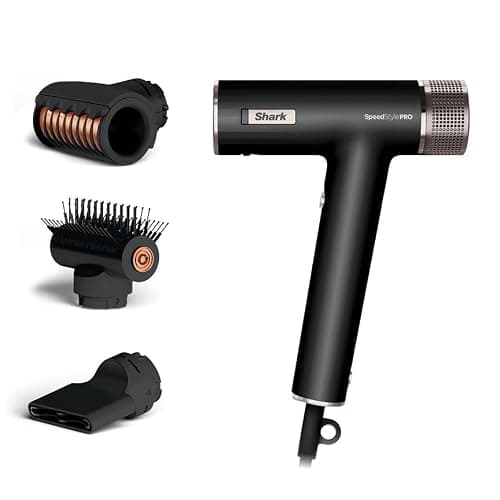
Shark SpeedStyle Pro hair dryer
The highest published wattage of the premium dryers here and the most attachments in the box, at a fraction of Dyson's asking price.
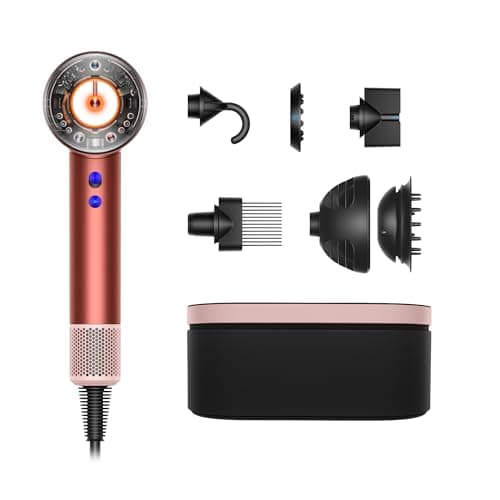
Dyson Supersonic hair dryer
1,600 W is less power than a drugstore dryer draws, and Dyson publishes that openly — the pitch is airflow and heat control, not wattage.
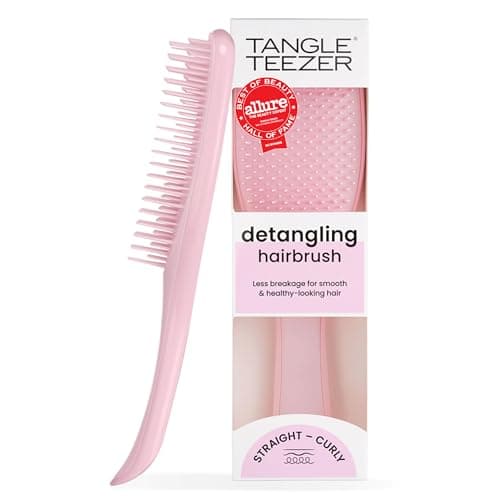
Tangle Teezer The Ultimate Detangler
Three published sizes and a two-tier bristle design, on the one tool in this registry whose whole job is reducing the force you pull with.
Questions people actually ask
Can heat-damaged 4C hair be repaired?
Coil pattern that has been genuinely heat-damaged does not return — new growth is the only source of new pattern. A large share of what gets attributed to heat on 4C hair is actually mechanical breakage from detangling, and that is fixable.
How do I know if my 4C hair is heat damaged or just breaking?
The wet test. Hair that coils when soaking and hangs loose when dry is a drying or product problem. Hair that does not coil even in the shower has lost pattern. Short broken pieces with the pattern intact is mechanical breakage.
Why is coily hair more prone to breakage?
Published work found bleaching, dyeing and UV increased combing work on Afro-ethnic tresses, meaning more force for the same stroke. Combined with more direction changes per inch, that is the setup for impact loading, which breaks hair at lower forces than steady tension.
What is the best way to stretch 4C hair with heat?
A wide-tooth comb attachment, which dries under tension supplied by the teeth rather than by a clamped plate. Only the Dyson Supersonic and Shark SpeedStyle Pro publish one in our registry.
Sources
- Bloch et al. — Chemical and physical treatments damage Caucasian and Afro-ethnic hair fiber, JEADV 2019
- Robbins — Hair breakage during combing II: impact loading and hair breakage, J Cosmet Sci 2006
- Evans and Park — A statistical analysis of hair breakage II: repeated grooming experiments, J Cosmet Sci 2010