Heat Damage & Protection
Can Heat-Damaged Curly Hair Be Repaired?
Curly hair has a failure mode straight hair does not: the pattern itself stops coming back. That is the question this page answers.
Updated September 2026 · Sawyer V.
Curl pattern that has been genuinely heat-damaged does not come back — the structure that held it has been altered, and new growth is the only source of new pattern. What does come back is pattern that was only weighed down, dehydrated or coated, which is why the first job is telling those apart.
We earn a commission if you buy through the links on this page, at no extra cost to you. It never changes which tool we pick or which one we tell you to skip. How this site is funded.
Why this question is different for curly hair
On straight hair, heat damage shows up as roughness, breakage and split ends. All of those happen to curly hair too — plus one more that straight hair cannot experience: the curl stops returning.
Sections that used to spring back sit limp and straightish while the hair around them still curls. That unevenness is the distinctive signature, and it is what people mean when they ask whether heat-damaged curly hair can be repaired.
The honest answer, and the reasoning
Curl pattern is a property of the fiber’s internal structure — how keratin is arranged and cross-linked along its length. Heat that alters that structure alters the pattern, and nothing reassembles it.
Published microscopy of hair treated with a curling iron shows radial and axial cracking along with scale edge fusion even in dry conditions, and severe damage plus bubbling and buckling of the cuticle when the same treatment is applied wet — Ruetsch and Kamath, Journal of Cosmetic Science. Those are structural changes, not surface ones.
So: genuinely heat-damaged pattern does not return. Growing it out and cutting it off is the only route, and that is the same conclusion as the general repair page reaches for every other kind of heat damage.
We would rather say that plainly than sell you a treatment. What we can usefully do is help you work out whether that is actually what you have — because frequently it is not.
Damage, or something reversible?
Three things routinely get mistaken for lost pattern, and all three do come back.
Telling the four apart
| What you see | Likely cause | Does it come back? |
|---|---|---|
| Whole head looks looser, evenly | Product buildup or heavy conditioner weighing it down | Yes — clarify and it returns |
| Curls dry, frizzy, but still curling | Dehydration; cuticle roughness | Yes — moisture and technique |
| Pattern loose only where you brush or clip | Mechanical stress, not heat | Yes — change the handling |
| Specific sections straight, others normal | Heat damage | No — grow out and cut |
The diagnostic that separates them: is it even or patchy? Buildup and dehydration affect the whole head fairly evenly. Heat damage is patchy, because you applied heat unevenly — the front sections, the pieces you always straighten, the crown.
The second diagnostic: does it behave differently when wet? Hair that clumps and curls in the shower and then dries straight in the same spots is usually a drying-technique problem. Sections that do not clump even when soaking are the ones that have lost pattern.
What the evidence supports doing
Modest things, stated at the size the research supports them.
- Conditioning reduces further breakage. Conditioning treatments were measured to provide considerable retardation of breakage in repeated-grooming experiments — Evans and Park, Journal of Cosmetic Science. That is prevention of future loss, not restoration of past loss.
- Low-molecular-weight conditioners penetrate. The curling-iron study found fibers treated with conditioners showed improved characteristic life, especially those able to penetrate into the fiber rather than sit on it.
- Detangling technique matters more than product. Curly hair is structurally more vulnerable to mechanical stress, and longer breaks occur mostly through impact loading — a sudden yank — which snaps hair at lower forces than steady tension.
What none of that supports is rebuilding a curl pattern. Anything marketed as doing so is describing a temporary cosmetic effect.
The grow-out, practically
Hair grows at roughly half an inch a month, so a section damaged at shoulder length takes a long time to replace entirely. Two approaches, and most people use both.
- Cut it off gradually. Regular small trims rather than one dramatic cut. Damaged ends also split upward, so waiting costs you length rather than saving it — why.
- Style to the weakest pattern. Rather than fighting straight sections into curling, choose looks that do not depend on a uniform pattern — which mostly means stretched or pulled-back styles while it grows.
- Stop the input. Obvious and the part people skip. The sections that lost pattern are the sections you keep applying heat to.
Drying curls without adding to it
If you still want to dry with heat during the grow-out — and most people do — the way to do it costs the least.
Air speed disturbs a drying curl more than heat does, so the specification that matters is a genuinely low speed rather than a low temperature. Dyson publishes three speed settings on the Airwrap at 1,300 W, the lowest mains rating in our registry. Shark publishes a diffuser in the FlexStyle’s configurable set but no settings count at all.
Technique is free and does more: cup and hold rather than sweeping, dry to 90 percent rather than 100, and stop touching it while it dries — every pass of a hand breaks the clump that was forming. The full method is on the curly blow-dry guide, and which tools publish a diffuser is on the diffusers page.
Price per use, at 5 uses a week over 5 years
| What you pay | Cost per use | Cost per year |
|---|---|---|
| $30 | $0.02 | $6.00 |
| $60 | $0.05 | $12.00 |
| $100 | $0.08 | $20.00 |
| $150 | $0.12 | $30.00 |
| $200 | $0.15 | $40.00 |
| $300 | $0.23 | $60.00 |
| $400 | $0.31 | $80.00 |
| $500 | $0.38 | $100.00 |
5 uses a week for 5 years is 1300 uses. Both figures are stated assumptions, not measurements — halve the life and every cost per use doubles. We publish the ladder rather than a worked example for one specific product because a price we typed into a sentence would be wrong within a week.
If the damage was chemical rather than thermal
Very common on curly hair, and it changes the tool advice. A study comparing chemical and physical treatments across hair types found that bleaching and dyeing caused wear on the cuticles with high protein loss and reduced tryptophan content, independently of curl pattern — Bloch et al., JEADV.
On that hair, the specification to buy for is a floor below 365°F, and only one iron in our registry has one. The case is on the bleached hair page.
The realistic expectation
Pattern that is genuinely gone is gone. Pattern that was buried under product, dehydrated, or flattened by handling comes back within a wash or two of changing what you are doing.
Most people asking this question have some of each — and the reversible share is usually larger than they fear. Start by clarifying, changing how you detangle, and diffusing properly for two weeks before concluding anything.
If the answer is that some sections are genuinely damaged, the useful next question is how to keep the rest — how often you can use heat and the heat-free options.
The tools on this page
Prices come from the live price layer. Where none is available the button says so rather than showing a number we cannot stand behind.
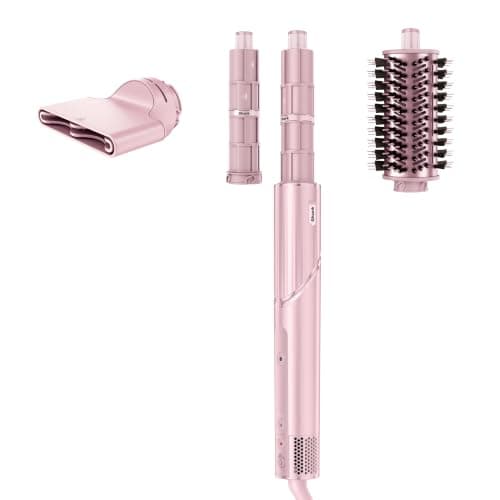
Shark FlexStyle air styling and drying system
Exactly the same published wattage as the Dyson Supersonic, in a tool that also converts to a dryer — the single strongest number in the dupe argument.
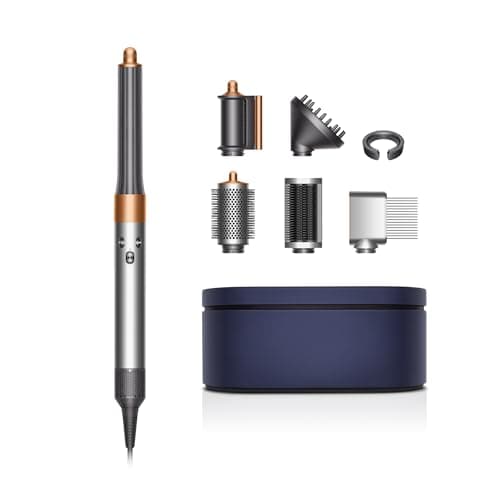
Dyson Airwrap multi-styler (Complete Long)
1,300 W is the lowest published wattage of any mains tool in this registry. That is the design argument, and it is also why it is slow on thick hair.
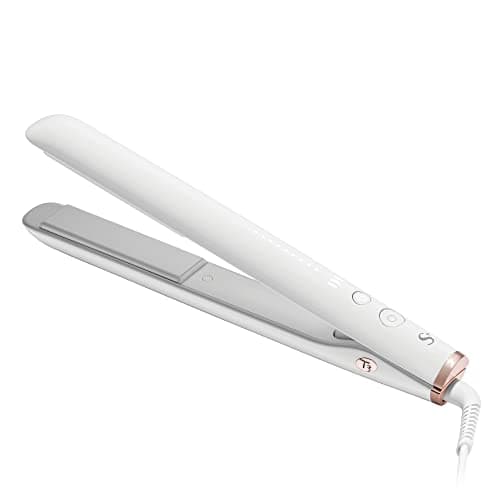
T3 SinglePass StyleMax 1 inch flat iron
Nine heat settings and genuine 100–240 V dual voltage: the most adjustable iron here and the only one you can pack for Europe without a thought.
Questions people actually ask
Can heat-damaged curly hair be repaired?
Genuinely heat-damaged curl pattern does not come back — the internal structure that held it has been altered, and new growth is the only source of new pattern. Pattern that was weighed down, dehydrated or flattened by handling does return.
How do I tell heat damage from dryness in curly hair?
Heat damage is patchy — specific sections straight while others curl normally — because you applied heat unevenly. Buildup and dehydration affect the whole head fairly evenly and reverse within a wash or two.
Will my curls come back if I stop using heat?
The sections that are genuinely damaged will not, but new growth will curl normally. What frequently does come back is pattern that was buried under product or flattened by handling, which people often mistake for damage.
Do protein treatments restore curl pattern?
No. Conditioning treatments have measured support for retarding further breakage, which is prevention rather than restoration. Nothing reassembles the internal structure that held a curl.
Sources
- Ruetsch and Kamath — Effects of thermal treatments with a curling iron on hair fiber, J Cosmet Sci 2004
- Evans and Park — A statistical analysis of hair breakage II: repeated grooming experiments, J Cosmet Sci 2010
- Bloch et al. — Chemical and physical treatments damage Caucasian and Afro-ethnic hair fiber, JEADV 2019