Blow-Dry Brushes
The Best Blow-Dry Brushes for Fine Hair in 2026
Fine hair is the type a hot air brush helps most, because volume at the root is exactly what these tools do.
Updated September 2026 · Sawyer V.
Fine hair benefits more from a hot air brush than any other type, because the barrel lifts at the root while it dries — which is the one thing fine hair actually needs. Look for four or more heat settings so the low end is genuinely low, and a barrel small enough to reach the root.
We earn a commission if you buy through the links on this page, at no extra cost to you. It never changes which tool we pick or which one we tell you to skip. How this site is funded.
Quick picks
Tap any row to jump to the full write-up. Prices come from the live price layer; where none is available the button says so rather than showing a number we cannot stand behind.
| # | Product | Best for | Price |
|---|---|---|---|
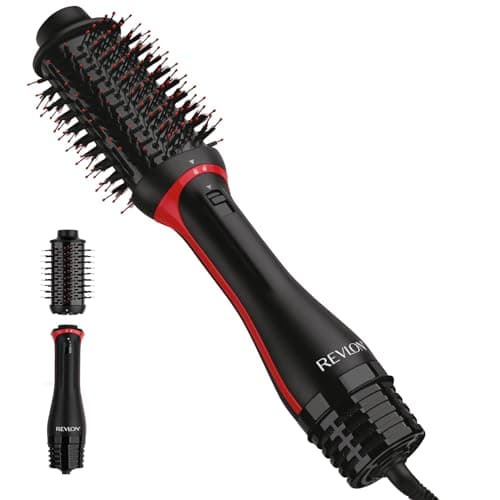
| 1 | Revlon One-Step Volumizer Plus hair dryer and hot air brush Four heat settings including a dedicated cool, plus a four-year warranty — the longest on this site. | Fine hair that goes flat by lunchtime | |
| 2 | 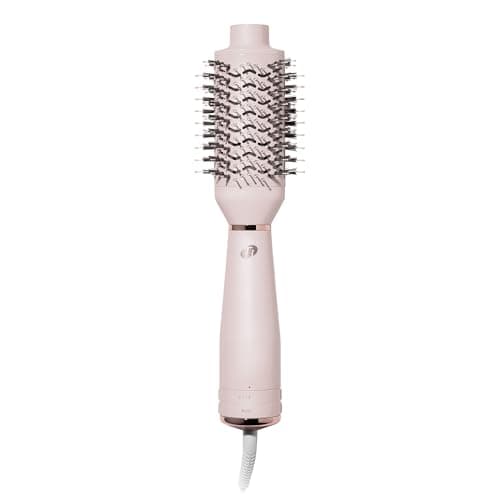 T3 AireBrush One-Step smoothing and volumizing dryer brush Three heat and two speed settings, 16 oz published, an 8 ft swivel cord and ceramic bristles. | Anyone who wants to know what they are buying | |
| — | 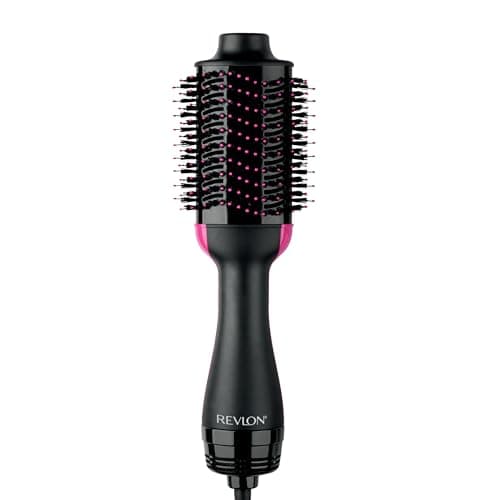 Revlon Salon One-Step hair dryer and volumizer Same four-year warranty, non-detachable brush head, and no published heat-setting count at all. We’d skip this | Nobody, while the Plus exists |
1. Best heat range for the money
Revlon One-Step Volumizer Plus hair dryer and hot air brush
Best for: Fine hair that goes flat by lunchtime
Four heat settings including a dedicated cool, plus a four-year warranty — the longest on this site.
Four heat settings — low, medium, high and cool — is more granularity than most hot air brushes publish, and the cool setting matters disproportionately on fine hair. Hair sets in the shape it cools into, so finishing a section cool is what stops the volume collapsing an hour later.
Revlon publishes a ceramic titanium barrel with tourmaline ionic technology and a detachable brush head. The detachable head is a practical detail: it is what lets you clean the barrel properly, and on a tool pulling hair through a heated brush for four years that is not a nicety.
Four-year limited warranty — double what Dyson, Shark and T3 publish on anything.
What’s wrong with it
Revlon publishes no wattage, weight, cord length or speed-setting count for it, so no running cost can be computed and you cannot check what you are holding.
Published specifications — Revlon One-Step Volumizer Plus hair dryer and hot air brush
| Wattage | Not published |
|---|---|
| Heat settings | 4 heat settings — low, medium, high, cool |
| Speed settings | Not published |
| Weight | Not published |
| Cord length | Not published |
| Noise (dB) | Not published |
| Attachments | Detachable brush head |
| Plate / barrel | Ceramic titanium barrel; tourmaline ionic |
| Dual voltage | Not published |
| Warranty | 4-year limited warranty |
Every figure above is taken from Revlon Hair Tools — One-Step Volumizer Plus product page. “Not published” means the figure does not appear on that page — it is not an estimate withheld, it is a number the manufacturer does not state. How we compile these.
What it costs to run for a year
Revlon does not publish a wattage for this tool, so there is nothing honest to compute. The formula is watts ÷ 1,000 × hours a year × your rate per kWh; if you find a rating plate on the handle, 65 hours a year and 18.34 cents per kilowatt-hour will get you the rest of the way.
2. Most published specification
T3 AireBrush One-Step smoothing and volumizing dryer brush
Best for: Anyone who wants to know what they are buying
Three heat and two speed settings, 16 oz published, an 8 ft swivel cord and ceramic bristles.
Six heat-and-speed combinations against the Revlon’s four heat steps, and — unusually for this category — a published weight and cord length. T3 states 16 oz without the cord and an 8 ft 360-degree swivel cord.
CeraGloss ceramic surface with heat-resistant bristles, positioned by T3 for even heat without hot spots. Even heat matters on fine hair for the same reason it matters on a flat iron: hot spots force a second pass.
The swivel cord is worth more than it sounds on a brush, because you rotate the tool constantly while styling and a fixed cord twists against you.
What’s wrong with it
Two-year warranty against the Revlon's four, no published wattage, and it costs considerably more for one fewer heat step.
Published specifications — T3 AireBrush One-Step smoothing and volumizing dryer brush
| Wattage | Not published |
|---|---|
| Heat settings | 3 heat settings |
| Speed settings | 2 speed settings |
| Weight | 16 oz (cord not included) |
| Cord length | 8 ft, 360-degree swivel cord |
| Noise (dB) | Not published |
| Attachments | None supplied |
| Plate / barrel | CeraGloss ceramic surface, heat-resistant bristles |
| Dual voltage | No — 125 V |
| Warranty | 2-year warranty |
Every figure above is taken from T3 Micro — AireBrush One-Step product page. “Not published” means the figure does not appear on that page — it is not an estimate withheld, it is a number the manufacturer does not state. How we compile these.
What it costs to run for a year
T3 does not publish a wattage for this tool, so there is nothing honest to compute. The formula is watts ÷ 1,000 × hours a year × your rate per kWh; if you find a rating plate on the handle, 65 hours a year and 18.34 cents per kilowatt-hour will get you the rest of the way.
The one we'd skip
Revlon Salon One-Step hair dryer and volumizer
Best for: Nobody, while the Plus exists
Same four-year warranty, non-detachable brush head, and no published heat-setting count at all.
The original Salon One-Step is still sold alongside the Volumizer Plus, and on published information there is no reason to choose it.
Same four-year limited warranty. But Revlon publishes no heat-setting count for this model where the Plus states four, and the brush head is non-detachable where the Plus detaches.
For fine hair specifically, the missing heat-setting count is the disqualifier. This is the hair type that most needs a genuine low setting and a cool finish, and the product page will not tell you whether either exists. Buy the Plus.
What’s wrong with it
No published heat-setting count, a brush head that does not detach for cleaning, and fewer published specifications than its own newer sibling.
Published specifications — Revlon Salon One-Step hair dryer and volumizer
| Wattage | Not published |
|---|---|
| Heat settings | Not published |
| Speed settings | Not published |
| Weight | Not published |
| Cord length | Not published |
| Noise (dB) | Not published |
| Attachments | Non-detachable brush head |
| Plate / barrel | Ceramic coating |
| Dual voltage | Not published |
| Warranty | 4-year limited warranty |
Every figure above is taken from Revlon Hair Tools — Salon One-Step hair dryer and volumizer. “Not published” means the figure does not appear on that page — it is not an estimate withheld, it is a number the manufacturer does not state. How we compile these.
What it costs to run for a year
Revlon does not publish a wattage for this tool, so there is nothing honest to compute. The formula is watts ÷ 1,000 × hours a year × your rate per kWh; if you find a rating plate on the handle, 65 hours a year and 18.34 cents per kilowatt-hour will get you the rest of the way.
Why this is the right tool for fine hair
Fine hair’s most common complaint is not frizz or damage, it is that it goes flat. A conventional blow-dry can build volume, but only with two-handed round-brush technique that takes genuine practice. A hot air brush puts the airflow through the brush barrel so one hand does both, and lifting at the root is what the barrel shape does naturally.
There is a second, quieter advantage. A flat iron works directly against volume — it presses hair flat. For someone whose problem is limpness, the tool most often recommended is the one making it worse.
The specification that matters
Heat-setting count, and specifically whether there is a cool option. Hair holds the shape it cools into, so a cool finish on each section is the difference between volume that lasts until evening and volume that lasts until you leave the house.
What is published, on the brushes here
| Brush | Heat settings | Speeds | Weight | Warranty |
|---|---|---|---|---|
| Revlon One-Step Volumizer Plus | 4 (low, medium, high, cool) | Not published | Not published | 4-year limited |
| T3 AireBrush One-Step | 3 | 2 | 16 oz | 2-year |
| Revlon Salon One-Step | Not published | Not published | Not published | 4-year limited |
This category publishes less than any other on the site. Not one of these three states a wattage.
Technique on fine hair
- Start on damp, not soaking. Rough-dry to about eighty percent first. Styling soaking hair means far longer heat exposure for the same result.
- Lift at the root, then pull through. The volume is created in the first inch. Everything after that is smoothing.
- Small sections. A brush cannot lift what it cannot reach through.
- Finish cool, every section. On fine hair this is the whole game.
An honest caution
A hot air brush is not a low-heat tool by definition. It applies heat for as long as you keep it against your hair, and fine hair is the type that reaches temperature fastest. The mechanism is gentler than a clamped plate, and that is a real difference, but the heat damage guidance applies here in full.
Price per use, at 5 uses a week over 5 years
| What you pay | Cost per use | Cost per year |
|---|---|---|
| $30 | $0.02 | $6.00 |
| $60 | $0.05 | $12.00 |
| $100 | $0.08 | $20.00 |
| $150 | $0.12 | $30.00 |
| $200 | $0.15 | $40.00 |
| $300 | $0.23 | $60.00 |
| $400 | $0.31 | $80.00 |
| $500 | $0.38 | $100.00 |
5 uses a week for 5 years is 1300 uses. Both figures are stated assumptions, not measurements — halve the life and every cost per use doubles. We publish the ladder rather than a worked example for one specific product because a price we typed into a sentence would be wrong within a week.
Questions people actually ask
Do hot air brushes give fine hair volume?
That is the tool's main strength. The barrel lifts at the root while the hair dries, which is exactly what fine hair needs — and it is the opposite of what a flat iron does.
What heat setting should I use on fine hair?
The lowest that dries the section, finishing every section on cool. Hair sets in the shape it cools into, so the cool step does more for lasting volume than any heat setting does.
Are blow-dry brushes bad for fine hair?
They apply heat, so the usual rules apply — low settings, keep moving, do not go over the same section repeatedly. They avoid the clamped contact of a flat iron, which is genuinely gentler, but they are not heat-free.