Curling Irons & Wands
The Best Curling Irons for Curly Hair in 2026
Buying a curling iron for hair that already curls sounds absurd until you have spent a morning with a pattern that only agrees with itself on one side of your head.
Updated September 2026 · Sawyer V.
Use one to even out a pattern that curls differently on each side, to refresh day-three curls, or to add movement back after straightening. Match the barrel to your natural pattern or go slightly tighter — a looser barrel produces a hybrid that drops within hours.
We earn a commission if you buy through the links on this page, at no extra cost to you. It never changes which tool we pick or which one we tell you to skip. How this site is funded.
Quick picks
Tap any row to jump to the full write-up. Prices come from the live price layer; where none is available the button says so rather than showing a number we cannot stand behind.
| # | Product | Best for | Price |
|---|---|---|---|
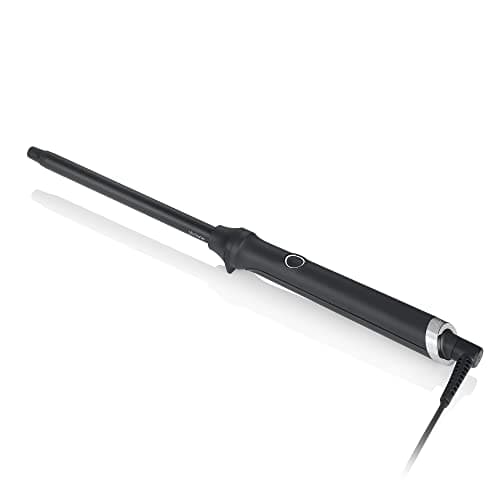
| 1 | ghd Curve Thin curling wand (0.5 inch barrel) A 0.5 in clipless barrel — the smallest here and the only one that matches a genuinely tight natural pattern. | Refreshing or evening out tighter curls | |
| 2 | 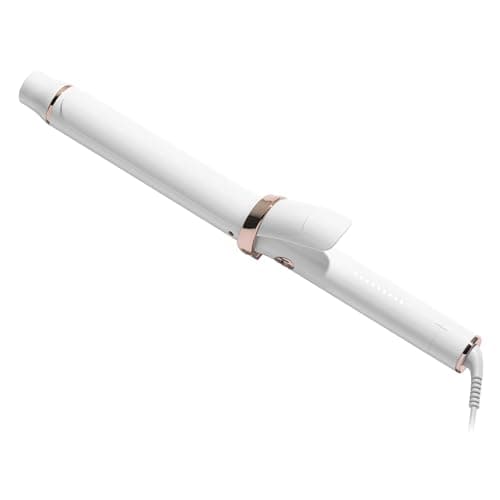 T3 SinglePass Curl X extra-long barrel curling iron Nine heat settings and a 6.5 in barrel, in three published diameters with a published weight for each. | Hair that curls tightly at the nape and barely at the crown | |
| 3 | 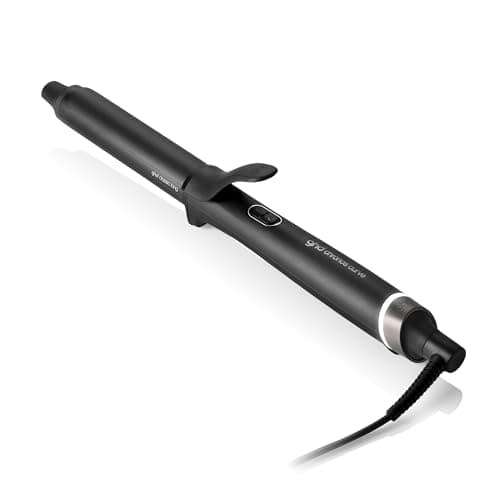 ghd Chronos Curve Classic curling iron (1 inch barrel) One fixed 365°F with no dial at all, plus a 20-minute sleep mode. | Curls that have already had too much heat | |
| — | 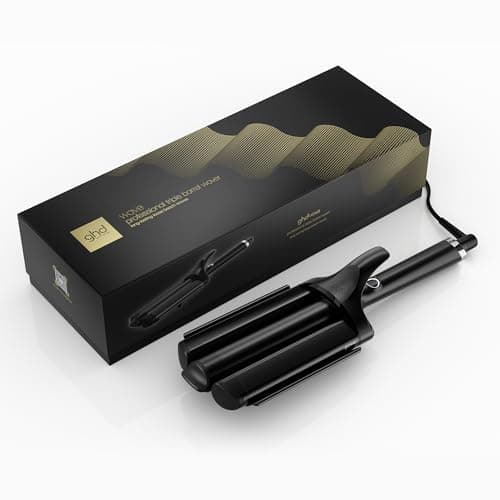 ghd Wave triple barrel hair waver A triple barrel imposes an even, repeating S-bend — the opposite of what curly hair needs from a tool. We’d skip this | Not hair that already has a pattern |
1. Best match for a tight pattern
ghd Curve Thin curling wand (0.5 inch barrel)
Best for: Refreshing or evening out tighter curls
A 0.5 in clipless barrel — the smallest here and the only one that matches a genuinely tight natural pattern.
The rule for curly hair is to match your own pattern or go slightly tighter, and on tight curls that means half an inch. Every other barrel in this registry is an inch or more, which on a tight pattern produces something looser than the hair beside it — the exact mismatch you were trying to fix.
Clipless matters here too. A clamp leaves a small crease where it sits, and on hair with an existing pattern that crease reads as a flaw rather than a style. The cool tip is what makes a clipless wand usable without a glove.
Fixed at 365°F with a 30-second heat-up, universal voltage, an 8.8 ft swivel cord, a built-in safety stand and a two-year warranty.
What’s wrong with it
ghd publishes no weight for it, and a fixed 365°F gives you nothing to lower on hair that has already been chemically treated.
Published specifications — ghd Curve Thin curling wand (0.5 inch barrel)
| Wattage | Not published |
|---|---|
| Heat settings | One fixed temperature — 365°F |
| Speed settings | Not applicable |
| Weight | Not published |
| Cord length | 8.8 ft, 360-degree swivel cord |
| Noise (dB) | Not applicable |
| Attachments | Cool tip, built-in safety stand |
| Plate / barrel | 0.5 in thin barrel, clipless |
| Dual voltage | Yes — universal voltage |
| Warranty | 2-year warranty |
Every figure above is taken from ghd — Curve Thin curling wand product page. “Not published” means the figure does not appear on that page — it is not an estimate withheld, it is a number the manufacturer does not state. How we compile these.
What it costs to run for a year
ghd does not publish a wattage for this tool, so there is nothing honest to compute. The formula is watts ÷ 1,000 × hours a year × your rate per kWh; if you find a rating plate on the handle, 65 hours a year and 18.34 cents per kilowatt-hour will get you the rest of the way.
2. Most control for a mixed pattern
T3 SinglePass Curl X extra-long barrel curling iron
Best for: Hair that curls tightly at the nape and barely at the crown
Nine heat settings and a 6.5 in barrel, in three published diameters with a published weight for each.
Mixed patterns are the most common reason curly-haired people reach for an iron, and they are also the case that needs the most adjustment. The looser sections need less heat than the tight ones, and nine settings is the only range here that lets you actually do that.
The 6.5 inch barrel is the other reason. Curly hair is usually denser than it looks, and a long barrel means fewer sections for the same head — fewer applications of heat to hair that is already working hard.
Genuine 100–240 V auto world voltage, an 8 ft swivel cord, CeraGloss ceramic, two-year warranty. Published weights of 10.6 oz, 13.2 oz and 15.1 oz by barrel size.
What’s wrong with it
Nine settings is nine chances to choose one hotter than curly hair needs, and T3 publishes no wattage for it.
Published specifications — T3 SinglePass Curl X extra-long barrel curling iron
| Wattage | 78 W |
|---|---|
| Heat settings | 9 heat settings |
| Speed settings | Not applicable |
| Weight | 10.6 oz (1 in), 13.2 oz (1.25 in), 15.1 oz (1.5 in) — cord not included |
| Cord length | 8 ft, 360-degree swivel cord |
| Noise (dB) | Not applicable |
| Attachments | None supplied |
| Plate / barrel | CeraGloss ceramic barrel, 6.5 in long |
| Dual voltage | Yes — auto world voltage, 100–240 V |
| Warranty | 2-year warranty |
Every figure above is taken from T3 Micro — SinglePass Curl X product page. “Not published” means the figure does not appear on that page — it is not an estimate withheld, it is a number the manufacturer does not state. How we compile these.
What it costs to run for a year
$0.93 a year
78 W × 65 hours a year = 5.1 kWh, at 18.34 cents per kilowatt-hour. The hours assume 15 minutes a session, 5 days a week — that is an assumption, not a measurement, so swap in your own if it is wrong.
3. The discipline pick
ghd Chronos Curve Classic curling iron (1 inch barrel)
Best for: Curls that have already had too much heat
One fixed 365°F with no dial at all, plus a 20-minute sleep mode.
Curly hair is disproportionately likely to have been chemically treated as well as heat-styled, and the combination is where the damage compounds. An iron with no way to turn it up removes the decision that does the most harm.
The 20-minute sleep mode is a small feature that turns out to matter on curly hair specifically, because curl styling is a long, interrupted process — you set a section, do something else, come back. A tool that shuts itself off is one fewer thing sitting at 365°F on a counter.
1 in clipped ceramic barrel, an 8.8 ft professional cable, two-year warranty.
What’s wrong with it
1 inch is looser than a tight natural pattern, ghd publishes no voltage rating for it, and the clip leaves a crease that shows against an existing curl.
Published specifications — ghd Chronos Curve Classic curling iron (1 inch barrel)
| Wattage | Not published |
|---|---|
| Heat settings | One fixed temperature — 365°F |
| Speed settings | Not applicable |
| Weight | Not published |
| Cord length | 8.8 ft professional cable |
| Noise (dB) | Not applicable |
| Attachments | None supplied |
| Plate / barrel | Ceramic barrel, 1 in, clipped |
| Dual voltage | Not published |
| Warranty | 2-year warranty |
Every figure above is taken from ghd — Chronos Curve Classic curling iron product page. “Not published” means the figure does not appear on that page — it is not an estimate withheld, it is a number the manufacturer does not state. How we compile these.
What it costs to run for a year
ghd does not publish a wattage for this tool, so there is nothing honest to compute. The formula is watts ÷ 1,000 × hours a year × your rate per kWh; if you find a rating plate on the handle, 65 hours a year and 18.34 cents per kilowatt-hour will get you the rest of the way.
The one we'd skip
ghd Wave triple barrel hair waver
Best for: Not hair that already has a pattern
A triple barrel imposes an even, repeating S-bend — the opposite of what curly hair needs from a tool.
This is a good product doing the wrong job. The Wave produces a uniform, deliberate wave in a fraction of the time a single barrel takes, and on straight hair that is exactly the appeal.
On hair that already curls, uniformity is the problem rather than the solution. Your natural pattern is irregular, and pressing a regular S-bend through part of it produces two competing patterns in the same head — which reads as damage rather than as styling.
It also cannot be adjusted. Fixed 365°F, and ghd publishes no voltage rating, no weight and no cord length for it. If you want a waver, buy it for straight hair; for curls, a single barrel matched to your pattern is the tool.
What’s wrong with it
Imposes a uniform pattern on hair whose appeal is that it is not uniform, with no temperature adjustment and four blank rows on the spec sheet.
Published specifications — ghd Wave triple barrel hair waver
| Wattage | Not published |
|---|---|
| Heat settings | One fixed temperature — 365°F |
| Speed settings | Not applicable |
| Weight | Not published |
| Cord length | Not published |
| Noise (dB) | Not applicable |
| Attachments | None supplied |
| Plate / barrel | Three ergonomic barrels, dual temperature sensors |
| Dual voltage | Not published |
| Warranty | 2-year warranty |
Every figure above is taken from ghd — Wave triple barrel hair waver product page. “Not published” means the figure does not appear on that page — it is not an estimate withheld, it is a number the manufacturer does not state. How we compile these.
What it costs to run for a year
ghd does not publish a wattage for this tool, so there is nothing honest to compute. The formula is watts ÷ 1,000 × hours a year × your rate per kWh; if you find a rating plate on the handle, 65 hours a year and 18.34 cents per kilowatt-hour will get you the rest of the way.
You probably do not need one
Let us be straight about this before recommending anything. If your curls behave, a curling iron adds heat exposure to hair that is already more fragile than average and gives you a shape you already had.
Curly and coily hair is structurally more vulnerable to mechanical and chemical stress than straight hair — an analysis comparing chemical and physical treatments across hair types found bleaching and dyeing caused cuticle wear with high protein loss regardless of curliness, and increased combing work notably on Afro-textured hair — Bloch et al., JEADV. Adding daily heat on top of that is a real cost.
The tools that serve curly hair best are the ones that dry it without disturbing the pattern, and those are diffusers and air stylers rather than irons — the dryers page and the stylers page are the better starting points for most people.
The three cases where you genuinely do
An uneven pattern
Very common and rarely discussed. Most curly heads are not uniform — the nape curls tighter than the crown, one side holds and the other drops, the front is looser from being handled. An iron used on the sections that disagree, matched to the pattern of the sections that behave, evens it out.
This is a spot-treatment use, not a whole-head one, which changes the buying decision: you want the right barrel, not the fastest tool.
Refreshing a set
Day three of a wash cycle is when curls flatten at the roots and separate at the ends. Re-curling a few pieces at the front is faster than rewashing and drying the whole head, and it is less total heat than a fresh diffused dry.
Putting movement back after straightening
If you have straightened and want some shape back before the next wash, an iron gets you there without re-wetting. Given that re-wetting means another full diffused dry, this is often the lower-heat option.
Matching the barrel to the pattern
Barrel size against natural pattern
| Your pattern | Barrel | Why |
|---|---|---|
| Tight curls and coils | 0.5 in | Anything larger reads as looser than the hair next to it |
| Defined ringlets | 0.5–1 in | Match, or go one step tighter to allow for drop |
| Loose curls | 1 in | The default, and it relaxes into the surrounding pattern |
| Waves | 1–1.25 in | Enough shape to define without changing the character |
The reason to go tighter rather than looser is drop. Every curl relaxes as it cools and keeps relaxing over the day, so a barrel matched exactly to your pattern produces a section slightly looser than its neighbours by the afternoon. More on that on the barrel size page.
Technique, briefly
- Work on dry hair only. Damp hair plus a 365°F barrel is the one combination that does immediate, visible damage.
- Use a heat protectant, but know its limits. What it does and does not do is on the protectant page.
- Wrap in the same direction as the natural pattern. Fighting the direction is why a curled section sticks out.
- Let it cool before touching it. Curl sets on cooling. Pulling a hot curl straight undoes the whole thing.
- Do not brush afterwards. On curly hair a brush separates the clump and the result is frizz, not volume.
Price per use, at 5 uses a week over 5 years
| What you pay | Cost per use | Cost per year |
|---|---|---|
| $30 | $0.02 | $6.00 |
| $60 | $0.05 | $12.00 |
| $100 | $0.08 | $20.00 |
| $150 | $0.12 | $30.00 |
| $200 | $0.15 | $40.00 |
| $300 | $0.23 | $60.00 |
| $400 | $0.31 | $80.00 |
| $500 | $0.38 | $100.00 |
5 uses a week for 5 years is 1300 uses. Both figures are stated assumptions, not measurements — halve the life and every cost per use doubles. We publish the ladder rather than a worked example for one specific product because a price we typed into a sentence would be wrong within a week.
Questions people actually ask
Should I curl already curly hair?
Usually not the whole head. The genuine cases are evening out a pattern that differs across your head, refreshing a set on day three, and adding movement back after straightening.
What barrel size for curly hair?
Match your natural pattern or go one step tighter, because every curl relaxes as it cools. Tight patterns need a half-inch barrel; loose curls do well on one inch.
Is a waver good for curly hair?
No. A triple-barrel waver imposes an even, repeating S-bend, and curly hair's character is that it is irregular. The two patterns compete and the result reads as damage rather than styling.