Curling Irons & Wands
The Best Curling Irons for Thick Hair in 2026
Thick hair does not fail to hold a curl because the iron is not hot enough. It fails because the section was too big and the curl was released warm.
Updated September 2026 · Sawyer V.
Thick hair pulls a curl out under its own weight, so go a barrel size smaller than you would expect and take much smaller sections. Heat recovery matters more than maximum temperature — an iron whose barrel cools between sections will feel weak whatever it says on the dial.
We earn a commission if you buy through the links on this page, at no extra cost to you. It never changes which tool we pick or which one we tell you to skip. How this site is funded.
Quick picks
Tap any row to jump to the full write-up. Prices come from the live price layer; where none is available the button says so rather than showing a number we cannot stand behind.
| # | Product | Best for | Price |
|---|---|---|---|
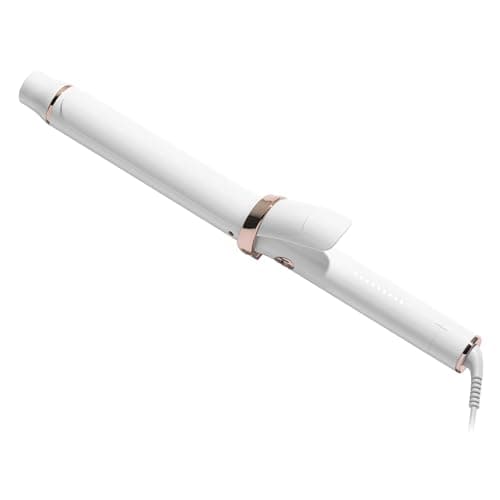
| 1 | T3 SinglePass Curl X extra-long barrel curling iron A 6.5 inch extra-long barrel and nine heat settings, with a published weight for every size. | Long dense hair that needs coverage per section | |
| 2 | 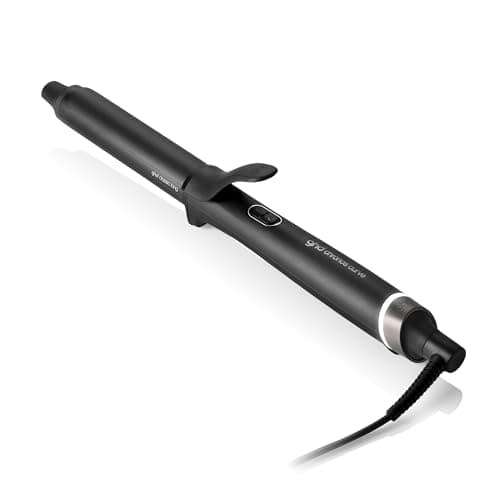 ghd Chronos Curve Classic curling iron (1 inch barrel) 365°F fixed with no dial, an 8.8 ft cable and a 20-minute sleep mode. | Thick hair that has been over-curled before | |
| 3 | 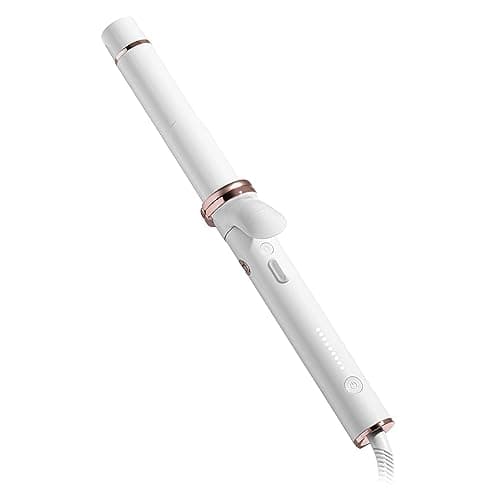 T3 CurlWrap automatic rotating curling iron A self-rotating long barrel with nine heat settings and dual voltage. | Long dense hair where a full head is exhausting | |
| — | 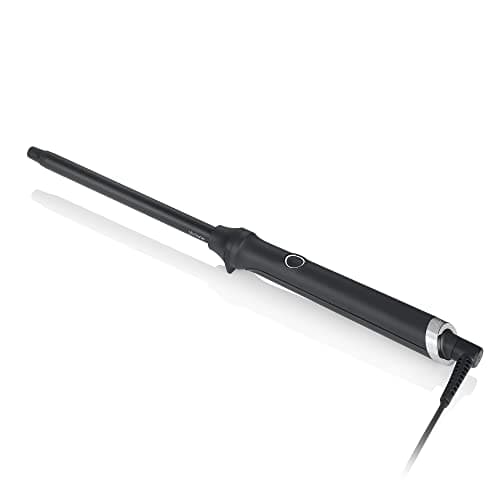 ghd Curve Thin curling wand (0.5 inch barrel) A 0.5 inch barrel on thick hair is hours of work for a result that drops out. We’d skip this | Not long dense hair |
1. Best barrel length
T3 SinglePass Curl X extra-long barrel curling iron
Best for: Long dense hair that needs coverage per section
A 6.5 inch extra-long barrel and nine heat settings, with a published weight for every size.
Barrel length is the specification thick hair benefits from and almost nobody publishes. T3 states 6.5 inches, which means more of a long dense section is in contact at once — fewer wraps, fewer sections, a shorter session.
Nine heat settings is the most granular range in our registry. Coarse hair tolerates more heat than fine hair, but the headroom is only useful if you can also come back down for the finer pieces at the nape.
T3 publishes a separate weight per barrel size — 10.6 oz for the 1 in, 13.2 oz for the 1.25 in, 15.1 oz for the 1.5 in, cord excluded. On a long session with your arm raised, that is not trivia. 100–240 V and an 8 ft swivel cord.
What’s wrong with it
No published wattage, so heat recovery cannot be assessed at all. The 1.5 in version at 15.1 oz is the heaviest curling tool here.
Published specifications — T3 SinglePass Curl X extra-long barrel curling iron
| Wattage | 78 W |
|---|---|
| Heat settings | 9 heat settings |
| Speed settings | Not applicable |
| Weight | 10.6 oz (1 in), 13.2 oz (1.25 in), 15.1 oz (1.5 in) — cord not included |
| Cord length | 8 ft, 360-degree swivel cord |
| Noise (dB) | Not applicable |
| Attachments | None supplied |
| Plate / barrel | CeraGloss ceramic barrel, 6.5 in long |
| Dual voltage | Yes — auto world voltage, 100–240 V |
| Warranty | 2-year warranty |
Every figure above is taken from T3 Micro — SinglePass Curl X product page. “Not published” means the figure does not appear on that page — it is not an estimate withheld, it is a number the manufacturer does not state. How we compile these.
What it costs to run for a year
$0.93 a year
78 W × 65 hours a year = 5.1 kWh, at 18.34 cents per kilowatt-hour. The hours assume 15 minutes a session, 5 days a week — that is an assumption, not a measurement, so swap in your own if it is wrong.
2. The temperature you cannot overshoot
ghd Chronos Curve Classic curling iron (1 inch barrel)
Best for: Thick hair that has been over-curled before
365°F fixed with no dial, an 8.8 ft cable and a 20-minute sleep mode.
The habit that damages thick hair is turning the heat up when a curl drops — and on dense hair curls drop constantly, because weight pulls them out. An iron with no dial removes that response entirely.
ghd fixes this at 365°F and publishes ceramic heating that maintains that temperature across the full barrel length, which on a dense section is the thing that stops one end being under-curled.
A 1 inch barrel, an 8.8 ft professional cable, and a 20-minute automatic sleep mode. Two-year warranty.
What’s wrong with it
No temperature headroom at all, which on very coarse resistant hair means more wraps rather than a hotter pass. ghd publishes no weight, wattage or barrel-length figure.
Published specifications — ghd Chronos Curve Classic curling iron (1 inch barrel)
| Wattage | Not published |
|---|---|
| Heat settings | One fixed temperature — 365°F |
| Speed settings | Not applicable |
| Weight | Not published |
| Cord length | 8.8 ft professional cable |
| Noise (dB) | Not applicable |
| Attachments | None supplied |
| Plate / barrel | Ceramic barrel, 1 in, clipped |
| Dual voltage | Not published |
| Warranty | 2-year warranty |
Every figure above is taken from ghd — Chronos Curve Classic curling iron product page. “Not published” means the figure does not appear on that page — it is not an estimate withheld, it is a number the manufacturer does not state. How we compile these.
What it costs to run for a year
ghd does not publish a wattage for this tool, so there is nothing honest to compute. The formula is watts ÷ 1,000 × hours a year × your rate per kWh; if you find a rating plate on the handle, 65 hours a year and 18.34 cents per kilowatt-hour will get you the rest of the way.
3. Removes the technique
T3 CurlWrap automatic rotating curling iron
Best for: Long dense hair where a full head is exhausting
A self-rotating long barrel with nine heat settings and dual voltage.
The genuine problem with curling thick hair is not heat, it is stamina — a full head is a lot of sections and every one needs a wrap, a hold and a release. A barrel that rotates itself removes the wrist work from all of them.
T3 publishes two barrel rotation speeds, a long CeraGloss ceramic barrel, and nine heat settings. Auto world voltage at 100–240 V and an 8 ft swivel cord.
For anyone who has given up halfway through curling dense hair, this is the specification that addresses the actual failure.
What’s wrong with it
No published wattage, weight or barrel diameter, so neither heat recovery nor curl size can be checked before buying. A rotating barrel is also one more thing to fail.
Published specifications — T3 CurlWrap automatic rotating curling iron
| Wattage | 77 W |
|---|---|
| Heat settings | 9 heat settings |
| Speed settings | Two barrel rotation speeds |
| Weight | 13.4 oz (cord not included) |
| Cord length | 8 ft, 360-degree swivel cord |
| Noise (dB) | Not published |
| Attachments | None supplied |
| Plate / barrel | Korean CeraGloss ceramic self-rotating long barrel, 1 in and 1¼ in |
| Dual voltage | Yes — auto world voltage, 100–240 V |
| Warranty | 2-year warranty |
Every figure above is taken from T3 Micro — CurlWrap automatic rotating curling iron product page. “Not published” means the figure does not appear on that page — it is not an estimate withheld, it is a number the manufacturer does not state. How we compile these.
What it costs to run for a year
$0.92 a year
77 W × 65 hours a year = 5.0 kWh, at 18.34 cents per kilowatt-hour. The hours assume 15 minutes a session, 5 days a week — that is an assumption, not a measurement, so swap in your own if it is wrong.
The one we'd skip
ghd Curve Thin curling wand (0.5 inch barrel)
Best for: Not long dense hair
A 0.5 inch barrel on thick hair is hours of work for a result that drops out.
This is a good wand and it is the wrong geometry for this page, in a way that is worth being explicit about because the reasoning looks backwards.
A smaller barrel does hold a curl better on fine hair. On long dense hair it fails twice: each section takes many more wraps so a full head becomes genuinely hours of work, and the tight curl it produces is precisely the shape that heavy hair pulls straight fastest.
Where it excels is short hair, where there is not enough length to wrap around anything larger — which is why we recommend it on the short-hair page.
What’s wrong with it
The smallest barrel in our registry on the hair type with the most weight pulling a curl out — the worst possible pairing of time spent to result held.
Published specifications — ghd Curve Thin curling wand (0.5 inch barrel)
| Wattage | Not published |
|---|---|
| Heat settings | One fixed temperature — 365°F |
| Speed settings | Not applicable |
| Weight | Not published |
| Cord length | 8.8 ft, 360-degree swivel cord |
| Noise (dB) | Not applicable |
| Attachments | Cool tip, built-in safety stand |
| Plate / barrel | 0.5 in thin barrel, clipless |
| Dual voltage | Yes — universal voltage |
| Warranty | 2-year warranty |
Every figure above is taken from ghd — Curve Thin curling wand product page. “Not published” means the figure does not appear on that page — it is not an estimate withheld, it is a number the manufacturer does not state. How we compile these.
What it costs to run for a year
ghd does not publish a wattage for this tool, so there is nothing honest to compute. The formula is watts ÷ 1,000 × hours a year × your rate per kWh; if you find a rating plate on the handle, 65 hours a year and 18.34 cents per kilowatt-hour will get you the rest of the way.
Why thick hair drops a curl
Weight. A curl is held by bonds that reform as the hair cools, and a heavy section applies constant downward force on that shape from the moment you release it. Fine hair has very little mass pulling on the curl; dense hair has a great deal.
Which means the two things that actually help are counterintuitive. Smaller sections, because a lighter section has less weight fighting the shape. And a full cooling period in your hand before releasing, because the curl has not set until it is cold.
What does not help is more heat. Hotter hair does not hold better; it just becomes damaged hair, and damaged hair holds a curl worse than healthy hair does. That is a loop, and a lot of thick hair is somewhere inside it.
Barrel size, against the intuition
Barrel diameter for dense hair by length
| Hair | For defined curls | For loose waves | Why |
|---|---|---|---|
| Thick, shoulder length | 1 in | 1.25 in | Weight is manageable; standard sizing applies |
| Thick, mid-back | 1 in | 1.25 in | Go a size smaller than a fine-haired person would |
| Thick, waist length | 1 in | 1.25 in | Weight pulls hard; a 1.5 in barrel will drop out by lunch |
| Thick and coarse | 1 in with more cooling time | 1.25 in | Coarse hair resists taking the shape as well as holding it |
This inverts the usual advice that long hair wants a large barrel. Long and heavy hair wants more turns, not fewer, because turns are what survive the weight.
The specification nobody publishes, again
Heat recovery. A dense section pulls a lot of heat out of a barrel, and how fast that barrel returns to temperature decides whether section four curls as well as section one. Not one manufacturer in our registry publishes a recovery figure.
ghd publishes ceramic heating that maintains 365°F across the full barrel, which is a related claim about consistency along the barrel rather than recovery over time. It is the closest thing to relevant information anyone offers, and we are flagging the distinction rather than treating it as the number.
Technique that beats every tool here
- Sections no wider than the barrel. If the section is wider than the barrel is long, the ends will not curl.
- Cool it in your hand. Wrap, release into your palm, hold until genuinely cold, then let go. On thick hair this is the difference between curls at 9am and none at 11am.
- Pin each curl while it cools if you have the patience. A pinned curl on dense hair holds noticeably longer than one dropped warm.
- Do not curl freshly conditioned, slippery hair. Heavy hair with a lot of slip has nothing to grip itself with.
Temperature, from the manufacturers
Both ghd curling tools in our registry are fixed at 365°F, and ghd publishes lab testing at 356–374°F for 1 inch barrels. That is the manufacturers’ own answer for typical hair, and coarse hair is not more heat-tolerant in any published sense — it is just harder to shape.
Published research puts the melting point of ordered keratin in dry hair at about 401°F, so there is no headroom above 400 whatever your density. The full evidence is at the styling temperature page.
Price per use, at 5 uses a week over 5 years
| What you pay | Cost per use | Cost per year |
|---|---|---|
| $30 | $0.02 | $6.00 |
| $60 | $0.05 | $12.00 |
| $100 | $0.08 | $20.00 |
| $150 | $0.12 | $30.00 |
| $200 | $0.15 | $40.00 |
| $300 | $0.23 | $60.00 |
| $400 | $0.31 | $80.00 |
| $500 | $0.38 | $100.00 |
5 uses a week for 5 years is 1300 uses. Both figures are stated assumptions, not measurements — halve the life and every cost per use doubles. We publish the ladder rather than a worked example for one specific product because a price we typed into a sentence would be wrong within a week.
Questions people actually ask
What size curling iron is best for thick hair?
Around 1 inch for defined curls and 1.25 inch for waves — a size smaller than a fine-haired person would use at the same length. Weight pulls a curl out, so more turns per section is what survives the day.
Why won't my thick hair hold a curl?
Almost always because the section was too big or the curl was released while warm. Hair sets in the shape it cools into, and a heavy section applies constant downward force from the moment you let go.
Should I use a higher temperature on thick hair?
Not above 400 degrees Fahrenheit. Both ghd curling tools in our registry are fixed at 365, and published research puts the melting point of dry hair keratin at about 401. Coarse hair is harder to shape, not more heat-tolerant.