Brushes & Accessories
Heat-Resistant Mats and Pouches: What to Look For
A counter surface, two minutes, and a 365-degree barrel. This is the least glamorous purchase in the category and one of the more sensible ones.
Updated September 2026 · Sawyer V.
A mat solves the gap between switching a tool off and it being cool enough to put away — usually a couple of minutes with a 365°F surface on a counter. Look for a named material and a stated temperature; if a listing says only “heat resistant”, treat it as decorative.
We earn a commission if you buy through the links on this page, at no extra cost to you. It never changes which tool we pick or which one we tell you to skip. How this site is funded.
The problem it actually solves
Not storage. Storage is the state a tool is in for twenty-three hours; this is about the two minutes after you finish, which is when the damage to surfaces — and occasionally to people — happens.
A flat iron at a working temperature of 365°F does not become safe to set down on a laminate counter in ninety seconds. Ceramic and metal hold heat well, which is exactly why they are used, and the outside of a barrel cools faster than its core. A tool that feels merely warm can still mark what it is resting on.
That gap is the whole use case, and it is why a mat on the counter is worth more than any organizer in a drawer — the storage argument.
The tools that solve it themselves
Worth checking before you buy anything, because three tools in our registry publish a feature that does this job.
Published heat-management features
| Tool | What it publishes | What it solves |
|---|---|---|
| Dyson Corrale | A travel pouch and a charging dock | The only iron here that ships a pouch |
| ghd Curve Thin | A built-in safety stand and a cool tip | Keeps a hot barrel off the surface during use |
| ghd Chronos Curve Classic | A 20-minute sleep mode | Switches itself off if you walk away |
| Everything else | Nothing published | You are on your own |
A built-in stand is the most useful of the three because it works during styling rather than after — curling is an interrupted activity, and a barrel that sits on its own stand between sections is a barrel not resting on a counter.
What to look for
We do not rank mats or pouches. This category is sold almost entirely by brands that publish no material specification and no temperature rating you could check, and every product on this site carries a spec block read off the manufacturer’s own page. The criteria instead:
- A named material. Silicone and glass-fiber are the usual ones. “Heat resistant” with no material and no temperature is a decorative claim rather than a specification.
- A stated temperature, ideally above 400°F. Tools in our registry run at a fixed 365°F or up from there, so a rating at or below that is not enough margin.
- Large enough for the tool plus the cord. A mat the size of the plates leaves the barrel hanging off the edge.
- Non-slip underneath. A mat that slides while you set a hot iron on it has made things worse.
- Flat rather than a drawstring bag, if it is doing double duty for travel. A mat you can put a hot tool down on in an unfamiliar bathroom is more useful than a pouch you cannot use until the tool is cold.
The thing a pouch must not become
A reason to skip cooling.
This is the failure mode the product invites: a heat-resistant pouch suggests you can bag a hot iron and go. The heat still has to go somewhere, and now it is going into a zipped fabric envelope with nowhere to dissipate, usually inside a bag with clothes.
Cool first, then bag. A pouch is for transporting a cold tool safely, not for shortcutting the wait — and the tool that ships one, the Dyson Corrale, is also a battery tool where heat in an enclosed space is exactly what you do not want.
Where the money is better spent
Honest ordering, since a mat is a real but small purchase.
The two ways heated tools actually die are cord failure at the strain relief — caused by wrapping the cord around the tool — and impact to the heating element from being at the bottom of a drawer. A mat addresses neither.
A wall hook costs less than a mat and addresses both: the cord hangs in a loose loop and nothing sits on top of the tool. If you are buying one thing for your styling setup, buy the hook. The full reasoning is on the storage page.
The mat is the second purchase, and it is genuinely worth it if your counter is laminate, wood or anything you care about.
Price per use, at 5 uses a week over 5 years
| What you pay | Cost per use | Cost per year |
|---|---|---|
| $30 | $0.02 | $6.00 |
| $60 | $0.05 | $12.00 |
| $100 | $0.08 | $20.00 |
| $150 | $0.12 | $30.00 |
| $200 | $0.15 | $40.00 |
| $300 | $0.23 | $60.00 |
| $400 | $0.31 | $80.00 |
| $500 | $0.38 | $100.00 |
5 uses a week for 5 years is 1300 uses. Both figures are stated assumptions, not measurements — halve the life and every cost per use doubles. We publish the ladder rather than a worked example for one specific product because a price we typed into a sentence would be wrong within a week.
Travel, where the case is stronger
Away from home the argument improves, because you are setting a hot tool down on a surface you do not own and did not choose.
Hotel bathrooms have less counter space than you expect, often no socket near the mirror, and surfaces that mark. A flat mat that doubles as the thing you pack the tool in solves both problems with one object, which is the right shape for a bag.
The rest of the packing argument is on the packing list, and what the airline rules actually say is on the carry-on page.
The free version
Before buying anything: switch the tool off earlier, and put it somewhere it can cool without being in the way. Most of the risk in those two minutes comes from the tool being set down somewhere unplanned because you were still using the space.
And run the cool shot on anything with a motor before switching it off. It pulls residual heat out of the element rather than leaving it to soak into the housing, which shortens the wait.
The tools on this page
Prices come from the live price layer. Where none is available the button says so rather than showing a number we cannot stand behind.
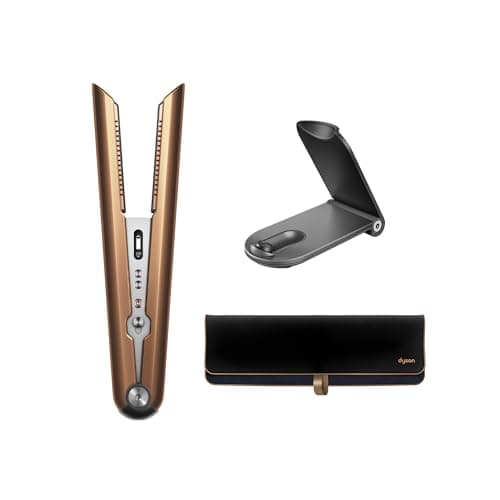
Dyson Corrale straightener
Cordless, and the only iron here whose plates flex. The 200 W figure is a battery rating and is not comparable to a corded iron's draw.
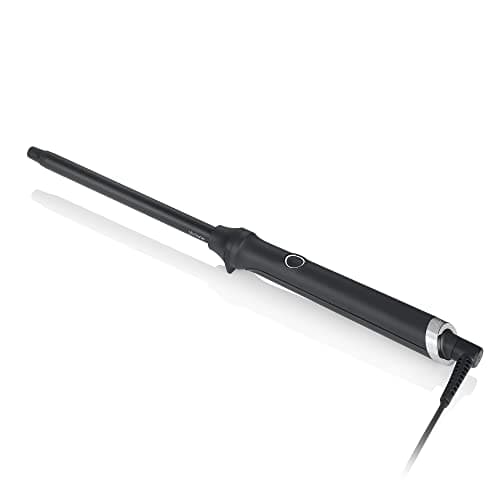
ghd Curve Thin curling wand (0.5 inch barrel)
A 0.5 inch barrel is the smallest in this registry and the one that holds a curl on short hair, with a 30-second heat-up and universal voltage.
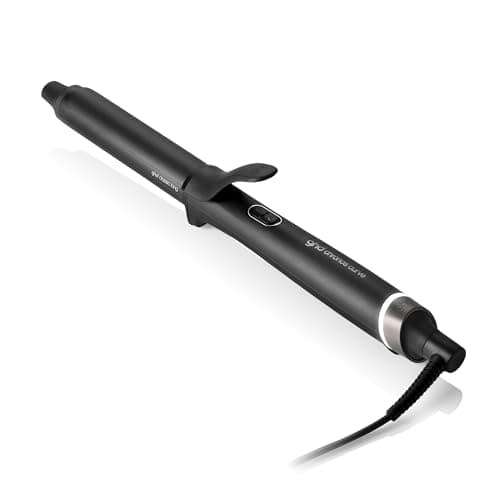
ghd Chronos Curve Classic curling iron (1 inch barrel)
A curling iron with no temperature dial at all — 365°F fixed, and a 20-minute sleep mode, which is unusual restraint in this category.
Questions people actually ask
Do I need a heat-resistant mat for hair tools?
If your counter is laminate, wood or anything you care about, yes — a tool at 365°F takes a couple of minutes to become safe to set down. If your surface is stone or tile, a wall hook is a better first purchase.
What temperature should a heat mat be rated to?
Above 400°F. Tools in our registry run at a fixed 365°F or up from there, so a rating at or below that leaves no margin. A listing that says only heat resistant, with no material and no temperature, is not a specification.
Can I put a hot flat iron straight into a heat-resistant pouch?
We would not. The heat still has to go somewhere and a zipped fabric envelope gives it nowhere to dissipate, usually inside a bag with clothes. Cool first, then bag.
Which hair tools come with a heat-resistant case?
In our registry, Dyson publishes a travel pouch with the Corrale — the only iron that ships one. ghd publishes a built-in safety stand on the Curve Thin and a 20-minute sleep mode on the Chronos Curve Classic.