Multi-Stylers & Dupes
How to Use an Air Styler Properly
An air styler is the least intuitive tool in this category, and almost every complaint about one traces back to three fixable mistakes.
Updated September 2026 · Sawyer V.
Work on hair that is about 80 percent dry, in sections no wider than the barrel, wrapping away from your face and holding until the section is completely dry — then hit it with cool before releasing. Hair that is too wet or too dry is the reason most people think these tools do not work.
We earn a commission if you buy through the links on this page, at no extra cost to you. It never changes which tool we pick or which one we tell you to skip. How this site is funded.
The dampness window is real and narrow
This is the single biggest cause of disappointment with air stylers, and it is genuinely counterintuitive.
Too wet, and the section never fully dries in the time you are willing to hold it, so it relaxes the moment you release. Too dry, and there is no water left to evaporate — and evaporation is the mechanism that sets the shape. A completely dry section wrapped around a warm barrel does almost nothing.
The target is around 80 percent dry: the hair no longer feels wet and moves freely, but is not bone dry. Rough-dry to that point with a conventional dryer or with the styler’s own concentrator, then start.
There is a damage argument for the same routine. Applying contact or concentrated heat to genuinely wet hair produces steam inside the fiber, and published microscopy shows that causes bubbling and buckling of the cuticle on top of the cracking seen in dry treatment — Ruetsch and Kamath, Journal of Cosmetic Science. The fuller version is on the wet hair page.
The method
1. Rough-dry to 80 percent
Squeeze with a towel first, wait ten minutes, then dry on the highest comfortable speed with no styling attachment. If your styler converts to a dryer — the Shark FlexStyle does — use it with the concentrator on for this stage.
2. Section, and keep them narrow
Clip everything up. Work in sections no wider than the barrel and about an inch thick. This is the second most common mistake: a section wider than the barrel cannot wrap evenly, so part of it sets and part of it does not.
Start at the nape and work up, finishing with the top layer. The top is what people see, so it should be the freshest.
3. Point the barrel, then let the air do it
Hold the barrel vertically with the airflow arrows pointing the direction you want the hair to wrap, bring the ends of the section near the tip, and let the airflow catch and pull the hair around. Do not wind it on by hand — that is a curling iron technique and it fights the tool.
If the section will not catch, it is one of three things: too much hair, too wet, or the speed is too low to generate the effect. Fix the first two before touching the third.
4. Wrap away from your face, and alternate if you want it undone
Away from the face on the sections framing it — that is what makes a blowout look like a blowout. Behind the ears, alternating direction between sections gives an irregular, less set result. Uniform wrapping in one direction reads as a deliberate curl pattern rather than as movement.
Tools that publish a left and a right barrel — T3’s Aire 360 does — are solving exactly this, so both sides can wrap away from the face without reversing your wrist.
5. Hold until dry, then cool
The section is not set when it is warm and shaped; it is set when it has dried and cooled in that shape. Hold until it feels completely dry, then switch to the cool setting for two seconds with the hair still wrapped, then release.
Skipping the cool step is why an air styler result drops within the hour. It costs two seconds a section and it is the difference between a style that lasts and one that does not.
6. Leave it alone
Do not brush it out immediately. Let everything cool completely, then break it up with your fingers if you want a softer result. A brush on fresh curls gives volume you did not ask for and, on curly hair, separates the clumps into frizz.
The three mistakes, ranked
What goes wrong, and what it looks like
| Mistake | What you see | Fix |
|---|---|---|
| Hair too wet | Curl drops immediately on release | Rough-dry to 80 percent first |
| Hair completely dry | Nothing happens at all | Mist lightly, or style straight after the rough dry |
| Sections too wide | Half the section holds, half does not | No wider than the barrel, about an inch thick |
| Released while warm | Looks right for ten minutes, then falls | Cool on the barrel for two seconds before release |
| Wound on by hand | Uneven, kinked, slow | Let the airflow catch the ends and pull |
Settings: lower than you think
Air speed, not heat, is what disturbs a pattern you are trying to set — and it is also what generates the Coanda effect that makes the tool work. You need enough speed to wrap and no more.
This is where published settings counts earn their money. Dyson publishes three heat and three speed settings on the Airwrap; T3 publishes three and three on the Aire 360. Shark publishes no count at all for either FlexStyle, which means you cannot check how low a Shark goes before you buy it — a gap we have flagged before.
On fine or colored hair, start at the lowest heat that dries the section in a reasonable hold time and only go up if it genuinely will not set.
Attachment, matched to intent
- Barrels for curls and waves. Left and right versions if your tool has them.
- Oval or paddle brush for smoothing and stretching — the attachment most people underuse, and the most useful one on short or coily hair.
- Round volumizing brush for root lift.
- Diffuser for drying a curl pattern without changing it. Only the Shark FlexStyle publishes one in its configurable set.
- Concentrator for the rough dry, not the styling.
Which attachments actually come in which box is a live question in this category, because two of the four stylers we cover publish no list at all — the attachments page has the full table.
Price per use, at 5 uses a week over 5 years
| What you pay | Cost per use | Cost per year |
|---|---|---|
| $30 | $0.02 | $6.00 |
| $60 | $0.05 | $12.00 |
| $100 | $0.08 | $20.00 |
| $150 | $0.12 | $30.00 |
| $200 | $0.15 | $40.00 |
| $300 | $0.23 | $60.00 |
| $400 | $0.31 | $80.00 |
| $500 | $0.38 | $100.00 |
5 uses a week for 5 years is 1300 uses. Both figures are stated assumptions, not measurements — halve the life and every cost per use doubles. We publish the ladder rather than a worked example for one specific product because a price we typed into a sentence would be wrong within a week.
How often is reasonable
An air styler is one of the gentler heat tools in this category, because there is no clamped plate and the air is cooler than a plate surface. That does not make it free, and the tools publishing the lowest wattages are also the slowest — which means longer sessions.
The honest framework — count applications rather than minutes, and reduce the highest-intensity ones first — is on the how-often page. And if the honest answer this week is “less”, the alternatives are on the heat-free page.
The tools on this page
Prices come from the live price layer. Where none is available the button says so rather than showing a number we cannot stand behind.
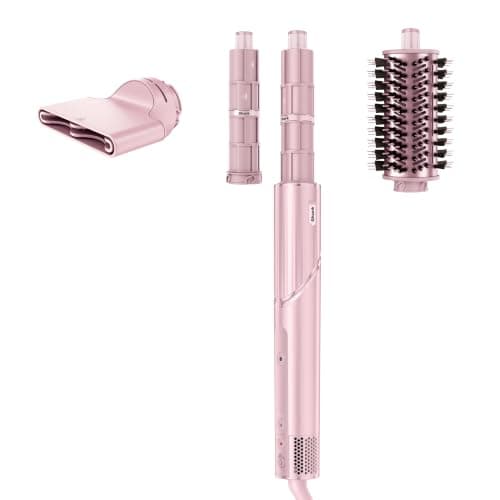
Shark FlexStyle air styling and drying system
Exactly the same published wattage as the Dyson Supersonic, in a tool that also converts to a dryer — the single strongest number in the dupe argument.
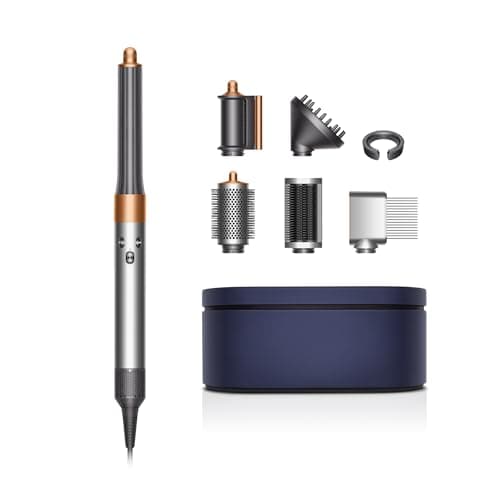
Dyson Airwrap multi-styler (Complete Long)
1,300 W is the lowest published wattage of any mains tool in this registry. That is the design argument, and it is also why it is slow on thick hair.
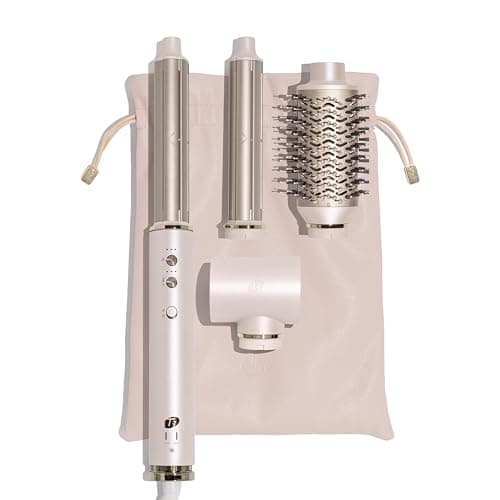
T3 Aire 360 dual voltage ceramic air styler
The only dual-voltage air styler in this registry, and T3's one product that publishes a wattage — 1,200–1,400 W, above the Airwrap.
Questions people actually ask
Should hair be wet or dry when using an air styler?
About 80 percent dry. Too wet and the section never dries in the hold time so the curl drops; too dry and there is no evaporation to set the shape, so nothing happens at all.
Why won't my Airwrap or FlexStyle catch my hair?
Usually the section is too wide or too wet. Take less hair, no wider than the barrel, and rough-dry further before starting. Raising the speed is the last thing to try, not the first.
Why do my air styler curls fall out?
Because the section was released while still warm. Hair sets as it cools, so hold until the section is completely dry, then use the cool setting for two seconds before releasing.
Is an air styler less damaging than a curling iron?
Generally, because there is no clamped plate and the air is cooler than a hot barrel surface. The trade is time — the lowest-wattage stylers are the slowest, and a longer session is more total exposure.