Shop by Hair Type
The Best Hair Tools for Long Hair in 2026
Length is not density, and the tools built for thick hair are not automatically the ones built for long hair. Weight and coverage decide this.
Updated September 2026 · Sawyer V.
Long hair means more sections and a longer session, so the specifications that matter are weight, cord length and coverage per pass — not wattage. The ends you are styling have been on your head for two years and have measurably less structure than the roots.
We earn a commission if you buy through the links on this page, at no extra cost to you. It never changes which tool we pick or which one we tell you to skip. How this site is funded.
Long is not the same as thick
These get treated as one problem and they are two. Density is how many hairs you have; length is how long each one is. You can have fine, sparse hair to your waist or a dense head cropped to the jaw.
What each problem asks of a tool
| Thick hair | Long hair | |
|---|---|---|
| The complaint | The inside stays damp; sections take three passes | There are forty sections and my arms ache |
| What helps most | Power, airflow, plate contact | Low weight, long cord, coverage per pass |
| The risk | Repeat passes on the same area | Over-working ends that are already two years old |
If your hair is both, take the weight and coverage reasoning from here and the power argument from the thick hair router. That combination is the hardest case on this site.
Your ends are the oldest hair you own
Hair grows at roughly half an inch a month, so hair past the shoulder blades has tips that have been on your head for two years or more — through every wash, every brush and every previous styling session.
That is measurable rather than metaphorical. Researchers cutting hair into segments from root to tip found that concentrations of free polar lipids and covalently bound fatty acids decreased steadily along the fiber, with a significant reduction in tensile properties across the same span — Duvel et al., International Journal of Cosmetic Science.
Two free adjustments follow. Drop a step on the lengths if your tool has one. And never go back over the ends to fix a section — a repeat pass on the weakest hair you own is the worst trade available. Why splits form where they do is on the split ends page.
Section count is the number to attack
Everything here reduces to one arithmetic. If a wide plate lets you do thirty sections instead of forty-five, that is fifteen fewer heat applications every time you style — repeated across a year it dwarfs any difference between 365°F and 380°F.
The other lever is free: section properly before you start. Sections thicker than about an inch have hair in the middle that never contacts the tool, stays unstyled, and sends you back over it — the method.
The other thing length changes
Weight, and not just the tool’s. A curl in long hair is fighting gravity from the moment you release it, which is why long-haired people so often conclude their curls do not hold.
Two fixes. Let each curl cool completely before it takes any weight — pinning it to your head while it cools is the classic technique for exactly this. And go one step tighter than the finished look you want, because a curl in long hair relaxes further than the same curl in short hair. The full version is on why curls drop.
Price per use, at 5 uses a week over 5 years
| What you pay | Cost per use | Cost per year |
|---|---|---|
| $30 | $0.02 | $6.00 |
| $60 | $0.05 | $12.00 |
| $100 | $0.08 | $20.00 |
| $150 | $0.12 | $30.00 |
| $200 | $0.15 | $40.00 |
| $300 | $0.23 | $60.00 |
| $400 | $0.31 | $80.00 |
| $500 | $0.38 | $100.00 |
5 uses a week for 5 years is 1300 uses. Both figures are stated assumptions, not measurements — halve the life and every cost per use doubles. We publish the ladder rather than a worked example for one specific product because a price we typed into a sentence would be wrong within a week.
The category pages for length
Each of these ranks the whole field rather than one pick: dryers, flat irons, curling irons and blow-dry brushes.
Quick picks
Tap any row to jump to the full write-up. Prices come from the live price layer; where none is available the button says so rather than showing a number we cannot stand behind.
| # | Product | Best for | Price |
|---|---|---|---|
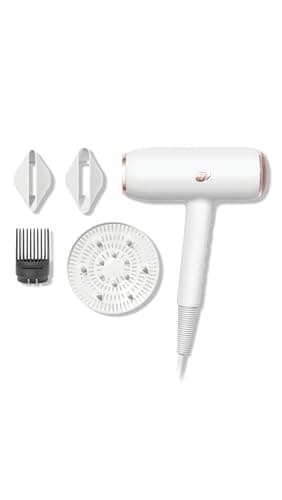
| 1 | T3 Featherweight StyleMax professional hair dryer 16.6 oz without the cord — the lightest corded dryer we list — with a 9 ft professional cord and fifteen heat-and-speed combinations. | Arms that give out before the hair is dry | |
| 2 | 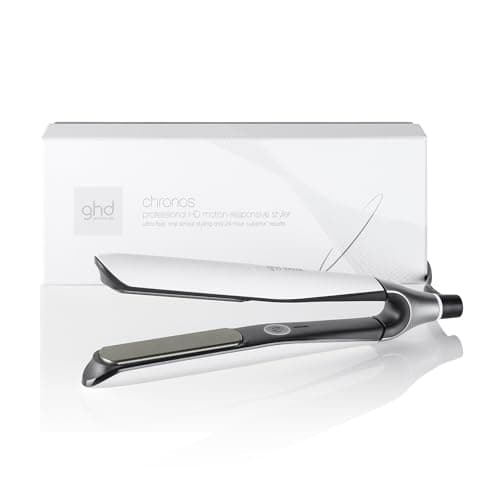 ghd Chronos flat iron (1 inch plate) ghd publishes the Chronos in a wide-plate version as well as 1 inch — the only wide option we cover. | Covering the most hair per pass | |
| 3 | 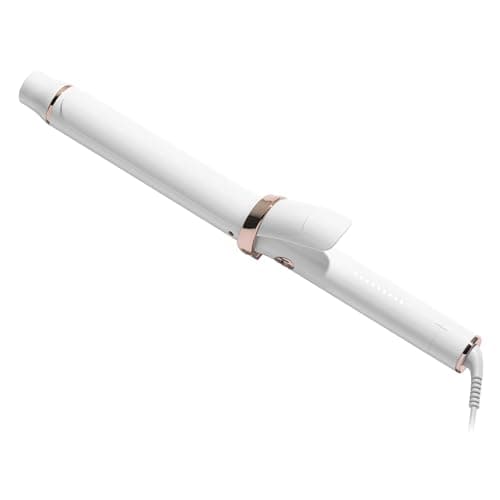 T3 SinglePass Curl X extra-long barrel curling iron A published 6.5 in barrel — the only barrel length published by anyone here — with nine heat settings and a weight for each diameter. | Curling a lot of hair without forty sections | |
| 4 | 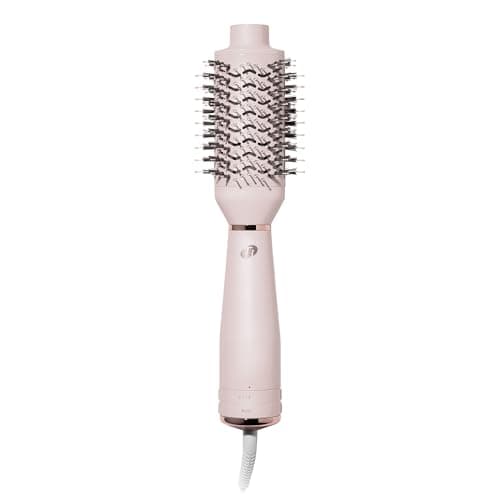 T3 AireBrush One-Step smoothing and volumizing dryer brush A smoothing paddle with separate heat and speed control, 16 oz published, and an 8 ft 360-degree swivel cord. | Smoothing a lot of hair per stroke | |
| — | 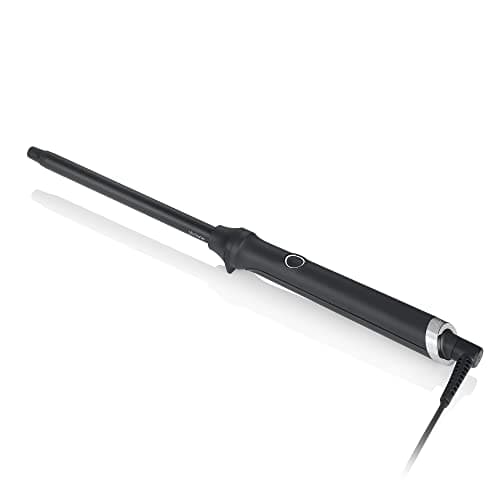 ghd Curve Thin curling wand (0.5 inch barrel) A 0.5 in barrel — the smallest here — which on long hair means the most sections and the tightest curl. We’d skip this | Not long hair |
1. Lightest dryer for a long session
T3 Featherweight StyleMax professional hair dryer
Best for: Arms that give out before the hair is dry
16.6 oz without the cord — the lightest corded dryer we list — with a 9 ft professional cord and fifteen heat-and-speed combinations.
Twelve ounces does not sound like much until you hold it at shoulder height for twenty-five minutes. 16.6 oz is 1.04 lb against the Dyson Supersonic’s published 1.8 lb, and on the hair length with the longest sessions that gap is the argument.
The 9 ft cord is joint longest in our registry and it earns its keep here specifically — long hair means working right around the back of your head, section by section.
Five heat and three speed settings lets you run the lengths cooler than the roots, which on long hair is not a refinement.
What’s wrong with it
T3 publishes no wattage at all, so drying capacity cannot be checked — and on a lot of hair, capacity is exactly what you are gambling on.
Published specifications — T3 Featherweight StyleMax professional hair dryer
| Wattage | Not published |
|---|---|
| Heat settings | 5 heat settings |
| Speed settings | 3 speed settings |
| Weight | 16.6 oz (cord not included) |
| Cord length | 9 ft professional cord |
| Noise (dB) | Not published |
| Attachments | Not published |
| Plate / barrel | Ceramic |
| Dual voltage | No — 125 V |
| Warranty | 2-year warranty |
Every figure above is taken from T3 Micro — Featherweight StyleMax product page. “Not published” means the figure does not appear on that page — it is not an estimate withheld, it is a number the manufacturer does not state. How we compile these.
What it costs to run for a year
T3 does not publish a wattage for this tool, so there is nothing honest to compute. The formula is watts ÷ 1,000 × hours a year × your rate per kWh; if you find a rating plate on the handle, 65 hours a year and 18.34 cents per kilowatt-hour will get you the rest of the way.
2. Only wide plate in the registry
ghd Chronos flat iron (1 inch plate)
Best for: Covering the most hair per pass
ghd publishes the Chronos in a wide-plate version as well as 1 inch — the only wide option we cover.
Plate width is what reduces section count, and section count is what drives total heat exposure on a lot of hair. A wider plate covers more per stroke, which means fewer separate heat applications across the same head.
Floating ceramic plates with a re-engineered wishbone hinge to hold them aligned — alignment being what stops a wide plate gripping unevenly across a long section.
Three-year warranty, the longest iron cover in our registry.
What’s wrong with it
Fixed at 365°F with no adjustment, and ghd publishes no voltage rating, weight or cord length for it — three blank rows at a flagship price.
Published specifications — ghd Chronos flat iron (1 inch plate)
| Wattage | Not published |
|---|---|
| Heat settings | One fixed temperature — 365°F |
| Speed settings | Not applicable |
| Weight | Not published |
| Cord length | Not published |
| Noise (dB) | Not applicable |
| Attachments | None supplied |
| Plate / barrel | Floating ceramic plates with ultra-gloss coating, 1 in; wide-plate version also sold |
| Dual voltage | Not published |
| Warranty | 3-year warranty |
Every figure above is taken from ghd — Chronos flat iron (1 inch plate) product page. “Not published” means the figure does not appear on that page — it is not an estimate withheld, it is a number the manufacturer does not state. How we compile these.
What it costs to run for a year
ghd does not publish a wattage for this tool, so there is nothing honest to compute. The formula is watts ÷ 1,000 × hours a year × your rate per kWh; if you find a rating plate on the handle, 65 hours a year and 18.34 cents per kilowatt-hour will get you the rest of the way.
3. Longest published barrel
T3 SinglePass Curl X extra-long barrel curling iron
Best for: Curling a lot of hair without forty sections
A published 6.5 in barrel — the only barrel length published by anyone here — with nine heat settings and a weight for each diameter.
Barrel length is the specification long hair needs and almost nobody publishes. More barrel means more hair per wrap, which means fewer sections and fewer heat applications.
Choose the diameter with the published weight in front of you: 10.6 oz at 1 in, 13.2 oz at 1.25 in, 15.1 oz at 1.5 in, cord not included. That is 42 percent heavier at the top.
Nine heat settings lets you drop a step for the ends, and genuine 100–240 V auto world voltage means it travels.
What’s wrong with it
The 1.5 in barrel most people want for long hair is the heaviest tool in this list, and T3 publishes no wattage for it.
Published specifications — T3 SinglePass Curl X extra-long barrel curling iron
| Wattage | 78 W |
|---|---|
| Heat settings | 9 heat settings |
| Speed settings | Not applicable |
| Weight | 10.6 oz (1 in), 13.2 oz (1.25 in), 15.1 oz (1.5 in) — cord not included |
| Cord length | 8 ft, 360-degree swivel cord |
| Noise (dB) | Not applicable |
| Attachments | None supplied |
| Plate / barrel | CeraGloss ceramic barrel, 6.5 in long |
| Dual voltage | Yes — auto world voltage, 100–240 V |
| Warranty | 2-year warranty |
Every figure above is taken from T3 Micro — SinglePass Curl X product page. “Not published” means the figure does not appear on that page — it is not an estimate withheld, it is a number the manufacturer does not state. How we compile these.
What it costs to run for a year
$0.93 a year
78 W × 65 hours a year = 5.1 kWh, at 18.34 cents per kilowatt-hour. The hours assume 15 minutes a session, 5 days a week — that is an assumption, not a measurement, so swap in your own if it is wrong.
4. Best paddle for length
T3 AireBrush One-Step smoothing and volumizing dryer brush
Best for: Smoothing a lot of hair per stroke
A smoothing paddle with separate heat and speed control, 16 oz published, and an 8 ft 360-degree swivel cord.
A paddle covers more hair per stroke than a round barrel — the same coverage arithmetic as plate width on an iron.
The swivel cord matters more here than at any other length. Long hair means many strokes, each with a rotation, and accumulated twist in a fixed cord becomes a kink that fights you.
Six heat-and-speed combinations, CeraGloss ceramic, 125 V, two-year warranty.
What’s wrong with it
No cool setting published and no wattage, and 16 oz held up through a long session is genuinely felt.
Published specifications — T3 AireBrush One-Step smoothing and volumizing dryer brush
| Wattage | Not published |
|---|---|
| Heat settings | 3 heat settings |
| Speed settings | 2 speed settings |
| Weight | 16 oz (cord not included) |
| Cord length | 8 ft, 360-degree swivel cord |
| Noise (dB) | Not published |
| Attachments | None supplied |
| Plate / barrel | CeraGloss ceramic surface, heat-resistant bristles |
| Dual voltage | No — 125 V |
| Warranty | 2-year warranty |
Every figure above is taken from T3 Micro — AireBrush One-Step product page. “Not published” means the figure does not appear on that page — it is not an estimate withheld, it is a number the manufacturer does not state. How we compile these.
What it costs to run for a year
T3 does not publish a wattage for this tool, so there is nothing honest to compute. The formula is watts ÷ 1,000 × hours a year × your rate per kWh; if you find a rating plate on the handle, 65 hours a year and 18.34 cents per kilowatt-hour will get you the rest of the way.
The one we'd skip
ghd Curve Thin curling wand (0.5 inch barrel)
Best for: Not long hair
A 0.5 in barrel — the smallest here — which on long hair means the most sections and the tightest curl.
An excellent tool doing the wrong job. It wins the short-hair page, it is the only genuine clipless wand we cover, and it publishes universal voltage.
On long hair the half-inch diameter works against you twice. It wraps the least hair per pass, so you do the most sections and apply the most heat across the head. And it produces a ringlet, which on long hair drops under its own weight faster than a looser curl does.
If you want tight curls on long hair you will be there a while with any tool, and this one longest.
What’s wrong with it
Smallest barrel here means the most sections on the most hair, and the tightest curl is the one gravity flattens fastest on length.
Published specifications — ghd Curve Thin curling wand (0.5 inch barrel)
| Wattage | Not published |
|---|---|
| Heat settings | One fixed temperature — 365°F |
| Speed settings | Not applicable |
| Weight | Not published |
| Cord length | 8.8 ft, 360-degree swivel cord |
| Noise (dB) | Not applicable |
| Attachments | Cool tip, built-in safety stand |
| Plate / barrel | 0.5 in thin barrel, clipless |
| Dual voltage | Yes — universal voltage |
| Warranty | 2-year warranty |
Every figure above is taken from ghd — Curve Thin curling wand product page. “Not published” means the figure does not appear on that page — it is not an estimate withheld, it is a number the manufacturer does not state. How we compile these.
What it costs to run for a year
ghd does not publish a wattage for this tool, so there is nothing honest to compute. The formula is watts ÷ 1,000 × hours a year × your rate per kWh; if you find a rating plate on the handle, 65 hours a year and 18.34 cents per kilowatt-hour will get you the rest of the way.
Questions people actually ask
What hair tools are best for long hair?
Ones that cover the most hair per pass and weigh the least. Plate width, barrel length and tool weight matter more than wattage, because long hair is a section-count problem rather than a power problem.
Is long hair the same as thick hair for choosing tools?
No. Density is how many hairs you have; length is how long each is. Thick hair needs power and plate contact; long hair needs low weight, a long cord and coverage per pass.
Why do the ends of long hair get damaged first?
Because they are the oldest part. Lipid content and tensile strength both decrease measurably from root to tip, so the setting that is fine at your mid-lengths is being applied to hair with less structure.