Blow-Dry Brushes
The Best Straightening Brushes in 2026
The category name covers two mechanically different tools. Getting that distinction right before you buy is most of the decision.
Updated September 2026 · Sawyer V.
“Straightening brush” describes two different tools: a heated-bristle brush with no airflow, and a hot air brush that dries and smooths at once. We cover the second kind, because those are the ones whose makers publish specifications — and for most people it is the more useful of the two anyway.
We earn a commission if you buy through the links on this page, at no extra cost to you. It never changes which tool we pick or which one we tell you to skip. How this site is funded.
Quick picks
Tap any row to jump to the full write-up. Prices come from the live price layer; where none is available the button says so rather than showing a number we cannot stand behind.
| # | Product | Best for | Price |
|---|---|---|---|
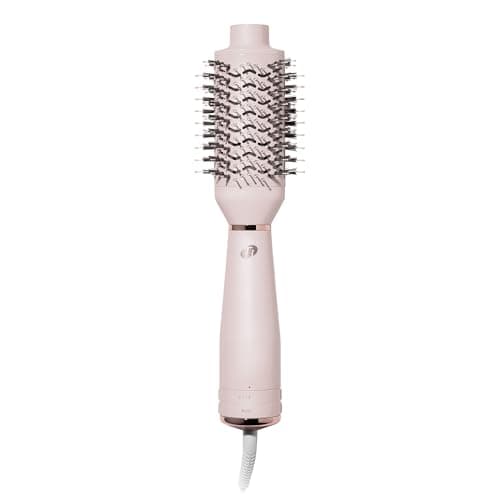
| 1 | T3 AireBrush One-Step smoothing and volumizing dryer brush A smoothing and volumizing paddle with three heat and two speed settings as separate controls, 16 oz, and an 8 ft swivel cord. | Chin length and longer, smoothing rather than curling | |
| 2 | 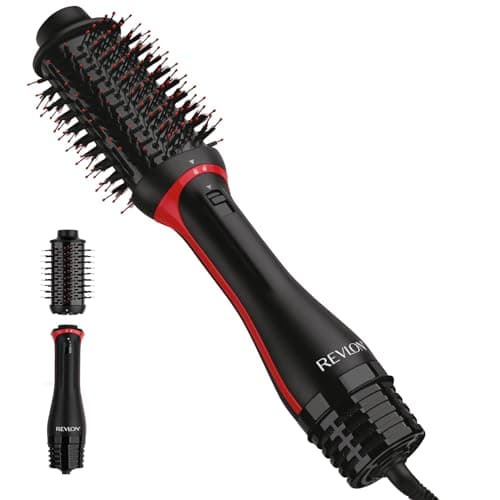 Revlon One-Step Volumizer Plus hair dryer and hot air brush Four heat settings including a dedicated cool, a detachable head, and a four-year limited warranty. | Smoothing with a finish that actually holds | |
| 3 | 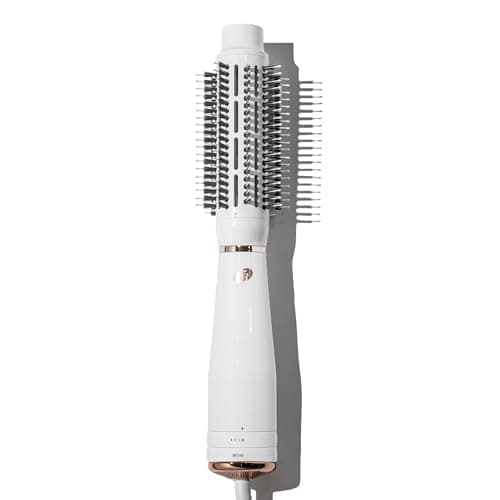 T3 AireBrush Round ionic blow-dry brush A round barrel at a published 1,200 W — the lowest mains figure in our registry — with three heat and two speed settings. | Bobs and shorter, where a paddle has nothing to grip | |
| — | 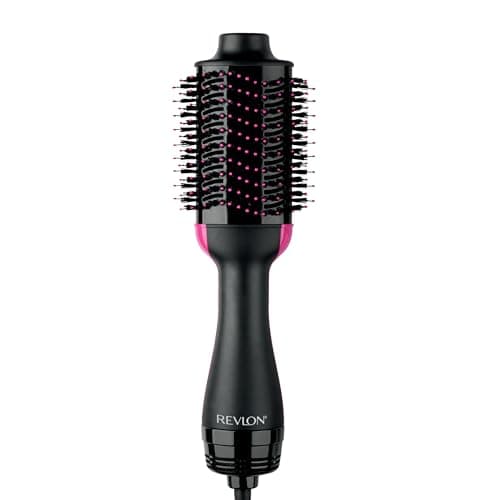 Revlon Salon One-Step hair dryer and volumizer The brush head does not detach, and Revlon publishes no heat-setting count for it at all. We’d skip this | Not frequent use |
1. Best smoothing shape
T3 AireBrush One-Step smoothing and volumizing dryer brush
Best for: Chin length and longer, smoothing rather than curling
A smoothing and volumizing paddle with three heat and two speed settings as separate controls, 16 oz, and an 8 ft swivel cord.
The paddle shape is what makes this the closest thing in our registry to a straightening brush. A wide surface with bristles gives you a long contact patch down the section, which is exactly the geometry that flattens the cuticle.
Separating heat from speed is the specification that matters here. Smoothing wants moderate warmth with enough airflow to dry as you go, and a single combined dial cannot give you that combination.
The 360-degree swivel cord earns its keep on a brush more than any other tool, because you rotate it constantly and a cord that will not twist fights every stroke. 125 V, two-year warranty.
What’s wrong with it
T3 publishes no wattage and no cool setting, and the two-year warranty is half what Revlon publishes on a cheaper tool.
Published specifications — T3 AireBrush One-Step smoothing and volumizing dryer brush
| Wattage | Not published |
|---|---|
| Heat settings | 3 heat settings |
| Speed settings | 2 speed settings |
| Weight | 16 oz (cord not included) |
| Cord length | 8 ft, 360-degree swivel cord |
| Noise (dB) | Not published |
| Attachments | None supplied |
| Plate / barrel | CeraGloss ceramic surface, heat-resistant bristles |
| Dual voltage | No — 125 V |
| Warranty | 2-year warranty |
Every figure above is taken from T3 Micro — AireBrush One-Step product page. “Not published” means the figure does not appear on that page — it is not an estimate withheld, it is a number the manufacturer does not state. How we compile these.
What it costs to run for a year
T3 does not publish a wattage for this tool, so there is nothing honest to compute. The formula is watts ÷ 1,000 × hours a year × your rate per kWh; if you find a rating plate on the handle, 65 hours a year and 18.34 cents per kilowatt-hour will get you the rest of the way.
2. Best value, and the cool setting
Revlon One-Step Volumizer Plus hair dryer and hot air brush
Best for: Smoothing with a finish that actually holds
Four heat settings including a dedicated cool, a detachable head, and a four-year limited warranty.
The cool setting is why this wins on holding power. Hair sets as it cools rather than while it is hot, so the last seconds of each section are what makes a smooth finish last past lunchtime. T3 publishes three heat settings with no cool among them.
Four years of limited cover is the longest warranty on any product in our registry — longer than anything Dyson, Shark, ghd or T3 publishes on anything — on the cheapest kind of tool we cover.
The detachable head is what keeps it working. These brushes pull air through the bristles and fill with lint and shed hair, and a clogged intake makes the element run hotter than the setting you chose.
What’s wrong with it
Revlon publishes no wattage, weight, cord length, speed count or voltage — five blank rows, so how gently it runs is unverifiable.
Published specifications — Revlon One-Step Volumizer Plus hair dryer and hot air brush
| Wattage | Not published |
|---|---|
| Heat settings | 4 heat settings — low, medium, high, cool |
| Speed settings | Not published |
| Weight | Not published |
| Cord length | Not published |
| Noise (dB) | Not published |
| Attachments | Detachable brush head |
| Plate / barrel | Ceramic titanium barrel; tourmaline ionic |
| Dual voltage | Not published |
| Warranty | 4-year limited warranty |
Every figure above is taken from Revlon Hair Tools — One-Step Volumizer Plus product page. “Not published” means the figure does not appear on that page — it is not an estimate withheld, it is a number the manufacturer does not state. How we compile these.
What it costs to run for a year
Revlon does not publish a wattage for this tool, so there is nothing honest to compute. The formula is watts ÷ 1,000 × hours a year × your rate per kWh; if you find a rating plate on the handle, 65 hours a year and 18.34 cents per kilowatt-hour will get you the rest of the way.
3. The one for short hair
T3 AireBrush Round ionic blow-dry brush
Best for: Bobs and shorter, where a paddle has nothing to grip
A round barrel at a published 1,200 W — the lowest mains figure in our registry — with three heat and two speed settings.
A paddle needs enough length to lie against it, which a chin-length cut does not have. A round barrel wraps a short section instead, and it is the only round-barrel brush we list.
1,200 W is genuinely low and appropriate for working close to the scalp, where more power mostly means more heat where you least want it. It is also the only T3 brush that publishes a wattage at all.
16 oz without the cord, 8 ft swivel, Korean CeraGloss ceramic with SmoothGrip bristles, plus quick-dry and style attachments — the only brush here that ships any.
What’s wrong with it
A round barrel is a curling and lifting shape, so it smooths less than a paddle does — and T3 publishes no voltage rating for it.
Published specifications — T3 AireBrush Round ionic blow-dry brush
| Wattage | 1,200 W |
|---|---|
| Heat settings | 3 heat settings |
| Speed settings | 2 speed settings |
| Weight | 16 oz (cord not included) |
| Cord length | 8 ft, 360-degree swivel cord |
| Noise (dB) | Not published |
| Attachments | Quick-dry attachment and style attachment |
| Plate / barrel | Korean CeraGloss ceramic surface, SmoothGrip bristles |
| Dual voltage | No — 125 V |
| Warranty | 2-year warranty |
Every figure above is taken from T3 Micro — AireBrush Round product page. “Not published” means the figure does not appear on that page — it is not an estimate withheld, it is a number the manufacturer does not state. How we compile these.
What it costs to run for a year
$14.31 a year
1,200 W × 65 hours a year = 78.0 kWh, at 18.34 cents per kilowatt-hour. The hours assume 15 minutes a session, 5 days a week — that is an assumption, not a measurement, so swap in your own if it is wrong.
The one we'd skip
Revlon Salon One-Step hair dryer and volumizer
Best for: Not frequent use
The brush head does not detach, and Revlon publishes no heat-setting count for it at all.
The original Salon One-Step is still sold, still popular, and carries the same excellent four-year limited warranty as the Plus. It is still the wrong buy of the two.
The head does not come off, so the intake cannot be properly cleaned. On a tool that pulls air through its own bristles that is a countdown rather than an inconvenience — reduced airflow makes the element run hotter than you selected.
Revlon publishes four heat settings including cool for the Plus and publishes no heat-setting count for this one. On a page about smoothing, where the cool step is what makes the finish hold, you cannot confirm it exists.
What’s wrong with it
Six blank rows on the spec sheet including the heat-setting count, and a head that cannot be removed for cleaning.
Published specifications — Revlon Salon One-Step hair dryer and volumizer
| Wattage | Not published |
|---|---|
| Heat settings | Not published |
| Speed settings | Not published |
| Weight | Not published |
| Cord length | Not published |
| Noise (dB) | Not published |
| Attachments | Non-detachable brush head |
| Plate / barrel | Ceramic coating |
| Dual voltage | Not published |
| Warranty | 4-year limited warranty |
Every figure above is taken from Revlon Hair Tools — Salon One-Step hair dryer and volumizer. “Not published” means the figure does not appear on that page — it is not an estimate withheld, it is a number the manufacturer does not state. How we compile these.
What it costs to run for a year
Revlon does not publish a wattage for this tool, so there is nothing honest to compute. The formula is watts ÷ 1,000 × hours a year × your rate per kWh; if you find a rating plate on the handle, 65 hours a year and 18.34 cents per kilowatt-hour will get you the rest of the way.
Two products, one name
This is the most confused product name in the category, and sorting it out is most of the buying decision.
The two tools sold as straightening brushes
| Heated-bristle brush | Hot air brush | |
|---|---|---|
| How it works | Bristles and a plate heat directly; no airflow | Warm air blows through the bristle field |
| Used on | Dry hair only | Damp hair, around 80 percent dry |
| Replaces | A flat iron, roughly | A dryer and a round brush |
| Speed | Faster on already-dry hair | Does drying and styling in one pass |
| Risk | Direct contact heat, like an iron | Lower — no clamped surface, cooler air |
If your hair is already dry and you want it flatter, the first kind is what you are picturing. If your hair is wet and you want to skip the two-handed blowout, the second kind is what you actually need — and it is the gentler of the two, because there is no clamped hot surface held against the fiber.
Why we cover one and not the other
Every product on this site carries a spec block read off the manufacturer’s own product page, and heated-bristle straightening brushes are sold overwhelmingly by brands that publish no plate temperature, no settings count and no warranty term we can cite.
We are not going to rank a category by inventing its specifications. That is the same position we take on storage bags and on universal diffusers, and it does not relax because a category is popular.
If you specifically want a heated-bristle brush, the criteria below are what to apply — we just will not pretend to a ranking we cannot source.
What to look for in a heated-bristle brush
- A published temperature or settings count. Not “adjustable” — a number. Without one you cannot tell whether it goes below 365°F, which is the threshold that matters for processed hair.
- Bristle tips you can feel are rounded. The contact points land on your scalp as well as your hair.
- An auto-off period. A heated brush left face-down on a counter is a heated surface on a counter.
- A stated warranty term. The one number that costs the maker money to get wrong.
- Dry hair only. Direct contact heat on wet hair produces steam inside the fiber — the published microscopy is on the wet hair page.
Straightening brush or flat iron?
Honestly: a brush will not get you pin-straight. It gets you smooth, which for most people on most days is what they actually wanted, and it does it at lower intensity than a clamped plate.
The trade is precision. An iron flattens a section between two surfaces; a brush passes over one side of it. On coarse or very curly hair the gap is large. On wavy or already-straightish hair it is small enough that most people would not choose the iron if they tried the brush first — which is the argument on brush versus flat iron.
The technique that closes most of the remaining gap costs nothing: tension, one slow pass, and a cool finish per section — the method is here.
Price per use, at 5 uses a week over 5 years
| What you pay | Cost per use | Cost per year |
|---|---|---|
| $30 | $0.02 | $6.00 |
| $60 | $0.05 | $12.00 |
| $100 | $0.08 | $20.00 |
| $150 | $0.12 | $30.00 |
| $200 | $0.15 | $40.00 |
| $300 | $0.23 | $60.00 |
| $400 | $0.31 | $80.00 |
| $500 | $0.38 | $100.00 |
5 uses a week for 5 years is 1300 uses. Both figures are stated assumptions, not measurements — halve the life and every cost per use doubles. We publish the ladder rather than a worked example for one specific product because a price we typed into a sentence would be wrong within a week.
What we would buy
The Revlon One-Step Volumizer Plus for most people — the cool setting, the detachable head and four years of cover, at the lowest price here. The T3 AireBrush One-Step if separate speed control matters to you, which it does on waves. The AireBrush Round if your hair is short.
Questions people actually ask
What is the difference between a straightening brush and a hot air brush?
A heated-bristle straightening brush heats directly with no airflow and is used on dry hair. A hot air brush blows warm air through the bristles and is used on damp hair, doing the drying and the smoothing in one pass.
Do straightening brushes damage hair less than flat irons?
A hot air brush generally does, because there is no clamped plate and the air is cooler than a plate surface. A heated-bristle brush is direct contact heat, so it carries much the same risk as an iron.
Why don't you rank heated-bristle straightening brushes?
Because the brands selling them publish no plate temperature, settings count or warranty term we can cite, and every product on this site carries a spec block sourced from the maker's own page. We give the criteria instead.
Can I use a straightening brush on wet hair?
Not a heated-bristle one. Direct contact heat on wet hair produces steam inside the fiber, and published microscopy shows that causes bubbling and buckling of the cuticle. Hot air brushes are designed for damp hair, around 80 percent dry.