Blow-Dry Brushes
Calista Perfecter Pro: What the Specs Say
Finer temperature control than most flat irons, on a tool that cannot dry a single strand.
Updated September 2026 · Sawyer V.
Calista publishes 325–395°F in 10°F intervals with a digital screen, a temperature lock and a one-hour auto shut-off, on an ion ceramic barrel with heat-resistant nylon teeth, dual voltage to 240 V and a 6 ft cord. There is no fan.
We earn a commission if you buy through the links on this page, at no extra cost to you. It never changes which tool we pick or which one we tell you to skip. How this site is funded.
Start here: it does not dry hair
This is the single most common misunderstanding in the category, and it decides whether this tool is right for you. The Perfecter Pro is a heated brush: a heated barrel with teeth, used on hair that is already dry. It has no fan, no airflow and no drying function.
A hot air brush — the Revlon One-Step, the T3 AireBrush, the L’ange Le Volume — has a fan and takes damp hair to a finished blow-dry. The spec row that tells them apart is speed settings: if a tool publishes airflow speeds, it has a fan.
Used on wet hair a heated brush does what the bubble-hair literature describes: water inside the shaft flashing to steam under direct contact heat Yin et al., Annals of Dermatology. Dry first, always.
The specification sheet, in full
Calista Perfecter Pro Heated Round Brush Gen 4, as published
| Row | Published figure |
|---|---|
| Wattage | Not published |
| Heat settings | 325-395°F in 10°F intervals |
| Speed settings | Not applicable - no fan |
| Weight | Not published |
| Cord length | 6 ft swivel |
| Noise | Not applicable - no fan |
| Attachments | Heat-safe travel bag and glide cleaning tool |
| Barrel | Ion ceramic with heat-resistant nylon teeth; 0.75, 1 and 1.5 in |
| Voltage | Dual voltage up to 240 V, American 2-prong plug |
| Warranty | 12 months, on Calista's warranty page rather than the product page |
Eight temperatures, which beats most irons
325–395°F in 10°F steps is eight selectable settings, shown on a digital screen, with a lock that stops the number being nudged mid-session on a tool you grip and rotate constantly.
For comparison: the ghd irons fix one temperature, CHI fixes one, Hot Tools publishes a ceiling only, and the T3 SinglePass StyleMax — the most granular iron here — publishes nine settings without stating their degrees. Calista states the degrees.
What it is actually for
- Second-day smoothing. Its best use: reviving dry hair without rewashing. See refreshing second-day hair.
- Replacing an iron pass on hair that only needs the ends and the crown straightened.
- Travel. Dual voltage to 240 V with a heat-safe bag in the box, which is unusual in this category.
- Not a blow-dry. If you want one tool that dries and shapes, buy a hot air brush.
Three barrel sizes, and how to choose
Calista publishes the Perfecter Pro in 0.75, 1 and 1.5 inch barrels, with dimensions stated for each. Because this is a heated brush rather than a curling tool, the diameter is doing a different job: it decides how much hair each stroke controls rather than what curl it forms.
Published barrel sizes and stated dimensions
| Barrel | Dimensions | Suits |
|---|---|---|
| 0.75 in | 13 × 1.25 × 1.25 in | Short hair, bangs, precision near the face |
| 1 in | 13 × 1.5 × 1.5 in | Most lengths - the default |
| 1.5 in | 13 × 2 × 2 in | Long or thick hair, smoothing in fewer strokes |
The temperature range, the cord, the screen, the lock and the auto shut-off are identical across all three, so this is purely a question of how much hair you are moving per stroke. On long hair the 1.5 in covers ground faster; around a fringe or a short layer it is unwieldy.
The gaps
No published wattage and no published weight. The weight omission is the more annoying: this is a tool held at head height and rotated through a section, and Calista tells you its dimensions but not its mass.
The 12-month warranty is published on the company’s warranty page rather than the product page, which is why our spec block says where the figure came from. Twelve months is short next to Revlon’s four years, though a tool with no fan and no motor has fewer parts to fail. See what a warranty is worth.
Who should buy it
Anyone who already dries their hair and wants to smooth or shape it afterwards at a temperature they choose to the degree — particularly fine, colored or heat-damaged hair, where the difference between 325°F and 395°F is the whole decision.
Anyone hoping to replace a hair dryer should buy something else: hot air brush vs hair dryer sets out the choice.
The tools on this page
Prices come from the live price layer. Where none is available the button says so rather than showing a number we cannot stand behind.
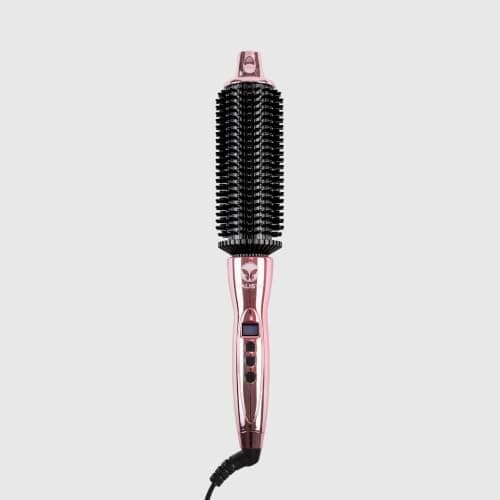
Calista Perfecter Pro Heated Round Brush Gen 4 (1 in)
A heated round brush with no fan at all — which is why it publishes a 10°F temperature interval where every hot air brush here publishes 'low, medium, high'.
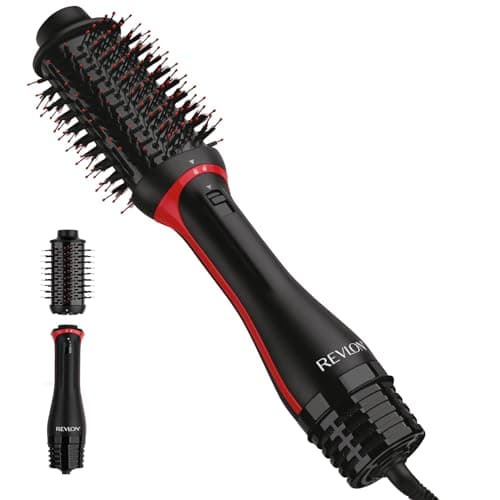
Revlon One-Step Volumizer Plus hair dryer and hot air brush
A 4-year limited warranty, the longest in this registry, on the cheapest kind of tool in it. Worth noticing before paying six times more elsewhere.
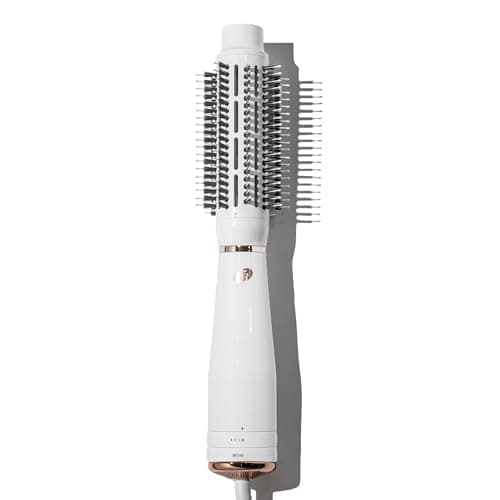
T3 AireBrush Round ionic blow-dry brush
A round barrel rather than a paddle, and the only T3 brush that publishes a wattage — the one built for lift rather than smoothing.
Questions people actually ask
Does the Calista Perfecter Pro dry hair?
No. It has no fan and no airflow - it is a heated ceramic barrel with nylon teeth, used on hair that is already dry. Using it on wet hair is the situation the bubble-hair literature warns about.
What temperature does the Perfecter Pro reach?
325 to 395 degrees Fahrenheit, selectable in 10-degree intervals on a digital screen, with a temperature lock and a one-hour auto shut-off. That is eight settings, finer than most flat irons offer.
Is the Calista Perfecter Pro dual voltage?
Yes, up to 240 V, on an American two-prong plug - so it needs a plug adapter abroad but not a voltage converter. A heat-safe travel bag is included.
Heated brush or hot air brush - which should I buy?
A hot air brush if you want one tool that dries and shapes; a heated brush if you already dry your hair and want to smooth it afterwards with precise temperature control. They solve different days.