Blow-Dry Brushes
Hot Air Brush vs Heated Brush: The Fan Is the Whole Difference
They look like the same tool and they are sold beside each other. Only one of them can dry your hair, and only the other one will tell you how hot it gets.
Updated October 2026 · Sawyer V.
Buy the hot air kind unless your hair is already dry when you start. A hot air brush pulls air through its own bristles, so it dries and shapes from damp in one pass and replaces two tools. A heated brush has no airflow — Calista publishes “use on dry hair only” — so it is a second tool that finishes what a dryer started. In exchange it publishes an actual temperature, 325–395°F in 10°F steps, which no air brush here except one will give you.
We earn a commission if you buy through the links on this page, at no extra cost to you. It never changes which tool we pick or which one we tell you to skip. How this site is funded.
Two tools, one shelf, no label telling you which
Walk the category and you will find two mechanically different objects sold under names that barely distinguish them: “dryer brush,” “blow-dry brush,” “hot air brush,” “heated round brush,” “styling brush.” Only one of those names reliably tells you whether the thing has a motor in it.
A hot air brush is a hair dryer in the shape of a brush. There is a fan in the handle, air is pulled through vents and pushed out between the bristles, and the hair dries while the barrel shapes it. You start on damp hair.
A heated brush is a hot barrel with bristles on it. No fan, no airflow, no vents. The barrel itself is the heat source and the bristles hold the hair against it, the same way a curling iron does without a clamp. You start on dry hair.
In this registry the split is lopsided: five of the six brushes blow air, and one does not. That single difference goes on to decide four other published rows, which is why it is worth a page rather than a footnote.
The two kinds, side by side
Hot air brush against heated brush, on the rows that differ by mechanism
| Row | Hot air brush (5 of 6 here) | Heated brush (1 of 6 here) |
|---|---|---|
| What moves the heat | A fan, through the bristles | Nothing - the barrel conducts it directly |
| Hair state to start | Damp - it dries as it styles | Dry only, published outright by Calista |
| Replaces your dryer? | Yes, on most hair | No - it is a second tool |
| Published temperature | Rarely. 1 of 5 publishes degrees (L'ange, 3 settings topping at 225.7°F); the rest publish low / medium / high | Yes - 325-395°F in 10°F intervals, with a digital screen and a temperature lock |
| Top of the range | 225.7°F, where a figure exists at all | 395°F |
| Speed settings | Published on the T3 brushes (2 each); not published on either Revlon or the Le Volume | Not applicable - there is no fan to set |
| Noise | Not published by anyone, but there is a motor | Not applicable - no fan |
| Dual voltage | None of the five publish it - 125 V or no figure | Yes - up to 240 V, on an American 2-prong plug |
| Cleaning problem | Pulls hair into its own air intake | No intake; ships a glide cleaning tool |
| Warranty range here | 1 year (L'ange) to 4 years (both Revlons) | 12 months, and not printed on the product page |
Quoted from each maker's own product pages. calistatools.com was re-read 2026-10-22; revlonhairtools.com returned HTTP 403 to an automated fetch the same day, so the Revlon figures are the readings already on file with their source URLs.
Why only the fanless one tells you its temperature
This is the most useful thing on the page, and it is a consequence of the mechanism rather than a difference in how honest the two companies are.
On a heated brush the barrel is the heat source and it touches the hair. Its temperature is therefore a meaningful, measurable, publishable number — so Calista publishes 325–395°F in 10°F intervals, with a digital temperature screen and a temperature lock, read from Calista’s own product page on 2026-10-22. Ten-degree resolution is finer than anything else in this registry manages, including every flat iron.
On a hot air brush the thing reaching your hair is moving air, and its temperature at the hair depends on fan speed, distance and how long you dwell. A single number would be misleading, so makers publish a settings count instead: Revlon four (low, medium, high, cool), T3 three heat plus two speeds, L’ange three. The one exception is the L’ange Le Volume, which does name all three of its settings — cool 95.4°F, low 178.9°F, high 225.7°F — and is the only hot air brush in this registry to publish a degree figure at all. The Le Volume review has the full sheet.
So the honest summary is: if being able to set and know a temperature matters to you, the fanless kind is the only one that offers it, and the Le Volume is the only air brush that comes close. Why a dial number is not a temperature is the general version of this argument.
The finding most buyers will not expect
Put the two published ceilings next to each other. The heated brush tops out at 395°F. The hottest air brush figure published here is 225.7°F. That is a gap of nearly 170 degrees between two things sold as the same sort of tool.
It gets more pointed. Every flat iron in this registry sits at 365°F or above, and ghd fixes its irons at a published 365°F. So a heated brush at the top of its range runs hotter than a ghd flat iron. “It is only a brush” is doing a lot of unearned work in people’s heads here.
That matters because heat is cumulative and the fiber does not recover: repeated thermal cycling measurably degrades hair’s mechanical properties Evans and Park, Journal of Cosmetic Science, and bleached or chemically processed hair starts with measurably less margin to spend Dyer et al., International Journal of Cosmetic Science.
The practical reading, and it is the reason the ten-degree resolution is a feature rather than a spec-sheet flourish: a tool that can be set to 325°F and locked there is safer on fragile hair than one that can only be set to “low.” A tool that can be set to 395°F and often is, is not. What temperature is actually safe has the guidance by hair type, and blow-dry brushes for damaged hair ranks on exactly this row.
One tool or two, which is the real price
Calista publishes “use on dry hair only” on the product page. Take that seriously, because it is the whole cost of the fanless design and it is not in the price.
A hot air brush is bought instead of a dryer-and-round-brush pair: you go from towel-dried to finished with one object in one hand. That is the entire reason the category exists — hot air brush vs hair dryer is the page for that decision.
A heated brush is bought in addition to a dryer. You dry first, by whatever means, and then use it to smooth, add shape, or revive a bend that has dropped. Judged as a one-tool solution it fails on the maker’s own instruction; judged as a finisher it is very good, and it is a genuinely useful second-day tool — refreshing hair without rewashing is where that use lives.
So compare total cost honestly: a heated brush plus a dryer against an air brush alone. On that arithmetic the cheap air brush does more jobs for less money, which is why it wins this page for most people.
The one row the fanless kind wins outright
Voltage. The Calista publishes dual voltage up to 240 V on an American two-prong plug. Of the five hot air brushes here, not one publishes dual voltage: both T3 brushes and the L’ange state 125 V, and both Revlons publish no voltage figure at all, which has to be read as single voltage rather than assumed universal.
That is not a coincidence either. A fan motor and a heating element drawing mains power is harder to make genuinely dual-voltage than a heating element alone. So if you want a brush that works on a 230 V supply with nothing but a plug adapter, there is exactly one in this registry and it is the fanless one — the travel blow-dry brush list has all six and what the other five would do abroad, and adapter vs converter covers why those are different objects.
Noise and cleaning, both decided by the fan
- Noise. Nobody in this registry publishes a decibel figure for anything, which is a standing complaint on this site — see dryer noise. The fanless brush is the one tool where that row is legitimately not applicable rather than simply unpublished: there is no motor to make a sound. If a shared bathroom or a sleeping household is your constraint, that is a real and rare advantage.
- Cleaning, and lifespan. A hot air brush pulls air through its own bristles, which means it collects hair exactly where you cannot reach, and a clogged intake on a hot tool is the most common way one dies. That is why a detachable head is a lifespan feature rather than a convenience — the Revlon One-Step Volumizer Plus publishes one and the older Salon One-Step does not. The fanless brush has no intake to clog at all, and ships a glide cleaning tool for the barrel. Cleaning and maintenance has the method for both.
Warranty, which runs backwards to price as usual
The cheapest tools here carry the longest cover, which is the pattern across this whole registry rather than a quirk of this category.
Both Revlon One-Step brushes publish a four-year limited warranty — the longest fixed term on this site. Both T3 brushes publish two years. The L’ange Le Volume publishes one. The Calista publishes twelve months, and not on the product page: the figure lives on a separate warranty page, which is worth less than a number printed next to the price. On a tool with a digital screen and a temperature lock that is a notable place to economize. What a hair tool warranty is actually worth puts every figure side by side.
Which kind to buy
- A hot air brush, if you are starting from damp hair. Which is most people, most mornings. One tool, one hand, and the cheapest option here also carries the longest warranty — the Revlon One-Step Volumizer Plus review.
- A hot air brush, if you want one purchase rather than two. The fanless kind does not replace a dryer and its own maker says so.
- A heated brush, if your hair is already dry. Finishing, smoothing, reviving a dropped bend, second-day shape. It is better at that than an air brush is, because no air is blowing the shape around as you set it.
- A heated brush, if you want to set an exact temperature. 325–395°F in 10°F steps with a lock is the finest resolution in this registry, and on fragile hair being able to pick 325°F and stop is worth real money — the Calista Perfecter Pro review.
- A heated brush, if you travel. It is the only brush in this registry publishing dual voltage.
- A heated brush, if noise is the constraint. No motor, so nothing to be loud.
- Not a heated brush on bleached or heat-damaged hair, without discipline. Its ceiling is higher than a ghd flat iron’s fixed setting. The tool is fine; the top half of its range is not, for that hair.
- Neither, if you want a published temperature AND airflow. The closest thing is the L’ange Le Volume, which publishes three stated settings topping out at 225.7°F — the lowest published ceiling of any brush here.
- Neither, if your hair is coarse and resistant and you want it straight. A brush of either kind is not plates — blow-dry brush vs flat iron and brushes for straightening cover what each finish actually looks like.
How to tell which one a listing is selling
Retail names are unreliable, so check for these instead. Any one of them settles it.
- A speed setting means a fan. No airflow tool has one. If the listing says two or three speeds, it blows air.
- A temperature in actual degrees usually means no fan — or a rare exception like the Le Volume. “Low, medium, high” alone points to airflow.
- A “cool shot” or cool setting means a fan. You cannot blow cool air without a blower.
- “Use on dry hair” means no fan. An air brush used on dry hair is just a hot brush you overpaid for.
- A wattage near 1,000–1,200 W means a fan. Motor plus element. The fanless brush in this registry publishes no wattage at all, and the two air brushes that do publish 1,000 W and 1,200 W.
What we could not compare
Wattage on four of the six brushes, including the fanless one, so the two kinds cannot be costed against each other — running costs explains why we print the formula rather than a guess. Weight on four of six, including the Calista, which publishes outside dimensions but no mass. Noise, on everything, as everywhere on this site. Airflow volume on all five air brushes, which is the figure that would actually explain the difference between them. Heat-up time on all six. Barrel surface temperature on the fanless one, which is not the same number as its setting. And how long either kind lasts: nobody in this category publishes an expected lifespan and we hold no first-party testing — how we research sets out exactly what that means.
The tools on this page
Prices come from the live price layer. Where none is available the button says so rather than showing a number we cannot stand behind.
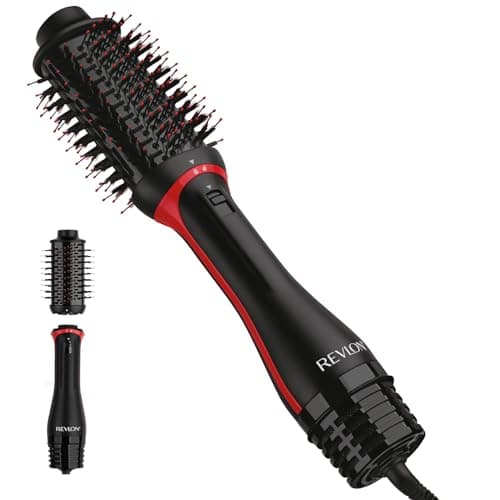
Revlon One-Step Volumizer Plus hair dryer and hot air brush
A 4-year limited warranty, the longest in this registry, on the cheapest kind of tool in it. Worth noticing before paying six times more elsewhere.
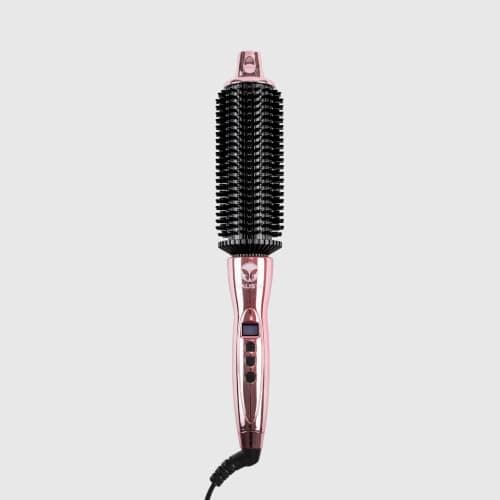
Calista Perfecter Pro Heated Round Brush Gen 4 (1 in)
A heated round brush with no fan at all — which is why it publishes a 10°F temperature interval where every hot air brush here publishes 'low, medium, high'.
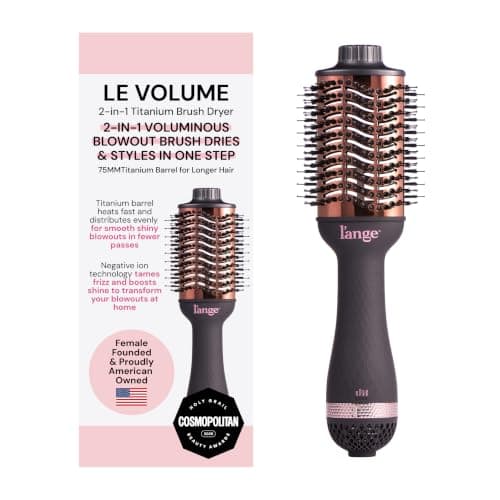
L'ange Le Volume Brush Dryer
The only hot air brush in this registry that publishes an actual temperature for every setting — and the highest of the three is 225.7°F, well under any flat iron here.
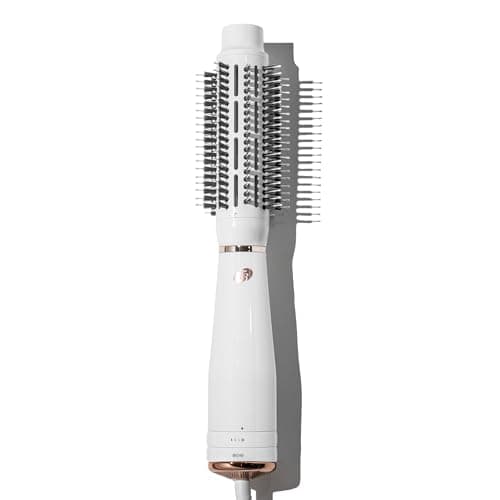
T3 AireBrush Round ionic blow-dry brush
A round barrel rather than a paddle, and the only T3 brush that publishes a wattage — the one built for lift rather than smoothing.
Questions people actually ask
What is the difference between a hot air brush and a heated brush?
A hot air brush has a fan in the handle and blows hot air out through its bristles, so it dries and styles damp hair in one pass. A heated brush has no airflow at all — the barrel itself conducts the heat, like a curling iron without a clamp — so it is used on hair that is already dry.
Can you use a heated brush on wet hair?
No. Calista publishes 'use on dry hair only' for the Perfecter Pro, and that instruction is the whole cost of the fanless design: it does not replace a dryer, it finishes what one started. A hot air brush is the kind designed to start on damp hair.
Which gets hotter, a hot air brush or a heated brush?
The heated brush, by a wide margin. Calista publishes a 325 to 395 degree Fahrenheit range; the hottest published figure for any hot air brush in this registry is the L'ange Le Volume's 225.7 degrees. At the top of its range a heated brush runs hotter than ghd's fixed 365 degree flat iron setting.
Why do heated brushes publish a temperature when hot air brushes don't?
Because on a heated brush the barrel is the heat source and touches the hair, so its temperature is a real measurable number. On an air brush the thing reaching your hair is moving air, whose temperature depends on fan speed, distance and dwell — so makers publish a settings count instead. Only the L'ange Le Volume publishes degrees for an air brush here.
Are any blow-dry brushes dual voltage?
Exactly one in this registry, and it is the fanless Calista Perfecter Pro, which publishes dual voltage up to 240 V on an American two-prong plug. Both T3 brushes and the L'ange Le Volume publish 125 V, and neither Revlon publishes a voltage figure at all.
Is a heated round brush worth it if I already own a hair dryer?
That is the case where it makes most sense. As a finisher on dry hair it does something an air brush does less well, because no air is blowing the shape around while it sets, and the ten-degree temperature steps let you pick a setting and lock it. Judge it as a second tool, which is what its maker's dry-hair-only instruction makes it.
Which kind of brush is quieter?
The heated brush, necessarily — it has no fan, so there is no motor to make a sound. It is the one tool in this registry where the noise row is legitimately not applicable rather than simply unpublished, since no maker here publishes a decibel figure for anything.
Sources
- Calista — Perfecter Pro Heated Round Brush Gen 4 product page (re-read 2026-10-22, HTTP 200)
- Revlon Hair Tools — One-Step Volumizer Plus (HTTP 403 to an automated fetch on 2026-10-22; figures are the reading on file)
- L'ange — Le Volume Brush Dryer product page
- T3 Micro — AireBrush Round product page
- Evans and Park - thermal cycling and mechanical properties
- Dyer et al. - bleaching and the hair fiber