Blow-Dry Brushes
The Best Blow-Dry Brushes for Damaged Hair in 2026
The gentlest heat tool in this category is also the one that pulls hardest. On damaged hair those two facts have to be weighed against each other.
Updated September 2026 · Sawyer V.
Buy the brush with a cool setting and a cleanable head. A hot air brush is gentler than a clamped plate but it applies mechanical tension, and repeated brushing behaves as a fatigue process on hair that already has flaws. The cool step lets you set a style with no added heat.
We earn a commission if you buy through the links on this page, at no extra cost to you. It never changes which tool we pick or which one we tell you to skip. How this site is funded.
Quick picks
Tap any row to jump to the full write-up. Prices come from the live price layer; where none is available the button says so rather than showing a number we cannot stand behind.
| # | Product | Best for | Price |
|---|---|---|---|
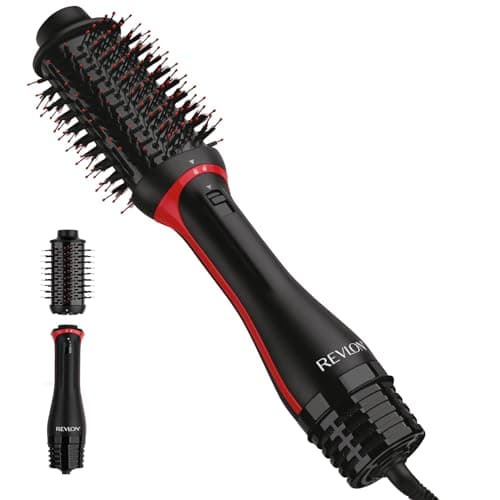
| 1 | Revlon One-Step Volumizer Plus hair dryer and hot air brush Four heat settings including a dedicated cool, a detachable head you can actually clean, and a four-year warranty. | Setting a style without adding heat to weakened lengths | |
| 2 | 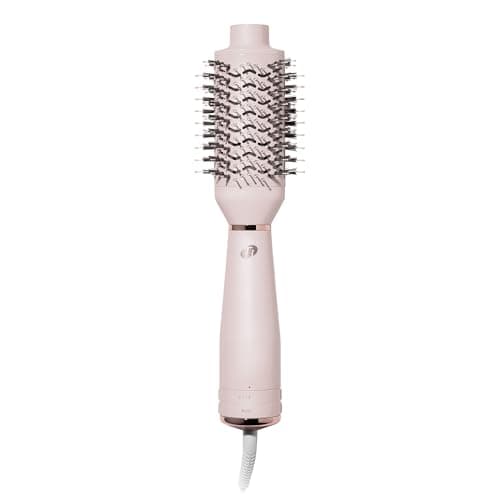 T3 AireBrush One-Step smoothing and volumizing dryer brush Three heat and two speed settings as separate controls, with a published 16 oz weight and an 8 ft swivel cord. | Drying weakened lengths at moderate heat | |
| 3 | 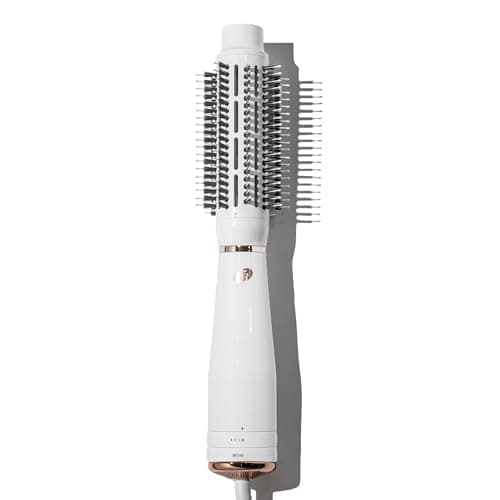 T3 AireBrush Round ionic blow-dry brush 1,200 W published — the lowest mains figure of any tool in our registry — with three heat and two speed settings. | Short damaged hair, and root work near the scalp | |
| — | 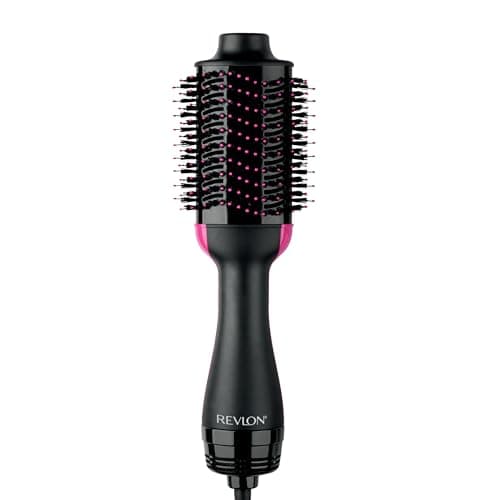 Revlon Salon One-Step hair dryer and volumizer A non-detachable head on a tool that clogs, and no published heat-setting count at all. We’d skip this | Not compromised hair |
1. Best cool step for compromised hair
Revlon One-Step Volumizer Plus hair dryer and hot air brush
Best for: Setting a style without adding heat to weakened lengths
Four heat settings including a dedicated cool, a detachable head you can actually clean, and a four-year warranty.
The cool setting is the reason this wins here. Hair sets as it cools rather than while it is hot, which means the final seconds of every section can be done at zero thermal cost — if the tool has a cool step. T3 publishes three heat settings on both its brushes with no cool among them.
The detachable head matters more on damaged hair than elsewhere, because it is a heat issue rather than a hygiene one. These brushes pull air through the bristles and fill with shed hair and lint; a clogged intake makes the element run hotter than the setting you chose. Damaged hair is the least able to absorb that.
Four years limited is the longest warranty on any product in our registry. Ceramic titanium barrel with tourmaline ionic technology.
What’s wrong with it
Revlon publishes no wattage, weight, cord length, speed count or voltage — five blank rows — so how gently it can actually be run is partly unverifiable.
Published specifications — Revlon One-Step Volumizer Plus hair dryer and hot air brush
| Wattage | Not published |
|---|---|
| Heat settings | 4 heat settings — low, medium, high, cool |
| Speed settings | Not published |
| Weight | Not published |
| Cord length | Not published |
| Noise (dB) | Not published |
| Attachments | Detachable brush head |
| Plate / barrel | Ceramic titanium barrel; tourmaline ionic |
| Dual voltage | Not published |
| Warranty | 4-year limited warranty |
Every figure above is taken from Revlon Hair Tools — One-Step Volumizer Plus product page. “Not published” means the figure does not appear on that page — it is not an estimate withheld, it is a number the manufacturer does not state. How we compile these.
What it costs to run for a year
Revlon does not publish a wattage for this tool, so there is nothing honest to compute. The formula is watts ÷ 1,000 × hours a year × your rate per kWh; if you find a rating plate on the handle, 65 hours a year and 18.34 cents per kilowatt-hour will get you the rest of the way.
2. Most airflow control
T3 AireBrush One-Step smoothing and volumizing dryer brush
Best for: Drying weakened lengths at moderate heat
Three heat and two speed settings as separate controls, with a published 16 oz weight and an 8 ft swivel cord.
Separating heat from speed is the specification that matters on damaged hair, because the combination you want is unusual: moderate warmth with enough airflow to dry quickly, rather than high heat with low airflow. A single combined dial cannot give you that.
The 360-degree swivel cord earns its place here too. A cord that binds makes you tug, and tugging on compromised hair is exactly the mechanical stress you are trying to avoid.
CeraGloss ceramic surface with heat-resistant bristles, 125 V, two-year warranty.
What’s wrong with it
No cool setting published, and half the Revlon's warranty. T3 also publishes no wattage for this brush, so its power cannot be checked.
Published specifications — T3 AireBrush One-Step smoothing and volumizing dryer brush
| Wattage | Not published |
|---|---|
| Heat settings | 3 heat settings |
| Speed settings | 2 speed settings |
| Weight | 16 oz (cord not included) |
| Cord length | 8 ft, 360-degree swivel cord |
| Noise (dB) | Not published |
| Attachments | None supplied |
| Plate / barrel | CeraGloss ceramic surface, heat-resistant bristles |
| Dual voltage | No — 125 V |
| Warranty | 2-year warranty |
Every figure above is taken from T3 Micro — AireBrush One-Step product page. “Not published” means the figure does not appear on that page — it is not an estimate withheld, it is a number the manufacturer does not state. How we compile these.
What it costs to run for a year
T3 does not publish a wattage for this tool, so there is nothing honest to compute. The formula is watts ÷ 1,000 × hours a year × your rate per kWh; if you find a rating plate on the handle, 65 hours a year and 18.34 cents per kilowatt-hour will get you the rest of the way.
3. Lowest published power
T3 AireBrush Round ionic blow-dry brush
Best for: Short damaged hair, and root work near the scalp
1,200 W published — the lowest mains figure of any tool in our registry — with three heat and two speed settings.
1,200 W is a genuinely low figure and on this page that is the point. Every conventional dryer here draws more, and the most powerful draws 1,875 W. Less available heat is a real constraint working in your favor on hair that has already lost structure.
The round barrel means you can work close to the root — where the hair is newest and strongest — and leave the fragile lengths largely alone, which is a strategy a paddle shape does not allow.
16 oz without the cord, 8 ft swivel, Korean CeraGloss with SmoothGrip bristles, quick-dry and style attachments, two-year warranty.
What’s wrong with it
A round barrel requires wrapping, which is more tension per section than drawing a paddle down the length — the opposite of what you want on brittle ends.
Published specifications — T3 AireBrush Round ionic blow-dry brush
| Wattage | 1,200 W |
|---|---|
| Heat settings | 3 heat settings |
| Speed settings | 2 speed settings |
| Weight | 16 oz (cord not included) |
| Cord length | 8 ft, 360-degree swivel cord |
| Noise (dB) | Not published |
| Attachments | Quick-dry attachment and style attachment |
| Plate / barrel | Korean CeraGloss ceramic surface, SmoothGrip bristles |
| Dual voltage | No — 125 V |
| Warranty | 2-year warranty |
Every figure above is taken from T3 Micro — AireBrush Round product page. “Not published” means the figure does not appear on that page — it is not an estimate withheld, it is a number the manufacturer does not state. How we compile these.
What it costs to run for a year
$14.31 a year
1,200 W × 65 hours a year = 78.0 kWh, at 18.34 cents per kilowatt-hour. The hours assume 15 minutes a session, 5 days a week — that is an assumption, not a measurement, so swap in your own if it is wrong.
The one we'd skip
Revlon Salon One-Step hair dryer and volumizer
Best for: Not compromised hair
A non-detachable head on a tool that clogs, and no published heat-setting count at all.
The original Salon One-Step is still sold and it carries the same excellent four-year limited warranty as the Plus. On this page it is still the wrong buy, for two published reasons.
The head does not detach, so the intake cannot be properly cleaned. On any hot air brush a blocked intake means reduced airflow and an element running hotter than the setting you selected — and on damaged hair, heat you did not ask for is the whole problem.
Revlon publishes four heat settings including cool for the Plus and publishes no heat-setting count for this one. On the page where the cool step is the deciding feature, you cannot confirm it exists. Buy the Plus instead — same idea, same warranty, two published differences that both matter here.
What’s wrong with it
Six blank rows on the spec sheet including the heat-setting count, and a head that cannot be removed for cleaning.
Published specifications — Revlon Salon One-Step hair dryer and volumizer
| Wattage | Not published |
|---|---|
| Heat settings | Not published |
| Speed settings | Not published |
| Weight | Not published |
| Cord length | Not published |
| Noise (dB) | Not published |
| Attachments | Non-detachable brush head |
| Plate / barrel | Ceramic coating |
| Dual voltage | Not published |
| Warranty | 4-year limited warranty |
Every figure above is taken from Revlon Hair Tools — Salon One-Step hair dryer and volumizer. “Not published” means the figure does not appear on that page — it is not an estimate withheld, it is a number the manufacturer does not state. How we compile these.
What it costs to run for a year
Revlon does not publish a wattage for this tool, so there is nothing honest to compute. The formula is watts ÷ 1,000 × hours a year × your rate per kWh; if you find a rating plate on the handle, 65 hours a year and 18.34 cents per kilowatt-hour will get you the rest of the way.
Gentler heat, more tension
A hot air brush is genuinely one of the lower-intensity heat tools in this category. There is no clamped plate, the air is cooler than a plate surface, and it is not held against the fiber — which is why it beats a flat iron on this comparison, argued on its own page.
The trade is mechanical. The whole technique depends on holding a section taut against the bristles, and tension on damaged hair is not neutral.
Published work treats repeated brushing and combing as a fatigue process: individual fibers experience repeated exposure to a stimulus, flaws propagate gradually, and eventually failure results — Evans and Park, Journal of Cosmetic Science. Damaged hair, by definition, starts that process with more flaws already present.
Usefully, the same work found that conditioning treatments provided considerable retardation of breakage. Not prevention — retardation. It is one of the few product claims in this subject that is straightforwardly supported, and the supported version is modest.
Two kinds of break, and which one a brush causes
Not all breakage is the same. Work on combing damage found that short fiber fragmentation and longer segment breaks occur by different pathways, with the longer breaks most likely occurring through impact loading — and that impact loading breaks hair at lower forces than steady tension does — Robbins, Journal of Cosmetic Science.
That distinction is practical here. Drawing a brush smoothly down a section under steady tension is the lower-risk motion. Yanking it through a knot is impact loading, and it is what actually breaks hair. So the instruction that follows is not “use less tension” — it is detangle before you start, and never pull through a snag.
What to change on damaged hair, in order of effect
| Change | Why |
|---|---|
| Detangle fully before any heat | Snags produce impact loads, which break hair at lower forces than steady tension |
| Finish every section on cool | Sets the style at zero thermal cost — only possible if the tool has a cool step |
| Rough-dry to 80 percent first | The brush is a finishing tool; using it to dry doubles the session |
| Less tension on the lengths than the roots | Ends are the oldest hair on your head and have measurably lower tensile strength |
| Clean the intake monthly | A clogged brush runs hotter than the setting you selected |
Why the cool setting is the deciding specification
On healthy hair a cool shot is a nice finish. On damaged hair it is the only part of the session that costs nothing.
Hair takes its shape as it cools, not while it is hot. That means the last two seconds of every section — the part that actually locks the style in — can be done with the heat off. Over a whole head that is a meaningful fraction of the session moved from heated to unheated.
Revlon publishes a dedicated cool among four heat settings on the One-Step Volumizer Plus. T3 publishes three heat settings on both its brushes and lists no cool. That is the clearest published difference between the two brands on this page, and it is why the cheaper tool wins it.
Your ends are the problem, not your hair
Damage is not evenly distributed and treating it as though it is leads people to buy the wrong thing. Hair grows about half an inch a month, so the ends of shoulder-length hair have been on your head for well over a year — and both lipid content and tensile properties decrease measurably from root to tip — Duvel et al., International Journal of Cosmetic Science.
So the practical technique is to work the roots and mid-lengths properly and treat the last few inches lightly: less tension, lower heat, and no repeat passes. If the ends have already split, no tool and no product rejoins them — the honest version is on the split ends page.
If the damage is chemical
Bleached and double-processed hair is a different case again, because it arrives at the tool already carrying molecular changes normally associated with thermal treatment. On that hair the specification to buy for is how far down the heat goes.
Neither of the brush brands here publishes a temperature scale — you get a settings count, not degrees — so the lower-power tool is the closest proxy available, which is the argument for the 1,200 W AireBrush Round. The full reasoning is on the bleached-hair page and the color-treated page.
Price per use, at 5 uses a week over 5 years
| What you pay | Cost per use | Cost per year |
|---|---|---|
| $30 | $0.02 | $6.00 |
| $60 | $0.05 | $12.00 |
| $100 | $0.08 | $20.00 |
| $150 | $0.12 | $30.00 |
| $200 | $0.15 | $40.00 |
| $300 | $0.23 | $60.00 |
| $400 | $0.31 | $80.00 |
| $500 | $0.38 | $100.00 |
5 uses a week for 5 years is 1300 uses. Both figures are stated assumptions, not measurements — halve the life and every cost per use doubles. We publish the ladder rather than a worked example for one specific product because a price we typed into a sentence would be wrong within a week.
The honest alternative
Some weeks the right answer is no heat at all. That is not a moralizing line — it is the only intervention on this subject that has no cost, and on hair that is actively breaking it does more than any purchase.
What that looks like in practice is on the heat-free styling page, and how to judge a sustainable weekly pattern is on the how-often page.
Questions people actually ask
Are blow-dry brushes bad for damaged hair?
They are gentler than a clamped plate but they apply mechanical tension, and repeated brushing behaves as a fatigue process on hair that already has flaws. Detangling fully before you start matters more than the heat setting.
What is the best blow-dry brush for damaged hair?
The one with a cool setting and a cleanable head. The Revlon One-Step Volumizer Plus publishes four heat settings including a dedicated cool, a detachable head and a four-year warranty.
Does a cool setting actually matter?
Yes, more on damaged hair than anywhere else. Hair sets as it cools rather than while it is hot, so the final seconds of each section can be done with the heat off entirely.
Can a blow-dry brush repair damaged hair?
No. Nothing repairs damaged hair structurally. Conditioning treatments have been measured to considerably retard breakage during repeated grooming, which is a real but modest claim.
Sources
- Evans and Park — A statistical analysis of hair breakage II: repeated grooming experiments, J Cosmet Sci 2010
- Robbins — Hair breakage during combing II: impact loading and hair breakage, J Cosmet Sci 2006
- Duvel et al. — Hair lipids and tensile properties as a function of distance from scalp, Int J Cosmet Sci 2005
- Revlon Hair Tools — One-Step Volumizer Plus published cool setting