Brands
L'ange Hair Tools: The Brand That Publishes Temperatures
Three tools, three full specification sheets, and one published figure that contradicts itself.
Updated September 2026 · Sawyer V.
L’ange publishes rated wattage, rated voltage, frequency, weight in both pounds and grams, cord length and warranty on every tool we checked, plus an actual temperature for each heat setting. Only one of the three is dual voltage. One cord-length figure on the site contradicts itself.
We earn a commission if you buy through the links on this page, at no extra cost to you. It never changes which tool we pick or which one we tell you to skip. How this site is funded.
What full disclosure actually looks like
Ten rows is the standard on this site, and most brands leave two or three blank. L’ange fills more of them than anyone here except T3, and fills a row T3 never does: rated wattage. T3 publishes weights to a tenth of an ounce and nine heat settings, and publishes no wattage on any product at all. L’ange publishes both.
L'ange - the three tools in this registry, side by side
| Row | Le Duo (Standard) | Axia HaloRing | Le Volume |
|---|---|---|---|
| Wattage | 36 W | 1,300 W | 1,000 W |
| Temperature | 280-430°F, 5 settings | 140-230°F, 4 settings | 95.4 / 178.9 / 225.7°F |
| Weight | 0.8 lb (358 g) | 0.7 lb (317.5 g) | 1.1 lb (500 g) |
| Cord | 8.2 ft (2.5 m) | 6.6 ft (2 m) | 6.6 ft, also stated as 2.4 m |
| Dual voltage | Yes, 100-240 V | No, 125 V | No, 125 V |
| Warranty | 1 year | 1 year | 1 year |
Publishing a temperature in degrees rather than a setting count is the most useful thing a maker can do, because it is the only form in which the number can be checked against the damage literature. A tool that says “five heat settings” tells you nothing about whether setting one is safe for bleached hair. A tool that says 280°F tells you exactly where you stand.
The 36 W question
36 W looks like an error next to a category where 1,875 W is normal, and it is worth being explicit about why it is not. A hair dryer spends nearly all of its power heating a large volume of moving air. A plate styler heats two small ceramic or titanium surfaces and holds them at temperature; the energy required is tiny by comparison. The Le Duo moves some air, but it is a styler with an airflow channel rather than a blower.
The practical consequence: at 65 hours a year, the Le Duo costs about 43 cents in electricity. The Hot Tools Pro Artist dryer at 1,875 W costs about $22.35. If you have ever wondered whether leaving a styler on matters to your bill, the honest answer for this class of tool is that it does not.
It matters for a different reason, though. An unattended heated surface is a burn and fire question rather than an energy one, which is why how to store hair tools spends its time on cooling and containment rather than on standby draw.
Why the floor beats the ceiling
Almost every tool in this category advertises its maximum. 455°F appears on Hot Tools, on much of the professional market, and on the packaging of tools sold to people whose hair should never see it.
The damage literature is consistent about direction. Repeated high-temperature contact on hair that is not fully dry produces the cavitated shafts described as bubble hair in the dermatology literature Kaushik et al., Indian Dermatology Online Journal, and repeated thermal cycling degrades mechanical properties measurably Evans and Park, Journal of Cosmetic Science. Nothing in that work suggests a higher ceiling helps. It suggests a lower floor, used consistently, is what protects the fiber.
L’ange’s 280°F on the Le Duo is the lowest published starting temperature of any plate or barrel tool on this site, and the Axia is one of very few dryers here that states its air temperature at all. That is the strongest single argument for the brand, and it is entirely visible on their own product pages.
Who L’ange is for
- Fine or color-treated hair. The 280°F floor on the Le Duo is lower than anything else here publishes. Start at tools for fine hair.
- Anyone who travels. The Le Duo’s 100–240 V makes it packable; neither other tool is. See tools for international travel.
- Long drying sessions. 0.7 lb on the Axia is the lightest dryer here by a clear margin.
- Not the warranty buyer. One year across the line is the shortest term in this registry, against Revlon’s four and Hot Tools’ lifetime.
Quick picks
Tap any row to jump to the full write-up. Prices come from the live price layer; where none is available the button says so rather than showing a number we cannot stand behind.
| # | Product | Best for | Price |
|---|---|---|---|
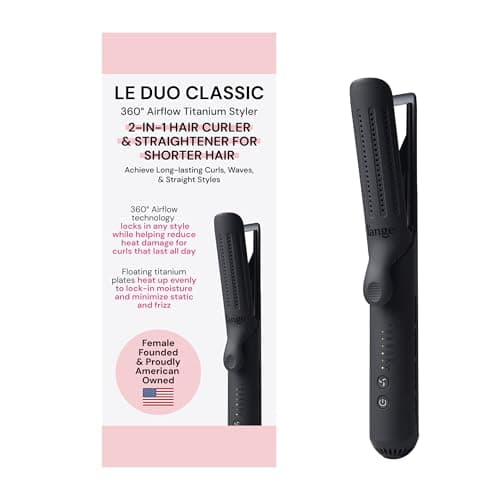
| 1 | L'ange Le Duo 360° Airflow Styler (Standard) Five settings from a published 280°F floor, 100-240 V, 0.8 lb - and 36 W, which is roughly 43 cents of electricity a year. | Fine hair that wants a low, stated temperature | |
| 2 | 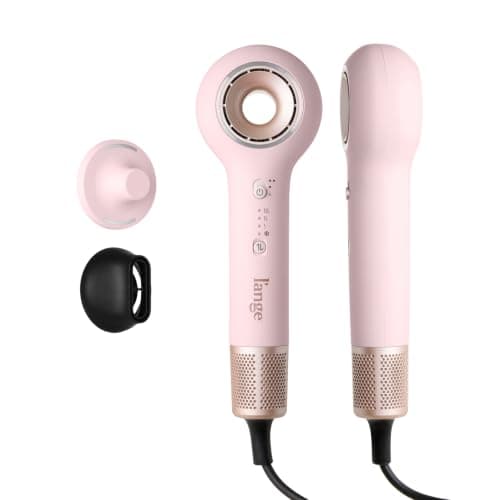 L'ange Axia HaloRing Hair Dryer 0.7 lb without the cord, a published 140-230°F range, four heat settings and two speeds. | Long sessions, raised arms, small bathrooms | |
| — | 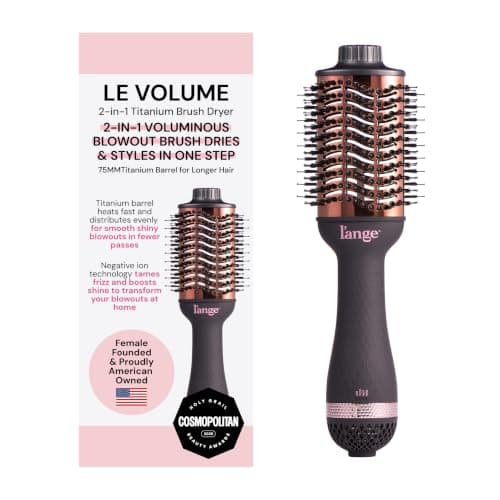 L'ange Le Volume Brush Dryer 1,000 W with an actual Fahrenheit figure for all three settings, topping out at 225.7°F - and a cord length the page states twice, differently. We’d skip this | Volume on straight to wavy hair, at home only |
1. Lowest running cost on this site
L'ange Le Duo 360° Airflow Styler (Standard)
Best for: Fine hair that wants a low, stated temperature
Five settings from a published 280°F floor, 100-240 V, 0.8 lb - and 36 W, which is roughly 43 cents of electricity a year.
The specification that matters most here is the floor. 280°F is the lowest published starting temperature of any heated styling tool in this registry — below the ghd Platinum+’s fixed 365°F, below the T3 SinglePass StyleMax’s bottom setting, and a long way below the 455°F ceilings the category likes to advertise. On fine, color-treated or previously damaged hair, the floor is the whole decision.
36 W is not a typo and it is not a hair dryer figure. This is a plate styler with an airflow channel rather than a heated blower, so the power draw sits two orders of magnitude below a dryer. At 65 hours a year and 18.34 cents per kilowatt-hour that is about 43 cents of electricity annually. The running-cost question simply does not arise.
100–240 V at 50/60 Hz makes it one of the few genuinely packable heated tools on this site. 0.8 lb published for the Standard, 0.9 lb for the Grande, and an 8.2 ft cord.
What’s wrong with it
Speed settings and attachments are both unpublished, and the one-year warranty is the shortest term in this registry.
Published specifications — L'ange Le Duo 360° Airflow Styler (Standard)
| Wattage | 36 W (Standard); 50 W (Grande) |
|---|---|
| Heat settings | 5 settings, 280–430°F |
| Speed settings | Not published |
| Weight | 0.8 lb / 358 g (Standard); 0.9 lb / 400 g (Grande) |
| Cord length | 8.2 ft (2.5 m) |
| Noise (dB) | Not published |
| Attachments | Not published |
| Plate / barrel | Titanium floating plates with rounded edges, 3.5 in × 1 in |
| Dual voltage | Yes — 100–240 V, 50/60 Hz |
| Warranty | 1-year warranty |
Every figure above is taken from L'ange — Le Duo 360° Airflow Styler product page. “Not published” means the figure does not appear on that page — it is not an estimate withheld, it is a number the manufacturer does not state. How we compile these.
What it costs to run for a year
$0.43 a year
36 W (Standard); 50 W (Grande) × 65 hours a year = 2.3 kWh, at 18.34 cents per kilowatt-hour. The hours assume 15 minutes a session, 5 days a week — that is an assumption, not a measurement, so swap in your own if it is wrong.
2. Lightest dryer here at 0.7 lb
L'ange Axia HaloRing Hair Dryer
Best for: Long sessions, raised arms, small bathrooms
0.7 lb without the cord, a published 140-230°F range, four heat settings and two speeds.
0.7 lb (317.5 g) without the cord makes this the lightest dryer in the registry. The ghd Flight+ publishes 0.99 lb including its cord and nozzle, the T3 Featherweight StyleMax 16.6 oz — about 1.04 lb — and the Dyson Supersonic 1.8 lb. The measurement bases differ, so treat the gap as indicative rather than exact; the ordering is not in doubt.
More unusual is the published air temperature range: 140°F to 230°F. Almost nobody in the dryer category states this. It lets you compare the tool against the temperature guidance on the heat-damage temperature table rather than guessing from a heat-setting count.
1,300 W is modest by category standards, and the two supplied attachments — a magnetic concentrator and a magnetic wall mount — are an unusual pair. The wall mount is a storage answer, which is more than most dryers offer.
What’s wrong with it
125 V only, so it cannot travel, and no diffuser is supplied - a real gap if you have a curl pattern.
Published specifications — L'ange Axia HaloRing Hair Dryer
| Wattage | 1,300 W |
|---|---|
| Heat settings | 4 — cool shot, low, medium, high (140–230°F published) |
| Speed settings | 2 speeds |
| Weight | 0.7 lb (317.5 g) without the cord |
| Cord length | 6.6 ft (2 m) |
| Noise (dB) | Not published |
| Attachments | 2 — magnetic concentrator nozzle and magnetic wall mount |
| Plate / barrel | HaloRing body; no heated styling surface |
| Dual voltage | No — 125 V, 50/60 Hz |
| Warranty | 1-year warranty |
Every figure above is taken from L'ange — Axia HaloRing Hair Dryer product page. “Not published” means the figure does not appear on that page — it is not an estimate withheld, it is a number the manufacturer does not state. How we compile these.
What it costs to run for a year
$15.50 a year
1,300 W × 65 hours a year = 84.5 kWh, at 18.34 cents per kilowatt-hour. The hours assume 15 minutes a session, 5 days a week — that is an assumption, not a measurement, so swap in your own if it is wrong.
The one we'd skip
L'ange Le Volume Brush Dryer
Best for: Volume on straight to wavy hair, at home only
1,000 W with an actual Fahrenheit figure for all three settings, topping out at 225.7°F - and a cord length the page states twice, differently.
We would not buy this one, and the reason is not the tool. Publishing 95.4°F, 178.9°F and 225.7°F for cool, low and high is better disclosure than any other hot air brush here manages. A 225.7°F ceiling is genuinely gentle — below the 355–400°F region where the keratin literature puts real structural risk.
The problem is the rest of the sheet. 125 V at 60 Hz means it cannot leave North America. Speed settings are unpublished. And the cord row states “6.6 ft.” and “2.4 m” on the same line, which cannot both be true — 6.6 ft is 2.0 m and 2.4 m is 7.9 ft. We report it as published rather than picking the number we prefer, but a page that contradicts itself on a figure you can measure with a tape is a page to read carefully.
At 1,000 W it publishes the lower of the only two hot air brush wattages on this site — the T3 AireBrush Round states 1,200 W and Revlon publishes none at all. Revlon does publish a four-year warranty against L’ange’s one year.
What’s wrong with it
125 V only, one-year warranty, unpublished speeds, and a self-contradicting cord specification.
Published specifications — L'ange Le Volume Brush Dryer
| Wattage | 1,000 W |
|---|---|
| Heat settings | 3 — cool 95.4°F, low 178.9°F, high 225.7°F (all published) |
| Speed settings | Not published |
| Weight | 1.1 lb (500 g) |
| Cord length | 6.6 ft — the same line also states 2.4 m, which is 7.9 ft |
| Noise (dB) | Not published |
| Attachments | 2 — protective cover and cleaning brush |
| Plate / barrel | Titanium oval barrel, 60 mm or 75 mm |
| Dual voltage | No — 125 V, 60 Hz |
| Warranty | 1-year warranty |
Every figure above is taken from L'ange — Le Volume Brush Dryer product page. “Not published” means the figure does not appear on that page — it is not an estimate withheld, it is a number the manufacturer does not state. How we compile these.
What it costs to run for a year
$11.92 a year
1,000 W × 65 hours a year = 65.0 kWh, at 18.34 cents per kilowatt-hour. The hours assume 15 minutes a session, 5 days a week — that is an assumption, not a measurement, so swap in your own if it is wrong.
Questions people actually ask
Are L'ange hair tools worth it?
On disclosure, yes - they publish wattage, voltage, weight in grams, cord length and an actual Fahrenheit figure for every heat setting, which almost nobody else does. The weak row is warranty: one year across the line, against four years from Revlon and a lifetime term from Hot Tools.
Are L'ange tools dual voltage?
Only some. The Le Duo publishes 100-240 V at 50/60 Hz and travels. The Axia HaloRing dryer and the Le Volume brush dryer both publish 125 V and cannot be used on European supply, converter or not.
Why does the L'ange Le Duo only use 36 watts?
Because it is a plate styler with an airflow channel, not a blower. Heating two small plates takes a fraction of the energy needed to heat a large moving volume of air, which is why hair dryers sit between 1,000 W and 1,875 W and this sits at 36 W.
What temperature does the L'ange Le Duo start at?
280 degrees Fahrenheit, published, across five settings up to 430 degrees. That floor is the lowest published starting temperature of any heated styling tool in this registry.