Hair Dryers
L'ange Axia vs Le Volume: Which L'ange Dryer to Buy
These are the only two tools in this registry from a brand that tells you what temperature its dryers actually reach. So for once the decision can be made on numbers.
Updated October 2026 · Sawyer V.
Buy the Axia if you want a hair dryer. Buy the Le Volume if your actual complaint is that you cannot work a round brush and a dryer at the same time. L’ange publishes 1,300 W, 0.7 lb, four settings across 140–230°F and two speeds for the Axia; 1,000 W, 1.1 lb and three stated temperatures topping out at 225.7°F for the Le Volume. Neither is dual voltage, and both carry a one-year warranty — the shortest in this registry.
We earn a commission if you buy through the links on this page, at no extra cost to you. It never changes which tool we pick or which one we tell you to skip. How this site is funded.
Side by side, published only
L'ange Axia HaloRing Hair Dryer vs L'ange Le Volume Brush Dryer, as published
| Row | Axia HaloRing | Le Volume |
|---|---|---|
| What it is | A hair dryer | A dryer and a round brush in one handle |
| Wattage | 1,300 W | 1,000 W |
| Temperature | 4 settings across a stated 140–230°F range | 3 stated settings — cool 95.4°F, low 178.9°F, high 225.7°F |
| Speed settings | 2 | Not published |
| Cool setting | Cool shot button | Cool, at a stated 95.4°F |
| Weight | 0.7 lb (317.5 g), cord excluded | 1.1 lb (500 g) |
| Cord | 6.6 ft (2 m) | 6.6 ft — the same line also states 2.4 m |
| Barrel / head | No styling surface — it is a dryer | Titanium oval barrel, 60 mm or 75 mm |
| In the box | Magnetic concentrator nozzle, magnetic wall mount | Protective cover, cleaning brush |
| Sold separately | Axia magnetic diffuser | Not applicable |
| Voltage | 50/60 Hz stated, no rated voltage | 125 V, 60 Hz |
| Warranty | 1 year | 1 year |
Quoted from L'ange's own product pages, both re-read 2026-10-15.
Ten of the twelve rows are filled on both sides, which makes this the best-documented pair on this site. That is not an accident of which two tools we happened to pick — L’ange publishes more than any other brand in this registry, and the next section is the reason it matters.
The only brand here that tells you the temperature twice
Across nine dryers and six hot air brushes in this registry, almost nobody publishes a temperature. Dyson, Shark, T3 and Revlon publish settings counts. ghd publishes “variable.” The exceptions are the ghd flight+ at a stated 149°F, and these two L’ange tools.
The Axia publishes a range: four temperature settings across 140°F to 230°F. The Le Volume goes further and names each one — cool at 95.4°F, low at 178.9°F, high at 225.7°F (L’ange states 95.36, 178.88 and 225.68°F; we round to one decimal). No other hot air brush in this registry publishes a single temperature figure.
And here is the finding worth the most on this page: the brush tops out below the dryer. 225.7°F against 230°F is a gap of about four degrees, so in practice the two tools reach the same ceiling — and that ceiling is startlingly low next to anything with plates. Every flat iron in this registry sits at 365°F or above. Both of these top out more than 135 degrees below that.
That is the real argument for either tool over an iron, and it is a published one rather than a marketing one. Heat is cumulative and the fiber does not recover: repeated thermal cycling measurably degrades hair’s mechanical properties Evans and Park, Journal of Cosmetic Science, and hair that has been bleached or chemically processed starts with measurably less margin to spend Dyer et al., International Journal of Cosmetic Science. A tool whose maximum you can look up, and which is low, is worth more on that hair than any coating claim. The guidance by hair type is at what temperature is actually safe.
One honest caveat: a published setting temperature is not the same as the temperature at your hair, which depends on distance, dwell time and airflow. Neither maker publishes a figure for that, and nor does anyone else in this category.
They are not alternatives
Before any spec row, the shapes decide this, and the two tools do different jobs.
The Axia is a hair dryer. It moves air, you aim it, and whatever shape you want comes from a brush in your other hand. The Le Volume is a dryer built into a round brush: one object, one hand, and the barrel does the shaping as the air dries.
So the question is not which is better but which problem you have. If your blow-dries come out fine and you just want a dryer that is light and lets you set a temperature, the Axia is the tool. If your blow-dries come out flat or uneven because coordinating a dryer and a round brush is a skill you have not got, the Le Volume removes that skill rather than asking you to acquire it — which is the whole reason the hot air brush category exists.
The generic version of this trade, across every brand, is at hot air brush vs hair dryer. What it costs you is airflow and attachment choice; what it saves you is the technique. This page is the L’ange-specific instance of that choice, and it is the one where you can see both temperatures while you make it.
Weight, which inverts the usual logic
The Axia publishes 0.7 lb (317.5 g) without the cord. That is the lightest dryer in this registry by a clear margin — the Dyson Supersonic publishes 1.8 lb and the Shark SpeedStyle Pro 1.65 lb. The Le Volume publishes 1.1 lb (500 g).
Read naively, the dryer wins the weight row. Read properly, it does not, and this is worth spelling out: the Axia at 0.7 lb is one of two objects you are holding, because the brush is in your other hand. The Le Volume at 1.1 lb is the only thing you are holding. For anyone who finds the two-handed version tiring — which is most of the people who buy a brush dryer — the heavier tool is the lighter job.
It matters more at length. On long or dense hair the session runs long enough that weight is the row you feel most, and that is also where the brush starts to lose on airflow. The cross-over is covered at dryers for long, thick hair and blow-dry brushes for long hair.
1,300 W against 1,000 W
The Axia draws 300 W more, and on a brush dryer the lower figure is appropriate rather than a shortfall: a brush is finishing hair that is already most of the way dry, not drying a head from wet. Pushed past that it is slow, and slow on a hot tool means more minutes of heat rather than fewer.
Both figures are low for this category. The Revlon SmoothStay, the ghd Helios and the Hot Tools Pro Artist all publish 1,875 W. So even the Axia, L’ange’s actual dryer, sits well under the high-wattage end — which is the trade for 0.7 lb, and it is the honest reason the Axia is a poor choice on very dense hair. What wattage actually tells you has the full argument.
Running cost, with our assumptions stated: at 65 hours a year and the U.S. average residential rate of 18.34 cents per kilowatt-hour, 1,300 W costs about $15.50 a year and 1,000 W about $11.92. A four-dollar annual difference should not decide anything — running costs has the formula — but it is arithmetic you can only do because L’ange publishes the input, and on most of this category you cannot.
What is in the box, and what is not
Both pages publish an accessory list, which is better than most of this category manages. They are not equivalent lists.
- Axia: a magnetic concentrator nozzle and a magnetic wall mount, with adhesive and screw hardware. The concentrator is the attachment that matters — it narrows the airflow so it goes where you aimed it, which is what lets a brush do the smoothing.
- Axia, sold separately: the magnetic diffuser. L’ange lists it as an add-on at checkout rather than an inclusion. If your hair is curly or coily this is the attachment you actually need, so budget for it — diffuser vs concentrator covers which one your hair wants, and dryers for curly hair ranks on exactly that row.
- Le Volume: a protective cover and a cleaning brush. The cleaning brush is a more thoughtful inclusion than it sounds: a hot air brush pulls air through its own bristles and collects hair where you cannot reach, and a clogged intake on a hot tool is the most common way one dies — see cleaning and maintenance.
The wall mount deserves a line of its own because it is unusual. It is a storage answer rather than a styling one, and storage is what actually kills these tools — cord strain at the handle is the failure most warranties exclude. How to store hair tools and dryers for small bathrooms both turn on that row.
Barrel size, and the guidance L'ange actually publishes
Only one of these has a barrel, and L’ange publishes two diameters: a 60 mm and a 75 mm titanium oval. It also does something almost nobody in this category does — it tells you which hair length each suits, stating that the 60 mm barrel is designed for all hair types and lengths and is ideal for shoulder-length or shorter hair.
Maker-published fit guidance is rare enough to be worth acting on. Taking it at face value: shoulder-length or shorter, the 60 mm; longer than that, the 75 mm, because a wider barrel covers more ground per pass and fewer passes is the only free reduction in heat exposure available. The general reasoning is at barrel size.
Where each one stops
Neither sheet is complete, and the gaps are different.
What each L'ange page leaves out
| Blank row | Which tool | What it costs you |
|---|---|---|
| Speed settings | Le Volume | The Axia publishes 2; the Le Volume publishes none, so you cannot compare airflow control |
| Rated voltage | Axia | The page states 50/60 Hz and no voltage figure. An absent voltage has to be read as single voltage — do not pack it |
| Noise | Both | Nobody in this registry publishes a decibel figure, so the quietest tool is not a question the data can answer |
| Drying time | Both | No maker publishes one and there is no standard test, so the 1,300 W against 1,000 W gap cannot be turned into minutes |
| Airflow at the hair | Both | The published setting temperature is not the temperature at your hair |
Our reading of the two product pages, not a manufacturer claim.
One self-contradiction to flag, because we would want to know: the Le Volume page gives the cord as “6.6 ft. | 2.4 m” on a single line, and 2.4 m is 7.9 ft, not 6.6. We publish 6.6 ft, the imperial figure, and note the conflict rather than silently picking the flattering one. It does not change a purchase; a maker contradicting itself inside one line is still worth noticing.
The two things wrong with both
Worth stating plainly, because they are the reasons to buy neither.
- Neither travels. The Le Volume publishes 125 V outright. The Axia publishes a 50/60 Hz frequency and no rated voltage, which has to be treated as single voltage. So on a 230 V supply both need a converter rather than an adapter, and those are different objects that look alike — adapter vs converter. The only dual-voltage dryer in this registry is the ghd flight+, which is why it is on the buy list above; the full dual-voltage list has every tool that states one.
- A one-year warranty, on both. That is the shortest cover of any tool in this registry. T3, Dyson and Shark publish two years, ghd two or three, Revlon four on a cheaper brush, and Hot Tools lifetime limited. For a brand whose whole appeal is disclosure, the warranty row is the one it loses outright — what a warranty is actually worth puts every figure side by side.
L’ange does publish a 60-day returns guarantee alongside the one-year warranty on both pages, which is a longer trial window than most, and worth knowing if you are unsure which of these two your routine actually needs.
One small feature that is genuinely about heat
The Axia publishes a memory recall: it powers on to the last temperature you used rather than cycling back to a default.
That reads like a convenience and is really a heat-discipline feature. The method this site gives everywhere is to find the lowest setting that works for your hair once and then stop experimenting — and the thing that defeats it is a tool that resets every morning, so you end up re-finding the setting under time pressure and usually overshooting. A tool that remembers the number removes that. No other dryer in this registry publishes the behavior.
Which one to buy
- Buy the Axia if you want a dryer and your technique is fine. 0.7 lb is the lightest published weight here, the 140–230°F range is one of three real temperature figures in the category, and the concentrator and wall mount are in the box.
- Buy the Axia if you style often. The memory recall plus a published range is the best combination here for setting a low number once and keeping it.
- Buy the Le Volume if the round brush is the problem. One object, one hand, and three temperatures you can look up before you buy. For a flat or uneven blow-dry this is the fix.
- Buy the Le Volume for processed hair, if you are choosing between these two. 225.7°F published is a lower ceiling than the Axia’s 230°F and far below any iron, and there is no clamped plate — start at blow-dry brushes for damaged hair.
- Buy the Le Volume on price. It is the cheaper of the two by a wide margin and the warranty is identical, which makes it the lower-risk way to find out whether a brush dryer suits you at all.
- Neither, if you travel. Both are single voltage. The ghd flight+ is the only dual-voltage dryer here.
- Neither, if your hair is long and dense. 1,300 W and 1,000 W are modest figures, and a long session is more total heat. The power-first picks are at dryers for long, thick hair.
- Neither, if you want a diffuser in the box. The Axia sells its diffuser separately and the Le Volume has no diffuser at all, so curly and coily hair should check which dryers publish a diffuser first.
- Neither, if the warranty is what you are buying. One year is the shortest here.
The individual sheets are at the L’ange Axia review and the Le Volume review, and the brand picture — what L’ange publishes across its range and where it stops — is at the L’ange brand page. Against other brands, the Axia is compared at T3 Featherweight vs L’ange Axia and ghd flight+ vs L’ange Axia.
What we could not compare
Speed settings, because only the Axia publishes a count. Noise, on both and on every tool on this site. Drying time, on both: no maker publishes one and there is no standard test, so we will not turn the 300 W gap into an estimate. Airflow volume, on both, which is the figure that would actually explain the wattage difference. And the Axia’s rated voltage, which its page no longer states — we read an absent voltage as single voltage rather than assuming the brand’s other tool’s 125 V applies.
The tools on this page
Prices come from the live price layer. Where none is available the button says so rather than showing a number we cannot stand behind.
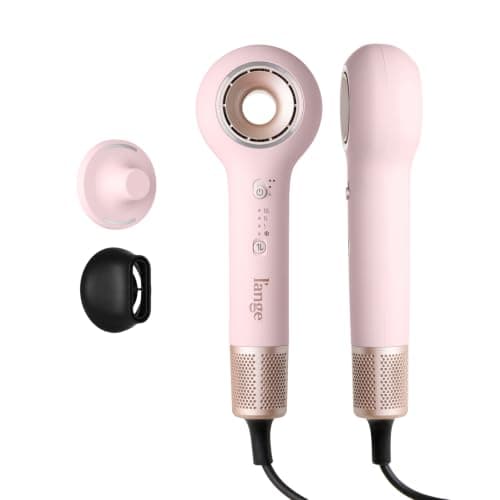
L'ange Axia HaloRing Hair Dryer
0.7 lb without the cord makes this the lightest dryer in the registry, and 140–230°F is a published temperature range almost nobody in the category gives you.
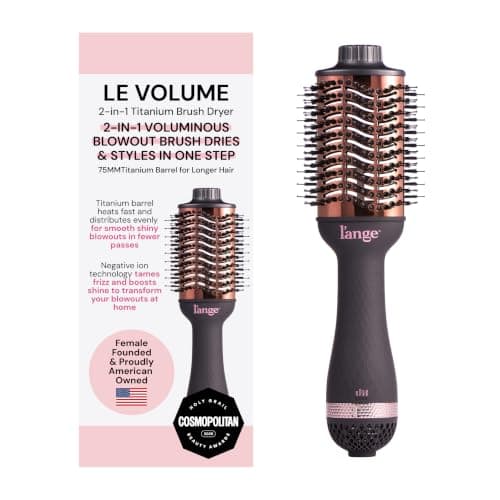
L'ange Le Volume Brush Dryer
The only hot air brush in this registry that publishes an actual temperature for every setting — and the highest of the three is 225.7°F, well under any flat iron here.
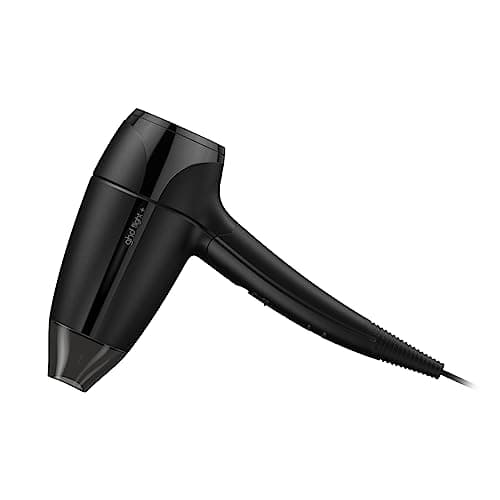
ghd flight+ travel hair dryer
The only dual-voltage dryer in this registry, at a published 0.99 lb with the cord on — the one dryer that genuinely travels.
Questions people actually ask
Which L'ange hair dryer should I buy?
The Axia if you want a hair dryer: 1,300 W, 0.7 lb without the cord, four settings across a published 140 to 230 degree Fahrenheit range, with a concentrator nozzle and a magnetic wall mount in the box. The Le Volume if you want a dryer and a round brush in one handle, at 1,000 W and 1.1 lb with three stated temperatures.
What temperature does the L'ange Le Volume reach?
L'ange publishes all three settings: cool at 95.4, low at 178.9 and high at 225.7 degrees Fahrenheit. It is the only hot air brush in this registry whose maker publishes a temperature figure at all, and its ceiling is more than 135 degrees below any flat iron here.
Is the L'ange Axia or the Le Volume hotter?
The Axia, but only just. Its published range tops out at 230 degrees Fahrenheit against the Le Volume's 225.7 — about four degrees apart. In practice they reach the same ceiling, and both are startlingly low next to any tool with plates.
How much does the L'ange Axia weigh?
0.7 lb, or 317.5 g, without the cord — the lightest published weight of any dryer in this registry. For comparison the Dyson Supersonic publishes 1.8 lb. The Le Volume publishes 1.1 lb, but it is the only object you hold, where the Axia is one of two.
Are L'ange hair dryers dual voltage?
No. The Le Volume publishes 125 V outright, and the Axia page states a 50/60 Hz frequency with no rated voltage, which has to be read as single voltage. Neither can be used on a 230 V supply with a plug adapter. The ghd flight+ is the only dual-voltage dryer in this registry.
Does the L'ange Axia come with a diffuser?
No. L'ange publishes a magnetic concentrator nozzle and a magnetic wall mount in the box, and lists the magnetic diffuser as a separate add-on at checkout. If your hair is curly or coily, budget for it or choose a dryer that includes one.
What warranty do L'ange tools have?
One year on both, alongside a published 60-day returns guarantee. One year is the shortest cover of any tool in this registry — T3, Dyson and Shark publish two years, ghd two or three, Revlon four on a cheaper brush, and Hot Tools lifetime limited.
Which Le Volume barrel size should I get?
L'ange publishes guidance on this, which is rare: it states that the 60 mm barrel suits all hair types and lengths and is ideal for shoulder-length or shorter hair. Taking that at face value, go 75 mm if your hair is longer than shoulder-length, because a wider barrel covers more ground per pass.
Sources
- L'ange — Axia HaloRing Hair Dryer product page (re-read 2026-10-15)
- L'ange — Le Volume Brush Dryer product page (re-read 2026-10-15)
- Evans and Park - thermal cycling and mechanical properties
- Dyer et al. - bleaching and the hair fiber
- U.S. Energy Information Administration — Electric Power Monthly, Table 5.3 (average residential price, June 2026)