Curling Irons & Wands
The Best Curling Irons for Hair Extensions in 2026
Growing hair recovers from a mistake. An extension does not. Everything here follows from that.
Updated September 2026 · Sawyer V.
Extensions have no blood supply and no growth, so heat damage to them is permanent in a way it is not on your own hair. The requirement is a tool that can sit at a low, stated temperature and stay there — which rules out every tool here that publishes only a ceiling.
We earn a commission if you buy through the links on this page, at no extra cost to you. It never changes which tool we pick or which one we tell you to skip. How this site is funded.
Quick picks
Tap any row to jump to the full write-up. Prices come from the live price layer; where none is available the button says so rather than showing a number we cannot stand behind.
| # | Product | Best for | Price |
|---|---|---|---|
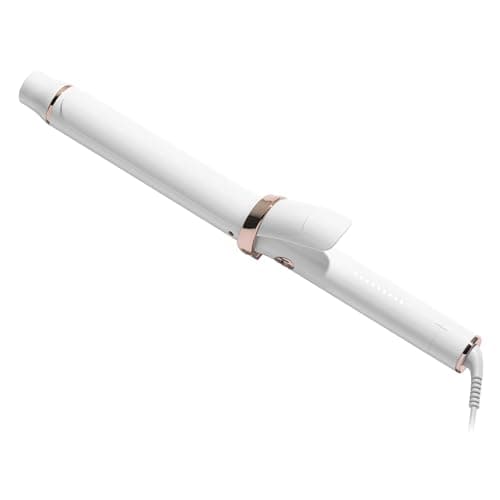
| 1 | T3 SinglePass Curl X extra-long barrel curling iron Nine published heat settings mean you can start at the bottom and only go up if the curl genuinely will not hold. | Human-hair extensions of any attachment type | |
| 2 | 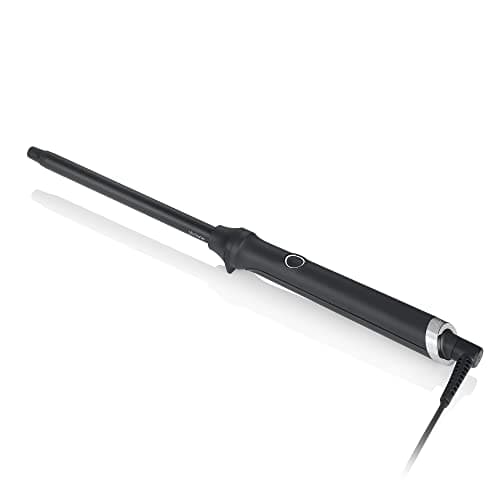 ghd Curve Thin curling wand (0.5 inch barrel) A clipless 0.5 in barrel at a fixed 365°F, with universal voltage and an 8.8 ft swivel cord. | Tape-ins, bonds and anywhere a clamp is a liability | |
| 3 | 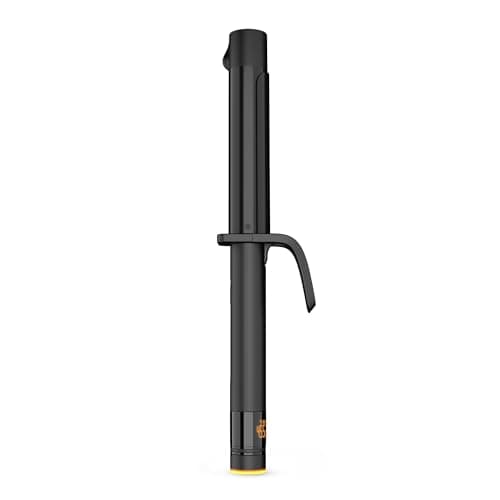 Hot Tools Black Gold 1¼" Digital Salon Curling Iron ¾, 1, 1¼ and 1½ in barrels, universal dual voltage and a lifetime limited warranty. | Matching an existing curl pattern across four diameters | |
| — | 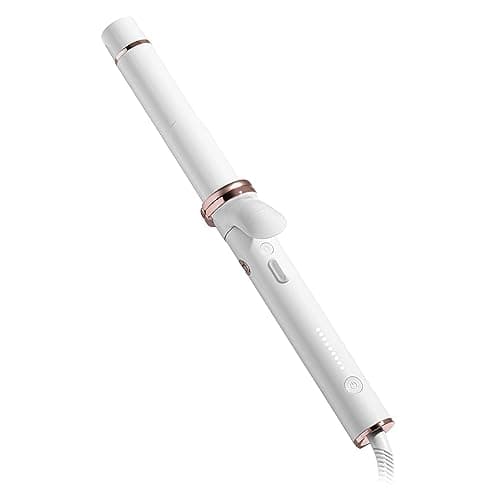 T3 CurlWrap automatic rotating curling iron A self-rotating barrel with nine heat settings - excellent on growing hair, and the wrong mechanism near an attachment point. We’d skip this | Not extensions |
1. Lowest selectable setting here
T3 SinglePass Curl X extra-long barrel curling iron
Best for: Human-hair extensions of any attachment type
Nine published heat settings mean you can start at the bottom and only go up if the curl genuinely will not hold.
This is the whole argument. Nine settings gives you somewhere low to stand, and a stated number to write down and repeat. Extensions are a repeated-use situation: the same lengths get styled again and again with no replacement growing in behind them, so the cumulative thermal load matters more than a single session does.
Published weights per barrel size — 10.6 oz, 13.2 oz and 15.1 oz — are useful here too. Extension wearers usually have more hair and longer hair than they started with, which means longer sessions.
6.5 in CeraGloss ceramic barrel, 8 ft swivel cord, 100–240 V. The clamp is the one thing to use carefully: keep it well below the attachment point.
What’s wrong with it
It is a clamped iron, so it needs deliberate handling near tape or bonds - the clip should never close over an attachment.
Published specifications — T3 SinglePass Curl X extra-long barrel curling iron
| Wattage | 78 W |
|---|---|
| Heat settings | 9 heat settings |
| Speed settings | Not applicable |
| Weight | 10.6 oz (1 in), 13.2 oz (1.25 in), 15.1 oz (1.5 in) — cord not included |
| Cord length | 8 ft, 360-degree swivel cord |
| Noise (dB) | Not applicable |
| Attachments | None supplied |
| Plate / barrel | CeraGloss ceramic barrel, 6.5 in long |
| Dual voltage | Yes — auto world voltage, 100–240 V |
| Warranty | 2-year warranty |
Every figure above is taken from T3 Micro — SinglePass Curl X product page. “Not published” means the figure does not appear on that page — it is not an estimate withheld, it is a number the manufacturer does not state. How we compile these.
What it costs to run for a year
$0.93 a year
78 W × 65 hours a year = 5.1 kWh, at 18.34 cents per kilowatt-hour. The hours assume 15 minutes a session, 5 days a week — that is an assumption, not a measurement, so swap in your own if it is wrong.
2. Nothing to close over a bond
ghd Curve Thin curling wand (0.5 inch barrel)
Best for: Tape-ins, bonds and anywhere a clamp is a liability
A clipless 0.5 in barrel at a fixed 365°F, with universal voltage and an 8.8 ft swivel cord.
Clipless is the structural advantage for extensions. There is no clamp to accidentally close over a tape tab, a keratin bond or a weft, and no mechanism that can catch and pull at an attachment point.
The trade is the temperature. 365°F fixed is not adjustable, and it is warmer than we would choose for synthetic fiber. On human-hair extensions it is a defensible single number; on synthetic it is not a decision the tool lets you make.
The 0.5 in barrel gives a tight curl that drops into a wave, which suits the extra length most extension wearers are working with. Universal voltage as well.
What’s wrong with it
Fixed at 365°F with no way to go lower, which is the wrong shape of tool for synthetic fiber.
Published specifications — ghd Curve Thin curling wand (0.5 inch barrel)
| Wattage | Not published |
|---|---|
| Heat settings | One fixed temperature — 365°F |
| Speed settings | Not applicable |
| Weight | Not published |
| Cord length | 8.8 ft, 360-degree swivel cord |
| Noise (dB) | Not applicable |
| Attachments | Cool tip, built-in safety stand |
| Plate / barrel | 0.5 in thin barrel, clipless |
| Dual voltage | Yes — universal voltage |
| Warranty | 2-year warranty |
Every figure above is taken from ghd — Curve Thin curling wand product page. “Not published” means the figure does not appear on that page — it is not an estimate withheld, it is a number the manufacturer does not state. How we compile these.
What it costs to run for a year
ghd does not publish a wattage for this tool, so there is nothing honest to compute. The formula is watts ÷ 1,000 × hours a year × your rate per kWh; if you find a rating plate on the handle, 65 hours a year and 18.34 cents per kilowatt-hour will get you the rest of the way.
3. Four barrel sizes, one warranty
Hot Tools Black Gold 1¼" Digital Salon Curling Iron
Best for: Matching an existing curl pattern across four diameters
¾, 1, 1¼ and 1½ in barrels, universal dual voltage and a lifetime limited warranty.
Extensions arrive with a curl pattern, and the job is often to match it rather than to invent one. Four published barrel diameters from a single line makes that matching realistic in a way a one-size tool does not.
Universal dual voltage and a lifetime limited warranty are both genuine advantages on a tool that will be used frequently and for years.
The reservation is the same one we have everywhere: the page publishes “variable, up to 455°F” and never states where the range begins. For extensions, the bottom of the range is the only part of it you care about.
What’s wrong with it
No published temperature floor - on extensions that is the one specification that decides whether the tool is suitable at all.
Published specifications — Hot Tools Black Gold 1¼" Digital Salon Curling Iron
| Wattage | Not published |
|---|---|
| Heat settings | Variable, up to 455°F |
| Speed settings | Not applicable |
| Weight | Not published |
| Cord length | 9 ft professional swivel cord |
| Noise (dB) | Not applicable |
| Attachments | None published beyond the iron and its cord |
| Plate / barrel | Black Gold ceramic-titanium barrel; ¾, 1, 1¼ and 1½ in |
| Dual voltage | Yes — universal dual voltage |
| Warranty | Lifetime limited warranty |
Every figure above is taken from Hot Tools — Black Gold 1¼" Digital Salon Curling Iron product page. “Not published” means the figure does not appear on that page — it is not an estimate withheld, it is a number the manufacturer does not state. How we compile these.
What it costs to run for a year
Hot Tools does not publish a wattage for this tool, so there is nothing honest to compute. The formula is watts ÷ 1,000 × hours a year × your rate per kWh; if you find a rating plate on the handle, 65 hours a year and 18.34 cents per kilowatt-hour will get you the rest of the way.
The one we'd skip
T3 CurlWrap automatic rotating curling iron
Best for: Not extensions
A self-rotating barrel with nine heat settings - excellent on growing hair, and the wrong mechanism near an attachment point.
We would not use this on extensions, and the objection is mechanical rather than thermal. The nine heat settings are exactly what extensions want; the self-rotating barrel is not.
A rotating barrel draws hair in continuously and does not know when it has reached a tape tab, a weft track or a bond. On your own hair the worst case is a tangle at the root. On extensions the worst case is traction at the attachment point, which is how bonds fail and how clip-in wefts loosen.
On growing hair it is a genuinely good tool and we recommend it elsewhere, including on automatic curlers. It is the application that is wrong here, not the product.
What’s wrong with it
A self-feeding mechanism has no way to stop at an attachment point, and traction at the bond is how extensions fail.
Published specifications — T3 CurlWrap automatic rotating curling iron
| Wattage | 77 W |
|---|---|
| Heat settings | 9 heat settings |
| Speed settings | Two barrel rotation speeds |
| Weight | 13.4 oz (cord not included) |
| Cord length | 8 ft, 360-degree swivel cord |
| Noise (dB) | Not published |
| Attachments | None supplied |
| Plate / barrel | Korean CeraGloss ceramic self-rotating long barrel, 1 in and 1¼ in |
| Dual voltage | Yes — auto world voltage, 100–240 V |
| Warranty | 2-year warranty |
Every figure above is taken from T3 Micro — CurlWrap automatic rotating curling iron product page. “Not published” means the figure does not appear on that page — it is not an estimate withheld, it is a number the manufacturer does not state. How we compile these.
What it costs to run for a year
$0.92 a year
77 W × 65 hours a year = 5.0 kWh, at 18.34 cents per kilowatt-hour. The hours assume 15 minutes a session, 5 days a week — that is an assumption, not a measurement, so swap in your own if it is wrong.
Why extensions change the rules
Your own hair is dead protein, but it is attached to a follicle that keeps producing more. Damage a length badly enough and you cut it off; replacement grows. An extension has no follicle behind it. The length you are styling is the only length there will ever be, and every thermal cycle it takes is permanent.
That changes the calculation on temperature. On growing hair, an occasional hot pass is a manageable cost. On extensions, the same pass is an unrecoverable one, and the damage accumulates across every styling session for the life of the installation.
Repeated thermal cycling degrades mechanical properties measurably Evans and Park, Journal of Cosmetic Science, and the fiber’s tensile behavior differs along its length to begin with Duvel et al., International Journal of Cosmetic Science. Extension hair has already been processed, sorted and often colored before it reaches you.
Synthetic fiber: the honest position
We are not going to give you a temperature for synthetic hair, because we cannot source one. Synthetic extension fiber is sold under dozens of trade names with no common standard, and the suppliers who publish a heat rating at all publish it per product rather than per material.
What we can say without inventing anything: synthetic fiber is a plastic, not keratin, and none of the damage literature this site cites applies to it. The only reliable instruction is the one printed on the packet your extensions came in. If it says heat-safe to a stated temperature, use a tool that can be set below that number — which on this page means the T3 SinglePass Curl X and nothing else. If it says nothing, do not apply heat.
This is the same position we take on wigs and extensions generally: rank what can be sourced, and decline to rank what cannot.
The attachment point is the fragile part
Whatever the method — tape, keratin bond, micro-link, sewn weft or clip — the failure happens where the extension meets your hair, not at the ends.
- Keep heat below the attachment. Keratin bonds soften with heat; that is how they were installed.
- Do not clamp over a tab or a track. A spring-loaded clip cannot tell the difference between hair and adhesive.
- Avoid self-feeding mechanisms. Rotating barrels and automatic curlers draw hair in continuously and cannot detect an attachment.
- Detangle before heat, not after. Combing force is a real mechanical load, measurable on textured hair Bloch et al., International Journal of Dermatology, and a wide-tooth comb reduces it.
Wide-tooth combs covers the detangling side, which does more for extension longevity than any curling tool choice.
The four tools, on the rows that matter here
What each tool publishes, for an extension wearer
| Tool | Temperature | Clamp | Voltage |
|---|---|---|---|
| T3 SinglePass Curl X | 9 stated settings | Yes - use below the bond | 100-240 V |
| ghd Curve Thin | Fixed 365°F | No - clipless | Universal |
| Hot Tools Black Gold | Ceiling only, 455°F | Yes | Universal dual voltage |
| T3 CurlWrap | 9 stated settings | Self-rotating - avoid | 100-240 V |
The temperature column is the one that decides it. A ceiling without a floor tells an extension wearer nothing.
Questions people actually ask
What temperature should I curl hair extensions at?
For human-hair extensions, the lowest setting that holds a curl - start at the bottom of the range and step up only if it does not hold. For synthetic fiber, follow the temperature printed on the packet, and if none is printed, do not apply heat.
Can you use a curling iron on synthetic hair extensions?
Only if the supplier publishes a heat-safe temperature for that specific product, and only with a tool that can be set below it. Synthetic fiber is a plastic rather than keratin, so no general rule from hair science applies to it.
Will a curling iron damage my extensions?
Heat damage to extensions is permanent, because there is no follicle producing replacement length. Repeated thermal cycling degrades the fiber measurably, and that damage accumulates across every session for the life of the installation.
Is a clipless wand better for extensions?
Usually yes, because there is no clamp that can close over a tape tab, bond or weft track. The trade is that clipless tools in this registry have fixed temperatures, so you lose the ability to set a lower number.