Guides
Styling Wigs and Extensions: What the Tools Can and Cannot Do
Two completely different materials sold in the same aisle, and only one of them is hair.
Updated September 2026 · Sawyer V.
Human-hair pieces take heat like your own hair, except that nothing grows back — so the damage is cumulative and permanent. Synthetic fiber is plastic, not keratin, and no rule from hair science applies to it. Follow the temperature on the packet, and if none is printed, use no heat.
We earn a commission if you buy through the links on this page, at no extra cost to you. It never changes which tool we pick or which one we tell you to skip. How this site is funded.
Two materials, one aisle
Nearly every mistake in this area comes from treating wigs and extensions as a single category. They are sold together and they are not the same thing at all.
Human hair versus synthetic fiber
| Human hair | Synthetic fiber | |
|---|---|---|
| Material | Keratin | Plastic (varies by brand) |
| Does hair science apply? | Yes | No |
| Heat tolerance | Similar to your own hair | Set by the manufacturer, if stated |
| Can it be damaged permanently? | Yes, and it cannot regrow | Yes, and it melts rather than degrades |
| Published heat guidance | Rare | Sometimes, per product |
| What we can rank | Tools, on their published floors | Nothing |
That last row is the honest limit of this page. We can tell you which tools publish a low, selectable temperature, because those figures are public. We cannot tell you what temperature your specific synthetic piece survives, because only its manufacturer knows and most of them do not say.
Human-hair pieces: the cumulative problem
Your own hair is replaced constantly. A length you ruin gets cut off and the follicle produces more. A wig or an extension has no follicle behind it: the length in your hand is the only length there will ever be, and every thermal cycle it takes stays with it.
Repeated thermal cycling degrades mechanical properties measurably Evans and Park, Journal of Cosmetic Science, and most commercial human-hair pieces have already been processed and often bleached before sale — a treatment that alters the fiber in its own right Dyer et al., Journal of Cosmetic Science. You are starting from a lower margin than you would with growing hair.
The practical rule: style at the lowest temperature that achieves the shape, and style less often than you would your own hair. A tool with nine published settings gives you somewhere low to stand; a tool that publishes only a 455°F ceiling does not.
Synthetic fiber: why we give no number
Synthetic hair is sold under dozens of trade names with no common standard. Some is explicitly heat-safe to a stated temperature, some is explicitly not, and a great deal of it says nothing at all.
We will not publish a temperature for it, because there is no honest source for one. What we can say without inventing anything:
- It is a plastic. It does not have a cuticle or a cortex, and none of the keratin literature this site cites tells you anything about it.
- Its failure mode is melting, not degrading. There is no gradual warning stage the way there is with hair.
- The packet is the only authority. If it states a heat-safe maximum, buy a tool that can be set below it. If it states nothing, use no heat.
- Steam and hot water methods exist for some synthetic fiber and are what the manufacturer will usually recommend instead.
Which tools suit either case
Only one specification matters and it is the same one in both situations: can the tool be set low, and does it tell you where low is?
Published temperature floors across this registry
| Tool | What the page states |
|---|---|
| L'ange Le Duo | 5 settings from a published 280°F |
| T3 SinglePass StyleMax | 9 stated settings |
| T3 SinglePass Curl X | 9 stated settings |
| Calista Perfecter Pro | 325-395°F in 10°F steps |
| ghd Platinum+ | Fixed 365°F, no adjustment |
| CHI 1" Original | Fixed 392°F, no adjustment |
| Hot Tools Black Gold | Ceiling only - 455°F, no floor stated |
The last row is the problem. A tool that publishes only its maximum tells a wig wearer nothing.
For synthetic fiber with a stated heat-safe limit, the L’ange Le Duo at a published 280°F floor is the only tool here that reaches genuinely low, and even that may be above what a given fiber allows.
The mechanical side matters more than people think
Wigs and extensions fail at the attachment or the knot far more often than they fail from heat. Combing force is a real, measurable load Bloch et al., International Journal of Dermatology, and on a wefted or knotted piece that load is concentrated where the hair is anchored rather than distributed along a growing shaft.
- Detangle from the ends upward with a wide-tooth comb, never from the root down. See wide-tooth combs.
- Keep clamps and rotating barrels away from bonds, tapes and tracks. See curling irons for extensions.
- Store on a stand or in a bag, not crushed in a drawer. See how to store hair tools.
What this page deliberately does not do
It does not rank wigs, extensions or fiber brands. This site compares published manufacturer specifications, and that market does not publish them in a form that can be compared — heat ratings appear per product rather than per material, and most listings carry none at all.
We take the same position on heat-resistant mats and hooded dryers: rank what can be sourced, and say plainly when nothing can.
The tools on this page
Prices come from the live price layer. Where none is available the button says so rather than showing a number we cannot stand behind.
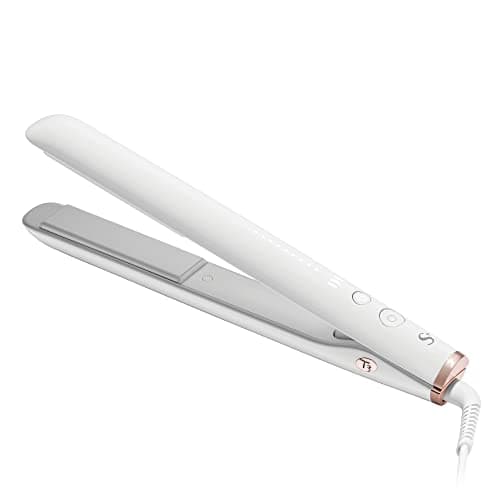
T3 SinglePass StyleMax 1 inch flat iron
Nine heat settings and genuine 100–240 V dual voltage: the most adjustable iron here and the only one you can pack for Europe without a thought.
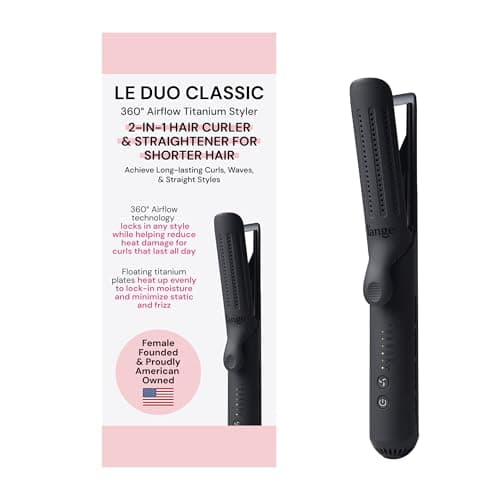
L'ange Le Duo 360° Airflow Styler (Standard)
36 W is the lowest published draw of any styling tool in this registry, by a factor of roughly fifty — and L'ange publishes it plainly rather than hiding behind a hair-dryer-sized number.
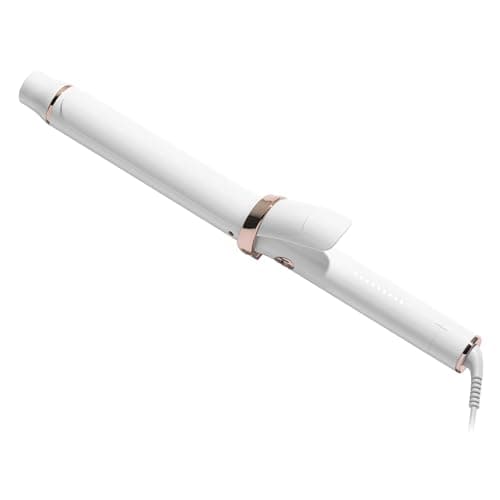
T3 SinglePass Curl X extra-long barrel curling iron
A 6.5-inch barrel and a separate published weight for every barrel size — unusual disclosure in a category where most makers publish a diameter and stop.
Questions people actually ask
Can you use a flat iron on a wig?
On a human-hair wig, yes, at the lowest temperature that achieves the shape - and less often than you would on your own hair, because nothing regrows. On a synthetic wig, only if the manufacturer publishes a heat-safe temperature for that specific product.
What temperature is safe for synthetic hair?
There is no general answer, and anyone who gives you one is guessing. Synthetic fiber is sold under many trade names with no common standard. Use the figure printed on the packet, and if there is none, use no heat.
Why do extensions get damaged faster than my own hair?
Because they are not replaced. Your own hair is continually renewed by the follicle, so damage is eventually cut away. An extension accumulates every thermal cycle for the whole life of the installation, usually having been processed before you ever got it.
What is the best tool for styling extensions?
One that publishes a low, selectable temperature. Nine stated settings or a published floor of 280 degrees Fahrenheit gives you somewhere safe to stand. A tool that publishes only a 455 degree ceiling tells you nothing useful.