Curling Irons & Wands
The Best Automatic Curlers in 2026
Both remove the wrist technique. One does it with a motor and one with moving air, and they are not interchangeable.
Updated September 2026 · Sawyer V.
There are two mechanisms. A rotating barrel turns a heated cylinder for you — the T3 CurlWrap. Coanda tools use fast airflow to pull hair around a barrel and dry it into shape — the Dyson Airwrap and Shark FlexStyle. The rotating kind curls dry hair; the airflow kind needs damp hair.
We earn a commission if you buy through the links on this page, at no extra cost to you. It never changes which tool we pick or which one we tell you to skip. How this site is funded.
Quick picks
Tap any row to jump to the full write-up. Prices come from the live price layer; where none is available the button says so rather than showing a number we cannot stand behind.
| # | Product | Best for | Price |
|---|---|---|---|
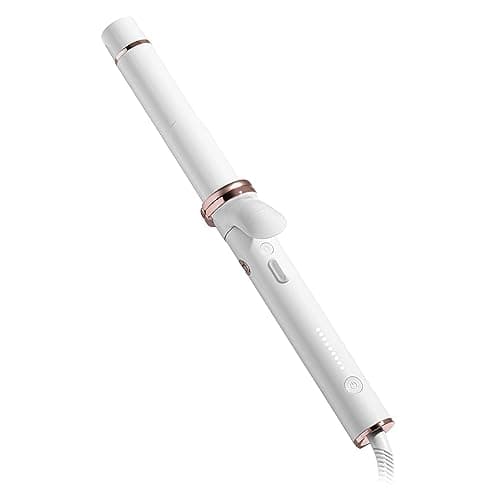
| 1 | T3 CurlWrap automatic rotating curling iron A self-rotating heated barrel with two published rotation speeds and nine heat settings. | Curling dry hair with no wrist technique at all | |
| 2 | 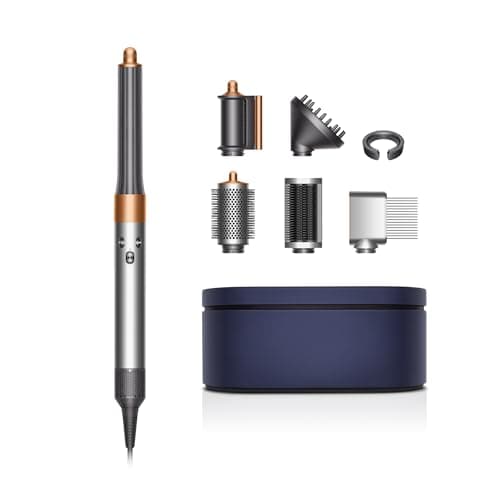 Dyson Airwrap multi-styler (Complete Long) Coanda airflow wrapping at 1,300 W — the lowest mains rating in our registry — with three published heat and three speed settings. | Fine or previously damaged hair that an iron has already cost | |
| 3 | 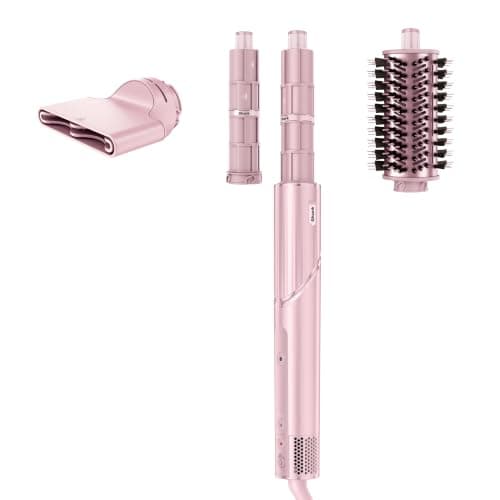 Shark FlexStyle air styling and drying system Auto-wrap curlers in a published configurable set, at 1,600 W, with a handle that converts to a standalone dryer. | Wanting the mechanism without buying a second dryer | |
| — | 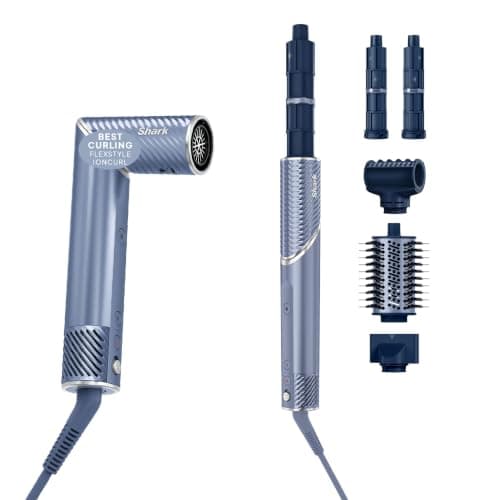 Shark FlexStyle IonCurl hair styler 1,700 W and no published attachment list — on a tool whose attachments are the entire product. We’d skip this | Not a considered purchase |
1. Best rotating barrel
T3 CurlWrap automatic rotating curling iron
Best for: Curling dry hair with no wrist technique at all
A self-rotating heated barrel with two published rotation speeds and nine heat settings.
This is the mechanism most people mean by an automatic curler: a heated barrel that turns itself, so you feed a section in and the tool does the wrapping.
Two published rotation speeds is the specification that makes it usable across different hair. A heavy section needs a slower wrap; fine hair can take a faster one. Most rotating tools publish one speed or none.
Nine heat settings makes it one of only two curling tools in our registry that goes below 365°F — which matters on processed hair, where every ghd curling tool is fixed. Auto world voltage 100–240 V, 8 ft swivel cord, two-year warranty. T3 now also publishes 77 W and 13.4 oz for it, the only wattage figure any curling tool here states — full sheet in our T3 CurlWrap review.
What’s wrong with it
A rotating mechanism can catch and tangle hair if a section is fed in untidily — the failure mode a manual barrel does not have. T3 also publishes a step count rather than a temperature for any of the nine settings.
Published specifications — T3 CurlWrap automatic rotating curling iron
| Wattage | 77 W |
|---|---|
| Heat settings | 9 heat settings |
| Speed settings | Two barrel rotation speeds |
| Weight | 13.4 oz (cord not included) |
| Cord length | 8 ft, 360-degree swivel cord |
| Noise (dB) | Not published |
| Attachments | None supplied |
| Plate / barrel | Korean CeraGloss ceramic self-rotating long barrel, 1 in and 1¼ in |
| Dual voltage | Yes — auto world voltage, 100–240 V |
| Warranty | 2-year warranty |
Every figure above is taken from T3 Micro — CurlWrap automatic rotating curling iron product page. “Not published” means the figure does not appear on that page — it is not an estimate withheld, it is a number the manufacturer does not state. How we compile these.
What it costs to run for a year
$0.92 a year
77 W × 65 hours a year = 5.0 kWh, at 18.34 cents per kilowatt-hour. The hours assume 15 minutes a session, 5 days a week — that is an assumption, not a measurement, so swap in your own if it is wrong.
2. Best airflow wrap for fragile hair
Dyson Airwrap multi-styler (Complete Long)
Best for: Fine or previously damaged hair that an iron has already cost
Coanda airflow wrapping at 1,300 W — the lowest mains rating in our registry — with three published heat and three speed settings.
A completely different mechanism. There is no clamped or contact barrel doing the curling; fast curved airflow pulls the hair around and dries it into shape. That means no hot surface pressed against the fiber.
1,300 W is the lowest mains figure on this site, and three published heat settings with three published speeds is the most complete published control in the category. On hair that has already been over-processed, that combination is the argument.
1.4 lb — the lightest styler here — an 8.5 ft cord, 120 V, two-year limited warranty.
What’s wrong with it
It needs hair at about 80 percent dry, so it is not a dry-hair tool at all, it is slow on dense hair, 120 V only, and it is the most expensive option here.
Published specifications — Dyson Airwrap multi-styler (Complete Long)
| Wattage | 1,300 W |
|---|---|
| Heat settings | 3 heat settings |
| Speed settings | 3 speed settings |
| Weight | 1.4 lb |
| Cord length | 8.5 ft |
| Noise (dB) | Not published |
| Attachments | Curling barrels, smoothing brushes, round volumizing brush, drying nozzle |
| Plate / barrel | Coanda airflow barrels; no clamped heat plate |
| Dual voltage | No — 120 V |
| Warranty | 2-year limited warranty |
Every figure above is taken from Dyson — Airwrap Complete Long product page. “Not published” means the figure does not appear on that page — it is not an estimate withheld, it is a number the manufacturer does not state. How we compile these.
What it costs to run for a year
$15.50 a year
1,300 W × 65 hours a year = 84.5 kWh, at 18.34 cents per kilowatt-hour. The hours assume 15 minutes a session, 5 days a week — that is an assumption, not a measurement, so swap in your own if it is wrong.
3. Airflow wrapping that also dries
Shark FlexStyle air styling and drying system
Best for: Wanting the mechanism without buying a second dryer
Auto-wrap curlers in a published configurable set, at 1,600 W, with a handle that converts to a standalone dryer.
The same Coanda idea at the same published wattage as the Dyson Supersonic, in a tool whose handle works as a plain dryer with a concentrator fitted.
That conversion is the strongest practical argument in this whole category. Curling is occasional; drying is daily. A tool that does the frequent job properly rather than making you buy twice is worth more than a marginally better wrap.
Shark publishes the configurable set — auto-wrap curlers, an oval brush, a paddle brush, a concentrator and a diffuser — chosen at purchase. 1.5 lb, 8 ft cord, two-year limited warranty.
What’s wrong with it
Shark publishes no heat- or speed-setting count at all, so how gently it can be run is unverifiable — and like all Coanda tools it needs damp hair.
Published specifications — Shark FlexStyle air styling and drying system
| Wattage | 1,600 W (peak 1,600 W) |
|---|---|
| Heat settings | Not published |
| Speed settings | Not published |
| Weight | 1.5 lb |
| Cord length | 8 ft |
| Noise (dB) | Not published |
| Attachments | Configurable — auto-wrap curlers, oval brush, paddle brush, concentrator, diffuser |
| Plate / barrel | Coanda airflow barrels; no clamped heat plate |
| Dual voltage | No — 120 V |
| Warranty | 2-year limited warranty |
Every figure above is taken from SharkNinja — Shark FlexStyle (HD400SN) product page. “Not published” means the figure does not appear on that page — it is not an estimate withheld, it is a number the manufacturer does not state. How we compile these.
What it costs to run for a year
$19.07 a year
1,600 W (peak 1,600 W) × 65 hours a year = 104.0 kWh, at 18.34 cents per kilowatt-hour. The hours assume 15 minutes a session, 5 days a week — that is an assumption, not a measurement, so swap in your own if it is wrong.
The one we'd skip
Shark FlexStyle IonCurl hair styler
Best for: Not a considered purchase
1,700 W and no published attachment list — on a tool whose attachments are the entire product.
The most powerful air styler in our registry at a published 1,700 W, and 100 W more than its own sibling at the same weight and cord length.
It is the skip because on an automatic curler the wrapping attachment is the tool, and Shark publishes no attachment list for this one. You cannot confirm what curling attachments are in the box, how many, or what diameter.
Shark publishes the standard FlexStyle’s set in full, which makes the omission here a gap rather than a house style. Buy the one where you can see what you are getting — the full comparison.
What’s wrong with it
No published attachment list and no published heat- or speed-setting count, which is two blank rows where the product actually lives.
Published specifications — Shark FlexStyle IonCurl hair styler
| Wattage | 1,700 W (peak 1,700 W) |
|---|---|
| Heat settings | Not published |
| Speed settings | Not published |
| Weight | 1.5 lb |
| Cord length | 8 ft |
| Noise (dB) | Not published |
| Attachments | Not published |
| Plate / barrel | Coanda airflow barrels; plastic and metal body |
| Dual voltage | No — 120 V |
| Warranty | 2-year limited warranty |
Every figure above is taken from SharkNinja — Shark FlexStyle IonCurl (HD840PK1) product page. “Not published” means the figure does not appear on that page — it is not an estimate withheld, it is a number the manufacturer does not state. How we compile these.
What it costs to run for a year
$20.27 a year
1,700 W (peak 1,700 W) × 65 hours a year = 110.5 kWh, at 18.34 cents per kilowatt-hour. The hours assume 15 minutes a session, 5 days a week — that is an assumption, not a measurement, so swap in your own if it is wrong.
Two mechanisms, sold under one name
This is the distinction to get right before you spend anything, because the two are not substitutes for each other.
Rotating barrel against Coanda airflow
| Rotating barrel | Coanda airflow | |
|---|---|---|
| What moves | A motor turns the heated barrel | Fast curved air pulls the hair |
| Hair state | Completely dry | About 80 percent dry |
| Heat contact | Direct — a hot surface against the fiber | Indirect — warm air, no clamped surface |
| Speed | Fast per section | Slower; it is drying as well as shaping |
| Also does | Nothing else | Drying, smoothing, volumizing, depending on attachment |
| In our registry | T3 CurlWrap | Dyson Airwrap, both Shark FlexStyles |
The practical consequence: if you want to curl hair that is already dry — a second-day refresh, a quick fix before going out — a Coanda tool will do almost nothing, because it needs moisture to evaporate in order to set a shape. And if you want a tool that also dries your hair, a rotating barrel cannot.
What "automatic" actually saves you
The wrist motion, and that is genuinely the hard part. Wrapping a section evenly around a barrel while keeping tension and not burning your fingers is a learned skill, and it is where most people give up on curling their own hair.
What it does not save you is anything else. You still section, still hold, still have to let the curl cool before it takes weight. An automatic tool that you release warm produces exactly the same dropped curl as a manual one — the mechanism is on why curls drop.
The failure mode nobody advertises
Rotating barrels can catch hair. If a section is fed in with loose strands or is wider than the mechanism expects, the rotation can pull in more than you intended — and unlike a manual barrel, you cannot simply stop turning your wrist.
The mitigations are technique: sections no wider than the tool expects, combed smooth before feeding, and the slower of the two published rotation speeds on anything heavy. This is a real trade against the convenience, and it is the reason we would not put a rotating tool in the hands of someone with very fine or already-fragile hair without saying so.
Heat, and why it still matters
Automatic does not mean gentle. A rotating barrel is direct contact heat exactly like a manual one, and published microscopy of hair curled with a curling iron shows radial and axial cracking with scale edge fusion even in dry conditions — Ruetsch and Kamath, Journal of Cosmetic Science.
Which is why the nine published heat settings on the CurlWrap matter more than the rotation does. Every ghd curling tool is fixed at 365°F; this and the SinglePass Curl X are the only two that go below. On processed hair that is the buying criterion, not automation — the damaged-hair page ranks on it.
Price per use, at 5 uses a week over 5 years
| What you pay | Cost per use | Cost per year |
|---|---|---|
| $30 | $0.02 | $6.00 |
| $60 | $0.05 | $12.00 |
| $100 | $0.08 | $20.00 |
| $150 | $0.12 | $30.00 |
| $200 | $0.15 | $40.00 |
| $300 | $0.23 | $60.00 |
| $400 | $0.31 | $80.00 |
| $500 | $0.38 | $100.00 |
5 uses a week for 5 years is 1300 uses. Both figures are stated assumptions, not measurements — halve the life and every cost per use doubles. We publish the ladder rather than a worked example for one specific product because a price we typed into a sentence would be wrong within a week.
What we would buy
The T3 CurlWrap if you want to curl dry hair and the wrist technique is what has defeated you. The Dyson Airwrap if your hair is fine or already damaged and you are drying it anyway — the lowest published power here with the most published control. The Shark FlexStyle if you want the mechanism and a dryer for one price.
And if what you actually want is a curl on dry hair with maximum control over temperature, a manual clipless wand still beats all of them on published specification — the wands page.
Questions people actually ask
What is the best automatic curler?
It depends which mechanism you need. The T3 CurlWrap rotates a heated barrel and works on dry hair; the Dyson Airwrap and Shark FlexStyle use airflow and need hair at about 80 percent dry. They are not substitutes.
Can automatic curlers damage your hair?
A rotating barrel is direct contact heat exactly like a manual curling iron, and published microscopy shows cracking and scale fusion even on dry hair. Rotating tools can also catch hair if a section is fed in untidily.
Do automatic curlers work on dry hair?
Rotating barrels do. Coanda airflow tools like the Airwrap and FlexStyle largely do not — they need moisture to evaporate in order to set a shape, so on bone-dry hair very little happens.