Curling Irons & Wands
The Best Curling Irons for Damaged Hair in 2026
The one study anyone should read before curling damaged hair used a curling iron, and it found the moisture in your hair changes everything.
Updated September 2026 · Sawyer V.
Buy an adjustable tool and use it on completely dry hair. Published microscopy of hair curled with a curling iron found radial and axial cracking with scale edge fusion even in dry conditions — and severe damage plus steam bubbling when the same treatment was applied wet.
We earn a commission if you buy through the links on this page, at no extra cost to you. It never changes which tool we pick or which one we tell you to skip. How this site is funded.
Quick picks
Tap any row to jump to the full write-up. Prices come from the live price layer; where none is available the button says so rather than showing a number we cannot stand behind.
| # | Product | Best for | Price |
|---|---|---|---|
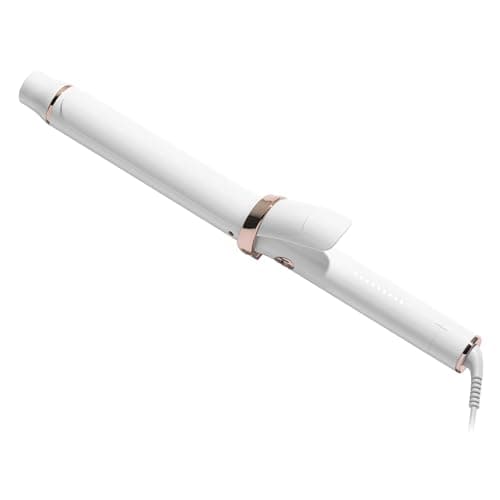
| 1 | T3 SinglePass Curl X extra-long barrel curling iron Nine heat settings — one of only two curling tools here with any adjustment at all — plus a published 6.5 in barrel. | Curling hair that has been bleached or over-processed | |
| 2 | 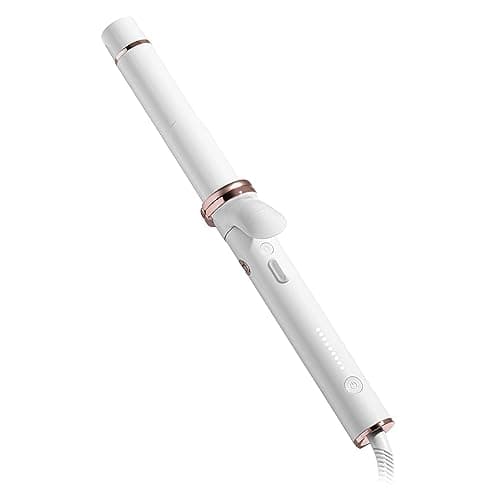 T3 CurlWrap automatic rotating curling iron A self-rotating barrel with two published rotation speeds, plus nine heat settings. | Fragile lengths that break when you wrap them by hand | |
| 3 | 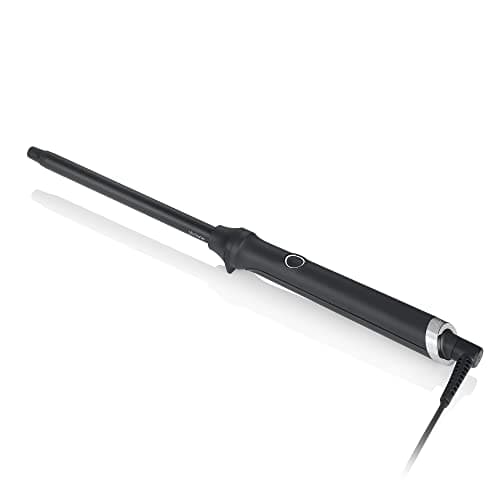 ghd Curve Thin curling wand (0.5 inch barrel) A 0.5 in clipless barrel with a cool tip, a 30-second heat-up and universal voltage. | Short or fine damaged hair that takes a curl quickly | |
| — | 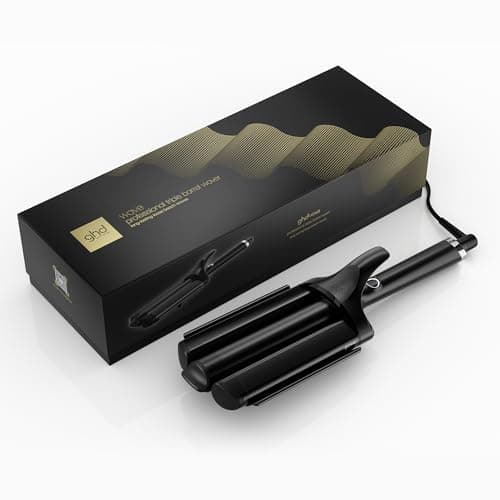 ghd Wave triple barrel hair waver Three heated barrels clamped onto a section at a fixed 365°F, with no adjustment and no published hold time. We’d skip this | Not compromised hair |
1. Most adjustable for compromised hair
T3 SinglePass Curl X extra-long barrel curling iron
Best for: Curling hair that has been bleached or over-processed
Nine heat settings — one of only two curling tools here with any adjustment at all — plus a published 6.5 in barrel.
Every ghd curling tool is fixed at 365°F. On hair that has been chemically processed, that floor is the problem: bleaching produces molecular changes normally associated with thermal treatment before you apply any heat, so the same setting costs more than it used to.
Nine settings is the published route to somewhere lower. It also lets you treat a head as the mixed surface it usually is — healthier regrowth near the root, weaker processed hair through the lengths.
The 6.5 inch barrel matters for a second reason on this page: longer barrel, fewer sections, fewer separate heat applications on hair that has less margin. 100–240 V, 8 ft swivel cord, two-year warranty.
What’s wrong with it
Nine settings is nine chances to pick a hotter one, and T3 publishes no wattage and no temperature scale — you get a step count, not degrees.
Published specifications — T3 SinglePass Curl X extra-long barrel curling iron
| Wattage | 78 W |
|---|---|
| Heat settings | 9 heat settings |
| Speed settings | Not applicable |
| Weight | 10.6 oz (1 in), 13.2 oz (1.25 in), 15.1 oz (1.5 in) — cord not included |
| Cord length | 8 ft, 360-degree swivel cord |
| Noise (dB) | Not applicable |
| Attachments | None supplied |
| Plate / barrel | CeraGloss ceramic barrel, 6.5 in long |
| Dual voltage | Yes — auto world voltage, 100–240 V |
| Warranty | 2-year warranty |
Every figure above is taken from T3 Micro — SinglePass Curl X product page. “Not published” means the figure does not appear on that page — it is not an estimate withheld, it is a number the manufacturer does not state. How we compile these.
What it costs to run for a year
$0.93 a year
78 W × 65 hours a year = 5.1 kWh, at 18.34 cents per kilowatt-hour. The hours assume 15 minutes a session, 5 days a week — that is an assumption, not a measurement, so swap in your own if it is wrong.
2. Least hand tension
T3 CurlWrap automatic rotating curling iron
Best for: Fragile lengths that break when you wrap them by hand
A self-rotating barrel with two published rotation speeds, plus nine heat settings.
Damaged hair fails under mechanical stress as much as under heat, and hand-wrapping applies uneven tension — hardest exactly where your grip is tightest. A barrel that rotates itself applies the tension the mechanism needs rather than the tension your hand happens to give it.
That matters because repeated grooming behaves as a fatigue process: flaws propagate through a fiber until it fails, and damaged hair starts with more flaws. Anything that makes the mechanical load more even is working in your favor.
Two rotation speeds means you can slow it right down on the sections you are worried about. Nine heat settings, auto world voltage, CeraGloss ceramic, two-year warranty.
What’s wrong with it
T3 publishes no weight or wattage for it, and a rotating mechanism can catch hair if a section is not fed cleanly — the opposite of gentle when it happens.
Published specifications — T3 CurlWrap automatic rotating curling iron
| Wattage | 77 W |
|---|---|
| Heat settings | 9 heat settings |
| Speed settings | Two barrel rotation speeds |
| Weight | 13.4 oz (cord not included) |
| Cord length | 8 ft, 360-degree swivel cord |
| Noise (dB) | Not published |
| Attachments | None supplied |
| Plate / barrel | Korean CeraGloss ceramic self-rotating long barrel, 1 in and 1¼ in |
| Dual voltage | Yes — auto world voltage, 100–240 V |
| Warranty | 2-year warranty |
Every figure above is taken from T3 Micro — CurlWrap automatic rotating curling iron product page. “Not published” means the figure does not appear on that page — it is not an estimate withheld, it is a number the manufacturer does not state. How we compile these.
What it costs to run for a year
$0.92 a year
77 W × 65 hours a year = 5.0 kWh, at 18.34 cents per kilowatt-hour. The hours assume 15 minutes a session, 5 days a week — that is an assumption, not a measurement, so swap in your own if it is wrong.
3. Least contact time per curl
ghd Curve Thin curling wand (0.5 inch barrel)
Best for: Short or fine damaged hair that takes a curl quickly
A 0.5 in clipless barrel with a cool tip, a 30-second heat-up and universal voltage.
Clipless is the argument here. A clamp presses the section against the barrel at one point, and on brittle hair that pressure point is where breaks start. A wand holds the hair against the barrel with your hand instead, which is gentler and more even — and the published cool tip is what makes that possible without a glove.
A narrow barrel also takes a curl faster on hair that curls easily, which damaged fine hair usually does. Less time on the barrel is less contact time, and contact time is half the damage equation.
Fixed 365°F, 8.8 ft swivel cord, built-in safety stand, universal voltage, two-year warranty.
What’s wrong with it
Fixed at 365°F with nothing below, which is the wrong floor for bleached hair, and ghd publishes no weight for it.
Published specifications — ghd Curve Thin curling wand (0.5 inch barrel)
| Wattage | Not published |
|---|---|
| Heat settings | One fixed temperature — 365°F |
| Speed settings | Not applicable |
| Weight | Not published |
| Cord length | 8.8 ft, 360-degree swivel cord |
| Noise (dB) | Not applicable |
| Attachments | Cool tip, built-in safety stand |
| Plate / barrel | 0.5 in thin barrel, clipless |
| Dual voltage | Yes — universal voltage |
| Warranty | 2-year warranty |
Every figure above is taken from ghd — Curve Thin curling wand product page. “Not published” means the figure does not appear on that page — it is not an estimate withheld, it is a number the manufacturer does not state. How we compile these.
What it costs to run for a year
ghd does not publish a wattage for this tool, so there is nothing honest to compute. The formula is watts ÷ 1,000 × hours a year × your rate per kWh; if you find a rating plate on the handle, 65 hours a year and 18.34 cents per kilowatt-hour will get you the rest of the way.
The one we'd skip
ghd Wave triple barrel hair waver
Best for: Not compromised hair
Three heated barrels clamped onto a section at a fixed 365°F, with no adjustment and no published hold time.
A triple barrel presses hair between three heated surfaces at once. That is more simultaneous contact area than any other tool in this hub, and on hair that has already lost cuticle it is the wrong direction.
There is also nothing to turn down. Fixed 365°F is a defensible design on healthy hair — we say so on our review — and it leaves you no move at all on hair that needs less.
The speed argument is genuine and it does not rescue it here. Fewer applications is worth something, but not when each application is three barrels of fixed-temperature contact on fibers that are already cracking. ghd publishes no hold time per press, so you cannot even do the arithmetic.
What’s wrong with it
The most simultaneous contact area in this hub, no temperature adjustment, and no published weight, cord length or voltage rating.
Published specifications — ghd Wave triple barrel hair waver
| Wattage | Not published |
|---|---|
| Heat settings | One fixed temperature — 365°F |
| Speed settings | Not applicable |
| Weight | Not published |
| Cord length | Not published |
| Noise (dB) | Not applicable |
| Attachments | None supplied |
| Plate / barrel | Three ergonomic barrels, dual temperature sensors |
| Dual voltage | Not published |
| Warranty | 2-year warranty |
Every figure above is taken from ghd — Wave triple barrel hair waver product page. “Not published” means the figure does not appear on that page — it is not an estimate withheld, it is a number the manufacturer does not state. How we compile these.
What it costs to run for a year
ghd does not publish a wattage for this tool, so there is nothing honest to compute. The formula is watts ÷ 1,000 × hours a year × your rate per kWh; if you find a rating plate on the handle, 65 hours a year and 18.34 cents per kilowatt-hour will get you the rest of the way.
What a curling iron does under a microscope
There is one study that anyone thinking about this should know, and it used a curling iron specifically rather than heat in the abstract.
Researchers curled hair under a range of conditions — wet and dry, with and without tension, short and prolonged — and examined the fibers by scanning electron microscopy. Fibers treated dry, at 50 percent relative humidity, showed radial and axial cracking along with scale edge fusion — Ruetsch and Kamath, Journal of Cosmetic Science.
That is the baseline. Even done correctly, on dry hair, a curling iron leaves visible structural change. Nothing in the picks above avoids that, and any page telling you a particular barrel is damage-free is selling you something.
The finding that changes your routine
The same study found that similar thermal treatment on wet hair produced severe damage of that type plus bubbling and buckling of the cuticle, caused by steam forming inside the fiber and escaping. The authors state the principle directly: the propensity of the hair surface to damage depends on the moisture content of the hair.
So the single most useful thing on this page is free. Curl completely dry hair. Not damp, not nearly dry. On already-damaged hair the difference between those two states is the difference between cracking and cracking with steam blisters — the full treatment is here.
One genuinely encouraging result
The same paper found that fibers subjected to repeated curling in the dry condition showed slight increases in tensile mechanical properties, characteristic of a crosslinked fiber. And that fibers treated with conditioners showed an improvement in characteristic life, especially low-molecular-weight conditioners able to penetrate into the fiber.
Two things to take from that, carefully. Heat damage is not a single simple axis — a fiber can become stiffer and more brittle at the same time, and “stronger on one measure” is not “healthier”. And conditioning before heat has measured support, which is more than most claims in this subject can say.
What a heat protectant does and does not do is on its own page, and it is worth reading before treating one as permission.
What to change, in order of effect
Damaged hair, ranked interventions
| Change | Why it works | Cost |
|---|---|---|
| Curl completely dry hair only | Removes the steam-bubbling failure mode entirely | Free |
| Cut the number of sections | Pass count is the dominant term in total exposure | A longer barrel |
| Use the lowest setting that takes a curl | Temperature is the other term | An adjustable tool |
| Leave the last inch or two out | The ends are the oldest and weakest hair you have | Free — and it looks more current |
| Condition before heat | Measured to improve characteristic life under repeated curling | A product you probably own |
| Let each curl cool before it takes weight | Hair sets on cooling; handling warm curls undoes and stresses them | Free |
Note that four of the six cost nothing. On damaged hair the technique genuinely outperforms the purchase, which is not something we can say about most pages on this site.
The fixed-temperature problem
Most of the best curling tools we cover cannot be turned down. Every ghd curling product runs at one fixed 365°F, and the design argument behind that is good — people turn tools up when a section does not take, and removing the dial removes the failure.
On damaged hair the argument inverts. You are not trying to protect yourself from going up; you need to go down, and a fixed tool cannot. That leaves T3 as the only brand in our registry answering this page properly, which is a narrower field than we would like and is a fact about the category rather than a preference of ours.
If your damage is chemical rather than thermal, the specific case is on the bleached-hair page, and the whole-toolkit view is on the color-treated page.
Price per use, at 5 uses a week over 5 years
| What you pay | Cost per use | Cost per year |
|---|---|---|
| $30 | $0.02 | $6.00 |
| $60 | $0.05 | $12.00 |
| $100 | $0.08 | $20.00 |
| $150 | $0.12 | $30.00 |
| $200 | $0.15 | $40.00 |
| $300 | $0.23 | $60.00 |
| $400 | $0.31 | $80.00 |
| $500 | $0.38 | $100.00 |
5 uses a week for 5 years is 1300 uses. Both figures are stated assumptions, not measurements — halve the life and every cost per use doubles. We publish the ladder rather than a worked example for one specific product because a price we typed into a sentence would be wrong within a week.
The alternative worth taking seriously
If your hair is actively breaking, the honest answer this month may be no heat at all. That is not a moralizing line — it is the only intervention here with no cost and no trade-off, and on fibers that are already cracking it does more than any tool.
Heat-free ways to get a curl are on the heat-free styling page, how to judge a sustainable pattern is on the how-often page, and what recovery actually means — which is less than most sites imply — is on the repair page.
Questions people actually ask
Can you curl damaged hair safely?
Not without cost. Published microscopy shows radial and axial cracking with scale edge fusion even on dry hair. What you can do is curl only completely dry hair, cut the number of sections, and use the lowest setting that takes a curl.
Is it worse to curl wet hair?
Considerably. The same study found wet thermal treatment produced severe damage plus bubbling and buckling of the cuticle from steam forming inside the fiber — a failure mode dry hair does not have.
Does heat protectant help before curling?
There is measured support: fibers treated with conditioners showed improved characteristic life under repeated curling, especially low-molecular-weight ones able to penetrate the fiber. It reduces the cost of a session rather than removing it.
What curling iron temperature for damaged hair?
Lower than 365°F, which is where every ghd curling tool sits fixed. T3 publishes nine heat settings on the SinglePass Curl X and the CurlWrap, but publishes a step count rather than degrees.
Sources
- Ruetsch and Kamath — Effects of thermal treatments with a curling iron on hair fiber, J Cosmet Sci 2004
- Evans and Park — A statistical analysis of hair breakage II: repeated grooming experiments, J Cosmet Sci 2010
- T3 Micro — SinglePass Curl X published 9 heat settings
- ghd — Curve Thin published cool tip and universal voltage